Disclosure: As an Amazon Associate, we earn from qualifying purchases. If you click a link on this page and make a purchase, we may receive a small commission at no extra cost to you.
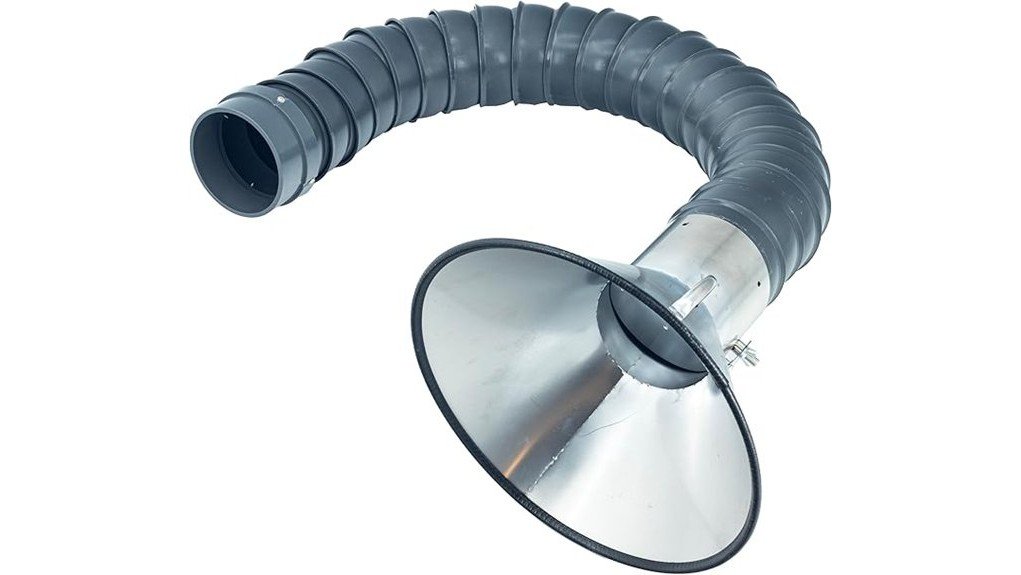
Capturing smoke, dust, or fumes at the source is easier when you can position the collection hood exactly where you need it. The Bay Heights Hard 4” Articulated Hose gives you a 3.3-foot flexible duct, a 4-inch outside diameter, a detachable round collector hood, and an adjustable airflow valve for use as part of a compatible extraction setup. Its main strength is flexible positioning, but it is important to understand that this is a hose and collector component, not a complete powered fume extractor. This review explains its specifications, practical uses, limitations, and the type of workspace where it makes the most sense.
Quick Verdict
Rating: Recommended with caveats
Best For: Workshops, laboratories, soldering benches, laser workstations, and other setups that already have a suitable extraction source.
Bottom Line: The 4-inch hose provides useful reach, flexible positioning, and manual airflow control in a simple collector-arm design. The main limitation is that you still need a compatible blower, extractor, duct system, or ventilation arrangement to create the airflow that actually moves contaminants.
Key Takeaways
- The Bay Heights articulated hose is approximately 3.3 feet long with a 4-inch outside diameter.
- Its flexible duct lets you position the collector close to a soldering, laser, welding, or dust-producing work area.
- The round collector hood is detachable and includes a handle for easier positioning and access.
- An adjustable valve at the collector lets you restrict or open airflow as your connected extraction system allows.
- The listed hose material is rubber, and the package includes one hose and one collector.
- This product is an extraction-system component. It does not contain its own fan, motor, or filtration system.
Key Specifications
| Specification | Detail |
|---|---|
| Brand | Bay Heights |
| Product Type | Articulated extraction hose / flexible duct collector arm |
| ASIN | B0DSVS52FG |
| Length | 3.3 feet, approximately 40 inches |
| Outside Diameter | 4 inches |
| Listed Dimensions | 40 in. L × 4 in. W |
| Listed Weight | 1.72 kg |
| Material | Rubber |
| Color | Gray |
| Collector | Detachable round collector hood with handle |
| Airflow Control | Manual adjustable valve at the collector |
| Included Components | 1 hose and 1 collector |
| Typical Uses | Laboratory extraction, laser work, soldering, welding-fume capture setups, and dust collection |
What Is the Bay Heights Hard 4” Articulated Hose?
The Bay Heights Hard 4” Articulated Hose is a flexible collector arm intended to become part of a larger air, smoke, dust, or fume extraction system. The duct measures about 3.3 feet long and has a 4-inch outside diameter, giving you enough reach to position the collection point near many bench-level processes.
The hose ends in a detachable round collector hood with a handle. A manual valve lets you adjust the opening for airflow control. This design is useful when your workspace needs a movable capture point rather than a fixed duct opening.
The distinction between a collector arm and a complete extractor matters. This product does not provide suction on its own. Your real extraction performance will depend on the blower or extraction unit, duct resistance, filter or exhaust setup, hood position, and the type of contaminant you are trying to capture.
Before You Buy: Confirm that your extraction equipment can accept or be properly adapted to a 4-inch hose. The 4-inch diameter alone does not guarantee compatibility with every vacuum, dust collector, fume extractor, blower, or ventilation system.
Who Should Buy It?
Best For
- You already have a suitable extractor, blower, or exhaust system and need a movable 4-inch collection arm.
- You work at a soldering, laser, welding, laboratory, or fabrication station where source positioning changes between jobs.
- You want manual airflow restriction at the hood instead of relying only on adjustments at the main extraction unit.
Skip If
- You need a complete plug-in fume extractor with its own fan and filtration.
- Your existing equipment cannot accept a 4-inch duct or a suitable adapter.
- You require a documented temperature rating, filtration specification, or process-specific certification that is not stated for this hose.
Key Features of the Articulated Hose
3.3-Foot Flexible Reach
The hose measures about 3.3 feet, or approximately 40 inches. That gives you room to bring the collector closer to a bench, enclosure opening, welding area, or other source without needing a long run of flexible duct.
A movable arm is especially useful when the location of the work changes. Instead of relocating your entire extraction system, you can reposition the collector to better match the job.
4-Inch Duct Diameter
The hose has a listed 4-inch outside diameter. This is a common size in many workshop ventilation and dust-management setups, but you should still measure your connection before ordering.
Connection size is only one part of system performance. The extractor must also provide enough airflow for the process, and any adapters, long duct runs, tight bends, or filters can affect the final airflow at the hood.
Detachable Collector Hood
The round collector hood is detachable and includes a handle. That makes the collection end easier to position around a workbench and gives you access to the hood when inspection or cleaning is needed.
Detachable does not automatically mean universally interchangeable. Replacement hood compatibility should be confirmed with the seller or manufacturer before you purchase a different nozzle or collector.
Adjustable Airflow Valve
The valve at the collector gives you a simple way to restrict or open airflow at the pickup point. This can be useful when a connected extraction system serves more than one location or when you want more control over suction at the hood.
The valve cannot increase the maximum airflow produced by your extractor. If suction is already weak, opening the valve fully will not compensate for an undersized blower, clogged filter, restrictive adapter, or excessive duct resistance.
Top Laboratory and Workshop Applications
The hose can serve as a positionable capture arm in several environments, provided it is connected to extraction equipment that is appropriate for the material or fumes involved.
| Application | How the Hose Helps | Important Consideration |
|---|---|---|
| Laser Work | Positions a capture hood near the point where smoke or particles are produced. | Use extraction and filtration or outdoor exhaust suitable for the material being processed. |
| Soldering | Lets you place the collector near the work rather than relying on a distant vent. | Actual capture depends on airflow and hood distance from the smoke source. |
| Welding | Can provide a movable capture point as part of a suitable local exhaust system. | The hose alone is not a complete welding-fume control system. |
| Dust-Producing Bench Work | Provides a 4-inch pickup point that you can reposition as the work changes. | Confirm the connected collector is suitable for the material and particle load. |
How It Performs in Real Use
At a Soldering Bench
The flexible arm can be brought closer to the area where smoke is produced, which is often more practical than placing a fixed vent farther away. The adjustable valve also gives you local control over the opening.
For good results, the connected extractor still needs enough airflow to capture the plume. Positioning the collector too far away can sharply reduce how much smoke reaches the duct.
At a Laser Workstation
The 3.3-foot reach can help connect a nearby extraction point to a laser workstation or enclosure arrangement. The flexible design is useful when you occasionally need to move the pickup location for access or maintenance.
Laser fumes vary greatly with the material being processed. Use an extraction and filtration or exhaust system intended for those materials rather than assuming the hose itself makes the air safe.
For Welding-Fume Capture
The 4-inch collector can function as the movable end of a local exhaust setup near some welding work. Its main benefit is positioning: you can aim the hood toward the fume source while keeping the connected extraction equipment farther away.
Welding fumes can be hazardous, so correct system design matters. Follow the requirements for your welding process, materials, ventilation equipment, and workplace rather than relying on the hose as your only protective measure.
For General Dust Collection
The hose can also be useful as a movable pickup point for appropriate dust-management systems. Its larger 4-inch connection is more suited to a duct-style setup than the small ports used on many handheld vacuums.
Before using it for heavy dust or debris, confirm that the connected collector, filters, ducting, and hose are suitable for the material involved.
How Users Benefit From Adjustable Airflow Control
The adjustable valve is one of the more practical parts of this design. It lets you change how open the collector is without walking back to the main extractor or changing the complete duct arrangement.
This is particularly useful in a system with more than one branch. Closing or restricting an unused branch may help you manage where the available airflow is directed, although the exact effect depends on the design and capacity of the connected extraction system.
The valve is best viewed as a control device, not a performance booster. Maximum suction is still limited by the equipment connected to the hose.
Pro Tip: Before permanently mounting or routing anything, place the collector where you normally work and check that the 3.3-foot reach is enough without forcing sharp bends. A smoother hose path generally gives your extraction system less restriction to work against.
Setup Tips Before First Use
- Measure the connection: Confirm that your extractor, duct, adapter, or manifold can work with the hose’s 4-inch outside diameter.
- Check the full system: The hose needs a source of suction. Make sure the blower or extractor is suitable for your application.
- Keep the collector close: Place the hood near the point where fumes, smoke, or dust are generated while keeping it out of the way of tools and moving parts.
- Avoid unnecessary bends: Tight or excessive bends can add resistance and may reduce airflow at the collector.
- Use the valve deliberately: Start with an open flow path, then adjust the valve only as needed for your setup.
- Inspect before use: Check the hose, collector, connections, and supporting extraction equipment for damage, blockage, or loose fittings.
Compatibility and Safety
The verified listing identifies the product as a rubber 4-inch articulated hose with a detachable collector and adjustable valve. It does not provide enough information to claim universal compatibility with vacuum systems, specific temperature resistance, filtration performance, or process-specific safety certification.
For that reason, match the hose to the rest of your system instead of choosing it by diameter alone. Consider connection size, airflow requirements, contaminant type, duct routing, filtration or outdoor exhaust requirements, and the specifications of your blower or extractor.
For welding, soldering, laser processing, or other work that creates potentially harmful fumes or particles, follow the instructions for your equipment and the safety requirements that apply to your process. A collection hose is only one part of exposure control.
What Buyer Feedback Suggests
Available public feedback for this exact product is positive about basic operation, but the amount of visible feedback is limited. That means it is more useful to judge the hose by its verified physical specifications and how well those specifications fit your system than by broad claims about customer satisfaction.
The features most likely to matter in daily use are its 3.3-foot flexible reach, 4-inch diameter, movable collector hood, and adjustable valve. Those details directly affect where you can position the pickup point and how easily you can integrate it into your workspace.
Pros and Cons
Pros
- 3.3-foot articulated design gives you a movable collection point.
- 4-inch outside diameter suits many duct-style extraction arrangements.
- Adjustable valve provides airflow control at the collector.
- Detachable round hood with handle makes positioning straightforward.
- Useful across soldering, laser, laboratory, welding, and compatible dust-extraction setups.
Cons
- It is not a complete extractor and does not create suction by itself.
- A 4-inch connection may require an adapter for some extraction equipment.
- No verified maximum temperature rating or universal compatibility specification is stated.
Why an Articulated Hose Can Improve Your Workspace
A fixed exhaust opening works well only when the source stays in one place. An articulated hose gives you more freedom to move the collector as your work changes, which can make source capture easier at a shared bench or multipurpose workstation.
The Bay Heights hose combines that positioning flexibility with a 4-inch duct and a valve at the hood. You get the most benefit when the rest of your extraction system is already appropriate for the process and simply needs a more convenient way to capture contaminants near their source.
Is It Worth the Price?
This product is best evaluated as a specialized extraction component rather than as an alternative to a complete fume extractor. Its value comes from the flexible 3.3-foot arm, 4-inch duct size, detachable collector, and local airflow valve.
It is worth considering if you already own suitable extraction equipment and adding a positionable collector would make your setup easier to use. It offers less value if you are starting from scratch because you will still need the fan, blower, filtration, exhaust routing, adapters, or other hardware required by your application.
Because current prices can change, compare the latest Amazon price with the cost of a complete extraction solution and any adapters you would need before deciding.
How It Compares to Alternatives
The HAKKO FA-430 is a different type of product because it is a complete powered air-purifying fume extraction system designed for soldering and can be used with HAKKO duct sets. It is more appropriate when you need the extraction unit and filtration rather than only a collector hose.
The HAKKO FA-400 is another different approach, using a compact desktop smoke-absorber format instead of a large articulated 4-inch collector arm. The Bay Heights hose makes more sense when you already have an extraction source and specifically want a larger, repositionable duct component for your own system.
Frequently Asked Questions
Does the Bay Heights articulated hose include a fan or extractor?
No powered fan, motor, or filtration unit is listed as part of this product. The package is listed as one hose and one collector, so you need compatible extraction equipment to create airflow.
Is the hose compatible with every vacuum or dust collector?
Universal compatibility is not stated. The hose has a 4-inch outside diameter, so measure your equipment and confirm the required connection or adapter before buying.
Can you use it for soldering fumes?
Soldering is one of the stated applications for the collector hose. You still need a suitable extraction and filtration or exhaust system, and the collector should be positioned close enough to capture the smoke effectively.
Can you use the hose for welding?
Welding is included among the stated applications, but the hose is only a capture component. Use it with extraction equipment designed for the welding process and follow appropriate ventilation and workplace safety requirements.
What is the maximum temperature the hose can withstand?
A verified maximum operating temperature is not stated in the available product information. Do not assume the hose is suitable for direct contact with hot material, sparks, flames, or high-temperature exhaust without confirmation from the manufacturer or seller.
Is the collector hood replaceable or interchangeable?
The round collector hood is described as detachable. That does not confirm that other hoods are universally interchangeable or that replacement collectors are sold separately, so check compatibility before ordering another nozzle or hood.
How should you clean and maintain the hose?
A specific manufacturer cleaning procedure was not verified. Inspect the hose and collector for buildup or damage, disconnect the extraction equipment before maintenance, and follow any care instructions supplied with the product or your connected system.
The Bottom Line
The Bay Heights Hard 4” Articulated Hose is a practical choice when you already have suitable extraction equipment and need a flexible 3.3-foot, 4-inch collector arm with local airflow adjustment. Its strongest feature is easy positioning near the source, while its biggest limitation is that it is only one part of the extraction system and does not provide suction or filtration on its own.
Choose it when those dimensions and features match your setup. Skip it if you need a complete powered extractor, confirmed high-temperature capability, or guaranteed compatibility with a specific machine.