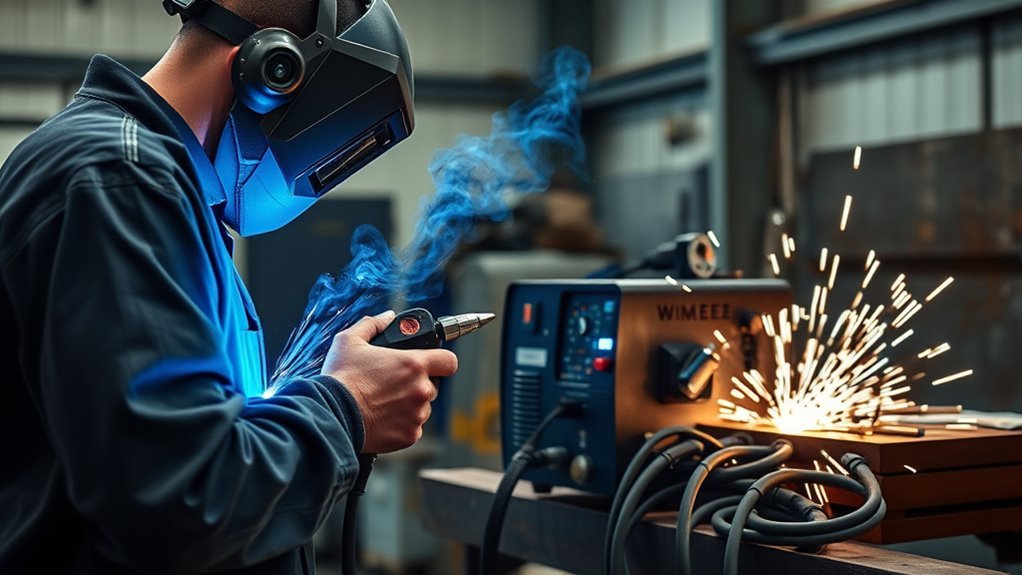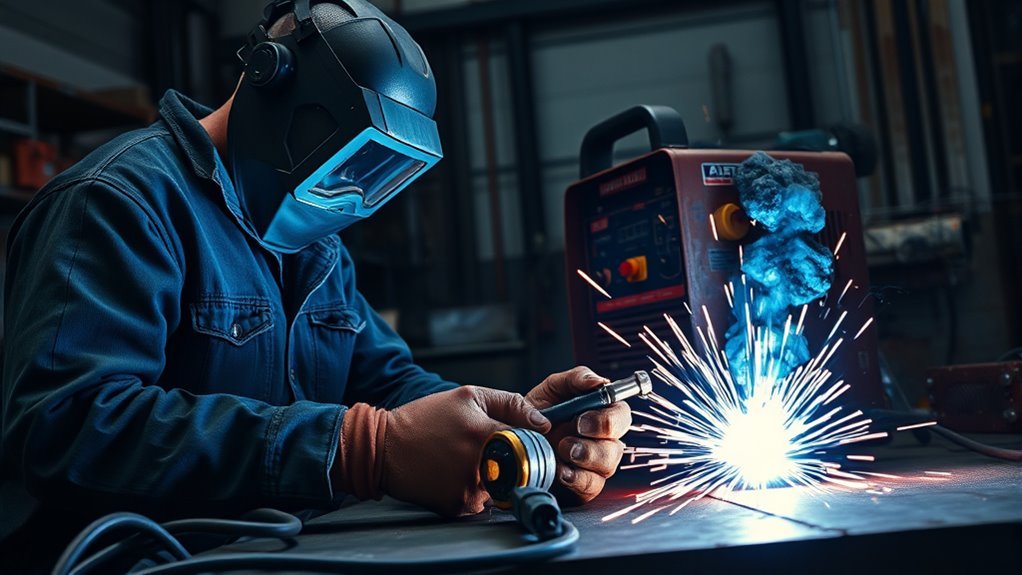
Hexavalent chromium, often called Cr(VI) or hex chrome, is one of the most serious hazards in stainless steel and chromium-alloy welding fumes. It can form when welding heat oxidizes chromium in base metal, filler metal, coatings, primers, or chrome-plated parts. The risk rises when the plume stays in your breathing zone, ventilation is weak, or exposure is repeated without monitoring, controls, and the right protective gear.
Quick Answer
Hexavalent chromium in welding fumes is dangerous because it can damage the nose, throat, lungs, skin, and eyes and is linked to lung cancer. It most often appears when welding stainless steel, chrome-coated parts, chromate-painted surfaces, or chromium-containing alloys. Reduce exposure with source-capture ventilation, air monitoring, cleaner materials, hygiene controls, and fit-tested respiratory protection when required.
Key Takeaways
- Hexavalent chromium can form during hot work on stainless steel and other chromium-containing metals.
- OSHA’s action level is 2.5 µg/m³ and its permissible exposure limit is 5 µg/m³, both measured as 8-hour time-weighted averages.
- The best first controls are cleaner materials, local exhaust ventilation at the arc, safe work positioning, and verified air monitoring.
- Respirators help only when properly selected, fit tested, and used under a respiratory protection program.
- Do not rely on employee rotation to meet the Cr(VI) exposure limit; OSHA requires feasible engineering and work-practice controls first.
At a Glance
| Highest-Risk Jobs | Welding, cutting, or grinding stainless steel, chromium alloys, chromate primers, chrome-plated parts, and coated structural steel |
| Main Exposure Route | Breathing welding fumes in the plume or handling contaminated dust, clothing, or surfaces |
| OSHA Triggers | Action level: 2.5 µg/m³. PEL: 5 µg/m³. Both are 8-hour TWAs. |
| Best First Controls | Identify chromium sources, remove coatings when safe, use local exhaust near the arc, keep your head out of the plume, and verify exposure with air sampling |
Warning: Do not weld stainless steel, chrome-plated parts, chromate-painted surfaces, or unknown coatings in a confined or enclosed space unless the job has proper ventilation, exposure controls, atmospheric safety procedures, and any required respiratory protection in place.
What Is Hexavalent Chromium and Where Is It Found?
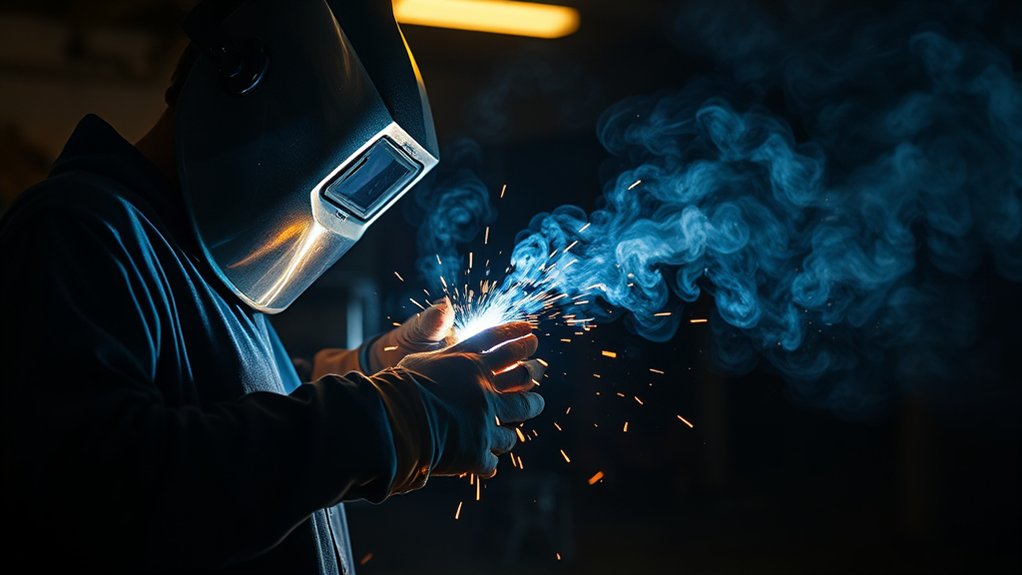
Hexavalent chromium is chromium in the +6 valence state. In welding, it can form when high heat changes chromium in metal, coatings, or consumables into a more hazardous airborne form. OSHA notes that a major source of worker exposure occurs during hot work such as welding on stainless steel and other chromium-containing alloy steels.
You may run into Cr(VI) when welding or cutting stainless steel, hardfacing alloys, chromium-bearing filler metals, chrome-plated parts, and chromate-containing primers or paints. It can also show up in industries that use chrome plating, pigments, coatings, and corrosion-resistant surface treatments.
Cr(VI) is a health concern because it can be inhaled deep into the lungs as welding fume. It can also contaminate gloves, clothing, helmets, tables, and nearby surfaces if the shop does not control dust and fume correctly.
How Does Hexavalent Chromium Affect Your Health?
Hexavalent chromium is not just a general welding irritant. It is a regulated toxic metal compound with cancer, respiratory, skin, and eye hazards. The risk depends on the dose, exposure time, job conditions, materials, and whether other welding fumes are present.
Health Risks Overview
Breathing Cr(VI) can irritate your nose, throat, and lungs. Short-term symptoms may include coughing, sneezing, throat irritation, runny nose, wheezing, shortness of breath, or chest tightness. Skin contact can cause irritation, allergic reactions, ulcers, or dermatitis, especially if contaminated dust stays on gloves, sleeves, or exposed skin.
ATSDR explains that chromium(VI) can damage the nose and cause cancer, and that breathing high levels can cause nose irritation, nose ulcers, runny nose, asthma, cough, shortness of breath, or wheezing. For welders, that makes source control and air monitoring more than a paperwork issue. It is a daily health-control step.
Specific Cancers Linked
The strongest cancer concern is inhalation. The National Cancer Institute states that occupational exposure to hexavalent chromium compounds is associated with increased risks of lung cancer and cancers of the paranasal sinuses and nasal cavity. That does not mean every short contact causes cancer, but it does mean repeated uncontrolled exposure should never be treated as normal shop dust.
Respiratory System Damage
Your respiratory system is the main target when Cr(VI) is in welding fume. The plume can carry fine particles into the breathing zone, especially when your helmet is directly over the arc. Over time, poor control can contribute to chronic irritation, reduced lung function, bronchitis-like symptoms, and occupational asthma concerns.
If you notice repeated coughing, throat burning, nose sores, wheezing, or shortness of breath after welding stainless or coated parts, stop treating it as ordinary smoke. Move to clean air, report the exposure, and ask for a proper exposure review.
Key Sources of Hexavalent Chromium Exposure in Welding
Cr(VI) exposure depends on what you weld, how you weld it, and how the air moves around the weld. These are the sources to check before you strike an arc:
- Stainless steel: Stainless steels contain chromium for corrosion resistance, so welding them can create Cr(VI) in the fume.
- Chromium-rich alloys and hardfacing rods: Specialty alloys and consumables may release more chromium-containing fume than mild-steel work.
- Chrome-plated parts: Welding, cutting, or grinding through plating can create toxic fumes and contaminated dust.
- Chromate primers and paints: Some industrial, marine, bridge, aerospace, and auto-refinish coatings may contain chromates.
- Dust from grinding or cleanup: Contaminated dust can be resuspended if you dry sweep, blow off clothing, or use compressed air without capture.
- Confined or enclosed spaces: Poor air movement lets welding fumes collect and can add oxygen-deficiency or gas hazards.
Process also matters. High-fume processes, poor torch angle, high current, dirty material, and poor hood placement can raise exposure. TIG welding may produce less visible fume than some other arc processes, but “less visible” does not mean “safe.” You still need exposure control when chromium is present.
Note: If you are not sure whether a part contains chromium, check the safety data sheet, filler-metal classification, coating history, and job specifications before welding. Unknown coatings should be treated as a potential fume hazard until identified.
Before You Weld: Quick Cr(VI) Checklist
Use this quick check before welding stainless, coated, or unknown metal:
- Identify the base metal. Confirm whether it is stainless steel or another chromium-containing alloy.
- Check filler metal and consumables. Read the SDS and product data for chromium content and fume warnings.
- Inspect coatings. Look for chrome plating, chromate primer, corrosion-resistant coatings, old paint, or unknown industrial finishes.
- Clean safely. Remove coatings only with methods that control dust and do not create a new inhalation hazard.
- Plan ventilation. Place local exhaust as close to the arc as practical without disturbing shielding gas.
- Keep your head out of the plume. Position your body so fumes move away from your breathing zone.
- Confirm PPE. Use welding PPE plus respiratory protection when exposure assessment or job conditions require it.
- Plan cleanup. Use HEPA-filtered vacuuming or wet methods where appropriate. Do not blow Cr(VI)-contaminated dust off surfaces or clothing.
What Are OSHA’s Limits for Hexavalent Chromium Exposure?
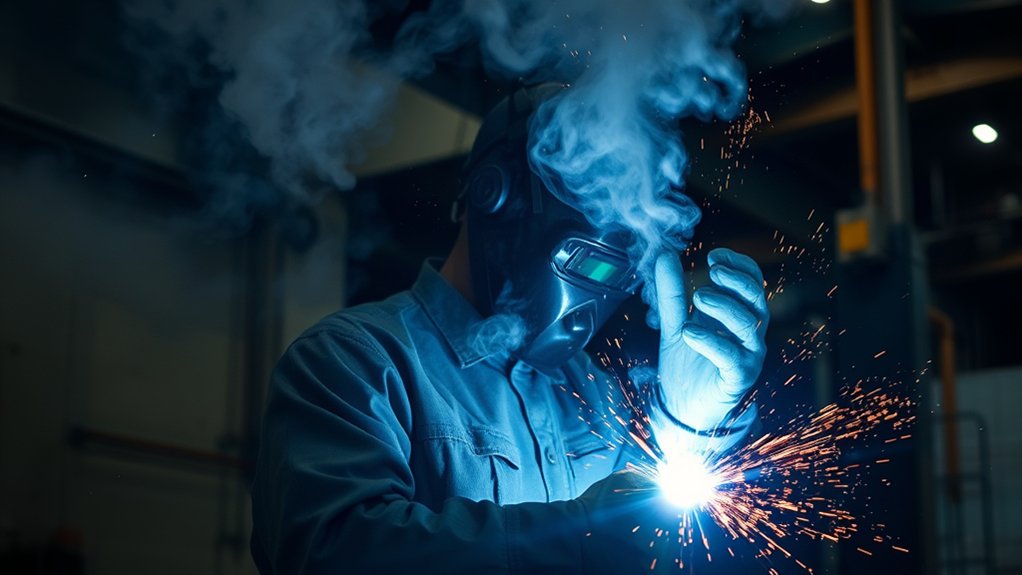
OSHA regulates hexavalent chromium under the Chromium (VI) standards for general industry, construction, and maritime work. For general industry, 29 CFR 1910.1026 sets the key exposure limits and employer duties.
Permissible Exposure Limits
The OSHA permissible exposure limit, or PEL, for airborne Cr(VI) is 5 micrograms per cubic meter of air, written as 5 µg/m³, calculated as an 8-hour time-weighted average. Employers must control work so employee exposure does not exceed this limit.
Action Level Requirements
The OSHA action level is 2.5 µg/m³ as an 8-hour time-weighted average. Reaching or exceeding the action level triggers additional requirements, including exposure monitoring and, in certain cases, medical surveillance.
Compliance Monitoring Practices
Air monitoring should reflect the worker’s breathing-zone exposure during real tasks, not just general shop air. OSHA requires employers to determine 8-hour TWA exposure for covered employees. If monitoring shows exposure at or above the action level, periodic monitoring is required at least every six months. If exposure is above the PEL, monitoring is required at least every three months.
| OSHA Point | What It Means for Welding Work |
| Action level: 2.5 µg/m³ | Triggers scheduled monitoring and may trigger medical surveillance if exposure occurs often enough. |
| PEL: 5 µg/m³ | Maximum allowed 8-hour TWA exposure under the OSHA standard. |
| Above PEL | Requires stronger controls, written corrective action, and periodic monitoring at least every three months. |
| Medical surveillance | Required for employees at or above the action level for 30 or more days per year, employees with symptoms, or employees exposed in an emergency. |
Proven Strategies to Minimize Hexavalent Chromium Exposure During Welding
Reducing Cr(VI) exposure works best when you follow the hierarchy of controls. Do not jump straight to a respirator and ignore the fume source. Respirators may be required, but they are not a substitute for feasible engineering and work-practice controls.
Products Worth Considering

3.3ft long adjustable flexible hose duct, 75mm OD, 68mm ID
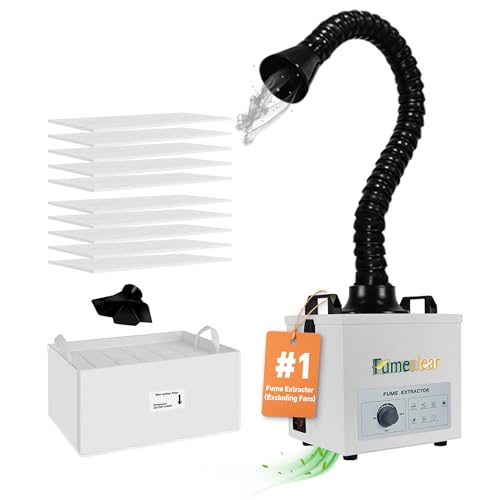
99.97% Purification Rate: The FumeClear FC100A fume extractor is ideal for small bench soldering. It has a maximum no-load power of 100W and is highly effective at filtering dust particles below 0.3 microns. The purification efficiency far exceeds that of small fume smoker absorbers. Keep your eyes and lungs free from pollution. Note: The FC100A is not suitable for the fume extraction needs of large laser engravers. Please select the FC-2002, FC-2003 and FC-2004 fume extractor models if required

99.91% Purification Efficiency: The VEVOR solder fume extractor is equipped with a robust 150W DC motor. The device produces an impressive airflow of 165 CFM, ensuring efficient and effective air purification. The device boasts an exceptional smoke purification rate of 99.91%, ensuring that users can once again enjoy fresh air.
Use Cleaner Materials and Safer Job Planning
Start by asking whether the chromium source can be reduced. Use non-chromate coatings where the job allows, remove hazardous coatings with controlled methods, select lower-fume consumables where suitable, and avoid welding through unknown coatings. Review the SDS for base metals, filler metals, and coatings before the job begins.
Capture Fume at the Source
Local exhaust ventilation is one of the most effective controls for welding fumes. Use a fume hood, extraction arm, downdraft table, or fume extraction gun positioned close enough to pull the plume away from your breathing zone. OSHA’s welding fume guidance says local exhaust systems can remove fumes and gases from the welder’s breathing zone when placed close to the plume source.
Pro Tip: If the plume rises inside your helmet or across your face before it reaches the hood, the capture point is too far away, the airflow is weak, or your body position needs to change.
Keep Your Head Out of the Plume
Work positioning matters. Keep your face out of the smoke column, use natural airflow to your advantage, and avoid leaning directly over the arc. Outdoor welding or a large open bay does not automatically mean exposure is controlled; wind can push the plume back into your breathing zone or toward coworkers.
Use Respiratory Protection When Controls Are Not Enough
When engineering and work-practice controls cannot keep exposure at or below the PEL, respiratory protection may be required. The respirator must be selected for the hazard, fit tested, maintained, and used under a respiratory protection program. A dust mask chosen by guesswork is not a Cr(VI) control plan.
Control Hygiene, Housekeeping, and Contaminated PPE
Cr(VI) control does not stop when the arc stops. Wash your hands and face before eating, drinking, smoking, or using the restroom. Keep food and drinks out of contaminated areas. Remove contaminated protective clothing in a way that does not shake dust into the air. Clean contaminated surfaces with HEPA-filtered vacuuming or other methods that minimize airborne exposure.
Do not use compressed air to blow dust off clothing, tables, or equipment unless it is part of a controlled system designed to capture the dust. Blowing off gear may look tidy, but it can put Cr(VI) back into the breathing zone.
Why Do Air Monitoring and Testing Matter for Your Safety?
Air monitoring is how you know whether your controls are working. Visible smoke is not a reliable exposure meter. Stainless steel welding may look cleaner than another process and still produce harmful levels of metal fume.
- Personal breathing-zone sampling measures what the worker is likely to inhale during the job.
- Initial monitoring helps determine whether exposure is below the action level, at or above the action level, or above the PEL.
- Repeat monitoring is needed when materials, processes, ventilation, work practices, or production conditions change.
- Written results help workers understand exposure and what corrective action is being taken.
Air monitoring also helps confirm whether a ventilation upgrade, fume extraction gun, or new work practice actually lowered exposure. Without testing, you are guessing.
Products Worth Considering

Powerful & Energy-Efficient: Equipped with a high-performance 585W AC motor, it delivers outstanding ventilation performance, achieving an airflow volume of 3198CFM. Quickly and thoroughly eliminate smoke, odors, and hot air.

Fume-Free Workspace in Minutes: The KQZ B1 Fume Extractor equips a high-efficiency centrifugal motor with 168 m³/h airflow. Strong instant suction captures fumes and fine particles. H13 HEPA filter with coal-based activated carbon delivers full purification for a safer working environment
Powerful & Energy-Efficient: Equipped with a high-performance 585W AC motor, it delivers outstanding ventilation performance, achieving an airflow volume of 3198CFM. Quickly and thoroughly eliminate smoke, odors, and hot air.
What Should You Do If You Encounter Hexavalent Chromium?
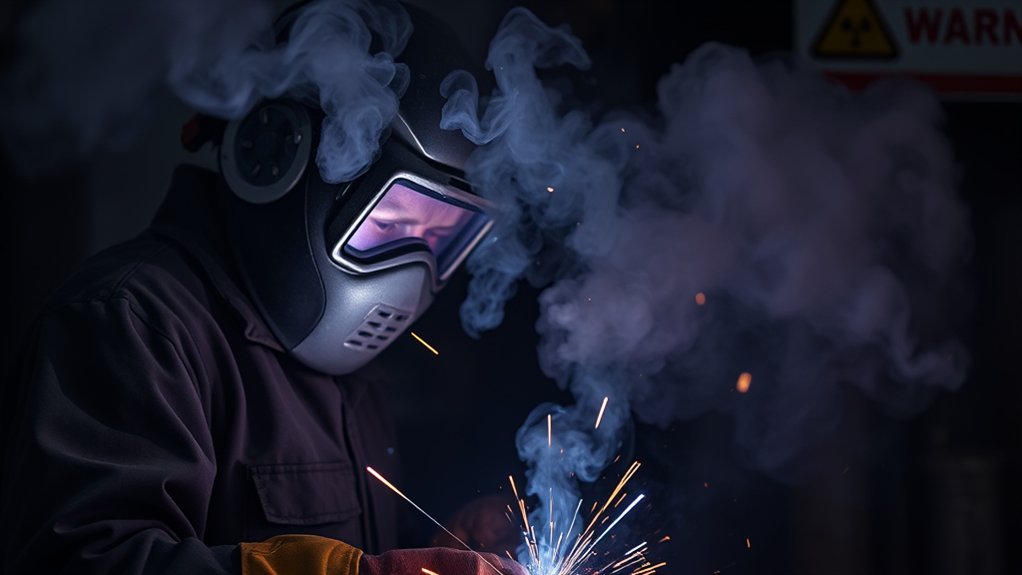
If you discover that a job may involve hexavalent chromium, slow down before continuing. The right response depends on whether it is a planned job, an uncontrolled exposure, or an emergency.
- For planned work: review the SDS, confirm the metal or coating, set up local exhaust, choose the correct PPE, and make sure exposure monitoring is addressed.
- For visible uncontrolled fume: stop welding, move out of the plume, improve ventilation, and do not restart until controls are corrected.
- For symptoms: leave the area, get fresh air, report the exposure, and seek medical evaluation if you have breathing trouble, chest tightness, severe throat irritation, nose sores, eye irritation, or skin burns.
- For a spill, dust release, or unknown coating: isolate the area, avoid dry sweeping or compressed air, and involve a qualified safety person or industrial hygienist.
- For repeated exposure concerns: request air monitoring results, medical-surveillance information, and training on the Cr(VI) standard and hazard communication.
Do not take contaminated gloves, sleeves, or coveralls into your vehicle or home. Keep Cr(VI) contamination in the work area and clean it using methods that limit airborne dust.
Frequently Asked Questions
Can hexavalent chromium accumulate in the body over time?
Chromium can be measured in blood, urine, or hair, and higher blood or urine chromium may show that exposure happened. However, those results cannot predict what health effects will develop. For welders, air monitoring, medical evaluation, and exposure history are more useful than assuming a simple “body burden” number tells the whole story.
What are the symptoms of hexavalent chromium exposure?
Possible symptoms include nose or throat irritation, coughing, sneezing, wheezing, shortness of breath, nose sores, eye irritation, skin redness, dermatitis, or skin ulcers. Severe breathing symptoms, chest tightness, or persistent irritation after welding stainless or coated metal should be reported and medically evaluated.
Are there any safe levels of hexavalent chromium?
OSHA sets legal workplace limits, including an action level of 2.5 µg/m³ and a PEL of 5 µg/m³ as 8-hour TWAs. Those limits are not a reason to ignore lower exposure. Because Cr(VI) is a carcinogenic hazard, the practical goal is to keep exposure as low as feasible with good controls.
How can I check if my workplace has hexavalent chromium?
Start with the SDS for base metals, filler metals, coatings, primers, and plating. Then confirm exposure with personal breathing-zone air sampling during representative welding tasks. General shop air readings are less useful than samples that match the worker, job, process, material, and ventilation setup.
What personal protective equipment is recommended for welding around Cr(VI)?
Use standard welding PPE, including a welding helmet, eye protection, flame-resistant clothing, welding gloves, and safety boots. When air monitoring or job conditions require respiratory protection, use a properly selected and fit-tested respirator under a respiratory protection program. Skin and hygiene controls matter too, because contaminated dust can stay on clothing and gloves.
Does a respirator replace ventilation?
No. Ventilation and work-practice controls should be used first when feasible. Respirators are used when those controls are being installed, are not feasible for the task, or cannot reduce exposure enough by themselves. A respirator should support the control plan, not replace it.
Is stainless steel welding always a Cr(VI) hazard?
Stainless steel welding should always be treated as a potential Cr(VI) exposure source because stainless contains chromium. Actual exposure depends on the process, current, filler metal, coating, ventilation, work position, and time spent welding. Use exposure assessment instead of assuming the job is safe because the fume is hard to see.
Conclusion
Hexavalent chromium in welding fumes deserves careful control, especially when you weld stainless steel, chromium alloys, chrome-plated parts, or chromate-coated materials. The safest approach is to identify chromium sources before the job, capture fume at the arc, keep your head out of the plume, verify exposure with air monitoring, and use proper PPE and hygiene practices. OSHA limits give you compliance targets, but good welding safety aims lower: reduce Cr(VI) exposure as much as feasible before it becomes a health problem.
Sources
- OSHA: Hexavalent Chromium — Cr(VI) overview, worker exposure sources, and health targets.
- OSHA 29 CFR 1910.1026: Chromium (VI) — PEL, action level, exposure monitoring, controls, hygiene, PPE, and medical surveillance requirements.
- OSHA Fact Sheet: Controlling Hazardous Fume and Gases during Welding — welding fume contents, Cr(VI) formation, ventilation, and respiratory protection guidance.
- ATSDR Chromium ToxFAQs — health effects, exposure routes, cancer information, and biological testing limits.
- National Cancer Institute: Hexavalent Chromium Compounds — cancer risks and occupational exposure routes.