You can trace the history of automotive welding from early electric arc experiments in the 1880s to today’s robotic spot, arc, laser, and battery-pack joining systems. In cars, welding gradually replaced many rivets and mechanical fasteners because it helped factories build lighter bodies, stronger joints, faster assembly lines, and more consistent vehicle structures.
Quick Answer
Automotive welding began moving into car production in the early 1900s as electric arc, resistance, and gas welding improved. By the 1920s and 1930s, welded frames and bodies helped replace rivets. After World War II, MIG, TIG, resistance spot, submerged arc, robotic, and laser welding shaped modern vehicle manufacturing.
Key Takeaways
- Practical arc welding dates back to the 1880s, while automotive adoption grew as factories needed faster and lighter joining methods.
- Welding helped replace rivets because it reduced weight, lowered labor, and gave engineers more freedom in body and frame design.
- Resistance spot welding became central to car bodies because it can join overlapping sheet metal quickly and repeatably.
- MIG, TIG, submerged arc, laser welding, and robotic welding each solved different production problems.
- Today’s automotive welding depends on automation, sensors, quality data, and specialized joining for EV batteries and lightweight materials.
The First Welds in Automotive History
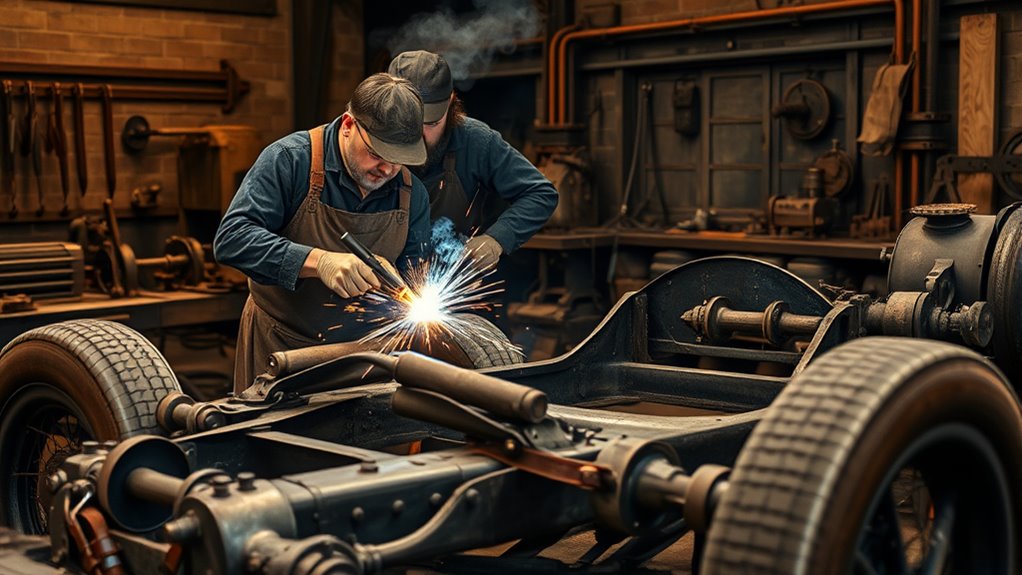
The first important step was not a single car factory event. It was the development of practical electric welding. Early arc-welding work grew through the 1800s, and Nicholas de Benardos and Stanislas Olszewski received U.S. Patent No. 363,320 in 1887 for working metals with direct electric current.
That matters because car production soon needed stronger, faster ways to join steel. Rivets, bolts, and hand-fitted parts worked, but they added weight and labor. Welding gave builders a way to fuse metal instead of fastening it only at drilled holes.
By the early 1900s, electric arc welding, resistance welding, and oxy-acetylene gas welding were becoming more useful in industrial shops. The automotive industry did not switch all at once, but welding began moving from experiment to production tool as equipment became more reliable.
In 1920, P.O. Nobel’s early automatic welding system at General Electric showed how a continuously fed wire could make welding more repeatable. It was not the same as modern MIG welding, but it pointed toward the automated wire-feed processes used later in factories.
The big change was not just that cars could be welded. It was that welding could be repeated thousands of times on a production line.
Automotive Welding Timeline
A simple timeline makes the shift easier to follow. The dates below show the welding milestones that shaped automobile production, even when the process first appeared outside the auto industry.
| 1880s | Practical carbon arc welding and early patents prove that electricity can fuse metal parts. |
| 1900s to 1910s | Arc, resistance, and gas welding improve enough for broader industrial use, including vehicle and equipment production. |
| 1920s | Automatic welding and welded frame production show how welding can support high-volume manufacturing. |
| 1930s to 1940s | Submerged arc welding, wartime production, GTAW/TIG, and GMAW/MIG expand the range of weldable parts and materials. |
| 1960s to 1980s | Resistance spot welding and robotic welding become central to high-volume body assembly. |
| 1990s to today | Laser welding, advanced sensors, quality data, and EV battery joining push welding toward tighter control and smarter automation. |
How Welding Replaced Rivets in Car Bodies
As welding methods improved in the early 20th century, automakers began replacing many rivets in car bodies and frames with welded joints. The reason was practical: rivets required holes, extra hardware, and more labor. Welds could join panels with less added weight.
This shift helped automotive manufacturing processes become faster and more flexible. Designers could shape body panels, frames, brackets, and reinforcements without planning around as many bulky fasteners. Welded construction also spread load across a joint instead of concentrating it only at rivet holes.
The change did not make rivets disappear from every vehicle part. Cars still use bolts, screws, adhesives, clinches, and mechanical fasteners where serviceability or mixed-material joining requires them. But in steel body structures, welding became the hidden backbone of mass production.
Clean metal also became more important. When welders worked with coated or galvanized steel, understanding zinc coating removal, ventilation, and coating repair helped reduce weld defects and corrosion problems.
Note: Automotive welding did not replace every fastening method. Modern vehicles often combine welds, structural adhesives, rivets, clinches, and bolts, especially when joining aluminum, high-strength steel, composites, and battery enclosures.
World Wars and Mass Production
World War I pushed electric arc welding from a workshop method toward a wider industrial tool. Military demand increased the need for faster fabrication, repair, and standard practices. In 1919, the American Welding Society was founded to advance welding and allied joining and cutting processes.
World War II accelerated the next stage. Shipbuilding, aircraft, armored vehicles, weapons, and factory equipment all needed fast joining methods. Submerged arc welding helped with heavy sections and long seams, while gas tungsten arc welding gave aircraft and advanced-material work cleaner control.
That wartime experience carried into postwar automobile production. Factories had better power supplies, better filler metals, better training, and a stronger standards culture. Later cutting and fabrication tools, including plasma cutting technology, also changed how metal parts could be prepared before welding.
The wars also changed the workforce. Women entered factories and shipyards in large numbers, often symbolized by Rosie the Riveter. Even though the symbol refers to riveting, the same industrial shift helped normalize welding, inspection, and fabrication work on a much larger scale.
The Main Welding Processes Used in Cars
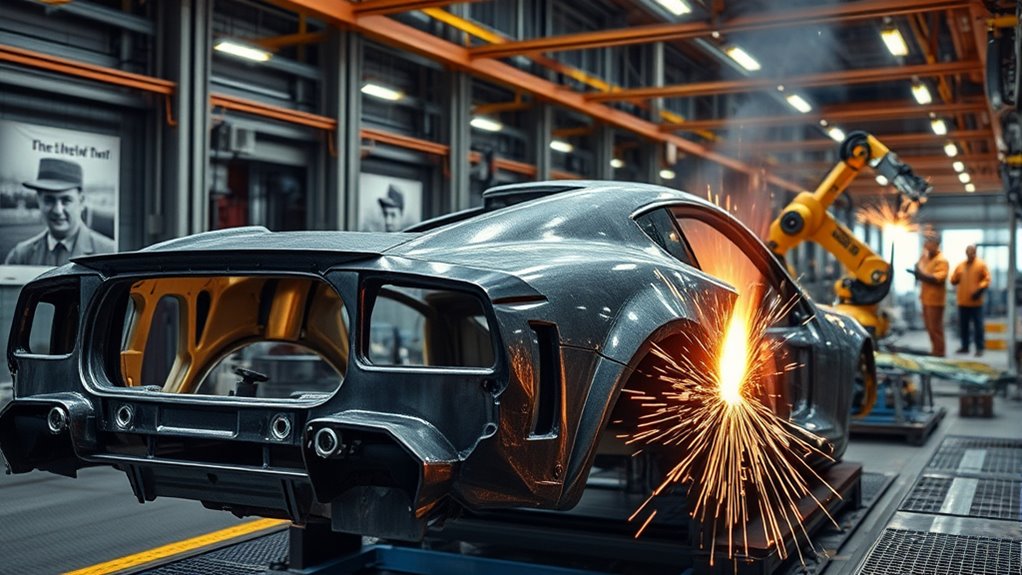
Automotive factories use several welding processes because one method cannot solve every joining problem. A thin roof panel, a rocker reinforcement, an exhaust part, and an EV battery tray all need different heat control, speed, access, and joint strength.
Resistance spot welding is the workhorse for many steel body-in-white structures. It clamps overlapping sheets between electrodes, passes current through the joint, and forms a weld nugget. It is fast, repeatable, and well suited to robotic body lines.
Gas metal arc welding, often called MIG or MAG welding, uses a continuously fed wire electrode and shielding gas. It is useful for brackets, frames, subassemblies, repair work, and many automated arc-welding cells. In field or repair conditions where wind or shielding gas can be a problem, self-shielded flux core welding may be considered for suitable non-critical applications, but structural automotive repairs must follow the vehicle maker’s procedure.
Gas tungsten arc welding, often called TIG welding, gives fine control on thin materials, aluminum, stainless steel, and custom fabrication. It is slower than many production methods, but it remains valuable where appearance and heat control matter.
Submerged arc welding is less visible in car body assembly, but it can be useful for thicker sections and high-deposition industrial welding. Laser welding and laser brazing add very tight heat control, small weld zones, and low distortion, which makes them useful for roof seams, tailored blanks, battery components, and precision assemblies.
Friction stir welding, ultrasonic welding, and resistance seam welding also matter in modern vehicles, especially for aluminum parts, electrical connections, and battery-related assemblies. These methods show how automotive welding now includes more than traditional arc welding.
Products Worth Considering

Professional Dent Removal: VEVOR Stud Welder Dent Puller offers a fast and efficient solution for removing dents from steel car body panels, all while providing precise dent pulling and controlled force for a professional-grade dent repair every time.

Pro-Grade Dent Removal: 3000W Spot Welder Dent Puller delivers industrial-quality dent removal for steel car and truck body panels. It ensures precise force control during dent pulling, consistently achieving seamless, professional-looking repairs that rival professional garage results—no more uneven surfaces or residual damage.

Why Spot Welding Became So Important in Car Bodies
The body-in-white is the welded vehicle body shell before paint, trim, glass, powertrain, and interior parts are installed. This structure must be light, stiff, accurate, and repeatable. That is why resistance spot welding became so important.
A modern body shell can contain thousands of spot welds. Each one is small, but together they help create the strength and stiffness of the passenger compartment. The process also works well with fixtures, robots, and production checks, which makes it a natural fit for assembly lines.
Spot welding also has limits. The electrodes must reach both sides of the joint, the sheets must fit tightly, coatings can affect consistency, and too much heat can weaken advanced high-strength steels. That is why factories often combine spot welds with adhesives, laser welds, arc welds, or mechanical fasteners.
Products Worth Considering

【Useful Function】: These pulling washers are designed for automotive sheet metal repair machines and are mainly used for pulling and repairing operations on dented areas of the car body. Working in conjunction with pulling equipment, they help to quickly correct body deformations and improve repair efficiency.
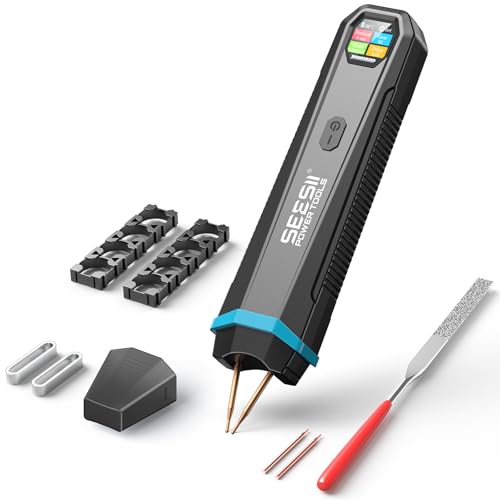
Fully Cordless: Say goodbye to tangled power cords—grab this spot welder and work anytime, anywhere; Note: For optimal performance, fully charge it to 100% before first use; If the product is left unused, please charge it monthly to preserve battery health

Weld Like a Pro: Designed for steel sheets up to 1/8" thick (such as carbon steel), this portable spot welder delivers strong, reliable welds for various fabrication tasks. (Not suitable for aluminum & stainless steel)
Quality Control and Weld Inspection
Automotive welding is only useful if the joints are consistent. A weld that looks clean from the outside can still have poor penetration, a small nugget, porosity, cracking, contamination, or weak fusion. For this reason, production lines use a mix of procedure control, destructive testing, nondestructive testing, and data monitoring.
Resistance spot welds may be checked through peel tests, chisel tests, ultrasonic inspection, electrode force monitoring, current tracking, and dynamic resistance data. Research on automotive resistance spot welding shows why digital process data is valuable: full offline testing can be too slow and costly for every weld on a large production line.
Arc welding quality is also becoming more data-driven. Current, voltage, travel speed, wire feed, shielding gas, torch angle, and sensor signals can help identify drift before a bad weld reaches the next station. Machine learning and online prediction systems are now being studied for weld-quality monitoring in gas metal arc welding.
Pro Tip: In automotive repair, never guess a weld type from appearance alone. Check the OEM repair procedure, steel grade, sectioning location, corrosion protection steps, and approved welder settings before welding a structural part.
Safety and Standards in Automotive Welding
Welding creates heat, ultraviolet light, fumes, sparks, electrical hazards, and fire risks. In a factory, school, or repair shop, welders need proper training, ventilation, fire control, eye and face protection, gloves, protective clothing, and safe handling of cylinders and electrical equipment.
The Occupational Safety and Health Administration lists welding, cutting, and brazing standards for general industry, maritime, and construction. The American Welding Society has also authored hundreds of standards for welding practices and procedures.
Warning: Do not weld automotive parts without the correct PPE, ventilation, fire watch, and repair procedure. Galvanized coatings, seam sealers, adhesives, paint, undercoating, and high-strength steels can create health, fire, and structural risks when heated.
Safety also affects quality. Contaminated panels, overheated steel, missing corrosion protection, and poor fit-up can weaken a repair. That is why welding safety, procedure control, and final inspection belong together.
Automotive Welding Today and What’s Next
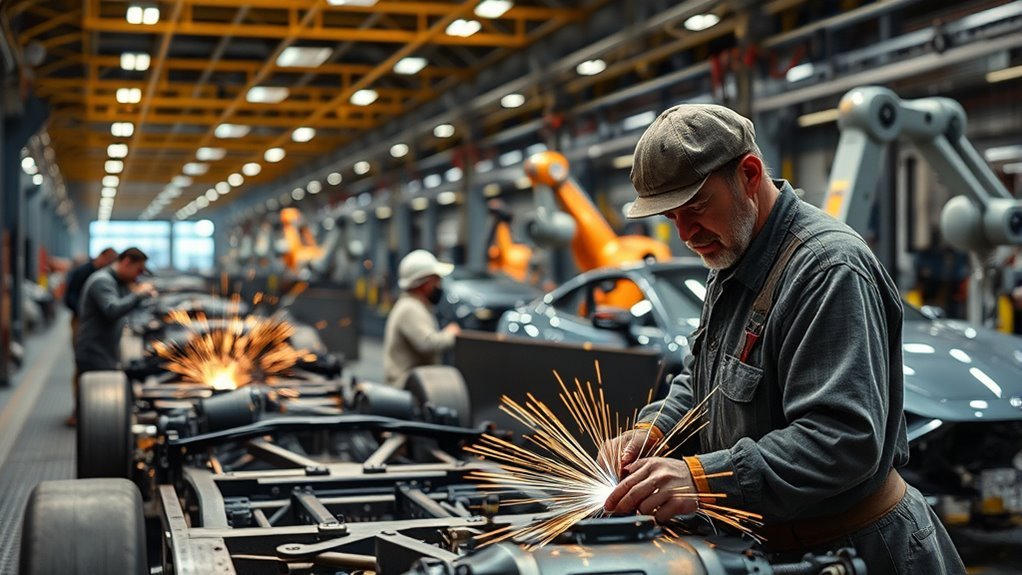
Today, automotive welding is being reshaped by automation, real-time sensing, and data-driven quality control. Robots handle many repetitive welds because they can repeat position, pressure, timing, and travel speed more consistently than manual production at high volume.
The International Federation of Robotics World Robotics 2025 report counted 542,076 industrial robot installations in 2024 and 4,663,698 industrial robots in operational stock. The same report said automotive was the second-largest customer industry for industrial robots in 2024, behind electrical and electronics.
Electric vehicles add new welding challenges. Battery trays, busbars, cooling plates, and sealed enclosures may require laser welding, ultrasonic metal welding, resistance welding, friction stir welding, adhesive bonding, or hybrid joining. Heat input, alignment, cleanliness, and sealing matter because battery safety and long-term performance depend on them.
Lightweight materials add another layer. Aluminum, ultra-high-strength steel, coated steel, castings, and mixed-material structures do not all respond the same way to heat. A versatile welding machine can help in a repair or fabrication shop, but production vehicle structures still require the right process, settings, filler, inspection method, and corrosion protection.
Tomorrow’s lines will combine robots, sensors, artificial intelligence, and flexible fixtures. The goal is not just faster welding. The real goal is fewer defects, better traceability, safer workers, and stronger vehicles built from more complex material combinations.
Frequently Asked Questions
Which car company first adopted welding in production?
There is no single, clean answer that fits every welding process. Ford helped popularize high-volume assembly, and suppliers such as A. O. Smith played a major role in welded frame production. It is safer to say that welding spread across automotive production during the early 1900s and became more important through the 1920s and 1930s.
How did welding affect automotive worker safety?
Welding introduced new hazards, including arc flash, fumes, burns, fire, electric shock, and cylinder risks. It also encouraged better training, protective gear, ventilation, fire prevention, and standards. Modern robotic welding can reduce some repetitive and exposure-heavy work, but workers still need strong safety controls around welding cells.
What patents influenced early automotive welding methods?
Early electric welding patents, including Benardos and Olszewski’s 1887 U.S. patent for working metals with direct electric current, helped prove that electric arcs could join or work metal. Later patents and process improvements in resistance welding, coated electrodes, automatic wire feeding, and shielding gases made welding more practical for mass production.
Which countries led welding equipment innovation for cars?
The United States, Germany, the United Kingdom, France, Russia, Japan, Italy, and Sweden all contributed to welding equipment, standards, power sources, automation, and production methods. Later, Japan, South Korea, China, and other major vehicle-producing countries became important in robotic welding, automation, and high-volume manufacturing.
How did welding change automotive repair practices?
Welding moved repairs from simple mechanical patching toward structural restoration. Modern collision repair may require MIG/MAG welding, squeeze-type resistance spot welding, weld bonding, sectioning, corrosion protection, and OEM-approved procedures. Repairers must match the method to the vehicle material and safety structure.
Why is resistance spot welding so common in car bodies?
Resistance spot welding is fast, repeatable, and well suited to overlapping sheet metal. Robots can place many spot welds quickly, and the process works well with fixtures that hold body panels in exact positions. That makes it one of the most important joining methods for body-in-white assembly.
Is laser welding replacing traditional automotive welding?
Laser welding is growing, but it is not replacing every traditional process. Automakers still use resistance spot welding, arc welding, brazing, adhesives, and mechanical fastening. Laser welding is most useful where factories need precision, low distortion, narrow heat input, and strong automation control.
Conclusion
The history of welding in automobiles is the story of stronger joints, faster factories, and changing vehicle design. Early electric welding made it possible to fuse metal directly. Mass production and wartime demand pushed welding into wider use. Resistance spot welding then became a backbone of body assembly, while MIG, TIG, submerged arc, laser, and robotic welding expanded what automakers could build.
Today, welding is still evolving. EV battery packs, lightweight materials, sensors, and AI-driven quality control are pushing the industry beyond simple metal joining. The welds may be hidden under paint, trim, and sealers, but they remain a major part of how modern vehicles stay strong, safe, and manufacturable.
Sources
- Google Patents: US363320A — supports the 1887 early electric arc metal-working patent by Benardos and Olszewski.
- American Welding Society: About AWS — supports AWS founding, mission, and welding standards context.
- OSHA: Welding, Cutting, and Brazing Standards — supports safety and standards guidance.
- International Federation of Robotics: World Robotics 2025 Executive Summary — supports current industrial robot installation and automotive automation data.
- Functional clustering methods for resistance spot welding process data in the automotive industry — supports modern RSW quality-control and process-data discussion.
- Towards a Deep Learning-based Online Quality Prediction System for Welding Processes — supports data-driven and machine-learning quality monitoring in GMAW.