The first time I considered fixing a cracked steel bracket with J-B Weld instead of a welder, the obvious question was: how much weight can J-B Weld hold? The honest answer is that there is no single pound rating. The result depends on the exact product, bonded area, joint design, base material, surface preparation, cure, temperature, vibration, and direction of the load.
Quick Answer
J-B Weld does not have a universal pound rating. Original Twin Tube is currently listed at 6,220 psi tensile strength, but that laboratory stress value is not a safe working load. Real capacity depends on joint shape, bonded area, preparation, cure, temperature, vibration, substrate strength, and peel forces. Never rely on it alone for a safety-critical structure.
J-B Weld can be useful for many non-critical repairs on steel, aluminum, stainless steel, castings, ceramics, and other compatible surfaces. It is not a fusion weld, however, and its published PSI value should never be treated as permission to repair a frame, hitch, suspension component, pressure vessel, lifting device, or occupied structure. This guide explains what the manufacturer’s strength figure means, what makes a bond succeed or fail, and when welding or mechanical fastening is the safer choice.
Key Takeaways
- J-B Weld has a tensile-strength rating, not a universal safe working-load rating in pounds.
- A broad, well-prepared overlap joint usually performs better than a narrow butt joint or an edge that can peel.
- Original Twin Tube currently lists 6,220 psi, while some Original syringe information lists 5,020 psi. Check the exact package.
- Oil, paint, rust, poor mixing, cold temperatures, early loading, vibration, and thermal cycling can reduce reliability.
- Do not use consumer epoxy as the sole repair for steering, brakes, suspension, frames, hitches, lifting equipment, pressure systems, or code-governed structures.
- Never weld over J-B Weld. Remove all epoxy and contamination to clean base metal before welding.
At a Glance
| Time Required | About 20–40 minutes of preparation and application, plus the full product-specific cure time |
| Difficulty | Easy for non-critical repairs; engineering review is required for structural bonded joints |
| Tools Needed | Gloves, eye protection, degreaser, clean lint-free cloths, coarse sandpaper or file, mixing surface, applicator, and clamps |
| Cost | One package of the selected epoxy plus basic cleaning and abrasion supplies; price varies by product size and retailer |

J-B Weld strength depends on the complete repair: product selection, joint geometry, surface preparation, cure conditions, and service load.
What Is J-B Weld and Why Is It Useful in a Welding Shop?
J-B Weld Original is a two-part, steel-reinforced epoxy made from separate resin and hardener components. Mixing the two starts a chemical cure that forms a hard polymer bond. The term “cold weld” is a product description; the epoxy does not melt and fuse the base metals as MIG, TIG, stick, or resistance welding does.
The current U.S. product page for Original J-B Weld Twin Tube lists a 1:1 mixing ratio, a 4–6-hour set time, a 15–24-hour full cure, tensile strength of 6,220 psi, and temperature resistance up to 550°F after full cure. These figures apply to that specific product page and should not automatically be assigned to every J-B Weld formulation.
Note: J-B Weld’s current FAQ lists 5,020 psi for the Original syringe, while the current Original Twin Tube page lists 6,220 psi. Read the label and technical information for the exact package in your hand rather than relying on a number from another format or an older article.
In a fabrication shop, epoxy is most useful when a repair is non-critical and heat would damage nearby paint, plastic, electronics, seals, or thin material. It can also fill surface defects, rebuild a damaged non-critical housing, secure a fixture, seal a compatible cover, or hold a mock-up before a separate permanent fastening process.
It should not be described as stronger than the surrounding material without a product-specific test. A repair can fail in the epoxy, at the adhesive-to-metal interface, in paint or corrosion beneath the epoxy, or in the weakened base material beside the repair.
How Much Weight Can J-B Weld Hold?
There is no responsible universal answer in pounds. J-B Weld publishes material strength in pounds per square inch, but it does not publish one safe working-load value that applies to every bracket, hook, plate, housing, or repair.
A PSI strength figure describes a laboratory stress result. It does not tell you how many pounds an unknown real-world joint can safely support.
Multiplying a tensile-strength figure by visible bond area may produce a theoretical failure force, but that result is not a safe load rating. Real joints rarely distribute stress evenly. The highest stress is often concentrated near an edge, hole, corner, crack tip, or point where the bonded parts begin to flex.
A safe structural bonded joint must be evaluated as a complete system consisting of the base materials, surface treatment, adhesive, bond thickness, cure process, joint geometry, environment, inspection method, and expected load history. That is why professional bonded structures are tested and qualified rather than sized from an adhesive package number alone. The FAA’s structural-bonding guidance describes this system-based approach.
Factors That Increase or Reduce Holding Power
| Factor | More Reliable Condition | Less Reliable Condition |
|---|---|---|
| Load direction | Load spread across a broad overlap | Peel, prying, cleavage, or load at one edge |
| Surface | Clean, dry, solid, and properly roughened | Oil, paint, rust, oxide, dust, or loose plating |
| Joint shape | Wide lap joint with supported edges | Narrow butt joint or unsupported crack |
| Loading | Light, static, non-critical service | Impact, vibration, fatigue, shock, or changing direction |
| Cure | Correct ratio, thorough mixing, clamping, and full cure | Uneven mix, movement, cold conditions, or early loading |
| Environment | Stable temperature and compatible chemicals | Thermal cycling, prolonged heat, immersion, fuel, or incompatible chemicals |
Breaking Down Tensile, Shear, Peel, and Real Load Conditions
Different forces stress an adhesive joint in different ways. A single tensile-strength number cannot represent all of them.
Tensile Load
A direct tensile load pulls the bonded faces apart. Laboratory tensile testing controls specimen shape, preparation, cure, load direction, and test speed. A real bracket may bend before it creates anything close to a uniform tensile load.
Shear Load
Shear tries to slide one bonded surface across the other. A properly supported overlap can place more of the adhesive in shear, which is generally more favorable than peeling one edge. Even then, stress is not perfectly uniform across the overlap.
Peel and Cleavage
Peel starts separation at an edge, much like pulling tape from a surface. Cleavage pries a rigid joint open from one side. Hard epoxies can perform poorly when a flexible bracket, long lever, or impact repeatedly concentrates force at one edge.
Compression
Compression pushes parts together. The epoxy may resist crushing while the surrounding part shifts, buckles, cracks, or squeezes the adhesive from the joint. A compression figure therefore does not automatically rate a repaired engine block, press component, jack, or lifting device.
Creep, Fatigue, and Thermal Cycling
A joint can slowly deform under a sustained load even when that load is below a short laboratory failure value. Repeated vibration can also grow a small crack over thousands of cycles. Temperature changes are especially important when bonding dissimilar metals because aluminum, steel, and stainless steel expand at different rates.
Pro Tip: Design a non-critical epoxy repair so the surrounding parts support one another and the adhesive mainly resists distributed shear. Avoid long levers, unsupported edges, and joints that can flex or peel.
When Should You Use J-B Weld for Load-Bearing Repairs?
J-B Weld may carry some load in a suitable non-critical joint, but “load-bearing” is too broad to serve as a safety decision. The first question should be what happens if the repair fails.
Reasonable Non-Critical Uses
- Securing a light shop fixture or guide where failure cannot injure anyone
- Repairing a non-pressurized metal cover or housing
- Rebuilding a stripped hole for a lightly loaded cover screw
- Bonding a nameplate, bracket cover, knob, trim piece, or guard that is not safety-related
- Filling a casting defect before sanding or machining, when the repair is not pressure-critical
- Holding a fabrication mock-up before parts are separated and properly fastened
- Sealing a small leak only when the selected product is approved for the material, fluid, temperature, and pressure
Repairs That Should Not Rely on Consumer Epoxy Alone
Warning: Do not use J-B Weld as the sole repair for vehicle frames, steering, brakes, suspension, wheels, axle mounts, hitches, recovery points, roll cages, seat-belt anchors, lifting equipment, cranes, jacks, presses, pressure vessels, compressed-gas parts, hydraulic cylinders, occupied structures, guardrails, or any connection governed by an engineering drawing, law, code, manufacturer procedure, or inspection requirement.
Structural steel welding is governed by qualification, fabrication, and inspection requirements such as those in AWS D1.1. Applying a consumer epoxy does not convert a damaged structural connection into a code-compliant repair.
Galvanized steel also requires careful treatment. Avoiding welding heat does not automatically make an adhesive repair structurally acceptable. The zinc coating may become the weak layer, and any future welding still requires proper coating removal, ventilation, and hot-work controls.
Step-by-Step Guide: Applying J-B Weld for Maximum Holding Power
These steps are intended for a compatible, non-critical repair. Follow the label and safety data for the exact formulation because mixing ratios, working times, curing times, temperature limits, and compatible materials vary.
1. Decide Whether Epoxy Is Appropriate
Identify the load, temperature, chemicals, moisture, movement, and consequence of failure. Stop if the part affects steering, braking, suspension, towing, lifting, pressure containment, structural support, or personal protection.
2. Choose the Exact Product
Original, KwikWeld, SteelStik, HighHeat, and ExtremeHeat are not interchangeable. Match the product to the base material, service temperature, available working time, gap shape, and exposure conditions.
3. Remove Weak Surface Layers
Remove loose paint, rust, scale, oxide, dirt, and previous adhesive. Bonding to paint only makes the repair as strong as the paint-to-metal connection. On aluminum, prepare the surface immediately before bonding so a fresh oxide layer has less time to form.
4. Degrease and Dry the Parts
Use a compatible detergent or degreaser as directed by the product manufacturer. Wipe with a clean, lint-free cloth and allow the surface to dry fully. Do not leave solvent trapped in a crack or enclosed joint.
5. Roughen the Bonding Area
Use coarse sandpaper or a file to create a clean, textured surface. Abrade the entire bonding area rather than scratching only the center. Remove sanding dust without touching the prepared surface with bare fingers.
6. Measure and Mix Thoroughly
For Original Twin Tube, dispense equal parts resin and hardener onto a disposable surface and mix until the color and texture are uniform. Do not add steel wool, grinder dust, wire pieces, solvent, filler powder, or extra hardener. Altering the formulation makes its published specifications inapplicable.
7. Apply, Assemble, and Clamp
Coat the prepared surfaces, bring the parts together, and clamp them so they cannot creep or rotate. Use enough pressure to hold alignment, but do not squeeze all adhesive from the joint. Remove excess before it hardens if appearance matters.
8. Allow the Full Cure
Original Twin Tube sets in approximately 4–6 hours and reaches full cure in approximately 15–24 hours under the manufacturer’s stated conditions. Set time is not full-cure time. Cold conditions can slow the process, so do not load the repair merely because the surface feels hard.
9. Inspect and Test Safely
Look for unmixed streaks, gaps, bubbles, edge lifting, movement, or bonding to loose paint or corrosion. Test only in a controlled manner where failure cannot drop a load, release pressure, damage equipment, or injure a person. Reinspect after the first heat, vibration, or service cycle.
Note: A successful pull by hand is not proof of a safe structural connection. Human force is inconsistent and may not reproduce the direction, duration, impact, temperature, or vibration the joint will see in service.
J-B Weld vs. Traditional Welding
Epoxy bonding and metal welding create different types of joints, so comparing their headline PSI figures is misleading. A weld’s performance depends on base metal, filler classification, weld size, penetration, heat input, discontinuities, procedure qualification, and inspection. An adhesive joint depends on the adhesive, substrate, surface treatment, bond line, cure, geometry, and environment.
| Consideration | J-B Weld Epoxy | Proper Metal Welding |
|---|---|---|
| Heat input | No welding heat during application | Creates a heat-affected zone and may cause distortion |
| Gap filling | Can fill irregular non-critical defects | Joint preparation and weld procedure control penetration and fill |
| Dissimilar materials | Can bond some compatible dissimilar materials | May require a specialized process, filler, transition, or mechanical connection |
| Peel and impact | Rigid bond can be vulnerable to edge peeling and repeated impact | A qualified ductile metal joint may tolerate cyclic loading better |
| Code compliance | Not automatically approved for code-governed structural work | Can be designed, qualified, inspected, and accepted under the applicable code |
| Best use | Compatible non-critical repairs, sealing, rebuilding, and fixtures | Permanent metal joints when the material, design, and procedure allow welding |
The lower purchase cost of epoxy can make sense for a small non-critical repair. Cost should not decide a safety-critical repair, however. Replacement, engineered fastening, or qualified welding is cheaper than a failure that causes a crash, dropped load, fire, or structural collapse.
Products Worth Considering

HEAVY-DUTY LIQUID WELD FOR RIGID REPAIRS: This 2-part metal epoxy glue bonds aluminum, steel, stainless steel, cast iron and other rigid surfaces, including wood, ceramic, glass, concrete and rigid plastics. Ideal for automotive parts, tools, equipment, plumbing repairs and everyday workshop projects where a strong, durable bond matters
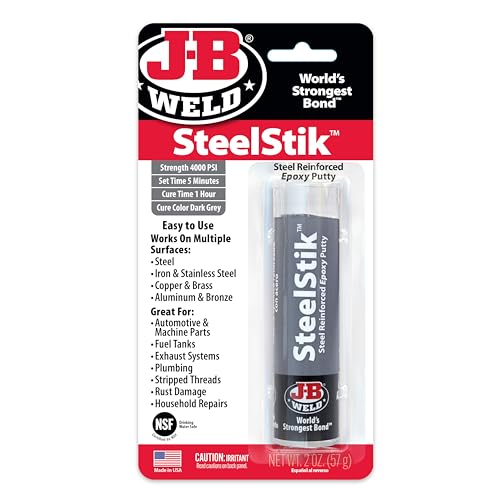
J-B Weld Steelstik: A Hand Mixable Two Part Epoxy Putty Stick That Is Steel Reinforced & Non-Rusting To Quickly Repair Or Rebuild Anything Made Of Metal! J-B Weld Steelstik Is Certified By The Nsf And Is Safe For Contact With Potable Water

Ready-to-use liquid weld for rigid parts: Metal epoxy glue bonds aluminum, steel, stainless, and cast iron; also wood, ceramic, glass, rigid plastics, and concrete—ideal for auto repair, marine hardware, plumbing leak repair, and home fixes.
Common Mistakes Under Heavy Loads and How to Avoid Them
Bonding Over Paint, Oil, or Rust
The epoxy may adhere to the coating while the coating separates from the metal. Remove weak layers and prepare solid base material.
Using a Butt Joint Where an Overlap Is Possible
A narrow end-to-end joint concentrates stress. A suitable overlap, backing plate, or mechanical support can spread load over a wider area, although any safety-critical redesign still requires engineering approval.
Loading the Repair Before Full Cure
A part may feel solid at set time but still lack its final properties. Observe the full cure time and account for cold or damp conditions.
Mixing Unequal Parts
Guessing the ratio or mixing incompletely can leave soft or weak pockets. Dispense carefully and mix until uniform.
Making the Epoxy Extremely Thick
More material does not automatically mean more strength. A thick, uneven mass can trap voids, increase shrinkage effects, and create a large lever at the repair edge. Joint support and preparation matter more than creating an oversized lump.
Ignoring Vibration and Movement
A repair that survives one static test may loosen after repeated vibration. Add a properly designed mechanical fastener when appropriate, but do not assume that a bolt automatically makes an unengineered safety-critical repair acceptable.
Trusting a Story Instead of a Rated Test
Claims about an epoxy holding an anvil, press, trailer, beam, swingarm, or multi-ton load do not establish a safe rating. Without dimensions, preparation records, cure conditions, test fixtures, load direction, duration, environmental exposure, and failure criteria, an anecdote cannot be used for design.
Real-World Welding and Fabrication Projects Using J-B Weld
Useful shop applications are usually the jobs where failure is inconvenient rather than dangerous. Examples include repairing a cracked tool housing, rebuilding a worn non-critical locating surface, securing a machine badge, filling a cosmetic casting flaw, bonding a light fixture, sealing a compatible inspection cover, or repairing a stripped thread that holds only a cover.
For automotive work, suitable uses may include trim, knobs, some non-pressurized covers, and selected housings after verifying chemical and temperature compatibility. A differential housing, engine casting, fuel-system part, or coolant component may experience heat, fluid exposure, vibration, internal pressure, or crack growth. Those conditions require a product-specific repair procedure rather than a general claim that the epoxy “held for thousands of miles.”
Marine repairs require the same caution. Water resistance does not create a structural rating for a transom, steering attachment, lifting eye, or hull connection. Use a marine-specific product where specified and follow the boat or component manufacturer’s repair procedure for structural damage.
For prototypes, epoxy can hold non-critical pieces during layout or demonstrate shape and fit. Do not treat an adhesive mock-up as a tested production joint unless the complete bonded system has been designed and validated for that service.
Combining J-B Weld with Welding Techniques
J-B Weld and welding may both appear during different stages of a project, but epoxy should never remain in the weld joint.
Warning: Do not MIG, TIG, stick weld, braze, solder, flame-cut, plasma-cut, or grind with heavy heat directly through J-B Weld. Heated epoxy can decompose and contaminate the joint. Remove it completely, clean to sound bare metal, and provide the ventilation and hot-work controls required for the metal and any remaining coating.
If epoxy was used to check alignment, separate the pieces and remove all residue before final welding. A grinder alone may smear material into pores or scratches, so inspect the surface carefully and continue cleaning until no adhesive remains.
Do not use epoxy as an open-root backing material, weld-gap filler, porosity reducer, or substitute for a backing bar. Weld-joint geometry, root opening, backing, filler, shielding, heat input, and procedure must be appropriate for the base metal and applicable welding standard.
An adhesive and a mechanical fastener can sometimes share load in a deliberately designed assembly. That combination still requires attention to stiffness, fastener preload, corrosion, temperature, inspection, and the possibility that one connection will take most of the load before the other engages.
Safety Considerations in Welding Environments
Read the current label and safety data sheet before mixing. The manufacturer’s safety data sheet for the steel-reinforced epoxy components identifies skin irritation, eye hazards, allergic skin sensitization, and precautions against breathing vapor, mist, or spray.
- Wear chemical-resistant gloves suitable for epoxy handling.
- Wear safety glasses or goggles that protect against splashes.
- Provide ventilation and avoid breathing vapors, mist, or sanding dust.
- Do not eat, drink, or smoke while handling uncured components.
- Wash exposed skin with soap and water; do not clean skin with solvent.
- Keep contaminated gloves and tools away from steering wheels, phones, door handles, and other shared surfaces.
- Keep the product away from children and follow local disposal requirements.
- When sanding cured material, control dust and use appropriate eye and respiratory protection.
OSHA notes that uncured epoxy resins can present a significant skin-exposure hazard and may cause irritation, dermatitis, or sensitization. Review the OSHA guidance on epoxy exposure when the product is used regularly in a workplace.
Hot-work safety remains separate from adhesive safety. Follow the applicable OSHA welding, cutting, and brazing requirements, including ventilation, fire prevention, PPE, and controls for coatings or contaminants.
Choosing the Right J-B Weld Product
The strongest advertised number is not always the right choice. Working time, viscosity, gap shape, heat, water, chemicals, and cure schedule may matter more than tensile strength.
| Product | Current Published Information | Typical Selection Reason |
|---|---|---|
| Original Twin Tube | 6,220 psi; 4–6-hour set; 15–24-hour cure; up to 550°F | Longer working time and general multi-surface repairs |
| KwikWeld | 3,127 psi; approximately six-minute set; 4–6-hour cure | Faster non-critical repairs where short working time is acceptable |
| SteelStik | 4,000 psi; five-minute set; one-hour cure; up to 350°F | Hand-molded rebuilding, filling, or shaping on compatible metal |
| HighHeat Epoxy Putty | 4,000 psi; one-hour set; eight-hour cure; 450°F continuous and 500°F intermittent | Compatible repairs exposed to temperatures beyond standard putty limits |
| ExtremeHeat Paste | One-hour set; 24-hour cure; manufacturer describes use in metal environments up to 1,000°F; no tensile rating shown | Filling cracks, pits, seams, or holes in specified high-temperature metal applications |
Always confirm these figures on the current package and manufacturer page because formulations, formats, regional listings, and published specifications can change. A high-temperature rating also does not create a structural load rating.
Products Worth Considering

Jb Weld Extreme Heat: Is Formulated For Repairs To Iron, Steel And Metal In High Temperature Environments 1000°F / 537°C. Non-Flammable, It Contains No Solvents Or Volatile Organic Compounds (Vocs).

J-B WELD HIGHHEAT: A hand mixable two part epoxy putty stick that is formulated to repair and rebuild materials that will be exposed to high temperatures in automotive and industrial maintenance applications. J-B Weld HighHeat is designed for DIY repairs on exhaust manifolds, tail pipes, mufflers, engine blocks, duct work and other various high temperature projects.

J-B Weld HighHeat is a two-part epoxy system that provides strong, lasting, heat-resistant repairs up to 550°F. Mixed at a ratio of 1:1, it forms a permanent bond that has a 4730 PSI strength and is chemical and fuel resistant. At room temperature, HighHeat sets in 1 hour and cures in 24 hours. HighHeat's cure time is accelerated by heat and can cure in 1 hour at 250°F.
Conclusion
J-B Weld can create a strong, useful bond when the correct product is applied to clean, roughened, compatible surfaces and allowed to cure fully. Its PSI figure does not answer how many pounds a real repair can safely hold, however. Joint geometry, load direction, base material, preparation, temperature, vibration, aging, and consequence of failure all matter.
Use it confidently for suitable non-critical repairs, fixtures, filling, sealing, and rebuilding. Choose qualified welding, replacement, engineered mechanical fastening, or a professionally designed adhesive system when a failed connection could affect a vehicle, lifting operation, pressure system, occupied structure, or personal safety. Do not change the epoxy formulation with metal filings, and remove every trace of it before future hot work.
Frequently Asked Questions
Can J-B Weld replace a full weld for structural loads?
Not automatically. Consumer epoxy does not replace a weld, fastener, or bonded joint required by an engineering drawing, vehicle repair procedure, building code, welding code, or inspection standard. Structural adhesive connections can be valid when they are specifically designed, processed, tested, and approved as a complete bonded system.
How long does J-B Weld need before it can hold weight?
Follow the exact product label. Original Twin Tube sets in approximately 4–6 hours and fully cures in approximately 15–24 hours. Do not treat set time as full strength, and allow additional time when the label warns that environmental conditions can slow curing.
Does 6,220 psi mean one square inch can safely hold 6,220 pounds?
No. The published figure is a tensile-strength value obtained under defined test conditions, not an allowable working load for every one-square-inch repair. Real joints have uneven stress, imperfect surfaces, peel forces, temperature changes, vibration, aging, and substrate limitations.
What is the difference between J-B Weld and ordinary epoxy?
J-B Weld is a brand with multiple formulations for different materials, working times, temperatures, and repair shapes. “Ordinary epoxy” covers a wide range of products with very different properties. Compare the exact technical data, compatible surfaces, cure schedule, temperature rating, chemical resistance, and intended use.
Will J-B Weld hold up under vibration?
It may handle limited vibration in a well-designed non-critical joint, but repeated movement can create fatigue, creep, or edge peeling. Do not rely on it as the sole connection for an engine mount, suspension part, hitch, recovery point, frame, or other safety-critical vibrating assembly.
Is J-B Weld safe for automotive load-bearing applications?
It can be suitable for selected non-critical automotive repairs when the product is compatible with the material, heat, fluid, and movement involved. It should not be the sole repair for steering, brakes, wheels, suspension, frames, axle mounts, hitches, seat anchors, recovery points, or other crash-critical components.
Can I weld over cured J-B Weld?
No. Epoxy can decompose when heated and contaminate the weld with fumes, porosity, inclusions, or lack of fusion. Remove all epoxy, coatings, residue, and contamination to clean sound metal before welding, then follow the applicable hot-work, ventilation, and welding-procedure requirements.
Sources
- J-B Weld Original Twin Tube specifications — current tensile-strength, mixing, preparation, set-time, cure-time, and temperature information.
- J-B Weld frequently asked questions — product-format strength, heat-resistance, cure, and compatibility distinctions.
- J-B Weld steel-reinforced epoxy safety data sheet — handling hazards, PPE, first aid, and sensitization information.
- OSHA Technical Manual: epoxy exposure — skin exposure, irritation, dermatitis, and sensitization hazards.
- OSHA welding, cutting, and brazing standards — hot-work, ventilation, fire-prevention, coating, and PPE requirements.
- AWS D1.1 Structural Welding Code—Steel — qualification, fabrication, inspection, and acceptance framework for structural steel welding.