I reach for J-B Weld on aluminum when the repair is small, non-structural, and better suited to a cold-cure adhesive than a torch. It can make a durable bond, but the number printed on the package is not a promise that any aluminum joint will carry that load. Surface preparation, joint shape, cure conditions, heat, vibration, and the consequences of failure matter more than a single PSI figure.
Quick Answer
Original J-B Weld can bond aluminum, but its published tensile rating is not an aluminum-joint load rating. J-B Weld currently lists 6,220 PSI on the 2-ounce Twin Tube page, while its FAQ lists 5,020 PSI. Actual strength depends on preparation, bonded area, load direction, cure, temperature, and the condition of the part.
Key Takeaways
- J-B Weld says Original epoxy works on aluminum, but its public pages currently show conflicting tensile ratings of 5,020 and 6,220 PSI.
- A product tensile rating cannot be converted directly into a safe weight limit for a real repair.
- Clean, rough, dry aluminum and a well-designed overlap joint give the bond its best chance.
- Original Twin Tube sets in about 4–6 hours and fully cures in roughly 15–24 hours; waiting a full day is the safer rule.
- Do not use epoxy as the only repair on steering, brakes, suspension, frames, ladders, pressure vessels, fuel systems, boat transoms, or other parts whose failure could injure someone.
At a Glance
| Time Required | About 20–40 minutes to prepare and apply, plus 15–24 hours for full cure |
| Difficulty | Easy to moderate; joint assessment and surface preparation are the important parts |
| Tools Needed | Gloves, eye protection, detergent or degreaser, fresh abrasive, lint-free wipes, mixing surface, applicator, and light clamps or tape |
| Cost | Roughly $8–$20 for a small repair, depending on the package and supplies already on hand |
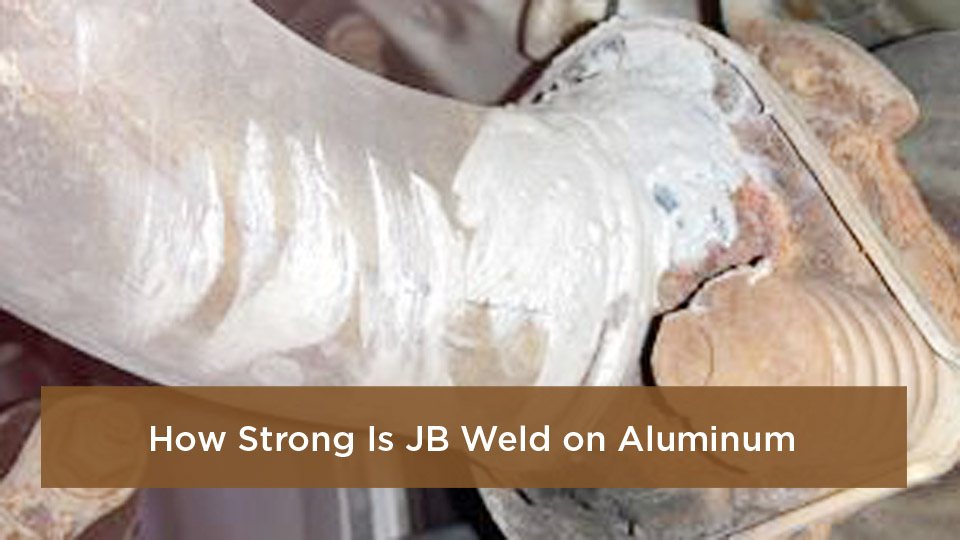
Example of a two-part epoxy repair on aluminum.
What Is J-B Weld, and Why Can It Bond Aluminum?
Original J-B Weld is a two-part, steel-reinforced epoxy. Equal parts resin and hardener are mixed, applied to the prepared surfaces, and left to cure into a hard, dark-gray material. It is an adhesive and gap filler—not fusion welding. No aluminum is melted, and the repaired pieces do not become one continuous metal structure.
The manufacturer lists metal, including aluminum, as a suitable surface for Original J-B Weld. It also says the cured material can be shaped, filed, sanded, drilled, tapped, and painted. That makes it useful for small brackets, covers, housings, mounting tabs, cosmetic damage, and other noncritical repairs where welding heat would be inconvenient or could distort thin material.
Note: “Cold weld” is a product description. J-B Weld does not produce a metallurgical weld, and welding codes do not turn a general-purpose epoxy repair into a code-qualified structural joint.
How the Epoxy Grips Aluminum
Epoxy bonds to the surface, so the condition of that surface controls the result. Aluminum quickly develops an oxide film, and real parts may also carry oil, polish, paint, anodizing, corrosion, or release agents. The goal is not to glue over dirt or a weak coating. The goal is to expose a clean, uniformly abraded, stable surface that the mixed epoxy can wet and lock onto.
That is why the manufacturer tells users to remove dirt, grease, oil, paint, and loose debris, then roughen the surface with a file or coarse sandpaper. Broader adhesive guidance follows the same pattern: degrease, abrade, clean away loose particles, avoid touching the prepared area, and bond soon after preparation.
J-B Weld Versus Other Epoxies
There is no universal winner for every aluminum repair. Original J-B Weld favors a hard, machinable, slow-cure bond. A faster epoxy may be better when downtime matters. A tougher structural adhesive may handle peel, impact, or repeated movement better. MarineWeld may be the more appropriate J-B Weld product around water, while exhaust-specific products are intended for exhaust service.
Choose by product data, service temperature, water or chemical exposure, cure time, joint movement, and the cost of failure—not by brand name alone. Also check the exact package. J-B Weld’s own FAQ lists different temperature ratings for Original Twin Tube and Original Syringe products.
How Strong Is J-B Weld on Aluminum?
The honest answer is: strong enough for many small, static, noncritical repairs, but not predictable from the advertised PSI number alone. The current J-B Weld page for the 2-ounce Original Twin Tube lists a tensile strength of 6,220 PSI. The company’s FAQ lists 5,020 PSI for Original Twin Tube and Original Syringe products. Because those official pages conflict, check the label and data for the exact SKU in your hand.
The package rating describes the adhesive under a test condition. It does not tell you the safe working load of your bracket, crack, lap joint, or repaired casting.
Why PSI Does Not Equal a Safe Weight Limit
PSI means pounds of force per square inch of tested area. A one-inch-long bead has no defined area until its width is known, and even a known area does not solve the whole problem. Real joints develop uneven stress. Edges may peel, parts may flex, gaps may concentrate load, and vibration can cause fatigue.
Adhesive test standards make the same point. ASTM D1002 covers apparent shear strength in a specific single-lap specimen and warns that the result is not a design allowable for a different joint without proper analysis. In practical terms, do not multiply the package PSI by bond area and call the answer a safe capacity.
Tensile, Shear, Peel, and Impact Loads
- Tensile load pulls the joined pieces straight apart.
- Shear load tries to slide one piece past the other.
- Peel or cleavage load concentrates force at one edge and is especially hard on a rigid epoxy.
- Impact and vibration repeat or spike the load, which can start cracks even when a static test looked fine.
J-B Weld does not publish an aluminum-specific lap-shear value on the product page used here. Unsupported figures such as “3,500 PSI shear on aluminum” should not be treated as product specifications.
How Aluminum Alloy and Surface Condition Affect the Bond
The alloy name alone does not provide a reliable strength adjustment. A clean 5052 sheet, a porous casting, a polished 6061 bracket, and an anodized 7075 part present different surfaces even before load and geometry are considered. Paint or powder coat may become the weak layer. Anodizing can bond well in some systems, but results depend on its structure, thickness, sealing, age, and contamination.
For a general repair, follow the adhesive manufacturer’s preparation instructions and test a sample when possible. For engineered or safety-critical bonded structures, use a specified adhesive system, controlled pretreatment, documented cure, and qualified design process rather than a household repair procedure.
When J-B Weld Is—and Is Not—a Good Aluminum Repair
Warning: Do not use J-B Weld as the sole repair on steering, brakes, suspension, wheels, frames, hitches, lifting equipment, ladders, pressure vessels, fuel systems, high-temperature exhaust parts, boat hulls or transoms, climbing gear, or any component whose failure could cause injury, flooding, fire, loss of control, or major property damage.
| Repair Type | Suitability | Reason |
|---|---|---|
| Cosmetic chip, small void, or noncritical casting blemish | Good candidate | Low consequence and mostly static loading |
| Small cover, housing, trim piece, or stationary mounting tab | Often suitable | Works well when the part is clean, stable, and not heavily loaded |
| Oil-exposed or wet nonpressurized housing | Use caution | Confirm product compatibility, temperature, and the source of the leak |
| Engine, drivetrain, or marine component with vibration | Use caution or seek professional repair | Heat cycles, fatigue, and hidden cracking can defeat a rigid patch |
| Structural, load-bearing, life-safety, pressure, fuel, or propulsion part | Not as a sole repair | The consequences and design demands exceed a general-purpose epoxy patch |
Products Worth Considering

QUICK UNDERWATER REPAIRS - Designed for emergency fixes on aluminum boats, outdrives, and underwater aluminum parts, this product hardens rapidly to provide efficient, durable repairs

✔ ALUMINUM-FILLED METAL REPAIR COMPOUND – Professional-grade aluminum-filled polymer designed to permanently repair cracks, blow holes, and casting imperfections in aluminum components including radiators, engine blocks, housings, tanks, and HVAC parts.
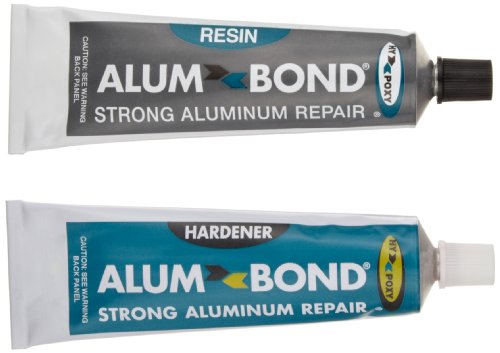
Epoxy metal weld for aluminum
Preparing Aluminum for J-B Weld
Surface preparation is the make-or-break step. J-B Weld’s product instructions call for cleaning away dirt, grease, oil, paint, and loose debris, then roughening the surface. A 3M technical bulletin on metal bonding also emphasizes that oil and grease removal, abrasion, particle removal, and prompt bonding are central to durable adhesion.
Step-by-Step Surface Preparation
- Decide whether epoxy is appropriate. Stop if the part is structural, pressurized, exposed to extreme heat, actively leaking fuel, or unsafe to take out of service.
- Unload and stabilize the part. Remove pressure, fluid, electrical power, and mechanical load as applicable. Let hot parts cool.
- Dry-fit the repair. Make sure the pieces align without forcing them. Add a backing plate or redesign the joint when more overlap is needed.
- Remove weak coatings and loose damage. Strip paint, corrosion, oxidation, and crumbling material from the bond area. Do not bond over a coating unless you are willing to rely on that coating’s adhesion.
- Degrease. Start with detergent or a suitable degreaser. J-B Weld also recommends acetone or lacquer thinner for surface cleaning; verify that the solvent will not damage nearby materials.
- Abrade to a uniform dull finish. Use a clean file, abrasive cloth, or sandpaper that roughens without deeply gouging thin aluminum. Use a fresh abrasive that has not picked up oil or steel contamination.
- Remove dust and clean again. Use a lint-free wipe and let the surface dry completely. Keep fingers off the prepared area.
- Bond promptly. Aluminum changes at the surface after abrasion, and prepared parts can be recontaminated while they sit.
Pro Tip: Prepare a little more overlap than the crack itself. A broad lap or backing patch spreads load better than a narrow bead sitting on top of a crack.
Preparation Mistakes That Cause Failure
- Bonding over oil: Common on engines, castings, and machined parts. Oil can migrate back out of pores after the first wipe.
- Bonding over paint or anodizing without testing: The epoxy may hold while the coating releases from the aluminum.
- Touching the prepared area: Finger oils undo part of the cleaning work.
- Using a contaminated wire wheel: A wheel used on greasy steel can transfer oil and particles to aluminum.
- Leaving moisture or solvent trapped: The surfaces should be dry before mixing and assembly.
- Using home-brew acid etches: Vinegar is not part of J-B Weld’s published preparation procedure, and uncontrolled chemical treatments can leave residues or damage the surface.
Applying and Curing J-B Weld on Aluminum
Once the aluminum is ready, accuracy matters more than speed. Original Twin Tube uses a 1:1 mix ratio. The manufacturer says it sets in 4–6 hours and fully cures in about 15–24 hours. Temperature and humidity can change the timing, so a cool shop may require more patience.
Mixing, Applying, Clamping, and Curing
- Protect yourself. Wear gloves and eye protection, and provide ventilation. The Safety Data Sheet classifies the resin as an eye irritant, skin irritant, and skin sensitizer.
- Dispense equal parts. Put equal amounts of resin and hardener on a disposable surface.
- Mix thoroughly. Fold and stir until the color and texture are uniform, scraping the mixing surface as you work.
- Wet both prepared surfaces. Spread an even layer across the bond area. Fill the gap, but do not build an unnecessarily thick lump when the parts can be fitted more closely.
- Assemble and align. Bring the parts together without sliding them around more than necessary.
- Clamp lightly. Use only enough pressure to hold alignment and maintain contact. Do not squeeze nearly all the epoxy out of the joint.
- Leave it alone during set. Avoid movement for at least 4–6 hours.
- Wait for full cure. Give the repair a full 24 hours before service when conditions are near room temperature, and longer if the area is cool or damp.
- Inspect before use. Look for tacky areas, voids, edge lifting, misalignment, or movement. Test only in a controlled, nonhazardous way.
Do not assume the 4–6-hour set time is the working time, and do not place Original J-B Weld in an oven unless the exact product instructions specifically call for a heat cure. The published Original Twin Tube instructions describe a room-temperature set and cure.
Finishing the Cured Repair
After full cure, Original J-B Weld can be filed, sanded, drilled, tapped, and painted. Support the part while machining so the bond is not peeled or flexed. Start gently, keep tools cool, and stop if the edge begins to lift.
For paint, scuff and clean the cured epoxy, then use a primer and topcoat that are compatible with both cured epoxy and the surrounding aluminum. A self-etching primer is intended for bare metal, so follow the coating maker’s directions rather than spraying it blindly over the epoxy.
Where J-B Weld on Aluminum Works Best
The best applications have generous bond area, low peel stress, moderate temperature, little movement, and a consequence of failure that is inconvenient rather than dangerous. In my shop, that means treating J-B Weld as an adhesive and repair compound—not as a substitute for a qualified weld on a critical part.
Automotive Aluminum Repairs
Reasonable candidates may include cosmetic casting damage, nonpressurized covers, trim, small housings, and noncritical tabs. Use extra caution around engines because heat cycling, oil contamination, vibration, and hidden cracks can shorten bond life.
Do not rely on Original J-B Weld alone for engine mounts, suspension, steering, wheels, brake components, cylinder-head cracks, spark-plug thread repairs, load-bearing brackets, fuel tanks, or pressurized cooling passages. Those jobs need the correct mechanical repair, welding procedure, replacement part, or specialist evaluation.
Marine and Outdoor Aluminum Applications
J-B Weld lists Original as resistant to water, chemicals, and fuel, but “resistant” is not the same as certified for every submerged, pressurized, or fuel-containing application. For repairs that live around water, compare Original with MarineWeld and follow the selected product’s data.
Keep epoxy patches off hull structure, transoms, propulsion mounts, critical trailer components, and safety gear. A patch that survives a bench test may still fail after flexing, wave impact, freeze-thaw cycles, salt exposure, or long-term immersion.
DIY Fabrication and Hobby Projects
Good uses include display pieces, appliance trim, metal housings, decorative panels, stationary fixtures, jigs, and light-duty noncritical brackets. Avoid bicycle frames, racks carrying people or heavy loads, trailers, ladders, lifting points, and overhead parts that could fall.
J-B Weld Versus Welding and Mechanical Fasteners
| Aspect | J-B Weld on Aluminum | TIG or MIG Welding | Mechanical Fasteners |
|---|---|---|---|
| How it joins | Surface adhesion through cured epoxy | Melts and fuses base and filler metal | Clamps parts with bolts, screws, rivets, or inserts |
| Published strength | Manufacturer pages currently list 5,020–6,220 PSI for Original, depending on page and format | Depends on alloy, filler, joint design, heat treatment, workmanship, and procedure | Depends on fastener grade, size, spacing, bearing area, and joint design |
| Heat input | No welding heat during application | High localized heat; distortion and heat-affected properties must be managed | Usually little heat, though drilling changes the part |
| Best use | Small, static, noncritical repairs and gap filling | Permanent structural or pressure-capable work when properly designed and qualified | Serviceable joints, reinforcement, and load transfer when access and edge distance allow |
| Main weakness | Peel, impact, fatigue, heat cycling, contamination, and uncertain field strength | Needs equipment, access, skill, shielding, and correct alloy procedure | Requires holes or access and can concentrate load or promote corrosion if poorly designed |
A hybrid repair can be useful when it is properly engineered: fasteners carry the load while adhesive seals, distributes stress, or prevents movement. That is different from hiding a cracked critical part under epoxy and hoping the bead will carry the structure.
Products Worth Considering

Ready-to-use liquid weld for rigid parts: Metal epoxy glue bonds aluminum, steel, stainless, and cast iron; also wood, ceramic, glass, rigid plastics, and concrete—ideal for auto repair, marine hardware, plumbing leak repair, and home fixes.

Product Description : Metal Repair Glue is a two-component, heavy- duty, high-temperature resistant, waterproof epoxy glue, it comes in 1.76oz container, including a set of pusher, scraper and mixed ratio 1:1 syringe. It is a non-irritating odor liquid metal cold welding adhesive, welding glue cures quickly, once cured, metal repair glue can form a strong and stable permanent bond.

Wide range of uses: metal welding glue is suitable for metal, aluminum, steel, stainless steel, ceramics, glass and many kinds of plastic adhesive repair welding. It can be used not only for repairing fuel tanks, pipes, broken concrete, water tanks and plastic buckets, but also for boats, cars, fuel tanks, heaters, vases, fences welding car bumpers and motorcycle crack repair.
What Controls Bond Strength and Service Life?
Temperature and Chemical Exposure
The current Original Twin Tube page says the fully cured product can withstand temperatures up to 550°F. J-B Weld’s FAQ, however, lists 300°F for Original Syringe and 550°F for Original Twin Tube. That difference is another reason to identify the exact product rather than assuming every gray J-B Weld formula has the same limit.
An upper temperature statement does not guarantee full room-temperature strength at that temperature, unlimited continuous exposure, or survival through repeated heat cycles. Exhaust components can exceed a general-purpose epoxy’s practical service conditions, and J-B Weld directs exhaust repairs to products made for that purpose.
Likewise, water, oil, fuel, and chemical resistance do not establish approval for a fuel tank, pressure vessel, drinking-water contact, or every chemical concentration. The company says its products are not rated food-safe and should not contact food or beverages directly.
Joint Design and Load Direction
A broad lap joint or backing patch normally gives the adhesive more area and reduces edge stress. A narrow butt joint or surface bead over a crack leaves the epoxy vulnerable to peel. Rounded transitions and a small edge fillet can reduce abrupt stress concentrations, while a giant mound of epoxy does not automatically make the joint stronger.
For vibration, reduce flex in the parts, increase overlap, avoid peel, and use mechanical reinforcement where appropriate. Do not add random fibers or mesh and claim a percentage strength increase unless the repair system has been tested as a complete assembly.
Dissimilar Metals and Corrosion
Epoxy between aluminum and steel can provide some electrical separation, but it does not guarantee protection from galvanic corrosion. Scratches, exposed fasteners, thin edges, and trapped moisture can still create a conductive path. Seal exposed edges, choose compatible fasteners and coatings, and inspect outdoor joints periodically.
Troubleshooting a Weak or Failed Bond
| Symptom | Likely Cause | Best Fix |
|---|---|---|
| Still tacky after the expected cure | Wrong ratio, incomplete mixing, low temperature, or contaminated product | Remove uncured material, clean safely, and restart with fresh product and a thorough 1:1 mix |
| Epoxy peels cleanly from aluminum | Oil, polish, paint, sealed anodizing, loose oxide, or insufficient abrasion | Strip back to a stable surface, degrease, abrade, clean, and rebond |
| Crack starts at one edge | Peel or cleavage load, flexing parts, or too little overlap | Redesign with more overlap, backing, and a load path that favors shear |
| Bond softens or leaks when hot | Wrong product or service temperature, chemical attack, or thermal cycling | Remove the patch and use a product or professional repair rated for the actual environment |
| Repair breaks beside the epoxy | Weak, thin, corroded, or fatigue-damaged aluminum | Replace or properly repair the damaged part; moving the patch may only move the failure |
Removing J-B Weld
For uncured material on skin, follow the Safety Data Sheet and wash with soap and water. For uncured residue on a compatible work surface, J-B Weld says acetone may help. Acetone is highly flammable and can irritate the eyes, skin, and respiratory system, so keep it away from ignition sources and use ventilation and protective equipment.
Fully cured J-B Weld usually requires filing, grinding, or careful mechanical removal. Do not burn it off; heating cured epoxy can create irritating decomposition products and can damage or weaken the aluminum part.
Conclusion: When J-B Weld Is Strong Enough for Aluminum
J-B Weld can make a solid aluminum repair when the job is small, static, noncritical, clean, and well designed. The published strength is roughly in the 5,000–6,220 PSI range on current manufacturer pages, but that number is not a safe working load for your joint. Treat it as a material property, not permission to repair anything that fits under a clamp.
For the best result, remove oil and weak coatings, roughen the aluminum, mix equal parts thoroughly, favor overlap over peel, clamp lightly, and wait a full day before use. When failure could hurt someone or damage a vehicle, boat, building, or machine, replace the part or use a qualified welding, fastening, or engineered bonding procedure.
Frequently Asked Questions
Can J-B Weld handle vibration on aluminum engine parts?
It may tolerate moderate vibration in a broad, well-supported, noncritical joint, but there is no universal vibration rating for an aluminum repair. Heat cycles, oil, flex, and fatigue can shorten its life. Do not use it as the sole repair for mounts, rotating equipment, pressurized passages, or other critical engine parts.
Is Original J-B Weld suitable for aluminum exhaust repairs?
Do not assume so. Exhaust temperatures and thermal cycling can exceed the practical limits of Original epoxy, and the manufacturer offers exhaust-specific products. Identify the exact location, temperature, metal, and product instructions before attempting any exhaust repair.
How long until J-B Weld reaches full strength on aluminum?
Original Twin Tube sets in about 4–6 hours and fully cures in roughly 15–24 hours according to the current product page. The FAQ gives a similar 16–24-hour cure range. Wait at least a full day before service, and allow longer in cool or humid conditions.
Does aluminum oxide weaken a J-B Weld bond?
A dirty, loose, polished, or contaminated surface can weaken adhesion. Clean the part, remove weak coatings and corrosion, abrade it to a uniform dull finish, remove dust, and bond soon after preparation. Avoid touching the cleaned bond area.
How much weight can J-B Weld hold on aluminum?
There is no safe universal answer. Weight capacity depends on bonded area, overlap, aluminum thickness, load direction, temperature, vibration, cure quality, and safety factor. The advertised PSI value cannot be multiplied into a reliable field load rating without a tested joint design.
Can J-B Weld bond anodized or painted aluminum?
It may bond to the coating, but then the repair is only as strong as the coating’s attachment to the metal. For maximum bond strength, remove weak paint and prepare the actual aluminum in the bond area. Anodized surfaces vary, so test first or follow an engineered pretreatment system.
Can I paint over J-B Weld on aluminum?
Yes. The manufacturer lists Original J-B Weld as paintable after cure. Sand the cured repair, remove dust and grease, and use a primer and topcoat compatible with cured epoxy and the surrounding aluminum.
Is cured J-B Weld food-safe?
No. J-B Weld says its fully cured products are not rated food-safe and should not be used where they directly contact food or beverages.
Sources
- J-B Weld Original Twin Tube product page — current strength, set time, cure time, temperature rating, surface preparation, and finishing claims
- J-B Weld FAQ — aluminum compatibility, product-format differences, cleaning guidance, resistance claims, and food-contact limitation
- J-B Weld Steel Reinforced Epoxy Resin Safety Data Sheet — irritation, sensitization, ventilation, gloves, and eye-protection guidance
- 3M Surface Preparation and Pretreatment for Structural Adhesives — degreasing, abrasion, contamination control, aluminum oxide, and coated-surface guidance
- ASTM D1002-10(2019) — limits of applying single-lap adhesive test results as structural design allowables
- NIOSH Pocket Guide: Acetone — flammability, exposure routes, symptoms, and personal-protection information