Welding aluminum and steel may look similar from a distance, but the two metals behave very differently under an arc. Aluminum pulls heat away quickly, melts at a much lower temperature than steel, and forms a hard oxide layer that must be removed before welding. Steel is usually more forgiving, but it still needs clean metal, the right filler, good shielding, and proper heat control for a strong weld.
Quick Answer
Aluminum welding differs from steel welding because aluminum conducts heat much faster, melts sooner, and has a high-melting oxide layer that must be removed. Steel usually welds more easily because it tolerates heat better and feeds more predictably. Aluminum often needs cleaner prep, faster travel, better shielding, and specialized wire feeding.
Key Takeaways
- Aluminum needs careful cleaning because aluminum oxide melts far above the base metal.
- Steel is usually easier for beginners because it feeds smoothly and gives a wider heat-control window.
- Common aluminum fillers include 4043 and 5356, while steel filler must match the steel grade and application.
- Most aluminum MIG setups work best with a spool gun or push-pull gun to avoid birdnesting.
- Never weld without eye, skin, fire, and fume protection. Follow shop rules and OSHA guidance for ventilation and respiratory protection.
At a Glance
| Time Required | 15-30 minutes for prep and setup; longer for thick material, practice welds, or critical joints |
| Difficulty | Steel: beginner to intermediate; aluminum: intermediate because heat, cleaning, and wire feeding are less forgiving |
| Tools Needed | MIG or TIG welder, correct filler, shielding gas, dedicated stainless brush for aluminum, solvent cleaner, clamps, PPE, and ventilation |
| Cost | Varies by process; aluminum often costs more because it may require argon, a spool gun or push-pull gun, and alloy-specific filler |
Understanding the Unique Properties of Aluminum and Steel
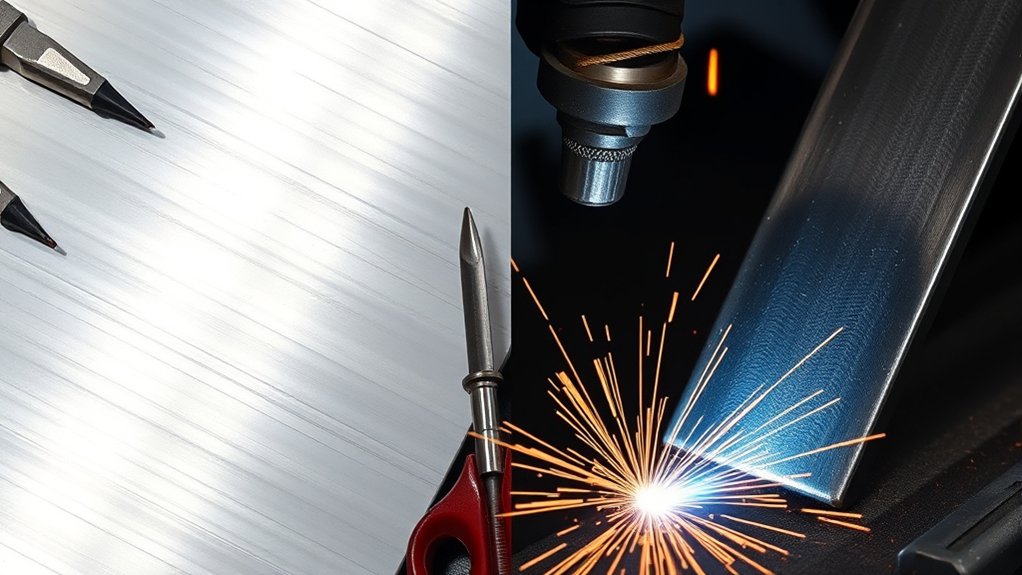
The biggest difference between aluminum and steel welding is how each metal handles heat. Pure aluminum melts at about 1,220°F, while many steels melt roughly around 2,500°F or higher, depending on the alloy. That does not mean aluminum needs careless high heat. It means aluminum needs fast, controlled heat because it conducts heat away several times faster than most steels.
Aluminum also forms a thin oxide layer almost immediately when exposed to air. That oxide layer melts far above the base aluminum, so the surface can look ready while the oxide is still blocking fusion. This is why aluminum prep matters so much. Use a clean solvent first, then a dedicated stainless-steel brush that has never touched steel.
Steel behaves differently. Mild steel and many low-alloy steels are more tolerant of heat and usually provide a wider working range. Still, steel must be cleaned of rust, paint, mill scale, oil, zinc coating, and moisture before welding. Dirty steel can still cause porosity, lack of fusion, weak beads, or toxic fumes.
Note: Steel is more forgiving than aluminum, but it is not “self-cleaning.” Both metals need clean surfaces, correct shielding, and filler metal matched to the job.
Aluminum vs. Steel Welding Comparison
| Factor | Aluminum | Steel |
| Heat behavior | Conducts heat quickly, so it needs fast, controlled heat input | Holds heat longer and gives a wider heat-control window |
| Surface prep | Must remove oil, moisture, and oxide before welding | Must remove rust, mill scale, paint, oil, coating, and moisture |
| Common process | TIG for precision, MIG with spool gun or push-pull gun for speed | MIG, TIG, stick, or flux-core depending on material and location |
| Common defects | Porosity, lack of fusion, burn-through, cracking, birdnesting | Undercut, spatter, slag inclusion, porosity, warping, lack of fusion |
| Beginner difficulty | Harder because the puddle can change fast and wire feeding is sensitive | Usually easier because the puddle is more visible and stable |
Common Welding Challenges: Aluminum vs. Steel and How to Overcome Them
Aluminum welding challenges usually come from three things: fast heat movement, oxide contamination, and hydrogen porosity. Because aluminum pulls heat away quickly, a cold start can leave poor fusion. Then, once the part is hot, it can suddenly melt too fast. That is why aluminum welders often use faster travel speed, a shorter arc, good fit-up, and test coupons before welding the actual part.
Steel problems are different. Mild steel is usually easier to weld, but it can still warp, crack, or trap defects if the joint is dirty, the heat is too high, the travel speed is wrong, or the filler does not match the base metal. Coated steel, galvanized steel, painted parts, and unknown scrap can also create toxic fumes when heated.
Warning: Do not weld painted, galvanized, oily, or solvent-contaminated metal without proper removal, ventilation, and respiratory protection. Welding fumes can contain harmful metal fumes and gases, and confined spaces can create asphyxiation hazards. Review OSHA welding fume guidance before doing hot work.
The Importance of Cleaning and Preparing Aluminum for Welding
Cleaning aluminum is not optional. Oils, shop dust, marker residue, moisture, and oxide can all weaken the weld. The best order is to remove grease first, then remove oxide. If you brush before degreasing, the brush can push oil and dirt deeper into the surface.
Start with acetone or an aluminum-safe cleaner on a clean lint-free cloth. After the solvent flashes off, use a dedicated stainless-steel brush for aluminum only. Brush in one direction with light pressure. Weld soon after cleaning because oxide starts forming again quickly.
| Cleaning Method | Best Use |
|---|---|
| Acetone or aluminum-safe cleaner | Removes oil, grease, and shop residue before brushing |
| Dedicated stainless-steel brush | Breaks the aluminum oxide layer after degreasing |
| Clean storage | Keeps aluminum dry and reduces contamination before welding |
| Test weld on scrap | Confirms settings, cleaning, and shielding before the final joint |
Proper preparation also helps when you are learning how aluminum behaves with different welding approaches. Even when the process changes, clean metal remains the foundation of a sound weld.
Comparative Melting Points and Thermal Conductivity of Aluminum and Steel
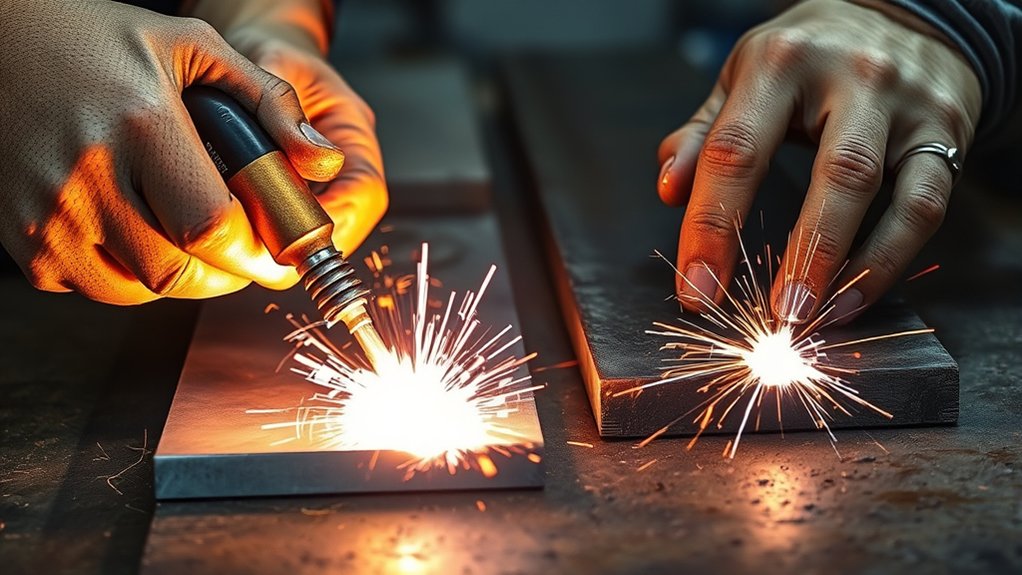
Aluminum melts much sooner than steel, but that is only half the story. Its high thermal conductivity spreads heat away from the arc quickly. This can make the weld start cold, especially on thicker aluminum, then become too hot once the whole part warms up.
Steel usually gives you a more gradual puddle response. The heat stays near the weld area longer, so the puddle is easier to watch and control. This is one reason many beginners learn steel first before moving into aluminum.
Aluminum is not harder because it is “stronger” than steel. It is harder to weld because its oxide, heat flow, and soft wire give you less room for mistakes.
Choosing the Right Filler Metal for Aluminum Welding
Choosing the right filler metal matters for strength, crack resistance, corrosion behavior, and appearance. For many 6xxx aluminum alloys, including 6061, 4043 and 5356 are common choices. The better option depends on the base alloy, joint design, service conditions, and whether the finished part will be anodized.
| Filler | Best Use | Watch Out For |
| 4043 aluminum filler | Good general choice for many 6xxx aluminum repairs; flows smoothly and helps reduce cracking risk | May not color-match after anodizing |
| 5356 aluminum filler | Often chosen when higher as-welded strength or better anodized color match is needed | Not ideal for every high-temperature service condition |
| ER70S-6 steel wire | Common MIG wire for clean to slightly mill-scaled mild steel | Not for aluminum and not for every steel alloy |
| Low-alloy or stainless filler | Used when the base steel has special strength, corrosion, or heat requirements | Must be matched to the base metal and procedure |
For fillet welds and structural work, filler choice is only one part of joint quality. Weld size and joint design also matter, so review how fillet weld size relates to plate thickness when strength is important.
Products Worth Considering
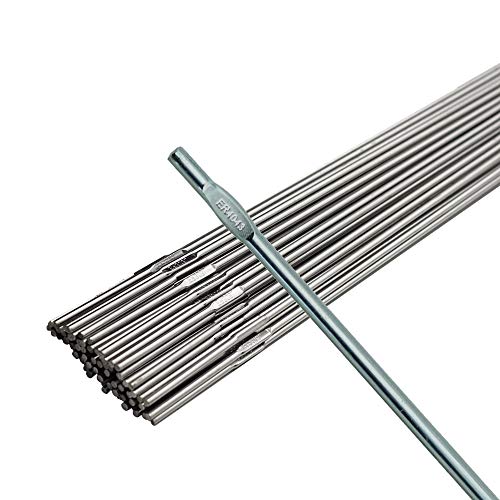
Premium quality ER4043 Aluminum TIG welding rods with available diameters 1/16", 3/32" and 1/8"; 36" length. Package of 2-Lb, 5-Lb and 10-Lb.
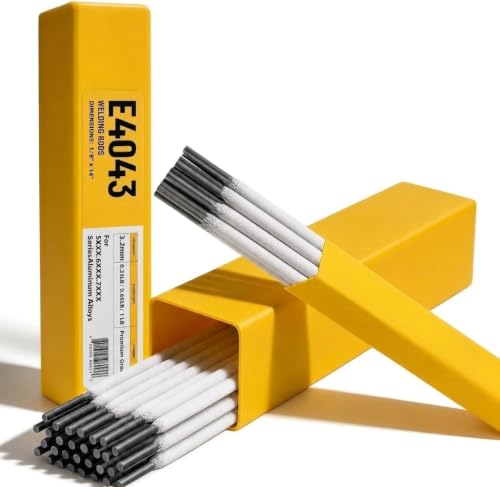
【Engineered E4043 Aluminum Welding Rods for Clean, Reliable Welds】These Aluminum Welding Rods feature a premium E4043 aluminum-silicon blend, providing stable melting and controlled puddles. They produce smooth, consistent welds and help minimize defects in both repair and fabrication projects.

ER4043 TIG WELDING ROD: This TIG welding rod has 5% added silicon, This can improve the liquidity of the melt pool.
Heat Management Techniques: Aluminum vs. Steel
Heat management is where aluminum and steel feel most different. With aluminum, avoid dwelling in one spot. Use enough amperage or wire speed to establish the puddle quickly, then move steadily. A cold aluminum weld can sit on top without tying in, while an overheated weld can sag, burn through, or leave a wide soft heat-affected zone.
For steel, heat control is still important, but the puddle usually responds slower. You can often adjust travel speed and gun angle more easily. On thin steel panels, use short welds, skip welding, clamps, copper backing, and cooling pauses to limit warping.
Pro Tip: On aluminum, run a test bead on scrap from the same material before touching the final part. The test bead tells you whether your cleaning, shielding gas, filler, travel speed, and amperage are close enough.
How to Manage Porosity in Aluminum Welding
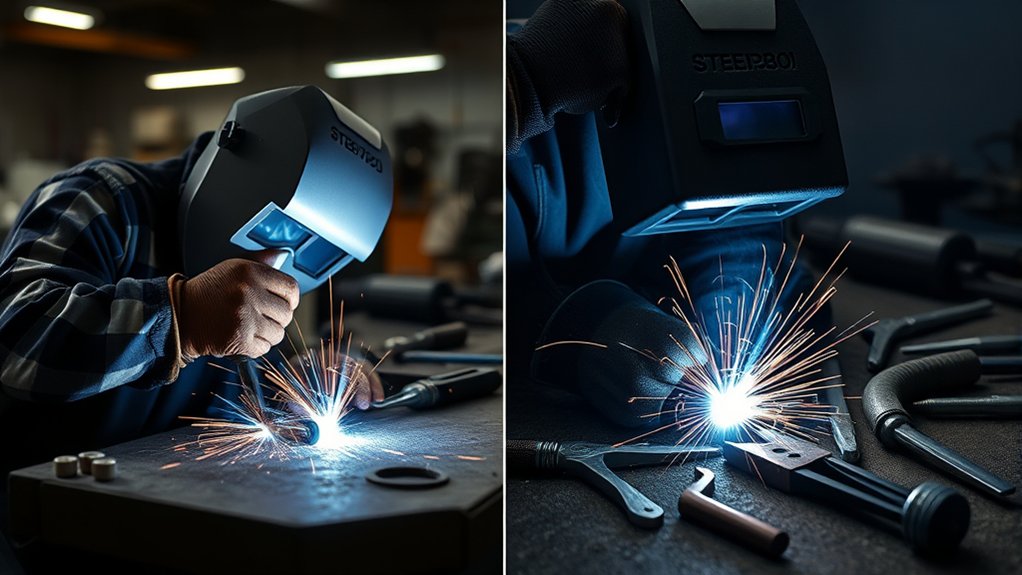
Porosity in aluminum welding often comes from hydrogen that becomes trapped as the weld solidifies. Moisture, dirty filler, contaminated base metal, poor shielding gas coverage, or an unstable arc can all contribute. You reduce porosity by controlling the whole setup, not by changing one setting at random.
- Clean the aluminum with solvent before brushing the oxide layer.
- Use dry, clean filler wire or rods stored away from moisture and dust.
- Check gas flow, cup size, wind, drafts, and torch angle.
- Keep the arc stable and avoid an excessively long arc length.
- Use enough heat for fusion, but do not overheat the joint.
- Let the puddle stay fluid long enough for gas to escape, especially on thicker sections.
For some thicker aluminum work, an argon-helium blend can improve heat input and penetration, but it is not a magic fix. Clean metal, correct gas coverage, and stable technique still matter. If you are working through common gas and machine setup issues, this guide to MIG welding aluminum without gas explains why shielding is such a major part of aluminum weld quality.
Feeding Techniques: Why Aluminum Differs From Steel
Aluminum MIG wire is softer than steel wire, so it is much easier to crush, shave, kink, or birdnest. A standard MIG setup can work for some short, careful aluminum runs, but a spool gun or push-pull gun usually gives better results because the soft wire has less distance to travel under pressure.
Use U-groove drive rolls for aluminum, not knurled rolls that can chew the wire. Keep the liner clean, reduce sharp cable bends, and set drive-roll tension only high enough to feed smoothly. Too much tension deforms aluminum wire and creates feeding problems.
Steel wire is stiffer and more forgiving. It can usually feed through a longer liner with standard drive rolls, which is one reason steel MIG welding is easier for beginners. If you are switching from steel to aluminum, do not assume the same feeder tension, liner, contact tip, or gun setup will work.
MIG vs. TIG for Aluminum and Steel
MIG is usually faster and easier to learn on steel. It is also practical for aluminum when you use the right machine, pure argon or the correct argon-helium blend, and a spool gun or push-pull setup. MIG works well for production, brackets, frames, trailers, and general fabrication when appearance is less important than speed and repeatability.
TIG gives better control, cleaner starts, and a neater bead. It is often the preferred process for thin aluminum, visible welds, stainless work, tanks, tubing, and precision repairs. TIG is slower, but it gives you more control over heat and filler addition. For aluminum TIG, AC is commonly used because it helps break up oxide while also heating the base metal.
Steel can be welded with MIG, TIG, stick, or flux-core. Aluminum is more limited for most home and small-shop welders. Flux-core aluminum claims should be treated carefully because many “gasless aluminum MIG” products are not suitable for structural work. When in doubt, follow the filler manufacturer’s instructions and test on scrap.
Products Worth Considering

【5-IN-1 155A WELDING MACHINE】– The AZZUNO 110V/220V dual-voltage MIG welder delivers powerful versatility with five welding modes: Flux Core MIG, Gas MIG, Aluminum MIG, Stick, and Lift TIG (TIG torch not included). Designed with just 2 buttons and 2 knobs, it allows for effortless operation and quick setup—perfect for beginners and professionals alike.

6 in 1 Welding Machine: The multi-function welding machine included Gas/Solid Wire MIG, Gasless Flux Core MIG, Stick/MMA, Spot welding, Lift TIG, spool gun compatible (tig gun and spool gun not included,WP-17V-35,LBT150).
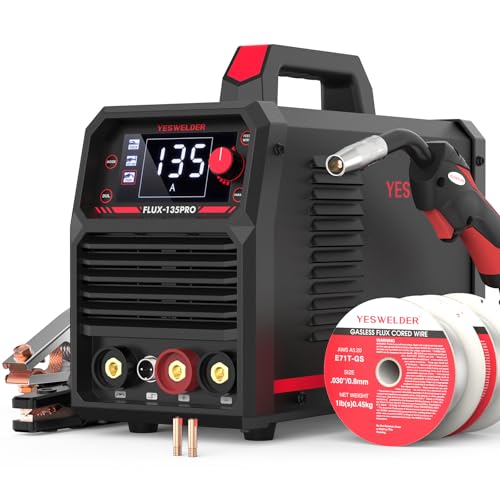
READY OUT OF THE BOX: Start welding immediately! It masterfully handles Gasless Flux Core MIG, Stick, and Lift TIG (Extra Lift TIG torch required). This budget-friendly 3-in-1 machine includes extra E71T-GS .030''&.035'' flux core wires, known for its smooth arc and high feedability. Say goodbye to heavy shielding gas cylinders—perfect for outdoor, windy, or all-position welding.
Can You Weld Aluminum to Steel?
Aluminum and steel should not normally be direct fusion welded together with a basic MIG or TIG setup. The metals have very different melting points, expansion rates, and chemistry. When they are melted together, brittle iron-aluminum intermetallic compounds can form and weaken the joint.
That does not mean aluminum and steel can never be joined. Shops may use mechanical fasteners, adhesive bonding, brazing, explosion-bonded transition inserts, friction stir welding, or other specialized processes. Research on aluminum-to-steel joining focuses on controlling the intermetallic layer so the joint can carry load without becoming brittle.
For ordinary repair work, treat aluminum-to-steel joining as a specialized job. Do not use a casual bead as a structural repair unless a qualified welding procedure, correct materials, and proper inspection are in place.
Best Practices for Successful Aluminum and Steel Welding
Good welds come from repeatable habits. Use these steps whether you are welding aluminum or steel:
- Identify the base metal before selecting filler or settings.
- Remove coatings, oil, rust, oxide, paint, and moisture from the weld area.
- Clamp the joint tightly so gaps do not force you to add excess heat.
- Use the correct shielding gas and protect the arc from drafts.
- Run a test bead on matching scrap before welding the final part.
- Watch for puddle shape, sound, bead wet-out, undercut, and discoloration.
- Let the weld cool naturally unless the procedure calls for another method.
- Inspect for cracks, porosity, lack of fusion, and distortion after welding.
For aluminum, stringer beads often give better control than wide weaving. For steel, the right pattern depends on position, thickness, filler, and joint type. If you are experimenting with specialized wire, review the limitations of aluminum flux-core welding before using it on anything load-bearing.
Safety When Welding Aluminum or Steel
Welding exposes you to arc radiation, heat, sparks, molten metal, electric shock risk, compressed gases, fire hazards, and fumes. OSHA notes that welding fumes can contain metals such as aluminum, chromium, manganese, nickel, iron, zinc, and lead, along with gases such as carbon monoxide, ozone, nitrogen oxides, argon, helium, and carbon dioxide. Use local exhaust ventilation when possible and avoid breathing the plume.
Wear a properly rated welding helmet, safety glasses, flame-resistant clothing, gloves, and hearing protection when needed. Keep combustibles away from the work area and have a suitable fire extinguisher nearby. Never weld in a confined space without proper training, atmospheric testing, ventilation, rescue planning, and required permits.
Warning: Shielding gases such as argon and helium can displace oxygen in enclosed spaces. They do not smell like a warning gas. Treat enclosed or low-ventilation welding as a serious safety risk.
Resources and Tips for Enhancing Your Welding Skills
The best way to improve is to practice one variable at a time. Change only travel speed, voltage, wire speed, amperage, or torch angle, then compare the bead. Cut and etch practice welds when possible so you can see penetration and fusion instead of judging by surface appearance only.
For aluminum, practice cleaning, tack spacing, starts, stops, and crater filling. Crater cracks are common when the end of the weld cools too fast, so fill the crater before breaking the arc. For steel, practice heat control, bead placement, and fit-up. Thin steel panels especially need patience because too much heat can warp the panel before the bead looks wrong.
Keep filler charts, machine settings, and practice notes in your shop. If a setup works on a certain thickness and alloy, write it down. Testing on scrap metal, reviewing a stick welding amperage chart, and comparing finished welds will help you build judgment faster than guessing from memory.
Frequently Asked Questions
How does aluminum welding differ from steel?
Aluminum welding needs cleaner prep, faster heat control, and more careful shielding because aluminum conducts heat quickly and forms a high-melting oxide layer. Steel is usually easier to weld because it feeds better, tolerates heat better, and gives a more stable puddle for beginners.
Is it easier to weld steel or aluminum?
Steel is usually easier, especially mild steel. It has a wider heat-control window, feeds more smoothly in MIG welding, and is more forgiving during practice. Aluminum is not impossible, but it demands cleaner metal, better setup, and faster response to puddle changes.
What filler metal should I use for 6061 aluminum?
4043 and 5356 are common choices for 6061 aluminum. Use 4043 when you want smooth flow and lower crack sensitivity in many general jobs. Use 5356 when higher as-welded strength or better anodized color match is needed. Always check the filler manufacturer’s guidance for the exact service condition.
What two metals cannot be welded together?
Aluminum and steel are a common example of metals that should not be directly fusion welded with a normal shop MIG or TIG setup. They can form brittle intermetallic compounds. They can be joined with specialized methods, transition inserts, brazing, adhesives, or mechanical fasteners when the joint is designed correctly.
Why do welders not live long?
It is not accurate to say welders “do not live long” as a rule. The real issue is unmanaged exposure. Welding can involve fumes, gases, UV radiation, heat, and fire risk. Good ventilation, PPE, training, respiratory protection when needed, and safe work procedures greatly reduce those risks.
Do I need pure argon for aluminum welding?
Pure argon is commonly used for many aluminum MIG and TIG jobs, especially on thinner material. Argon-helium blends may help on thicker aluminum because helium increases heat input and penetration. Avoid shielding gases meant for steel, such as argon-CO2 blends, unless the filler or procedure specifically allows them.
Conclusion
Welding aluminum and steel requires different habits. Steel is usually easier to learn because it feeds smoothly, handles heat better, and gives you more time to control the puddle. Aluminum needs cleaner prep, faster heat control, better shielding, and the right feeder setup. Once you understand the oxide layer, filler choice, heat behavior, and porosity risks, you can choose the right process and produce cleaner, stronger welds on both metals.
Sources
- OSHA – Controlling Hazardous Fume and Gases during Welding – welding fume hazards, ventilation, respiratory protection, and confined-space cautions
- PubChem – Aluminum Oxide – aluminum oxide identity and material property reference
- Optimization of a Welding Procedure for Making Critical Aluminum Welds on the LBNF Absorber Core Block – recent aluminum weld procedure research and preheat/process considerations
- A New Physical Simulation Tool to Predict the Interface of Dissimilar Aluminum to Steel Welds – aluminum-to-steel intermetallic layer and dissimilar joining context