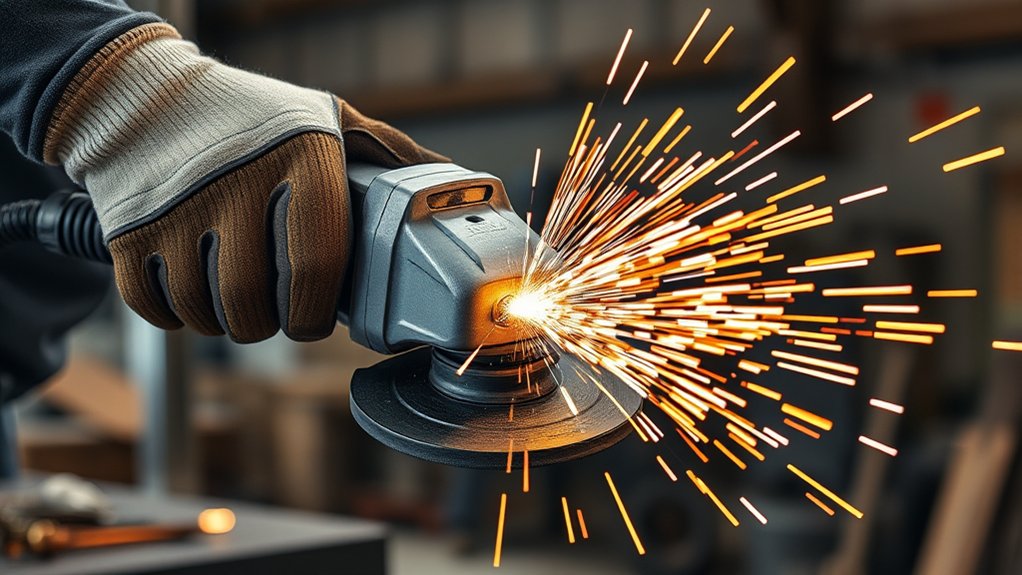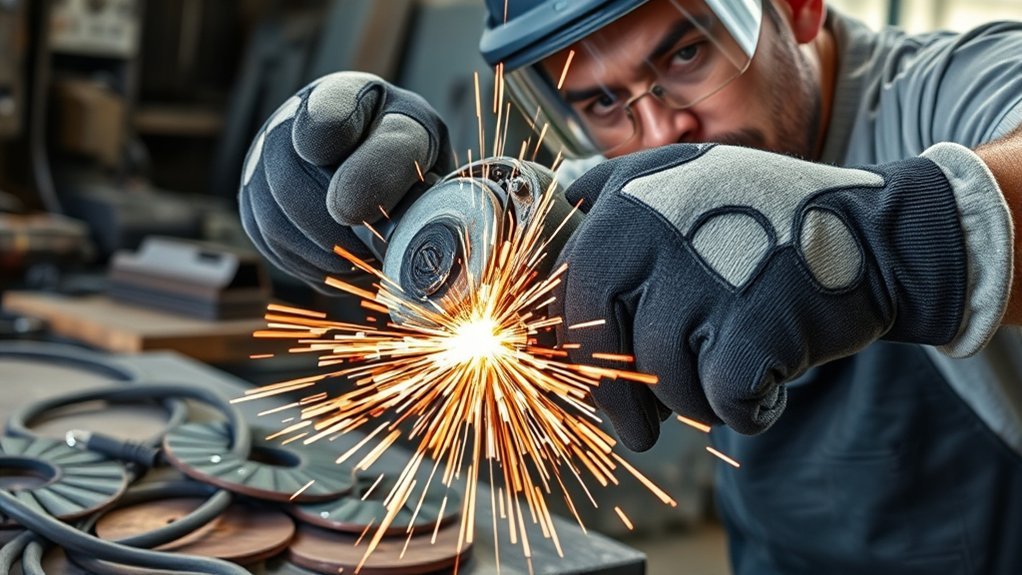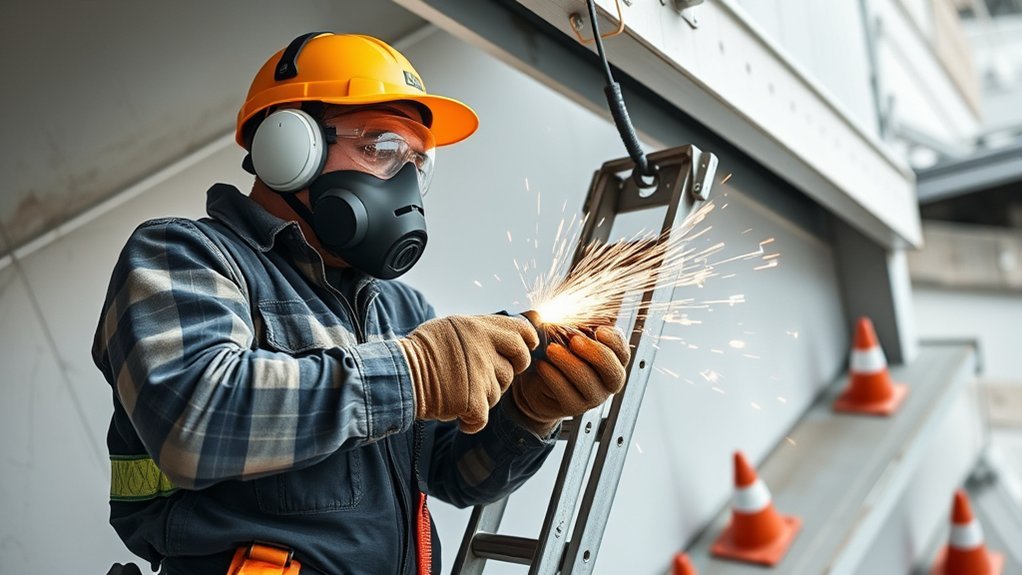
Aim angle grinder sparks away safely by planning where they will land before the wheel touches metal. The safest path is not automatically straight down; it is a clear, noncombustible area away from your body, other people, cords, hoses, vehicles, glass, painted surfaces, and anything that can ignite. The correct tool angle also depends on whether you are grinding, cutting, sanding, or wire-brushing.
Quick Answer
Keep the guard between you and the wheel, use the side handle and both hands, and orient the work so sparks travel toward a clear, noncombustible landing area. For ordinary right-angle surface grinding, follow the wheel manual; OSHA guidance uses 5–15 degrees. Keep cut-off wheels close to 90 degrees and never twist them in the cut.
Key Takeaways
- Direct sparks away from your body, bystanders, combustibles, cords, hoses, glass, paint, and hidden spaces.
- Use a shallow 5–15° position for ordinary right-angle surface grinding unless the wheel manufacturer specifies otherwise.
- Keep a cut-off wheel nearly square to the work and never twist, bend, or grind with its side.
- Keep the correct guard installed between you and the wheel, and use the side handle with both hands.
- Treat spark-producing grinding as hot work where workplace rules require it; remove or shield combustibles and inspect for fire afterward.
- Wear impact-rated eye protection beneath a face shield, plus suitable hearing, hand, clothing, footwear, and respiratory protection.
At a Glance
| Time Required | About 5–10 minutes for inspection and setup; grinding time depends on the job |
| Difficulty | Intermediate; requires two-handed tool control and fire-risk planning |
| Tools Needed | Angle grinder, compatible wheel, correct guard, side handle, clamps, PPE, fire-resistant barrier, and suitable fire extinguisher |
| Cost | No added cost if you already have approved equipment; PPE, guards, clamps, and barriers vary by job |
What’s in This Article
- Understanding Proper Spark Direction
- Plan the Spark Path Before You Start
- Choose the Correct Grinder Angle
- How to Aim Sparks Away Step by Step
- Maintain Safe Distances From Combustibles
- Position Your Body for Better Control
- Create a Clear Workspace
- Use Protective Barriers and Screens
- Wear the Correct PPE
- Angle-Grinding Safety Checklist
- Common Spark-Control Mistakes
- Troubleshoot Spark and Tool Problems
- Inspect the Area After Grinding
- Frequently Asked Questions
- Conclusion
- Sources
Understanding the Importance of Proper Spark Direction
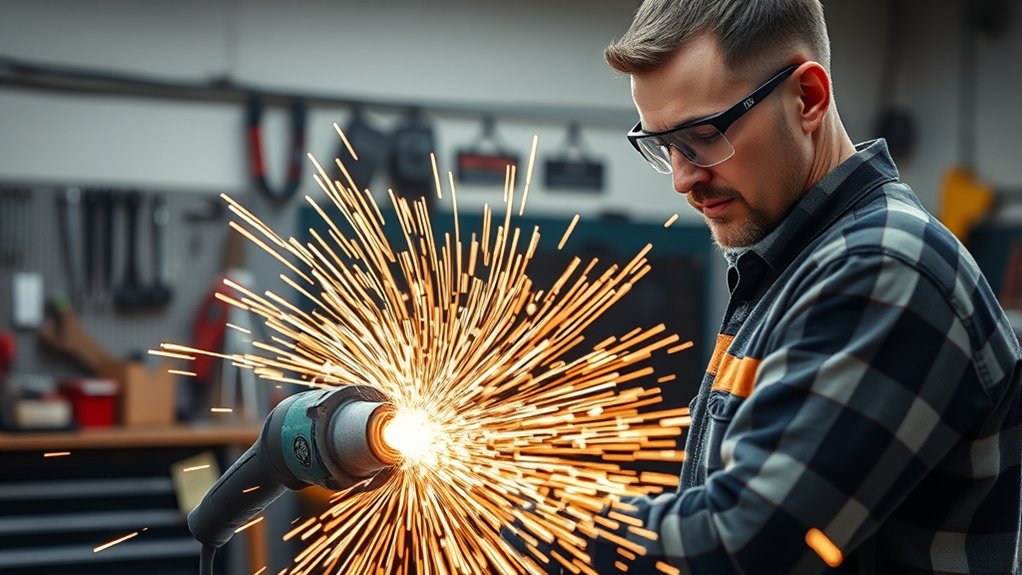
Angle grinder sparks are hot metal particles that leave the wheel near the contact point. They travel in the direction the wheel surface is moving, often in a wide stream rather than a single straight line. The particles can bounce across floors, pass through openings, lodge behind equipment, or strike objects outside your first line of sight.
The safe goal is to make that stream enter a clear landing area that cannot burn. Keep the path away from your face, hands, legs, clothing, other people, electrical cords, air hoses, fuel lines, glass, paint, batteries, tires, and stored chemicals. Aim downward only when the floor and every area below or behind the work are safe.
The guard helps deflect wheel fragments and some debris, but it cannot catch every spark. OSHA’s portable-tool rule requires the guard on a right-angle grinder to be positioned between the operator and the wheel. Bosch also instructs operators to direct sparks away from themselves and clear the area of flammable material.
Warning: Do not grind where flammable gases, fuel vapors, solvent vapors, or an explosive dust cloud may be present. Never grind, cut, or heat a drum, tank, pipe, or container that held a flammable substance unless it has been professionally cleaned, tested, and authorized for hot work.
Before You Start, Plan the Spark Path
Inspect the tool, wheel, workpiece, and surrounding area before connecting the grinder to power. A safe spark path cannot make an incorrect wheel, missing guard, loose workpiece, or combustible atmosphere safe.
- Read the instructions: Follow the grinder manual and the markings or instructions supplied with the wheel or accessory.
- Match the accessory: Confirm the wheel type, diameter, thickness, arbor, and maximum RPM are approved for the grinder. The wheel’s rated speed must equal or exceed the grinder’s no-load speed.
- Inspect the wheel: Do not use a cracked, chipped, wet, badly worn, contaminated, expired, or dropped bonded wheel.
- Install the correct guard: Use the guard specified for the grinding wheel, cut-off wheel, flap disc, wire wheel, or other approved accessory.
- Attach the side handle: Position it so you can maintain two-handed control throughout the job.
- Secure the work: Clamp the workpiece or support it so it cannot shift, sag, pinch the wheel, or fall.
- Check the landing area: Look below, behind, beside, and on the opposite side of the work for combustibles and heat-sensitive surfaces.
- Prepare PPE and fire controls: Put on your protection and place suitable extinguishing equipment where it can be reached without crossing the spark path.
Note: An accessory that physically fits the spindle is not automatically safe to use. OSHA and grinder manufacturers warn against unapproved accessories, incorrect wheel sizes, and wheels with a lower speed rating than the tool.
Choosing the Right Angle for Your Angle Grinder
Choose the working angle according to the accessory and task, not according to the spark pattern you want. Tilting a wheel too far, side-loading a cut-off disc, or using the edge of a grinding wheel can damage the accessory and increase the chance of kickback or breakage.
Optimal Angle Selection
For ordinary surface grinding with a right-angle grinder, OSHA guidance recommends holding the grinding face about 5–15 degrees from the work surface. Use light, controlled pressure and keep the wheel moving. The grinder or wheel manufacturer may specify a narrower range for a particular accessory.
| Accessory or Task | Normal Working Position | Avoid |
|---|---|---|
| Depressed-center grinding wheel | About 5–15° from the surface, using the intended grinding face | Excessive tilt, edge loading, heavy pressure, or holding the wheel in one spot |
| Cut-off wheel | Nearly 90° to the work and straight in the cut, as specified by the wheel instructions | Twisting, bending, side grinding, or forcing the wheel through a pinched cut |
| Flap or sanding disc | The shallow working angle printed in the accessory instructions | Assuming every flap disc uses the same angle or pressure |
| Wire wheel or brush | The manufacturer-approved position with light pressure and the required guard | Overspeeding, removing the guard, or standing where loose wires can strike you |
The operating angle changes how the wheel contacts the material, but it does not create a reliable degree-by-degree spark direction. To change where sparks land, reposition the workpiece, guard, barrier, and your stance while keeping the accessory at its approved working angle.
Safety Positioning Techniques
Keep the work in front of you while standing slightly offset from the wheel’s plane of rotation. This keeps your face and torso away from the most likely path of wheel fragments if the accessory breaks. Do not lean over the grinder or place your head behind the wheel.
Hold the rear grip and side handle firmly with both hands. Keep your wrists steady, elbows slightly bent, and feet far enough apart to resist a sudden pull. Arrange the work so the spark stream does not cross your legs, shoes, hands, or escape route.
There is no universal 10-foot bystander distance. Keep every other person outside the actual spark, fragment, and kickback zone. Increase separation or install fire-resistant screens when sparks travel farther than expected.
How to Aim Angle Grinder Sparks Away Safely
- Disconnect the power. Unplug a corded grinder or remove the battery before installing or adjusting the wheel, guard, handle, or flange.
- Inspect and match the equipment. Confirm that the accessory is undamaged, approved for the task, correctly mounted, and rated for at least the grinder’s maximum no-load speed.
- Clear the projected spark area. Remove combustible materials, protect anything that cannot be moved, and check openings, shelves, floors, wall cavities, vehicles, cords, hoses, and the opposite side of the work.
- Position the guard and workpiece. Keep the guard between you and the wheel. Clamp or support the work so the expected spark stream enters the chosen noncombustible area.
- Take a stable offset stance. Keep both hands on the grinder, your body out of the wheel plane, and your face away from the expected spark stream.
- Start away from the work. Switch on the grinder without touching the material, stand clear of the wheel plane, and let it reach full operating speed.
- Make light initial contact. Touch the work with light pressure and observe the spark path. If sparks enter an unsafe area, release the switch, wait for the wheel to stop, disconnect power, and reposition the work, guard, barrier, or your stance.
- Finish and inspect. Keep the approved working angle, avoid forcing the wheel, let it stop completely before setting the grinder down, and inspect the full spark path for hot particles or smoldering material.
Warning: Never remove the guard, twist a cut-off wheel, reverse an accessory, or use excessive pressure merely to make sparks travel in a preferred direction. Stop and change the setup instead.
Maintaining Safe Distances From Flammable Materials
Before grinding, identify everything nearby that can burn, melt, explode, or be damaged by hot particles. Paper, cardboard, wood dust, oily rags, fuel, paint, solvents, aerosol cans, batteries, plastics, insulation, dry vegetation, and chemical containers should not remain in the spark path.
For workplace hot work, OSHA uses 35 feet (10.7 m) as an important combustible-clearance benchmark. OSHA’s shipyard fire-watch guidance also identifies grinding as spark-producing hot work. Your employer, site permit, fire code, or insurer may require additional controls.
A 35-foot clearance is not permission to ignore the spark path: easily ignited material, openings, ducts, and hidden combustibles may still require shielding or a trained fire watch.
Identify Flammable Materials Nearby
Inspect under benches, behind machines, above the work, inside wall or floor openings, and on the opposite side of sheet metal or partitions. Heat can pass through metal, while sparks can enter cracks or travel through ventilation and conveyor systems.
Remove combustible dust before work, but use a cleanup method approved for the material. Allow metal particles to cool before collection. Do not use an ordinary household or shop vacuum for hot debris or potentially combustible aluminum, magnesium, titanium, or fine iron dust unless the collection system is specifically designed and approved for that hazard.
Establish Safe Work Zones
Create an exclusion zone that covers the entire spark and debris path rather than relying on a fixed distance alone. Mark or barricade the area in a shared shop, control access, and stop work whenever another person enters the danger zone.
Keep suitable fire-extinguishing equipment ready for immediate use and know how to sound the alarm. The extinguisher must match the materials present. Do not assume that water or a common extinguisher is suitable for burning combustible metal, energized electrical equipment, or every chemical hazard.
Use Fire-Resistant Barriers
When combustibles cannot be moved, protect them with metal shields, rated welding curtains, or fire-resistant blankets intended for hot work. Cover gaps through which sparks can pass and protect both sides of walls, partitions, floors, and ceilings when heat or sparks may reach the opposite side.
Inspect each barrier before use. Replace torn, contaminated, thin, or heat-damaged material. Position barriers so sparks cannot roll underneath, pass around an edge, or become trapped against combustible material.
How to Position Your Body for Better Control
Stand slightly to one side of the work instead of directly behind the wheel or spark stream. Keep your feet shoulder-width apart, maintain good footing, and make sure you have a clear escape path if the grinder binds or kicks back.
Use both hands at all times. Keep the side handle installed, your wrists firm, and your elbows slightly bent. Avoid overreaching, kneeling in the spark path, or holding the grinder where a sudden kickback could drive it toward your face or torso.
Keep the power cord or air hose behind the tool and away from the wheel. Arrange battery packs, extension cords, lighting, and extraction hoses so you cannot cut, burn, trip over, or become entangled in them.
Create a Clear Workspace to Reduce Hazards
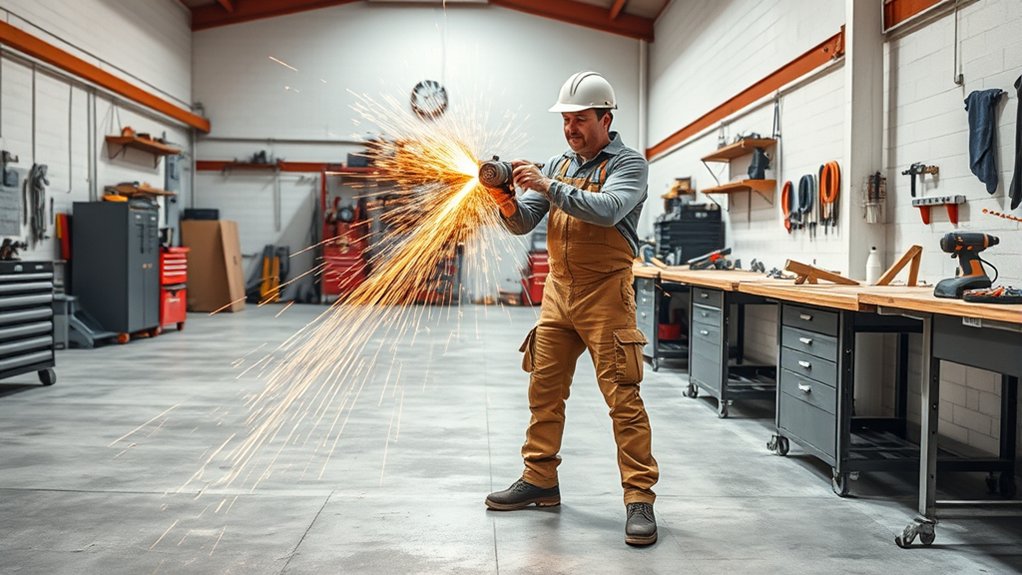
A clutter-free workspace gives sparks fewer places to hide and gives you room to maintain control. Remove scrap, unused tools, loose cables, packaging, rags, and tripping hazards from the bench and floor before starting.
Use a solid, stable, noncombustible work surface whenever possible. Bare concrete may be a suitable landing area if it is clean, dry, free of cracks containing debris, and clear of fuel, chemicals, cords, or coatings that could be damaged.
Provide ventilation or local dust extraction appropriate for the material. OSHA addresses ventilation and dust collection for grinding operations. Identify paint, plating, galvanizing, lead, cadmium, chromium, and other coatings before grinding because the dust—and fumes if the material becomes hot—may require specialized controls.
Note: A disposable nuisance-dust mask is not suitable for every metal or coating. Use ventilation first and select a NIOSH-approved respirator for the specific contaminant when a hazard assessment shows one is needed. Workplace respirator use must follow the employer’s respiratory-protection program.
How to Use Protective Barriers and Screens to Enhance Safety
Protective barriers help contain sparks and fragments when distance alone is not enough. Place metal shields, rated welding curtains, or fire-resistant screens between the spark stream and nearby people, shelves, machines, vehicles, windows, painted panels, and combustible surfaces.
Angle the barrier so sparks fall into a clear area instead of bouncing back toward you. Do not use cardboard, ordinary cloth, thin plastic sheeting, tarps, or other materials that may ignite, melt, or spread burning particles.
In a shared work area, place warning signs or barriers far enough away that another person cannot step around them and enter the wheel plane or spark path. Barriers supplement correct grinder handling; they do not replace the guard, PPE, clearance, or safe body position.
Pro Tip: Before switching on the grinder, stand in your planned working position and trace the full spark path with your eyes—from the wheel contact point to the landing area, including possible rebounds and openings.
Products Worth Considering
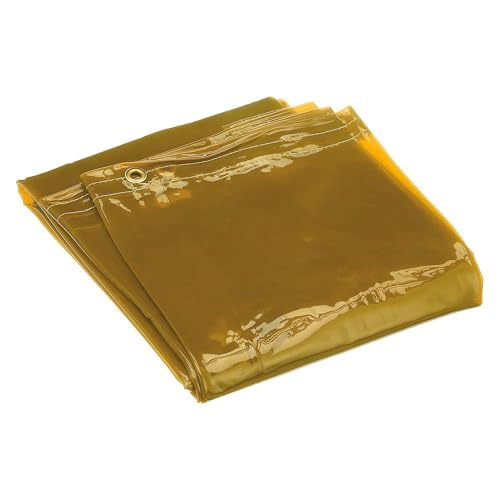
WELDING CURTAIN - Jackson Safety's Transparent Gold Welding Curtain allows better 2-way viewing between welding and bystander and is ideal when supervision is required

Composed of a top grade vinyl film processed with a color dye, flame retardant chemical and ultraviolet absorber

WELDING CURTAIN - Jackson Safety's Transparent Gold Welding Curtain allows better 2-way viewing between welding and bystander and is ideal when supervision is required
Essential Personal Protective Equipment (PPE) for Angle Grinding
Put on all required PPE before connecting the grinder to power. Inspect each item for cracks, burns, contamination, worn straps, poor fit, or other damage.
- Impact-rated safety glasses or goggles: Wear eye protection with side protection to guard against flying particles.
- Face shield: Wear a suitable face shield over your safety glasses or goggles for added protection from sparks, fragments, and wire-wheel debris. A face shield does not replace primary eye protection.
- Hearing protection: Use earplugs or earmuffs selected for the noise exposure and workplace requirements.
- Suitable gloves: Wear close-fitting work gloves that protect against sharp edges and hot particles without reducing your grip or becoming loose near the wheel.
- Flame-resistant or tightly woven clothing: Cover your arms and legs. Avoid loose sleeves, open cuffs, jewelry, and synthetic clothing that can melt against skin.
- Protective footwear: Wear sturdy, closed footwear that resists hot particles and dropped workpieces. Keep trouser cuffs over the footwear so sparks do not collect inside.
- Respiratory protection: Use ventilation and, when required, a properly selected NIOSH-approved respirator for the metal, coating, and dust involved.
OSHA requires suitable eye or face protection for flying-particle hazards. Workplace PPE selection should be based on a documented hazard assessment rather than a one-size-fits-all list.
Products Worth Considering

COMPLETE PROTECTION — Pairing anti-fog and scratch-resistant goggles with a tough polycarbonate torch face shield, this unbeatable duo has you covered from splashes, dust, and debris. And they are built to resist high-speed impacts, even in extreme temperatures.

SUPERIOR PROTECTION — Experience all-around face protection thanks to the curved design of this faceshield. The visor of this face guard is ANSI Z87+ certified, and up to 2x thicker for increased durability. Plus, you can comfortably wear your grinding face shield over prescription glasses.

HIGH IMPACT FACE SHIELD - Sellstrom's Advantage Face Shield is ideal for various types of machinery, welding, cutting, grinding, woodworking, and other types of work that present potential hazards to the face
What Are the Best Safety Tips for Angle Grinding?
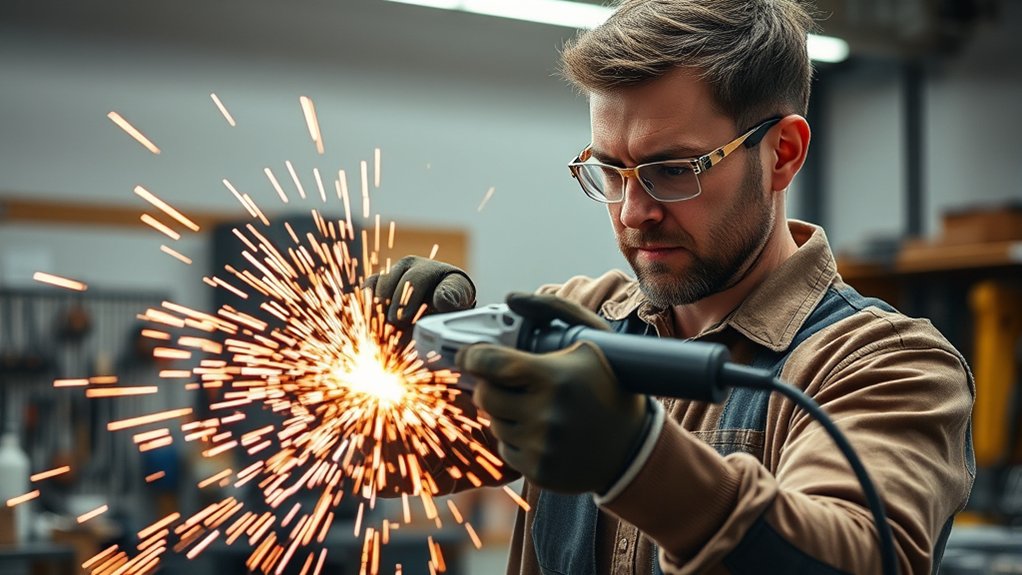
- Use only accessories specifically approved for the grinder and task.
- Make sure the wheel’s maximum RPM is not lower than the grinder’s no-load speed.
- Keep the correct guard and side handle installed.
- Inspect the wheel, flanges, spindle, switch, cord, battery, and handle before use.
- Clamp or securely support the workpiece.
- Stand outside the wheel’s plane while the grinder reaches full speed.
- Use light, steady pressure and let the wheel do the work.
- Never twist or side-load a cut-off wheel.
- Do not use a circular-saw blade or another unapproved accessory on an angle grinder.
- Keep sparks away from yourself, bystanders, combustibles, cords, hoses, glass, and finished surfaces.
- Stop immediately if the wheel binds, vibrates, wobbles, cracks, slows sharply, or changes sound.
- Wait for the wheel to stop completely before setting the grinder down.
Common Mistakes That Send Sparks the Wrong Way
Many spark-control problems begin with a rushed or incorrect setup. Avoid these common mistakes:
- Standing directly in line with the wheel: This puts your body in the likely fragment and kickback path.
- Using excessive pressure: Heavy pressure can slow the wheel, widen the spark pattern, overheat the accessory, and reduce control.
- Tipping a grinding wheel too far: Excessive tilt loads the edge instead of the intended grinding face.
- Twisting a cut-off wheel: Side pressure can bind or break a thin cutting disc.
- Removing or rotating the guard out of position: The guard must remain between you and the wheel as much as the task allows.
- Holding the work by hand: An unsecured part can move, pinch the wheel, or redirect sparks without warning.
- Ignoring hidden areas: Sparks may enter cracks, wall spaces, shelves, ducts, floor openings, or the opposite side of a metal panel.
- Grinding toward glass or finished paint: Hot particles can pit glass and embed themselves in painted or coated surfaces.
- Setting the grinder down while the wheel turns: The spinning accessory can grab the surface and pull the tool out of control.
Note: A guard cannot stop every spark or fragment. Its purpose is to reduce exposure and help deflect debris if the wheel breaks; it does not make unsafe positioning acceptable.
What to Do if the Spark Path or Tool Behavior Changes
Release the switch and wait for the wheel to stop whenever the grinder behaves differently than expected. Disconnect the power before touching the wheel, guard, flange, or workpiece.
| What You Notice | What to Do |
|---|---|
| Sparks suddenly fan wider or reach a new area | Stop and check pressure, wheel condition, contact angle, guard position, and workpiece movement. |
| The tool pulls, climbs, or kicks | Release the switch without fighting the tool. Check for binding, a pinched cut, poor support, or contact near an edge. |
| The wheel vibrates or wobbles | Remove it from service and inspect the wheel, flanges, spindle, mounting, and grinder for damage. |
| The wheel slows sharply | Reduce pressure and verify that the wheel is correct for the material and task. |
| The guard blocks access | Do not remove it. Reposition the work, use the correct approved guard, or select a more suitable tool. |
| You hear cracking, clicking, or an unusual sound | Stop immediately, disconnect power, and replace or service damaged equipment before continuing. |
Inspect the Area After Grinding
After the final pass, switch off the grinder and hold it securely until the wheel stops. Do not touch the wheel, workpiece, chips, or nearby metal until you know they have cooled.
- Inspect the entire spark path, including under benches and behind equipment.
- Check openings, cracks, shelves, insulation, wall cavities, ducts, and the opposite side of the work.
- Look and smell for smoke, scorching, melting, or smoldering material.
- Keep hot offcuts and grinding debris in a safe, noncombustible location.
- Do not place hot metal in ordinary trash, near oily rags, or against combustible surfaces.
- Follow the site’s hot-work permit and fire-watch procedure.
When OSHA workplace fire-watch requirements apply, the fire watch must continue for at least 30 minutes after covered hot work and longer when hazards remain. Even outside a regulated workplace, reinspect the area after it has had time to reveal hidden smoldering.
Warning: If a fire grows beyond the incipient stage, smoke blocks your exit, or you are unsure that your extinguisher is suitable, leave the area, alert others, and contact emergency services. Do not put yourself between the fire and your escape route.
Frequently Asked Questions
How can I reduce sparks when cutting with an angle grinder?
You cannot eliminate sparks when abrasive-cutting many metals, but you can control them. Use the correct undamaged cut-off wheel, keep it nearly square to the work, use light pressure, prevent the cut from pinching, and direct the discharge toward a clear, noncombustible area. Never twist or side-load the wheel.
What is the safest way to position the grinder while working?
Keep the work in front of you, stand slightly offset from the wheel plane, and hold the grinder with both hands using the side handle. Position the guard between you and the wheel. Arrange the work so sparks travel away from your body and enter a clear, fire-safe landing area.
How do you ensure safety while operating an angle grinder?
Inspect the grinder and wheel, verify the RPM and accessory compatibility, install the correct guard and side handle, clamp the workpiece, clear combustibles, wear proper PPE, and start the grinder away from the work. Stop if the wheel binds, vibrates, slows, cracks, or redirects sparks into an unsafe area.
Where should you position the angle grinder guard?
Position the correct guard between your body and the wheel so it helps deflect fragments and debris away from you. Adjust it only as permitted by the grinder manual. Never remove the guard or rotate it behind the wheel merely to improve access or change the spark direction.
Can angle grinder sparks start a fire?
Yes. Sparks and hot metal particles can ignite paper, wood dust, oily rags, dry vegetation, solvents, fuel vapors, insulation, and other combustibles. Remove or shield these materials, keep suitable extinguishing equipment ready, and inspect hidden areas after grinding.
Should angle grinder sparks always point downward?
No. Downward is safe only when the floor and every area below and behind the work are clear and noncombustible. The correct goal is a controlled landing area away from people and hazards. Sparks can bounce, pass through gaps, or damage surfaces even when they initially travel downward.
Can I reverse the grinder rotation to change the spark direction?
Do not modify or attempt to reverse the grinder’s designed rotation. Use the tool only as its manufacturer intended. Change the workpiece orientation, guard position within its approved range, your stance, or the fire-resistant barrier so the existing discharge direction enters a safe area.
Safety Disclaimer: This article is for general informational purposes and does not replace professional training, an employer hazard assessment, a hot-work permit, or the instructions supplied with your grinder and accessory. Follow applicable OSHA rules, local fire codes, workplace procedures, and manufacturer requirements.
Conclusion
Good spark control begins before the wheel touches the workpiece. Match the wheel and guard to the task, inspect the equipment, clear or shield combustibles, clamp the work, and choose a stable body position outside the wheel plane. Use the approved operating angle rather than tilting the wheel simply to redirect sparks.
Make light initial contact and confirm that the spark stream reaches the planned noncombustible landing area. Stop immediately if the path changes, the wheel binds, or the tool begins to vibrate. After grinding, let the wheel stop completely and inspect every exposed and hidden area for hot particles or signs of fire.
Sources
- OSHA — Safe Use of Portable and Hand-Held Power Tools — grinder angle, wheel inspection, guards, RPM compatibility, startup, and PPE
- OSHA 29 CFR 1910.243 — Guarding of Portable Powered Tools — portable abrasive-wheel guards, positioning, inspection, and speed requirements
- OSHA 29 CFR 1910.252 — General Hot-Work Requirements — 35-foot combustible clearance, shielding, extinguishers, fire watches, and post-work monitoring
- OSHA — Fire Watch Duties During Hot Work — grinding as spark-producing hot work, hidden-area hazards, and fire-watch duties
- OSHA 29 CFR 1926.102 — Eye and Face Protection — protection from flying particles and side-impact hazards
- Bosch Professional — Proper Use of Angle Grinders — accessory selection, clamping, combustible clearance, ventilation, two-handed use, and safe handling