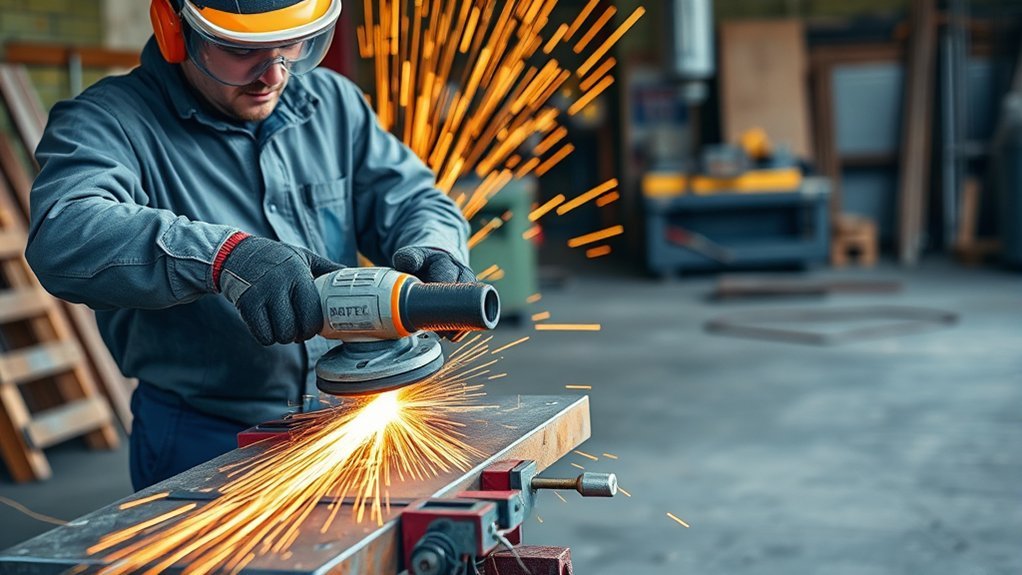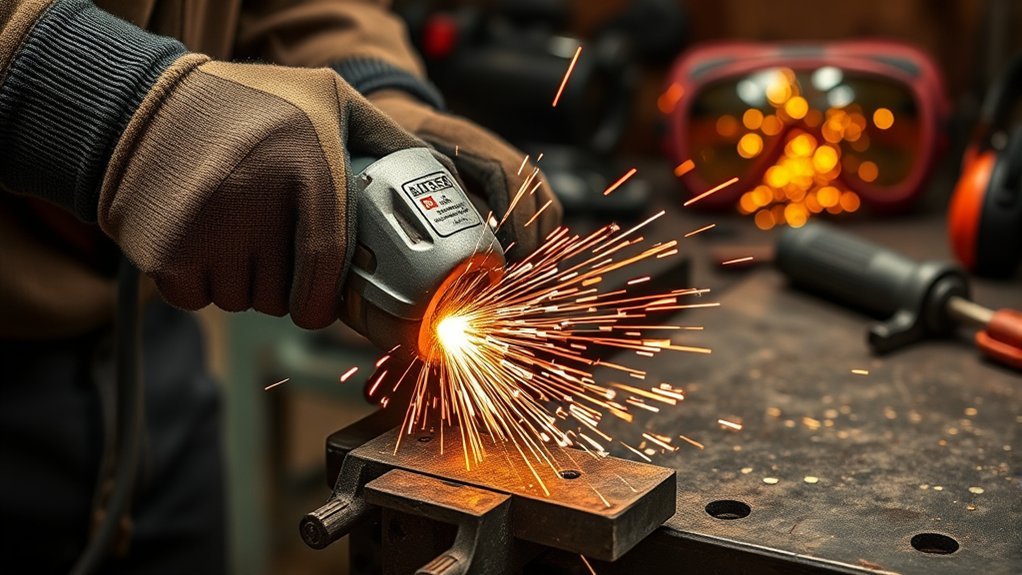
Beveling metal with an angle grinder is a practical way to prepare a plate edge for welding or create a clean chamfer. The key is not simply removing metal at an approximate angle. You must establish the required bevel geometry, choose an abrasive that matches the grinder and material, preserve any specified root face, and check the edge often as you work.
Quick Answer
To bevel metal with an angle grinder, first use the bevel angle and root-face dimensions shown on the drawing or welding procedure. Mark the waste area, clamp the work securely, fit a compatible guarded abrasive, and grind with two hands in overlapping passes. Check the angle often and finish without rounding the edge.
Key Takeaways
- Do not assume every weld needs a 22.5-degree bevel. Follow the drawing, welding procedure specification, or project requirements.
- Two opposing 22.5-degree bevels form a 45-degree included groove. A 22.5-degree bevel is 67.5 degrees from the flat plate surface—not 68.5 degrees.
- The disc’s working angle is not the same as the finished bevel angle. Follow the grinder and abrasive manufacturers’ instructions.
- Use the correct guard, side handle, disc size, arbor, and speed rating, and hold the grinder with both hands.
- Stop frequently to check the bevel angle, straightness, and root face. Do not rely on removing every trace of marker ink.
At a Glance
| Time Required | About 15–45 minutes for a short plate edge; thick or long edges take longer |
| Difficulty | Moderate; practice on scrap before preparing a critical weld joint |
| Tools Needed | Angle grinder with guard and side handle, compatible abrasive, bevel gauge or angle finder, marker, straightedge, clamps, and PPE |
| Cost | Low consumable cost if you already own the grinder, measuring tools, clamps, and PPE |
Plan the Bevel Before You Grind
Start by deciding why the edge needs a bevel. A cosmetic chamfer removes a sharp corner and may not require exact weld-joint dimensions. A welding bevel creates room for the weld metal and must match the joint design closely enough to achieve the required fit-up and penetration.
For welding work, use the angle, root face, and root opening shown on the drawing or welding procedure specification. Do not substitute a common angle simply because it is easy to mark. The American Welding Society standards catalog covers the standards used for many welding applications, while the project documents determine which requirements apply to the actual joint.
Understand the Four Main Measurements
- Bevel angle: The angle between the prepared edge and the original square edge of the plate.
- Included groove angle: The total angle between the two prepared faces after the parts are brought together.
- Root face or land: The small unground section left at the bottom of the bevel when the joint design requires one.
- Root opening: The gap between the parts during fit-up.
For example, beveling both mating plates 22.5 degrees from square creates a 45-degree included V-groove. If you measure the same 22.5-degree bevel from the flat plate surface instead of the square edge, the complementary reading is 67.5 degrees because 90 minus 22.5 equals 67.5.
Note: Angle finders and bevel gauges do not all display the same reference. Some show the bevel directly, while others show the angle from the plate face. Confirm how your tool reads before marking the work.
A grinder can prepare a weld bevel, but the required geometry varies. For example, Miller’s welding training material illustrates a 30-degree bevel and a 1/16-inch root face for one V-groove example. Treat that as an example, not a universal specification.
Gather the Right Tools and Abrasives
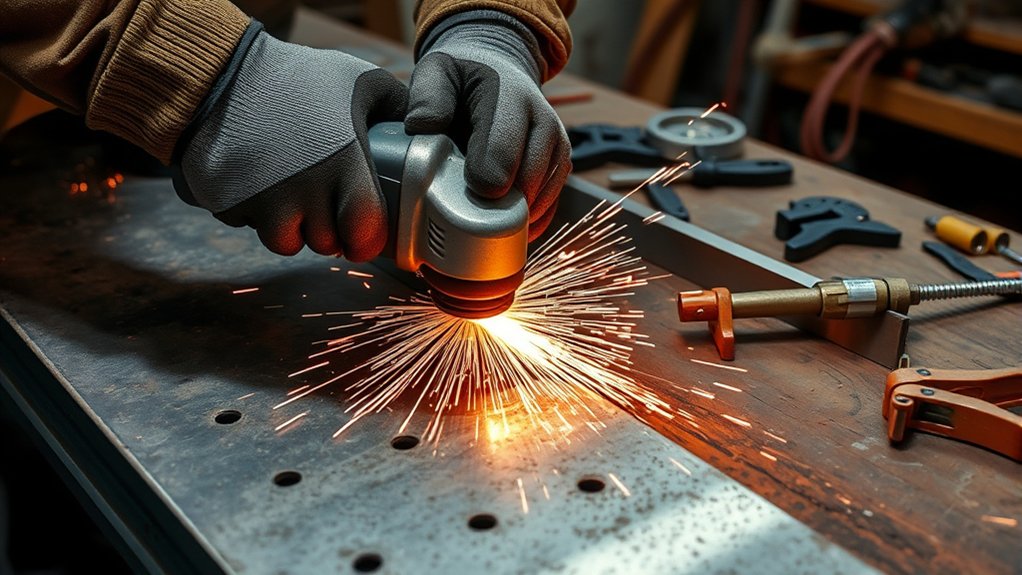
A 4-1/2-inch angle grinder is common for short plate edges and general fabrication, but it is not the only suitable size. Use a grinder that is appropriate for the plate, provides good control, and accepts the required accessory and guard.
Gather these items before starting:
- Angle grinder with its correct guard and securely attached side handle
- Compatible grinding wheel, flap disc, or fiber-disc system
- Bevel gauge, adjustable square, protractor, angle finder, or verified template
- Permanent marker or layout dye
- Straightedge or combination square
- Strong clamps or vise grips
- Stable metalworking bench
- File or deburring tool for the final edge
- Impact-rated safety glasses with side protection
- Full face shield, hearing protection, gloves, and hazard-appropriate respiratory protection
Products Worth Considering

Package Include 24 pcs grinding wheels 4 1/2 inch grit 40 60 80 120,6 of each

STRONGEST FIBER BACKING THAN OTHER PRODUCTS:4 1/2 grinding wheels made for TOP-LEVEL Hard zirconia.Good material for griding wheel. This Flap Disc is constructed of industrial grade high density premium zirconia material, increased durability than standard flap discs, built for a more robust and economical grinding wheel

PREMIUM QUALITY: These angled flap discs, also known as cut off wheels 4 1/2 inch, are constructed with industrial grade premium zirconia abrasive for strength, durability, and extended disc life as it holds up to high temperatures and pressure.
Choose the Right Abrasive
| Task | Typical Abrasive | Best Use |
|---|---|---|
| Heavy stock removal | Manufacturer-approved grinding wheel or aggressive coarse disc | Thick plate or long bevels where substantial metal must be removed |
| Controlled shaping | Coarse flap disc | Short bevels, lighter stock removal, and easier visual control |
| Final blending | Finer flap disc suitable for the metal | Removing coarse scratches and smoothing the bevel without rounding it |
Grinding wheels, flap discs, and fiber discs can all remove metal, but they behave differently. Norton’s abrasive-selection guidance describes bonded grinding wheels as aggressive stock-removal tools, while flap discs offer controlled material removal and a finer finish.
Use an abrasive that is marked for the base metal. Keep separate abrasives for stainless steel when cross-contamination matters, and use products specifically designed for aluminum when grinding aluminum. Never use a damaged, unidentified, incorrectly sized, or incompatible accessory.
Warning: Never use the side of a thin cut-off wheel to grind a bevel. Use only an accessory approved for side grinding, with the correct guard, arbor, diameter, and speed rating for your grinder.
Measure and Mark the Bevel Accurately
Clean loose rust, dirt, oil, and scale from the area so the marks remain visible. If the plate is painted or coated, identify the coating and the exposure controls required before grinding it.
Mark the Root Face First
If the drawing calls for a root face, mark it on the plate edge before laying out the bevel. This lower line is your stop point. Do not grind it away merely because marker ink remains visible.
When no root face is specified for a noncritical practice piece, avoid accidentally reducing the edge to a thin, fragile knife edge. For an actual weld joint, follow the procedure rather than guessing.
Mark the Bevel Boundary
Use a bevel gauge, angle finder, protractor, or template to establish the required angle. Extend the mark across the full edge with a straightedge. Shade the waste side so you can see which material must be removed.
Check the mark at both ends of the plate. A line that is correct at one end but offset at the other will produce a tapered or twisted bevel.
Pro Tip: Mark the bevel boundary on the top surface and the root-face line on the plate edge. The two references make it easier to spot an uneven pass before too much metal is removed.
Secure the Plate and Prepare the Work Area
Clamp the plate to a stable bench with the edge projecting only far enough to give the disc clear access. Excessive overhang allows the plate to vibrate. Place the clamps where the grinder cannot strike them during a full-length pass.
Before fitting or changing an accessory, disconnect the grinder from power or remove its battery. Inspect the grinder, guard, side handle, flanges, and abrasive. Confirm that the accessory’s marked maximum speed is at least equal to the grinder’s maximum speed. The accessory diameter, thickness, arbor, and thread must also match the tool.
Position the guard between your body and the wheel. Clear the spark path of fuel, solvents, sawdust, paper, hoses, cords, gas cylinders, and other materials that could burn or be damaged. Keep bystanders outside the work area.
DEWALT’s angle-grinder instructions call for clamping the workpiece to a stable platform, using the auxiliary handle, positioning the guard for operator protection, and matching accessory speed to the grinder.
How to Bevel Metal With an Angle Grinder Step by Step
- Confirm the required geometry. Record the bevel angle, root face, root opening, and which edge or edges receive preparation.
- Clean and mark the plate. Mark the bevel boundary and any required root face on the edge.
- Clamp the work securely. Support the plate on a stable bench and verify that the grinder can travel along the entire edge without hitting a clamp.
- Install the correct abrasive and guard. Disconnect power first, then verify the accessory size, arbor, condition, material rating, and maximum speed.
- Set your body and hand position. Hold the main grip with one hand and the side handle with the other. Stand out of the accessory’s direct plane and keep the guard between you and the wheel.
- Start with controlled overlapping passes. Allow the grinder to reach full speed before contacting the metal. Use light, steady pressure and move continuously along the edge.
- Stop and measure often. Check the bevel at both ends and in the center. Look for high spots, gouges, a rounded face, or a shrinking root face.
- Finish and clean the edge. Change to a suitable finishing disc if needed, remove burrs, and clean the joint to the condition required for welding or assembly.
Note: The abrasive’s contact angle and the completed bevel angle are different measurements. Follow the grinder and disc instructions for the safe contact angle while shaping the bevel to the dimensions shown on your gauge or template.
Master the Grinding Technique for a Consistent Bevel
Use overlapping passes that travel along the full working section of the edge. Short, isolated movements tend to create dips and high spots. Keep the grinder moving instead of holding it in one place.
Let the abrasive cut at operating speed. Excessive pressure slows many grinders, creates unnecessary heat, wears the disc unevenly, and makes it harder to maintain a flat face. The DEWALT manual linked above directs users to apply minimum pressure, keep the tool moving, and lift it from the work before switching it off.
Rough-Shape the Bevel
Begin on the waste side of the line rather than directly on the final boundary. Remove material in stages across the width of the bevel. Work down toward the root face gradually so you do not erase the land during the first few passes.
After each group of passes, look along the bevel from one end. Reflections and scratch patterns make humps, dips, and a twisted face easier to see. Correct small errors before continuing deeper.
Control Heat and Gouging
Heat builds when you press too hard, pause in one spot, use a loaded abrasive, or select an accessory that is poorly suited to the material. If the edge becomes too hot to inspect safely, stop and let it cool naturally while you check the disc and technique.
A deep gouge usually starts when the disc catches an edge or the operator pivots the grinder abruptly. Ease the abrasive onto the work, maintain two-handed control, and avoid jabbing the disc into the plate.
Finish the Bevel With a Flap Disc
A flap disc is useful for refining the bevel and blending coarse grinding marks. The goal is a flat, clean, uniform face—not a mirror-polished or rounded edge.
- Use the correct disc orientation. Follow the angle printed by the abrasive manufacturer. Norton’s flap-disc guidance recommends 0–15 degrees for Type 27 flap discs and 15–25 degrees for Type 29 flap discs.
- Keep the disc moving. Use overlapping forward-and-back passes so the face stays flat.
- Reduce pressure near the final dimensions. Make lighter passes as the bevel approaches the marked boundary.
- Protect the root face and corners. Do not roll the disc over the lower edge or round the ends of the bevel.
- Inspect the disc. Stop using it if flaps are missing, damaged, or separating from the backing.
Do not grind until every trace of black marker disappears. Leave the reference line barely visible until the gauge confirms that the bevel is correct, then remove only the material needed for the final fit.
Products Worth Considering
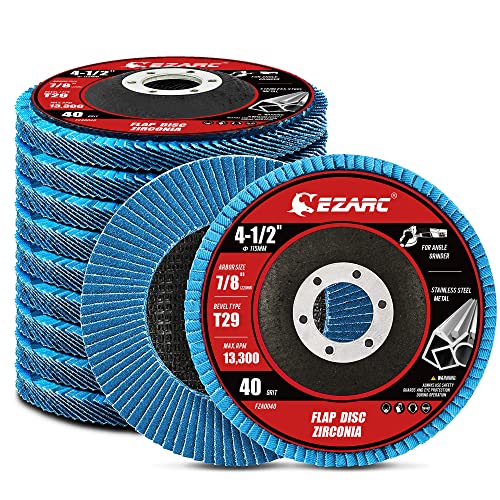
【Great Performance】EZARC flap sanding discs are made of hard zirconia material which lasts longer than standard aluminum oxide abrasive material, built for a more robust and economical grinding wheel

HIGH-DENSITY JUMBO DESIGN: Type 29 flap discs with a high-density jumbo layout support surface blending, beveling, grinding, deburring, and edge chamfering. Curved profile aids finishing, stock removal, and rust cleanup for pros and DIY enthusiasts

【 LONG LIFE & SMOOTH GRINDING 】 Merryland Flap Disc 4.5 inch Metal Stainless Steel INOX Grinding for Angle Grinder. Made of European Refined Calcined & Blue Zirconium Corundum Cloth. Craft-Line Flap Wheel. High Quality and Long Life!
Check the Finished Bevel
Inspect the preparation before welding, assembling, or moving to the next plate. A bevel that looks acceptable from one position may still vary along its length.
- Angle: Check both ends and at least one point in the middle.
- Root face: Confirm that its width is consistent and matches the required joint detail.
- Straightness: Sight along the bevel and use a straightedge where practical.
- Surface condition: Remove burrs, loose scale, oil, paint, and embedded debris as required for the next operation.
- Fit-up: Bring the mating pieces together and confirm the groove angle and root opening.
- Edge condition: Look for gouges, cracks, a knife edge, or rounded areas that could interfere with fit-up.
A correct-looking angle is only one part of a good weld preparation. The root face, straightness, surface condition, and final fit-up matter too.
Safety Precautions to Follow While Grinding

Angle grinders can throw sparks, abrasive fragments, and pieces of metal at high speed. OSHA’s portable-grinder requirements address guard placement, wheel inspection, and spindle speed. OSHA also requires suitable eye and face protection for flying-particle hazards under 29 CFR 1910.133.
Warning: Wear impact-rated safety glasses with side protection under a full face shield. A face shield provides added coverage but is not a substitute for safety glasses or goggles.
| Safety Precaution | What to Do |
|---|---|
| 1. Read the manual | Follow the grinder and abrasive manufacturers’ instructions, including approved accessories and working angles. |
| 2. Inspect the equipment | Do not use a cracked, dropped, damaged, excessively worn, or unidentified disc. |
| 3. Match the accessory | Confirm the disc’s diameter, arbor or thread, thickness, application, and maximum speed. |
| 4. Use the guard and handle | Install the correct guard, position it between you and the wheel, and tighten the side handle. |
| 5. Protect your eyes and face | Wear impact-rated safety glasses with side protection and a full face shield. |
| 6. Protect hearing and breathing | Use hearing protection and respiratory protection selected for the actual dust, coating, and ventilation conditions. |
| 7. Secure the workpiece | Clamp the plate to a stable bench instead of holding it by hand or bracing it against your body. |
| 8. Control the spark path | Remove flammable materials, protect cords and hoses, and keep bystanders clear. |
| 9. Maintain two-handed control | Let the grinder reach full speed, use steady pressure, and avoid twisting or forcing the disc. |
| 10. Wait for a complete stop | Lift the grinder from the metal before switching it off and do not set it down until the accessory stops. |
Wear close-fitting clothing and keep long hair, jewelry, cords, and loose material away from the rotating accessory. Use snug work gloves appropriate for handling sharp and hot metal, but never place a gloved hand near the moving disc.
Common Beveling Problems and Fixes
| Problem | Likely Cause | Correction |
|---|---|---|
| Rounded or convex bevel | Rocking the grinder or rolling over the edge | Use longer passes, hold a steadier contact angle, and check the face with a straightedge. |
| Angle changes along the edge | Short strokes, uneven pressure, or poor marking | Re-mark the high areas and check the angle at both ends and the center. |
| Root face disappears | Grinding until all marker ink is removed | Stop earlier, preserve the root-face line, and verify dimensions after each light pass. |
| Deep gouges | Excess pressure, pausing, or catching a corner | Reduce pressure, enter the work smoothly, and keep the abrasive moving. |
| Excess heat or discoloration | Wrong abrasive, loaded disc, heavy pressure, or slow movement | Inspect or replace the disc, reduce pressure, and use continuous overlapping passes. |
| Disc snags at the edge | Incorrect working angle or damaged abrasive | Stop immediately, inspect the accessory, and confirm the manufacturer’s required contact angle. |
| Poor fit-up after grinding | Incorrect angle, root face, or edge straightness | Measure each part separately, test-fit the joint, and correct only the high areas. |
Practice Tips to Improve Your Beveling Skills
- Start on scrap of the same thickness. Similar material gives you a realistic feel for removal speed and heat buildup.
- Mark more than one reference. Use a top boundary line, an edge root-face line, and several short angle-check locations.
- Measure after a small number of passes. Frequent checks take less time than repairing an overground edge.
- Study the scratch pattern. Uniform scratches usually indicate consistent contact; abrupt changes often reveal high spots or rocking.
- Practice stopping short. It is easy to remove another small amount of metal, but impossible to put an overground root face back without repair.
For a long production bevel, thick plate, or a joint with tight dimensional tolerances, a dedicated plate-beveling machine may produce a faster and more repeatable result than freehand grinding.
Frequently Asked Questions
Should the Bevel Be up or Down?
There is no universal bevel-up or bevel-down rule. Orient the plate so it is fully supported, the grinder can travel without hitting the bench or clamps, and the spark path is clear. Keep the correct guard between your body and the wheel and choose the position that gives you the best two-handed control.
What Are 10 Safety Precautions Before Using a Grinding Machine?
Read the manual, inspect the grinder and disc, match the accessory speed and size, install the correct guard, tighten the side handle, wear eye and face protection, protect your hearing and breathing, clamp the work, clear the spark path, and wait for the accessory to stop before setting the grinder down.
How Do You Make a Beveled Edge?
Determine the required angle and root-face dimensions, mark the waste area, clamp the metal, and remove material in overlapping passes with a compatible guarded abrasive. Stop often to check the angle and straightness, then blend the face without rounding the root edge.
How Do You Use an Angle Grinder Step by Step?
Inspect the tool, install the correct guard and rated accessory, attach the side handle, clamp the work, put on PPE, hold the grinder with both hands, allow it to reach full speed, contact the metal with light pressure, keep it moving, and wait for the disc to stop before putting the tool down.
Is a Grinding Wheel or Flap Disc Better for Beveling?
A grinding wheel is often useful for aggressive stock removal, while a flap disc provides easier blending and a finer finish. The best choice depends on plate thickness, required removal rate, material, grinder instructions, and the amount of control you need.
How Do You Check a 22.5-Degree Metal Bevel?
Use a bevel gauge, protractor, adjustable square, or verified template. A bevel that is 22.5 degrees from the original square edge is 67.5 degrees from the flat plate surface. Two matching 22.5-degree bevels create a 45-degree included groove.
Conclusion
Beveling metal with an angle grinder becomes much more predictable when you separate the finished bevel geometry from the abrasive’s working angle. Confirm the required dimensions, mark the root face, clamp the plate, and remove material in controlled stages. Frequent measuring—not grinding until the marker disappears—is what produces a straight, repeatable edge.
Use the correct guard, side handle, rated abrasive, and PPE every time. With those controls in place, practice on scrap will quickly improve your feel for pressure, travel speed, and angle consistency.
Sources
- OSHA 29 CFR 1910.243 — Guarding of Portable Powered Tools — guard placement, abrasive-wheel inspection, and spindle-speed requirements
- OSHA 29 CFR 1910.133 — Eye and Face Protection — protection from flying particles and side-impact hazards
- DEWALT DCG407/DCG408 Instruction Manual — clamping, side-handle use, guarding, rated accessories, pressure, and grinder operation
- Norton Abrasives — Do’s and Don’ts of Flap Discs — Type 27 and Type 29 working angles, inspection, and guard use
- Miller Electric Welding Training Manual — groove-joint terminology and an example of grinder-prepared weld bevel geometry
- American Welding Society Standards — welding codes, specifications, and joint-preparation references