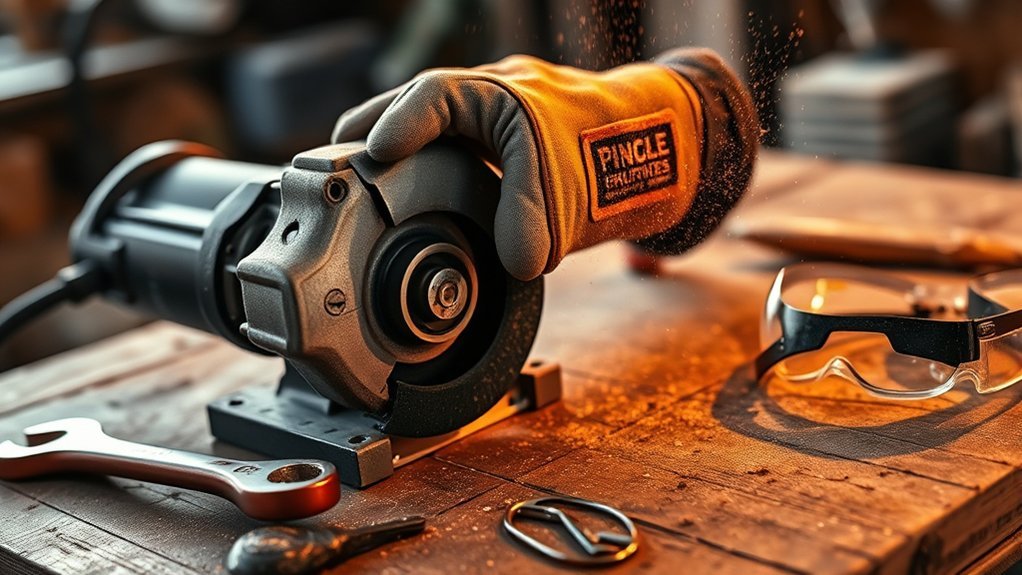
Changing an angle grinder wheel is a routine job, but a damaged disc, incorrect flange, missing guard, or accidental start can cause a serious injury. The safe method is to disconnect power, confirm the exact wheel-and-hardware combination in your grinder manual, inspect every mounting part, and complete a guarded no-load test before cutting or grinding.
Quick Answer
Unplug the angle grinder or remove its battery, wait for the wheel to stop, and engage the spindle lock. Remove the flange with the supplied wrench or an approved tool-free system, install a compatible wheel, guard, and flange, tighten them as the manual directs, and perform the specified no-load test before working.
Key Takeaways
- Disconnect the cord or battery and verify that the switch is off before touching the wheel.
- Match the wheel diameter, thickness, arbor, maximum RPM, guard, flange, and intended use to your grinder.
- Never press the spindle-lock button while the spindle is moving.
- Use the supplied spanner wrench or a manufacturer-approved tool-free flange rather than forcing the wheel or nut.
- Inspect and clean the spindle, flanges, guard, and new wheel before assembly.
- After installation, stand outside the wheel’s plane and complete the no-load test required by the grinder manual—commonly one minute.
At a Glance
| Time Required | About 5–10 minutes, plus the test period stated in the grinder manual |
| Difficulty | Easy when the flange and spindle are clean and undamaged |
| Tools Needed | Grinder manual, supplied spanner wrench or approved tool-free flange, clean brush or cloth, and task-appropriate PPE |
| Cost | Usually only the cost of the replacement wheel if you still have the supplied wrench |
What’s in This Article
- What You Need to Know About Changing an Angle Grinder Wheel
- Before You Begin Changing Your Angle Grinder Wheel
- Tools You Need for Changing Your Angle Grinder Wheel
- Match the Wheel, Guard, and Flanges
- Step-By-Step Guide: Change Your Grinder Wheel With a Spanner Wrench
- Replace Your Grinder Wheel Without a Spanner Wrench
- Easiest Way to Change Your Grinder Wheel
- Top 5 Mistakes to Avoid When Changing Your Grinder Wheel
- Safety Tips for Changing Your Angle Grinder Wheel
- Angle Grinder Wheel Maintenance Tips
- Common Problems After Changing an Angle Grinder Wheel
- Frequently Asked Questions
- Conclusion
- Sources
What You Need to Know About Changing an Angle Grinder Wheel
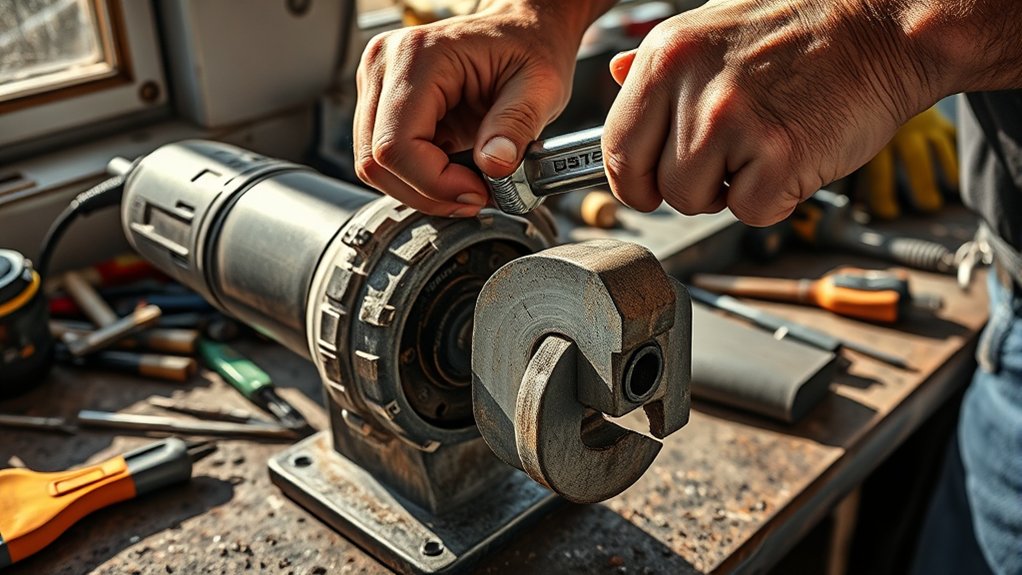
Most angle grinders hold the accessory on a threaded spindle with an inner flange and an outer flange or lock nut. The inner flange supports the wheel, while the outer flange clamps it in place. The guard helps shield the operator from accidental contact and redirects fragments if a wheel breaks.
The term wheel can refer to several accessories, including a depressed-center grinding wheel, thin cut-off wheel, flap disc, wire wheel, or diamond wheel. These accessories are not automatically interchangeable. A wheel that fits over the spindle may still have the wrong speed rating, thickness, guard, flange, or intended use.
According to OSHA’s portable abrasive-wheel requirements, the grinder must use an appropriate safety guard, and the guard must be aligned and positioned to protect the operator. Never remove the guard simply because a wheel appears to fit without it.
A wheel that fits the spindle is not necessarily safe. Its diameter, thickness, arbor, maximum RPM, guard, flange, and approved application must all match the grinder.
Start every change by unplugging the grinder or removing its battery. Wait for the wheel to cool and come to a complete stop. Only then should you press the spindle-lock button and loosen the flange in the direction specified by your grinder manual.
Note: Many grinders use a right-hand spindle thread that loosens counterclockwise when viewed from the wheel side. Do not assume this direction applies to every model; check the arrows, labels, or instructions in your manual.
Before You Begin Changing Your Angle Grinder Wheel
Prepare the grinder, wheel, and workspace before loosening any parts. A clean setup reduces the chance of dropping the flange, cross-threading the spindle, or installing the wrong accessory.
- Switch the grinder off, unplug its cord, or remove its battery.
- Wait until the old wheel has stopped completely and cooled enough to handle.
- Read the mounting section in the manual for your exact grinder model.
- Place the grinder on a clean, stable surface where it cannot roll or fall.
- Check the new wheel’s diameter, thickness, arbor, maximum RPM, and intended material.
- Confirm that the guard and both flanges are approved for that wheel type.
- Inspect the wheel for cracks, chips, warping, moisture damage, contamination, or a missing label.
- Inspect the spindle threads, spindle lock, guard, and flange faces for wear or damage.
Warning: Never install a cracked, chipped, dropped, oversized, poorly fitting, or under-rated wheel. Do not enlarge an arbor hole or force a wheel onto the spindle.
Tools You Need for Changing Your Angle Grinder Wheel
Most wheel changes require only the supplied mounting tools and a compatible replacement wheel. Gather them before removing the flange so the grinder is not left open where grit can reach the spindle.
- Angle grinder and manual: Use the model number to find the exact mounting, guard, and flange instructions.
- Compatible replacement wheel: Match the diameter, thickness, arbor, maximum RPM, wheel type, and intended material.
- Correct spanner wrench: Use the pin wrench or lock-nut wrench supplied or approved by the grinder manufacturer.
- Approved tool-free flange: Use one only when the grinder and wheel manufacturer permit that exact combination.
- Clean cloth or soft brush: Remove grit from the spindle, flange faces, and guard without damaging them.
- Eye and face protection: Wear appropriate protection during the powered test and later operation.
- Hearing and respiratory protection: Select these for the material and work performed after the wheel change.
- Close-fitting gloves: These may protect against sharp stationary edges while the grinder is disconnected, but they must not have loose cuffs.
Some grinders use a manufacturer-approved tool-free flange, such as a compatible Hilti Kwik Lock flange. Do not combine flanges, nuts, adapters, or backing parts from unrelated tools unless both manufacturers approve the setup.
Products Worth Considering

[7PCS 5/8"-11 Angle Grinder Nut Wrench Replacement Kit] 1 piece angle grinder wrench and 6 angle grinder nuts (3 inner flange nuts, 3 outer flange nuts) for lock nut removal, wheel/disc replacement.Compatible with most arbor grinders and lock nuts, Perfect for home DIY, workshop projects, and professional grinder parts replacement

Adjustable Lock-nut Grinder Wrench

【Value Sets】The grinder nut set includes 1 angle grinder wrench and 6 angle grinder nuts (3 inner flange nuts, 3 outer flange nuts). Please check size and compatibility before ordering. Please contact us with any questions or concerns. We prioritize your satisfaction .
Match the Wheel, Guard, and Flanges
Different accessories place different loads on the grinder. Use the grinder manual and wheel label together rather than choosing parts by appearance alone.
| Accessory | Mounting Check | Critical Restriction |
|---|---|---|
| Depressed-center grinding wheel | Use the specified grinding guard and matching inner and outer flanges. | The grinding surface must not project beyond the guard lip in an unsafe position. |
| Thin bonded cut-off wheel | Use the cut-off guard and flange orientation specified for the wheel’s thickness. | Never grind with the side of a wheel intended only for peripheral cutting. |
| Flap or sanding disc | Use the approved flange, backing pad, and guard listed for the accessory. | Do not use a cracked backing pad or an accessory that exceeds the tool’s capacity. |
| Wire wheel or brush | Match its thread or arbor, diameter, maximum RPM, and required guard. | Replace it if wires are loose, broken, or extending beyond the approved size. |
| Diamond wheel | Follow any rotation arrow and use the specified flanges and cutting guard. | Do not reverse a directional wheel or use it for an unapproved material. |
Visually inspect every accessory before mounting it. A ring test is not a universal test for all angle-grinder wheels. Norton explains that it is mainly applicable to certain vitrified bonded wheels and may not work for some sizes, shapes, or compositions. Follow the wheel manufacturer’s inspection instructions instead of tapping a thin cut-off, flexible, resin-bonded, or diamond wheel unless its instructions specifically call for it.
Products Worth Considering

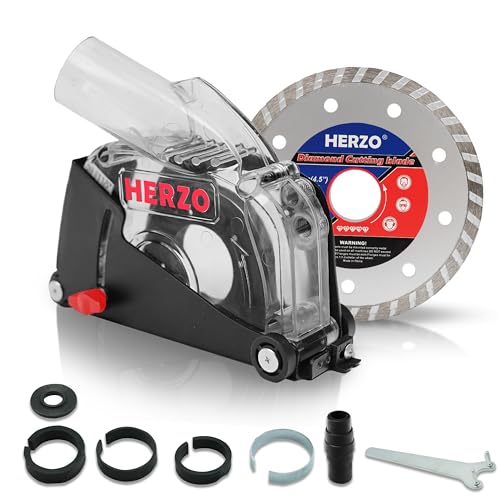
Widely Adapt:Suitable for 80% Main Brand 4-1/2 and 5 inch Angle Grinder

[High-Performance Cutting] Designed for cutting metal & stainless steel, these cut off wheels 4 1/2 inch work efficiently with any angle grinder wheel, supporting speeds up to 13,300 RPM.
Step-By-Step Guide: Change Your Grinder Wheel With a Spanner Wrench
Use this method when the grinder has a standard outer flange or lock nut that requires a pin spanner. Keep the grinder stable and follow the flange orientation shown in the model manual.
Tools Required for Replacement
You need the angle grinder, its manual, the correct spanner wrench, a compatible replacement wheel, and a clean cloth or brush. Have eye and face protection, hearing protection, and the side handle ready for the powered test.
Safety Precautions to Consider
Disconnect the power source before starting. Check that a corded grinder is unplugged or that the battery is physically removed from a cordless model. Confirm that the power switch is in the off position so the grinder does not start when power is restored.
Never engage the spindle lock while the wheel is moving. The Makita XAG03 manual, for example, warns that actuating the shaft lock while the spindle is moving can damage the tool.
Spanner Wrench Replacement Steps
- Identify the correct setup. Check the grinder model, wheel label, guard type, inner flange, outer flange, and any required adapter before taking the old wheel off.
- Disconnect the grinder. Unplug the tool or remove its battery, and place the switch in the off position.
- Wait for a complete stop. Let the wheel stop and cool before touching it.
- Stabilize the grinder. Place it on a clean surface with the spindle accessible and the guard supported rather than bent.
- Engage the spindle lock. Press the lock and turn the stationary wheel gently by hand until the spindle clicks into the locked position.
- Loosen the outer flange. Insert the wrench pins fully into the flange holes and turn in the direction specified in the manual. Many common right-hand-thread models loosen counterclockwise when viewed from the wheel side.
- Remove the old wheel. Lift off the outer flange and wheel without bending or striking either part. Keep track of the inner flange’s orientation.
- Inspect and clean the mounting area. Wipe the spindle threads and both flange faces. Replace a flange that is bent, cracked, badly worn, burred, or unable to sit flat.
- Inspect the replacement wheel. Confirm its diameter, thickness, arbor, maximum RPM, intended material, wheel type, and condition.
- Install the wheel and flanges. Seat the inner flange as shown in the manual, place the wheel flat and centered, and orient the outer flange for that wheel type and thickness.
- Start the flange by hand. Thread it on without force. If it binds immediately, remove it and check for cross-threading, dirt, or incompatible parts.
- Tighten it as directed. Hold the stationary spindle lock and use the correct wrench. Tighten securely without an extension bar or excessive force.
- Set the guard and side handle. Secure the correct guard between your body and the wheel, and install the side handle before the powered test.
- Complete the no-load test. Clear the area, wear the required PPE, hold the grinder firmly, and keep yourself and bystanders outside the wheel’s plane. Run it at maximum no-load speed for the period in the manual—commonly one minute—and stop immediately for wobble, rubbing, unusual noise, or vibration.
Pro Tip: Thread the outer flange on by hand for several turns before using the wrench. Smooth hand-threading is one of the easiest ways to detect dirt, misalignment, or damaged spindle threads.
The one-minute procedure is a common manufacturer instruction. For example, the DEWALT DCG432X manual directs users to run a new or replacement wheel at maximum no-load speed for one minute while everyone remains outside the rotating wheel’s plane.
Replace Your Grinder Wheel Without a Spanner Wrench
There is no safe universal workaround for a missing grinder wrench. A wrench-free wheel change is appropriate only when the grinder has a manufacturer-approved quick-release or tool-free flange, or when the manual expressly permits that flange to be loosened by hand.
- Disconnect power. Unplug the grinder or remove its battery and verify that the switch is off.
- Wait for the spindle to stop. Never engage the lock while any part is moving.
- Confirm that the flange is tool-free. Look for the flange model, manual instructions, or manufacturer markings.
- Engage the spindle lock. Rotate the stationary accessory gently until the spindle locks.
- Release the flange by hand. Turn only the approved release mechanism in the direction shown by the manufacturer.
- Install and tighten the new wheel. Follow the same inspection, flange-orientation, guard, and no-load-test steps used for a standard installation.
Warning: Do not use the abrasive wheel as a lever, and do not attack a stuck flange with pliers, a pipe wrench, punch, chisel, screwdriver, or hammer. These methods can crack the wheel, distort the flange, damage the spindle lock, or create hidden defects. Obtain the correct wrench or have the grinder serviced.
Use extra care with thin abrasive cut-off wheels. They are not designed to withstand twisting or side pressure. If a standard flange will not move with the proper wrench and moderate hand force, stop rather than bending the wheel.
Easiest Way to Change Your Grinder Wheel
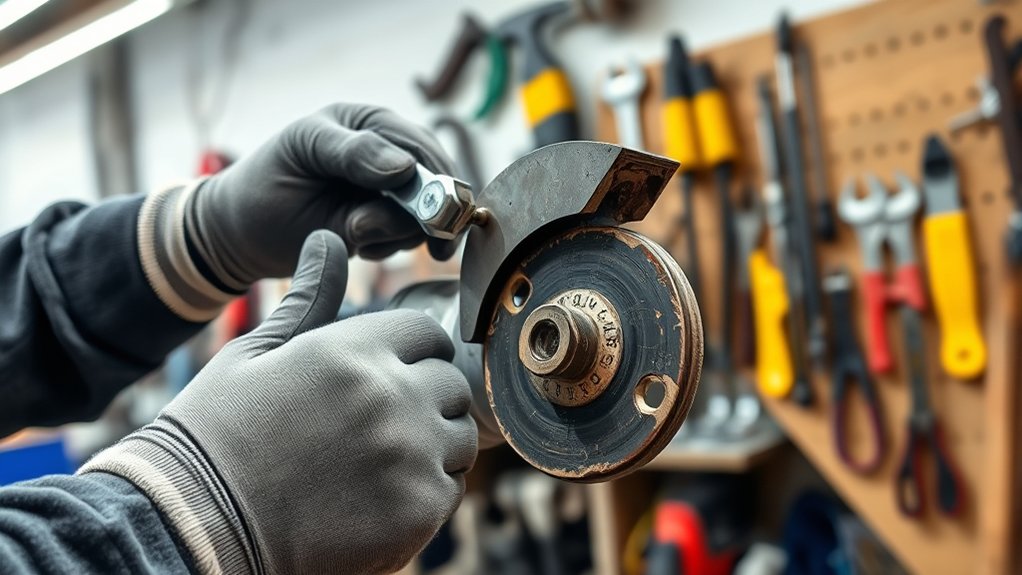
The easiest method is a compatible tool-free flange approved for your grinder and wheel. With power disconnected and the spindle fully stopped, press the spindle lock and release the tool-free mechanism by hand as its instructions describe.
Remove the old wheel and inspect the spindle, inner flange, outer flange, guard, and wheel-contact surfaces. Install the compatible replacement wheel flat against the inner flange, orient the tool-free flange correctly, and tighten it by hand according to its instructions.
Tool-free does not mean inspection-free. The wheel still needs the correct diameter, arbor, thickness, speed rating, guard, and intended application. Complete the same protected no-load test used after a wrench-mounted installation.
Note: A quick-release flange is not automatically compatible with every wire brush, cup wheel, backing pad, cut-off wheel, or diamond wheel. Check the flange instructions and grinder manual before using a new accessory type.
Top 5 Mistakes to Avoid When Changing Your Grinder Wheel
A correct wheel change depends on more than tightening the center nut. Avoid these five common mistakes:
- Forgetting to disconnect power: A live grinder can start if the switch or paddle is bumped.
- Pressing the spindle lock while the wheel is moving: This can damage the lock or gearbox.
- Using the wrong wheel, guard, or flange: A matching arbor alone does not make an accessory safe.
- Ignoring dirt or flange damage: Debris, burrs, or bent mounting faces can make the wheel run out of true.
- Under-tightening or over-tightening: A loose wheel can slip, while excessive force can damage the wheel, flange, or spindle threads.
Safety Tips for Changing Your Angle Grinder Wheel
Wheel handling, no-load testing, and normal grinder operation present different hazards. Select protective equipment for the task rather than treating one item as a complete solution.
Wear Protective Gear
- Safety glasses or goggles: Wear impact-rated eye protection during the test and grinder operation.
- Face shield: Use it over—not instead of—primary eye protection when fragments, sparks, or debris may reach your face.
- Close-fitting gloves: Use suitable gloves for handling a disconnected grinder or sharp stationary wheel when permitted, and keep loose cuffs away from moving parts.
- Hearing protection: Wear appropriate protection during the no-load test and normal operation.
- Respiratory protection: Use protection suitable for the dust generated by the material and process. A basic nuisance mask is not adequate for every hazardous dust.
- Fitted clothing: Secure long hair and remove loose sleeves, jewelry, drawstrings, and hanging items.
OSHA’s Safe Use of Portable and Hand-Held Power Tools fact sheet advises examining tools before use, following manufacturer instructions, using the correct accessories, and selecting PPE for the hazards involved.
Ensure Proper Workspace Setup
Set the grinder on a clean, stable surface before loosening the flange. Keep the replacement wheel, manual, wrench, and safety equipment within reach. Before the powered test, move flammable material, loose objects, and bystanders away from the area.
| Task | Why It Matters | What to Check |
|---|---|---|
| Clean the workspace | Reduces slips, contamination, and dropped parts | Remove clutter, metal grit, liquids, and loose debris |
| Wear appropriate PPE | Protects against fragments, dust, sparks, and noise | Check eye, face, hearing, clothing, hand, and respiratory protection |
| Disconnect power | Prevents an accidental start | Unplug the cord or remove the battery and set the switch to off |
| Prepare the test area | Reduces fire and fragment hazards | Install the guard and handle, clear bystanders, and move flammable items |
Angle Grinder Wheel Maintenance Tips
Regular inspection helps the wheel sit flat and makes future changes easier. Include these checks whenever you replace an accessory:
- Inspect every wheel for cracks, chips, warping, contamination, and uneven wear.
- Keep the wheel label readable so its diameter, maximum RPM, and intended use remain available.
- Clean the spindle threads and flange faces without removing material from them.
- Replace bent, cracked, badly worn, burred, or mismatched flanges.
- Check that the guard moves through its adjustment range and locks securely.
- Store thin bonded cut-off wheels flat, dry, and away from impact, moisture, and excessive heat.
- Store other wheels according to the abrasive manufacturer’s instructions rather than stacking them where they can warp or chip.
- Replace a wheel that has been dropped or damaged instead of trying to prove it is still usable.
Clean mounting faces and correct hardware are as important as the replacement wheel itself.
Common Problems After Changing an Angle Grinder Wheel
Stop the grinder immediately if it shakes, rubs, rattles, or sounds different after a wheel change. Disconnect power again before inspecting any part.
| Problem | Likely Cause | Safe Response |
|---|---|---|
| Wheel wobbles or vibrates | Debris, a damaged wheel, incorrect arbor, bent flange, or wrong flange orientation | Disconnect power, remove the wheel, clean and inspect every mounting surface, and replace damaged or incompatible parts. |
| Wheel rubs the guard | Incorrect wheel diameter, wrong guard, bent guard, or poor wheel seating | Do not operate the tool. Install the correct wheel and guard or replace the damaged guard. |
| Flange will not thread smoothly | Cross-threading, dirt, damaged threads, or the wrong nut | Stop immediately. Clean the parts and try again by hand; service damaged spindle threads. |
| Flange is stuck | Over-tightening, corrosion, contamination, heat, or damaged threads | Use only the correct wrench and moderate force. Do not strike or twist the wheel; seek service if it remains seized. |
| Spindle lock will not engage | The spindle is not aligned, the wheel is still moving, or the lock is damaged | Wait for a complete stop and turn the wheel gently by hand. Service the grinder if the lock slips or fails. |
| Flange loosens during testing | Wrong flange orientation, incompatible hardware, damaged threads, or insufficient tightening | Stop using the grinder and verify the complete mounting arrangement in the manual. |
Frequently Asked Questions
How do you replace a wheel on an angle grinder?
Disconnect the grinder, wait for the spindle to stop, engage the spindle lock, and remove the flange with the correct wrench or approved tool-free system. Inspect and clean the mounting parts, install the compatible wheel and guard, tighten the flange as directed, and complete the manual’s no-load test.
How do you swap an angle grinder blade?
Use the mounting procedure specified for that accessory. A diamond wheel, bonded cut-off wheel, and grinding wheel may require different guards or flange orientations. Never install a toothed saw blade unless the grinder manufacturer expressly designed and approved the tool for it.
How do you put a disc on an angle grinder?
Seat the correct inner flange on the spindle, place the compatible disc flat and centered, and install the outer flange in the orientation shown for that wheel type and thickness. Start the flange by hand, tighten it with the approved method, position the guard, and perform a no-load test.
Which way does the wheel go on an angle grinder?
Follow any rotation arrow printed on the wheel, especially on directional diamond wheels. Also follow the grinder manual because flange orientation may change with wheel type and thickness. If no direction is marked, do not guess—use the instructions supplied with the wheel and tool.
Can you change an angle grinder wheel without the wrench?
Only when the grinder uses an approved tool-free flange or its manual permits hand removal. Do not twist a bonded wheel, use pliers, or strike the flange. Obtain the correct replacement wrench when a standard lock nut cannot be removed safely.
How tight should an angle grinder flange be?
Tighten it securely using the method and force specified by the grinder manufacturer. Do not use an extension bar or excessive force, and do not leave it loose in the hope that normal rotation will finish tightening it.
Why does a new grinder wheel wobble?
Common causes include trapped grit, a damaged or warped wheel, an incorrect arbor, a bent flange, reversed mounting hardware, or cross-threading. Stop the grinder, disconnect power, and inspect every mounting surface before testing it again.
Should you ring-test every angle grinder wheel?
No. Visually inspect every wheel, but ring testing is mainly applicable to certain vitrified wheels and is ineffective or unsuitable for some wheel sizes, shapes, and compositions. Follow the abrasive manufacturer’s inspection instructions for the exact wheel.
Conclusion
A safe angle grinder wheel change begins by physically disconnecting power and ends only after a successful guarded no-load test. Match the wheel, flanges, guard, maximum RPM, and application to the grinder manual. Never force a stuck flange or rely on the wheel to tighten itself. A careful five-minute installation can prevent wheel damage, vibration, tool failure, and serious injury.
Sources
- OSHA 29 CFR 1910.243 — Guarding of Portable Powered Tools — guard, mounting, inspection, and maximum-speed requirements for portable abrasive-wheel tools
- OSHA Safe Use of Portable and Hand-Held Power Tools — inspection, PPE, guards, wheel testing, and safe startup guidance
- Makita XAG03 Angle Grinder Instruction Manual — shaft-lock, guard, flange, cut-off-wheel, and tightening instructions
- DEWALT DCG432X Instruction Manual — accessory fit, PPE, guard placement, maximum RPM, and one-minute no-load testing
- Norton Abrasives: How to Perform a Ring Test — ring-test method, scope, and limitations
- Hilti Kwik Lock Grinder Accessory — example of a manufacturer-specific tool-free flange