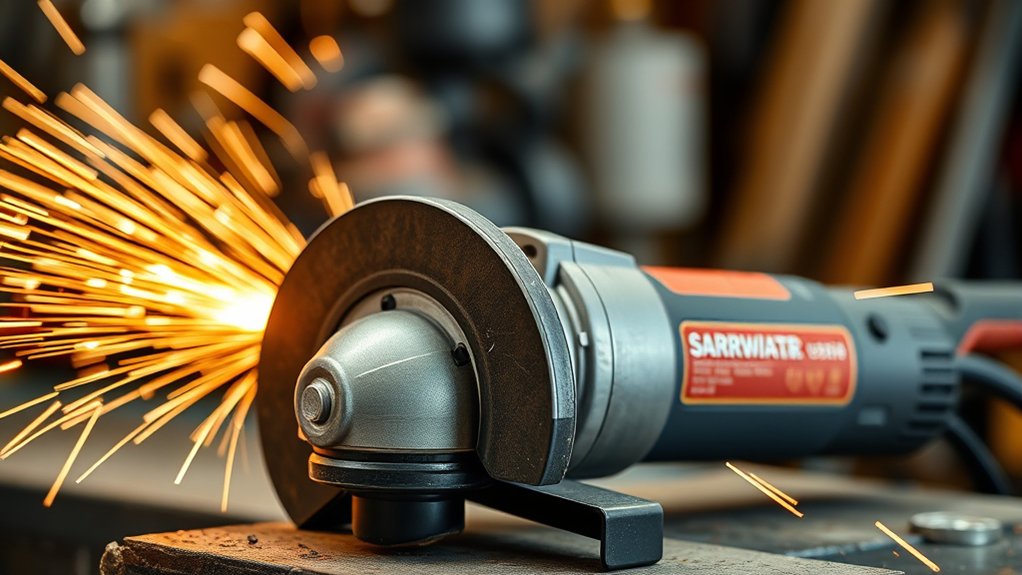
An angle grinder guard should place a solid barrier between you and the wheel while leaving only the working area exposed. The safest position depends on the wheel, the task, and your grinder’s guard mechanism. The steps below show how to choose the right guard, rotate it, lock it, and check it before grinding or cutting.
Quick Answer
Disconnect the grinder or remove its battery. Fit the guard designed for the wheel and task, then rotate it so the closed side sits between you and the wheel and the least possible wheel is exposed toward you. Lock it, confirm it cannot shift or touch the wheel, and direct sparks into a clear, nonflammable area.
Last updated: July 20, 2026
Key Takeaways
- Position the guard’s closed side between your body and the wheel, not behind the wheel.
- Use the guard specified for the exact wheel, accessory, diameter, and operation.
- Unplug the grinder or remove its battery before installing, rotating, or tightening the guard.
- Do not rely on a click alone. Check the lever, screw, latch, or detent specified in the owner’s manual.
- Stop immediately if the guard moves, rubs the wheel, is bent, or will not lock securely.
At a Glance
| Time Required | About 3 to 5 minutes for positioning and inspection |
| Difficulty | Easy, but model-specific instructions must be followed |
| Tools Needed | Owner’s manual, correct wheel guard, compatible accessory, and the supplied wrench or hex key if required |
| Cost | Usually no added cost when the correct guard came with the grinder; replacement cost varies by model |
Warning: Never install, rotate, loosen, or tighten an angle grinder guard while the tool is connected to power or while the wheel is moving. Do not remove, bend, weld, drill, or modify the guard to make an accessory fit.
Why Proper Guard Positioning Is Essential for Safety
The wheel guard helps shield you from accidental wheel contact, sparks, workpiece fragments, and pieces of an accessory that may break during use. It must remain securely attached and positioned so its closed side stands between you and the rotating wheel.

For right-angle-head or vertical portable grinders, OSHA 29 CFR 1910.243 states that the wheel’s exposure angle must not exceed 180 degrees and that the guard must be located between the operator and the wheel. This is a limit on exposed wheel area, not a rule saying that a guard must “cover at least 180 degrees.”
The guard should expose only the part of the wheel needed for the work while keeping its closed side between the wheel and your body.
A guard does not replace eye protection, a face shield where needed, hearing protection, proper clothing, a side handle, or safe body position. It is one part of the grinder’s safety system.
What You Need to Know About the Grinder’s Guard Mechanism
Angle grinder guards do not all mount or lock in the same way. Before you move one, identify both the correct guard type and the locking mechanism used on your grinder.
Use the Correct Guard for the Wheel
Match the guard to the grinder model, wheel diameter, wheel thickness, and operation. A wheel that physically fits the spindle is not automatically safe to use with the installed guard.
- Grinding wheels and flap discs: Use the grinding guard specified by the manufacturer. The working edge should remain accessible while the closed side protects the operator.
- Thin cut-off and diamond wheels: Use the dedicated cut-off guard, approved clip-on enclosure, or other guard arrangement listed in the manual. A standard open grinding guard may not provide the required side coverage.
- Wire wheels and wire brushes: Use a guard approved for the accessory’s diameter and thickness. The brush must fit inside the guard without rubbing it.
- Cup wheels and masonry work: Use the specialized guard or dust-collection shroud specified for the application.
- Dual-purpose wheels: Follow the wheel and grinder instructions. Some manufacturers require a cut-off-style guard even when a wheel is marked for both grinding and cutting.
The Makita GAG14 instruction manual, for example, identifies separate grinding-wheel and cut-off-wheel guards and warns that using the wrong guard can increase exposure to a rotating wheel, sparks, particles, and wheel fragments.
Guard Locking Mechanisms Vary
Your grinder may use one of several systems:
- A clamp lever with an adjustable tension screw
- A locking screw tightened with a screwdriver or hex key
- A tool-free latch or ratcheting detent
- A spring-loaded release lever with fixed guard positions
Some tool-free guards make a click as they move through their positions, but a click is not a universal locking test. A screw-secured or clamp-lever guard may make no click at all. Follow the manual and confirm the actual locking part is fully engaged.
Before You Adjust the Guard
- Isolate the power. Unplug a corded grinder or remove the battery from a cordless grinder. Wait for the wheel to stop completely.
- Check the grinder model. Use only a guard designed or approved for that grinder.
- Check the accessory. Confirm the wheel type, diameter, arbor size, and thickness match the tool and guard.
- Check the speed rating. The accessory’s rated speed must be at least equal to the grinder’s maximum speed.
- Inspect the wheel. Do not use an abrasive wheel with cracks, chips, severe wear, contamination, or other damage.
- Inspect the guard. Look for cracks, bends, missing parts, damaged screws, worn detents, or a loose clamp.
- Clear the area. Remove flammable material, combustible dust, loose debris, and anything that could be damaged by sparks.
- Prepare your PPE. Use suitable eye protection and add a face shield, hearing protection, gloves, protective clothing, and respiratory protection when the task requires them.
Note: This guide provides general safety information. Your grinder’s instruction manual, accessory instructions, workplace rules, and local regulations control whenever they are more specific.
Products Worth Considering

Included: (1) DeWalt N441218 Angle Grinder Guard Replacement for Angle Grinder DCG414B

EXACT REPLACEMENT PART - Measuring 6.45" in overall width, the 397661-01 metal angle grinder guard is designed to accommodate various blade sizes, including 4", 4-1/2", 5", 5.3" and 6" diameters. An essential and versatile attachment for your daily grinding needs.
How to Position the Angle Grinder Guard Correctly
Use this sequence each time you install a guard, change accessories, or change the direction from which you will approach the workpiece.
- Disconnect the power source. Unplug the grinder or remove its battery.
- Install the correct guard. Align the guard’s tabs, band, grooves, or protrusions with the matching notches on the grinder’s gear housing or bearing box.
- Seat the guard fully. The mounting band should sit squarely in its intended track. Do not force it over dirt, burrs, paint buildup, or damaged parts.
- Rotate the closed side toward your body. The solid part of the guard should stand between you and the wheel during the planned working position.
- Limit the exposed wheel. Leave only enough opening to place the correct working surface against the material. Do not rotate the guard farther back merely to improve your view.
- Plan the spark path. Aim sparks and debris away from your face, hands, legs, clothing, bystanders, vehicles, glass, hoses, cables, and flammable material.
- Lock the guard. Close the clamp lever, tighten the locking screw, or engage the tool-free latch as described in the manual.
- Check wheel clearance. Turn the spindle or wheel carefully by hand when the tool design allows it. The wheel must not touch the guard at any point.
- Check for movement. Apply gentle hand pressure to the guard. It should not rotate, lift, or slide out of position.
- Reinstall the side handle. Position it so you can control the grinder with both hands without placing either hand near the wheel.
Pro Tip: Hold the unplugged grinder in your intended working position before final tightening. This makes it easier to see whether the closed side remains between your body and the wheel throughout the cut or grinding pass.
Products Worth Considering

▶【Package Contents】: You will receive 2 pcs angle grinder protective cover, 2 pcs screws and 2 pcs nuts. Sophisticated accessories, to help you better protect your hands and prevent dust from flying.

IRON & ABS MATERIAL: Angle grinder protective cover adopts high-strength iron and ABS material for dual structural reinforcement. This adjustable angle grinder guard features sturdy construction, excellent pressure proof and wear proof. Sized at 205x220x155mm/8.1x8.7x6.1in, the angle mill protective cover is water proof and easy to clean, supporting long-term repeated industrial and household cutting operations with low maintenance difficulty

★This Safety Guard is repalce for 7 inch and 180mm Angle Grinder to DEWALT MAKTIA RYOBI METABO Wheel Guard.
How Can You Check If the Guard Is Securely Attached?

Use all of the following checks. Do not rely on one click, one pull test, or appearance alone.
- Alignment check: Confirm the guard band, tabs, and notches are seated in the locations shown in the manual.
- Locking check: Confirm the lever is fully closed, the screw is tight, or the latch is completely engaged.
- Movement check: Apply light hand pressure in both directions. The guard should not rotate during normal handling.
- Clearance check: Verify the wheel, flange, lock nut, and brush wires do not rub or strike the guard.
- Compatibility check: Confirm the guard is approved for the installed wheel type, diameter, and thickness.
- Condition check: Do not use a cracked, bent, heavily corroded, modified, or heat-damaged guard.
After installing a new accessory, follow the startup test in your grinder’s manual. Many current manuals instruct the operator to stand clear of the accessory’s rotational plane, keep bystanders clear, and run the tool at maximum no-load speed for about one minute. Stop immediately if you notice rubbing, abnormal vibration, wobble, unusual noise, or guard movement.
Adjusting the Guard for Optimal Spark Direction
Sparks leave the contact area in a fast-moving stream that changes with wheel rotation, tool angle, and travel direction. Position the guard so it protects your body first, then arrange the work and tool orientation so the spark stream enters a clear, nonflammable area.
Do not rotate the guard behind the wheel simply because that gives you a wider line of sight. Reposition the workpiece, your stance, or the side handle instead.
| Operation | Guard Position | Work-Area Check |
|---|---|---|
| Surface grinding | Closed side between the operator and wheel, with only the working edge exposed | Keep sparks away from your body, clothing, bystanders, and flammable material |
| Cutting | Use the approved cut-off guard or enclosure with the least practical wheel exposure | Keep your body out of line with the wheel and do not stand directly behind the possible kickback path |
| Wire brushing | Use the guard specified for the brush diameter and thickness | Protect nearby people from broken wires and keep the brush from contacting the guard |
Guard Positioning Mistakes to Avoid
- Placing the open side toward your body: The closed side should normally be between you and the wheel.
- Using the wrong guard: Do not use a grinding guard when the manual requires a cut-off guard or enclosed attachment.
- Assuming any click means locked: Confirm the actual lever, screw, latch, or detent is engaged.
- Leaving the guard loose: A guard that rotates under light hand pressure is not ready for use.
- Removing the guard for access: Change the approach, accessory, grinder, or approved guard instead.
- Forcing the guard into place: Resistance may indicate the wrong guard, damaged mounting parts, debris, or incorrect alignment.
- Allowing the wheel to rub: Contact can damage the wheel, guard, or both.
- Adjusting the guard while powered: Always disconnect the plug or battery and wait for a complete stop.
- Using an oversized wheel: Never fit a wheel that exceeds the grinder’s or guard’s rated capacity.
- Sacrificing protection for visibility: Do not rotate the guard away from yourself just to see more of the workpiece.
Troubleshooting Issues With Your Guard During Operation

If the guard moves, starts rubbing, or creates an unusual sound during use, release the trigger and hold the grinder securely until the wheel stops. Disconnect the power before touching the guard.
- The guard will not seat: Check for the wrong guard model, an unopened clamp, misaligned tabs, dirt in the mounting track, or damage to the bearing box.
- The guard rotates after locking: Check the clamp tension, screw, lever, latch, and mounting band. Remove the grinder from service if the guard cannot be secured.
- The wheel touches the guard: Confirm the wheel diameter and thickness, flange orientation, wheel seating, and guard type. Replace a bent guard rather than trying to reshape it.
- The guard blocks the cut: Do not remove it. Confirm that you are using the correct cut-off guard, then reposition the workpiece or approach the cut from a safer direction.
- The latch or screw is damaged: Replace the guard or damaged locking parts with manufacturer-approved components.
- Sparks travel toward you: Stop and change the guard position, tool angle, workpiece position, or travel direction while keeping the closed side toward your body.
- The grinder vibrates excessively: Stop immediately and inspect the accessory, flange, spindle, guard, and mounting hardware before restarting.
Warning: Do not continue working with a guard that shifts during use. Tightening it repeatedly without finding the cause can hide a worn clamp, damaged housing, wrong guard, or failed locking part.
Best Practices for Ongoing Guard Maintenance and Safety
- Inspect before every use: Check the guard, locking system, accessory, flanges, cord or battery connection, and side handle.
- Clean the mounting area: Remove dry dust, metal particles, and debris using a brush or method approved by the manufacturer.
- Keep the guard dry: Do not leave it packed with wet grinding residue or corrosive material.
- Do not modify it: Never cut, bend, grind, weld, or drill the guard.
- Replace damaged parts: A cracked, bent, loose, or incomplete guard should be replaced rather than repaired.
- Use approved replacements: Match the replacement guard to the exact grinder model and accessory application.
- Store the grinder carefully: Do not rest heavy tools or materials on the guard where they can bend it.
- Check the position during the job: Stop and reposition the guard whenever the work angle changes enough to expose the wheel toward your body.
OSHA’s guidance for portable and hand-held power tools also recommends regular maintenance, pre-use damage checks, manufacturer-approved accessories, and task-appropriate personal protective equipment.
Frequently Asked Questions
Where should an angle grinder guard be positioned?
Position the closed side of the guard between your body and the wheel. Expose only the working portion of the accessory, lock the guard securely, and arrange the tool so sparks and debris travel into a clear area away from you and other people.
What are OSHA’s requirements for angle grinder guards?
For right-angle-head or vertical portable grinders, OSHA 29 CFR 1910.243 limits the wheel’s maximum exposure angle to 180 degrees and requires the guard to be positioned between the operator and wheel so fragments from a broken wheel are directed away from the operator. Workplace requirements outside the United States may differ.
How close should a tongue guard be to a grinding wheel?
OSHA’s 1/4-inch tongue-guard clearance applies to specified stationary grinders, such as bench and floor-stand grinders. A handheld angle grinder normally uses a wheel guard rather than that adjustable tongue-guard arrangement. Follow the angle grinder manufacturer’s clearance and installation instructions.
How do you move the guard on an angle grinder?
Unplug the grinder or remove its battery, wait for the wheel to stop, release the guard’s lever, screw, or latch, and rotate the guard to the required position. Relock it, check wheel clearance, and confirm the guard cannot move by hand before reconnecting power.
Does an angle grinder guard have to click?
No. Some tool-free guards click as they move between detents, while others use a clamp lever or locking screw and may not click. Use the locking procedure in the grinder’s manual and verify that the guard cannot rotate or detach.
Can you use an angle grinder without the guard?
Do not remove the guard for normal grinding, cutting, or wire-brushing work. The guard helps protect against wheel contact, fragments, sparks, and broken wires. Use a different approved guard, accessory, or tool when the installed guard prevents safe access to the work.
Conclusion
The correct angle grinder guard position places the guard’s closed side between you and the wheel, leaves only the working area exposed, and sends sparks toward a clear, nonflammable space. The guard must also match the wheel and operation, lock securely, and remain clear of the rotating accessory.
Before every use, disconnect the power for adjustments, inspect the wheel and guard, check the locking mechanism, and confirm that nothing rubs or shifts. Never remove or rotate the guard away from yourself simply to gain a better view of the work.
Sources
- OSHA 29 CFR 1910.243, Guarding of Portable Powered Tools — portable grinder guard placement, exposure angle, and abrasive-wheel inspection requirements
- OSHA 29 CFR 1910.215, Abrasive Wheel Machinery — stationary grinder guarding and the 1/4-inch tongue-guard rule
- OSHA, Safe Use of Portable and Hand-Held Power Tools — tool inspection, PPE, guard alignment, and accessory safety
- OSHA-hosted Angle Grinder Safety Toolbox Talk — spark control, wheel-speed compatibility, guard positioning, and pre-use checks
- Makita GAG14 Angle Grinder Instruction Manual — guard selection, accessory compatibility, locking, PPE, and no-load testing