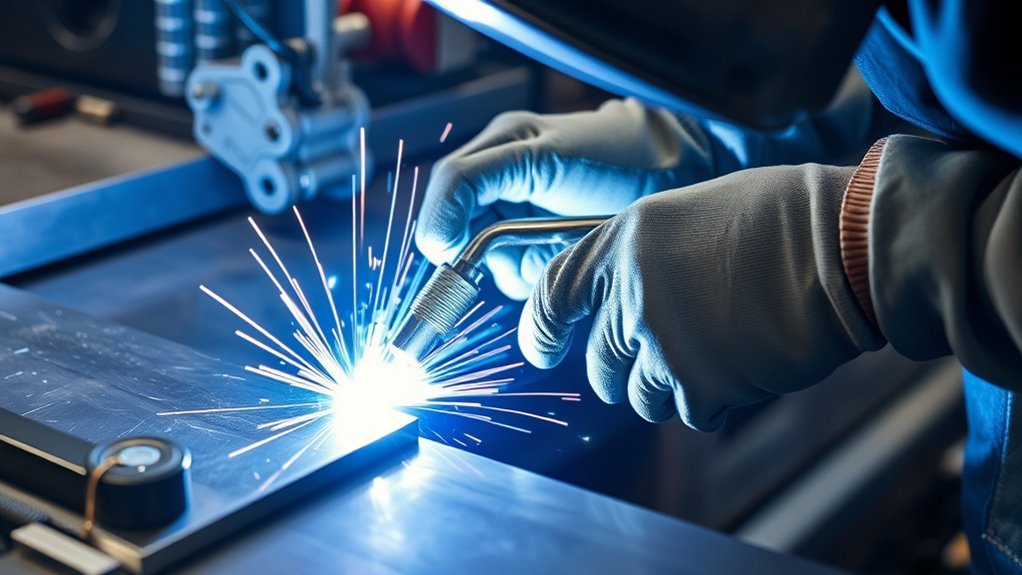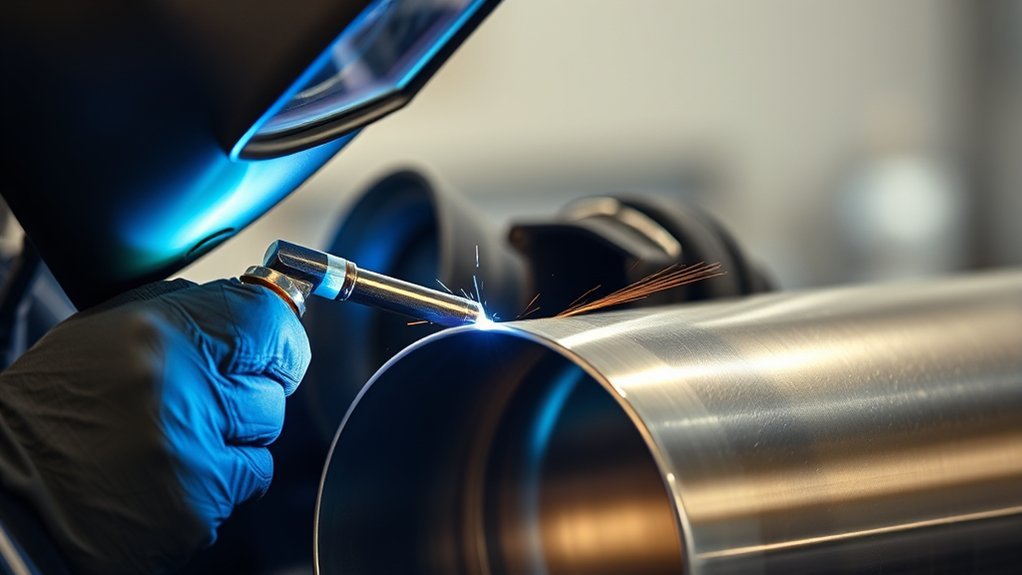
Thin stainless exhaust tubing reacts quickly to excess heat, poor fit-up, and weak gas coverage. A bead can look acceptable on the outside while the root turns black and crusty inside the tube. The most reliable TIG process combines clean metal, a tight joint, controlled DC amperage, matching filler metal, and a low-pressure argon back purge.
Quick Answer
To TIG weld stainless steel exhaust tubing, clean and tightly fit the joint, use DCEN with a sharp ceriated or lanthanated tungsten, shield the torch with argon, and back purge the tube. Set the machine slightly above the heat you expect to use, control the puddle with a pedal, and test on matching scrap first.
Key Takeaways
- Confirm the tubing grade and wall thickness before choosing filler metal or amperage.
- Use DCEN, a short arc, a pointed tungsten, and clean argon shielding for stainless TIG welding.
- Back purge butt joints so the root does not form heavy black oxide, commonly called sugaring.
- Keep the fit-up nearly gap-free, add small tacks, and control heat with travel speed and a pedal or fingertip remote.
- Ventilate the work area and keep chlorinated solvents, fuel, wiring, and combustible material away from the arc.
At a Glance
| Time Required | About 30 to 60 minutes for one accessible joint, including cleaning, purging, tacking, welding, and inspection |
| Difficulty | Intermediate; thin-wall fit-up and purge control require practice |
| Tools Needed | DC TIG welder, remote amperage control, argon, flowmeter or regulator, purge fittings, sharp tungsten, stainless filler, clamps, and PPE |
| Cost | Low consumable cost when you already own the welder and gas equipment; a complete setup varies widely by machine, torch, cylinder, and regulator |
Safety Before TIG Welding Stainless Exhaust
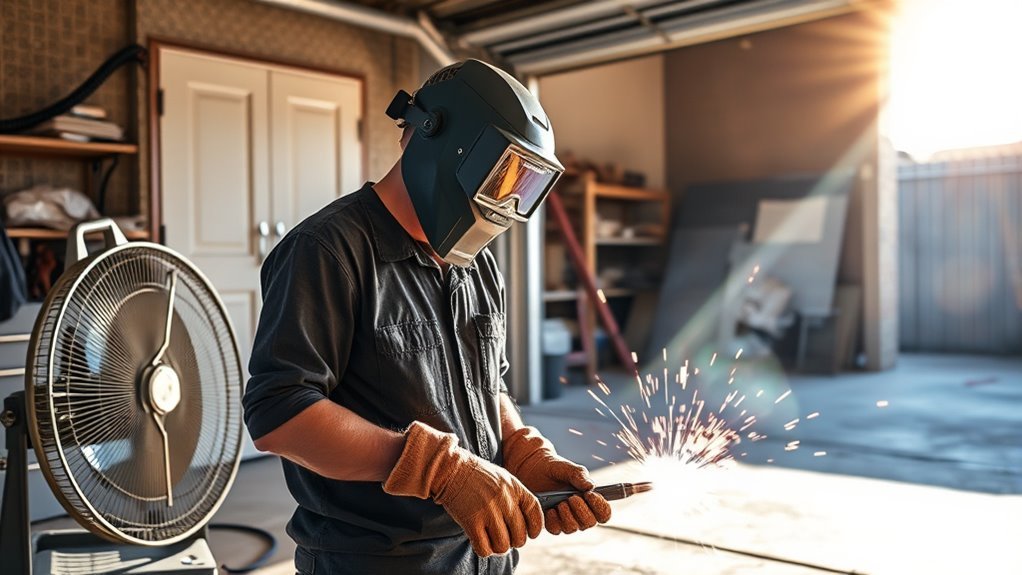
Stainless steel welding can produce chromium-containing fume, including hexavalent chromium. Use effective general ventilation or local fume extraction, keep your head out of the plume, and follow your workplace exposure-control plan. Argon can also displace oxygen, so never purge or weld in an unventilated confined space. See the OSHA welding-fume fact sheet for exposure guidance.
Warning: Do not clean the joint with chlorinated brake cleaner or another chlorinated solvent. Arc radiation can break down chlorinated solvent vapors into highly toxic gases. Use a welding-safe, nonchlorinated cleaner, remove all residue, and let the metal dry fully before striking an arc.
Remove the exhaust from the vehicle when practical. If you must weld in place, follow the vehicle manufacturer’s service procedure, protect fuel and brake lines, wiring, sensors, undercoating, and interior trim, and keep a suitable fire extinguisher nearby. Attach the work clamp to clean metal as close to the joint as practical so welding current does not travel through bearings, electronics, or bolted connections.
Essential Equipment for TIG Welding Stainless Steel
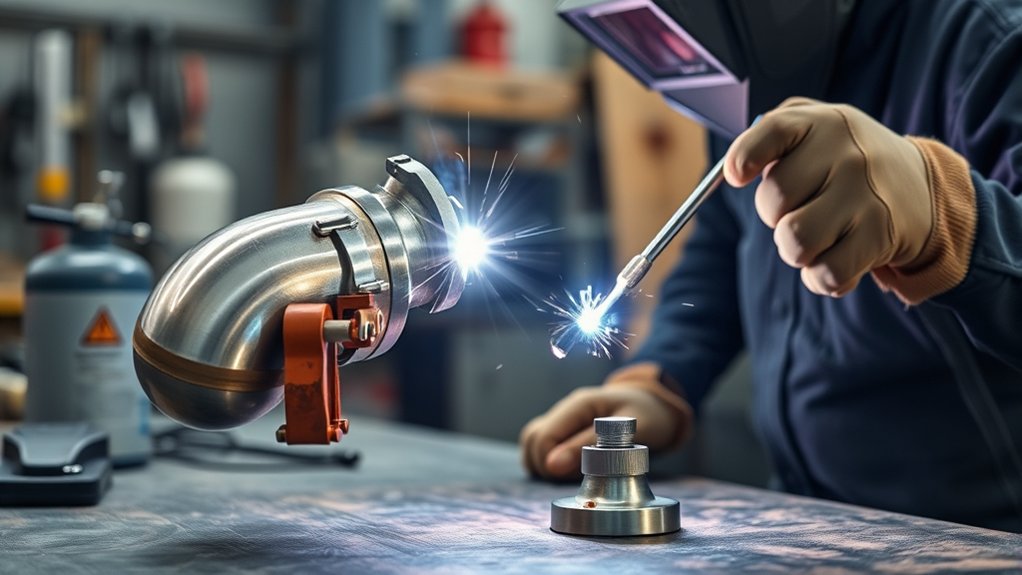
Use a TIG welder that can run direct current electrode negative, or DCEN. A foot pedal or fingertip amperage control makes thin-wall work easier because you can add heat quickly to form the puddle, then back off as the tube warms. An air-cooled torch is normally enough for short exhaust joints when you stay within its duty cycle; a water-cooled torch is more comfortable for long production runs.
For common thin exhaust tubing, a 0.040-inch or 1/16-inch 2% lanthanated or 2% ceriated tungsten is a practical choice. Grind it lengthwise to a clean point on a wheel used only for tungsten. A gas lens with a #6 to #8 cup can improve shielding and lets you see the joint without using excessive gas flow. Miller’s TIG welding basics guide also recommends DCEN for steel alloys, a pointed tungsten, and a short arc.
Products Worth Considering

ER308L TIG WELDING ROD: ER308L is a low -carbon stainless steel tig welding rod, which has excellent anti -crystal interval corrosion properties and full -location welding performance.

ER308L STAINLESS STEEL: ER308L is a low-carbon stainless steel TIG welding rod for general-purpose welding where moderate corrosion resistance and cryogenic performance are required.

ER308L: Most popular stainless rod for general-purpose applications where corrosion is moderate and applications at cryogenic temperatures.
Choose the Right Stainless Filler Metal
Match the filler to the base metal instead of assuming every exhaust is 304 stainless. ER308L is a standard match for 304 and 304L. ER316L suits 316 and 316L. ER347 is commonly used for stabilized 321 or 347 stainless. ER409Nb is intended for 409 and 409Ti ferritic stainless. ER309L is commonly used when joining stainless to mild steel. The Lincoln Electric stainless filler-metal catalog confirms these grade relationships.
For very thin tubing, 0.035-inch or 0.045-inch stainless wire gives fine control when it is available and clean. A 1/16-inch TIG rod is easier to find and works well on thicker wall tubing or larger gaps, but it can chill and flood a tiny puddle if you add too much at once.
Note: A magnet test cannot reliably identify every stainless grade. Use supplier markings, purchase records, or material documentation when filler-metal compatibility matters.
A separate regulator or flowmeter for the purge line makes adjustment easier. Do not split one unregulated hose and assume both flows are correct. Secure the argon cylinder upright, protect the valve, and use fittings rated for shielding gas.
Setting Up Your TIG Welder: Amperage and Gas Flow
There is no single amperage that fits every exhaust tube. Wall thickness, joint gap, torch angle, travel speed, filler size, and whether you can rotate the tube all change the heat requirement. Use the following ranges only as test-weld starting points, set the machine’s maximum current near the top of the range, and control the actual heat with the pedal.
| Tube Wall | Starting Maximum Amperage | Tungsten | Practical Approach |
|---|---|---|---|
| 0.035 in. / about 0.9 mm | About 35 to 45 A | 0.040 in. or 1/16 in. | Near-zero gap, tiny filler additions, fast travel |
| 0.049 in. / about 1.2 mm | About 45 to 60 A | 1/16 in. | Use the pedal to taper heat as the tube warms |
| 0.065 in. / about 1.6 mm | About 60 to 80 A | 1/16 in. | Use enough current to move quickly instead of soaking the joint |
Use clean argon for the torch. A flow of about 15 to 20 cubic feet per hour is a common indoor starting point for a standard cup or gas lens, but cup size, tungsten stickout, drafts, and torch design matter. Follow the torch and machine manuals, then change only one setting at a time.
Warning: More gas is not always better. Excessive flow can become turbulent and pull room air into the shielding envelope, causing discoloration, porosity, and an unstable arc.
Use enough post-flow to keep the tungsten from turning blue, purple, or chalky after the arc stops. Ten to 12 seconds is a safe general starting point on many machines, although low-current welds may need less. Keep the cup over the crater until the post-flow ends. Leave pulse off while establishing a sound basic procedure; if you use it later, test the machine-specific settings on matching scrap.
Before You Begin: Prepare the Tubing
Confirm the tubing grade, measure the wall thickness, and make a test coupon from the same material. Cut the ends square, deburr the inside and outside, and clean at least an inch around the joint. Remove oil first with a welding-safe cleaner, then lightly abrade with a dedicated stainless brush or clean stainless-only abrasive. Never use a carbon steel brush or a disc that has touched mild steel.
Fit-up matters as much as machine settings. Thin exhaust tubing usually welds best with a uniform, near-zero butt gap. A wide or uneven gap forces you to bridge with filler and raises the chance of burn-through. Clamp the tube without forcing it out of round, then place small tacks around the joint in an opposing sequence.
- Wipe the inside and outside of the tubing with a clean, lint-free cloth.
- Remove burrs that hold the joint apart or fall into the exhaust.
- Clean the filler rod or wire before welding.
- Keep oily gloves away from the prepared joint and tungsten.
- Check alignment at the flange, hanger, and downstream connection before adding final tacks.
Pro Tip: Tack at roughly opposite points and recheck alignment after every pair. A few tiny, fully fused tacks control the joint better than one large tack that overheats and pulls the tube sideways.
What You’ll Need for Stainless Exhaust TIG Welding
- DC TIG welder with high-frequency or another noncontact start method
- Foot pedal or fingertip amperage remote
- Clean argon shielding gas
- 0.040-inch or 1/16-inch ceriated or lanthanated tungsten
- Gas lens and suitable #6 to #8 cup
- Filler metal matched to the tubing grade
- Separate purge regulator or flowmeter, hose, plugs, dams, foil, or heat-resistant purge tape
- Dedicated stainless brush and clean stainless-only abrasives
- Clamps, tube fixture or positioner, welding helmet, gloves, protective clothing, and fume control
- Fire extinguisher and heat shielding when working near a vehicle
Estimated total time: Plan about 30 to 60 minutes for one small, accessible joint. Tight under-car access, repairs near a flange, or a purge volume that is difficult to isolate can take longer.
Products Worth Considering

Complete Welding Practice Projects Kit: Includes welding coupons and project parts to help beginners practice welding skills step by step.

Premium welding kit training steel, makes 1 dice and 1 Cube

Versatile Use: Weld into a 304 stainless steel vase, pen holder, or tool container.
Mastering Back Purging for Clean Welds
Back purging replaces oxygen around the root side of the joint with an inert gas. Without it, the hot stainless can form heavy, rough oxide called sugaring. That oxide damages the root surface and reduces corrosion resistance. TWI explains that an efficient back purge minimizes heat tint and recommends maintaining the purge until the root area has cooled sufficiently in applications that require corrosion control. See its guidance on avoiding stainless-steel heat tint.
Seal the tube ends with purpose-made purge plugs, purge dams, foil, or heat-resistant tape. Feed argon into the lower side of the purge space and provide a small vent at the high side so air can escape. Isolate the smallest practical volume instead of filling an entire exhaust system.
Essential Back Purging Techniques
- Check the seals. Make sure the inlet, vent, and joint tape do not leak excessively.
- Start the purge before welding. Allow enough time for argon to displace the air in the isolated section.
- Keep the flow low and steady. The goal is displacement, not pressure.
- Leave a vent path open. A sealed tube can build pressure and push the molten root outward.
- Maintain the purge through the weld and early cooling. Do not shut it off as soon as the arc stops.
- Inspect the root. A smooth silver-to-light-straw root is preferable; dark gray, black, crusty oxide means the purge or heat control failed.
Warning: Never seal both ends without a vent. Even low purge flow can raise pressure inside a closed tube and disturb the puddle or eject hot metal.
A dedicated purge monitor is the best way to confirm low oxygen for critical, coded, sanitary, or high-corrosion work. For a custom automotive exhaust, controlled purge flow, adequate pre-purge time, and direct root inspection provide practical checks, but bead color alone does not certify weld quality.
Preventing Weld Contamination
Contamination can come from oil, moisture, dirty filler, an air leak, a draft, or a tungsten that touched the puddle. If the tungsten dips into the weld or touches the filler rod, stop and regrind it before continuing. Do not try to burn contamination away.
Keep the hot end of the filler inside the shielding envelope. Pulling it into room air between dabs lets oxide form on the tip, which can then enter the puddle. Shield the work from fans and strong cross-drafts without reducing room ventilation.
Step-by-Step: How to TIG Weld Stainless Steel Exhaust Tubing
- Identify the material. Confirm the stainless grade and wall thickness, then select matching filler.
- Prepare matching scrap. Reproduce the same joint and use it to check amperage, gas coverage, and filler size.
- Clean the joint. Degrease, dry, deburr, and brush the inside and outside with stainless-only tools.
- Fit and tack the tube. Hold a uniform near-zero gap, align the system, and place small opposing tacks.
- Set up the purge. Isolate the joint, introduce argon at the low side, and leave a small high-side vent.
- Set the welder. Select DCEN, install a pointed tungsten, set the torch flow, and choose a maximum current based on the test coupon.
- Start the puddle quickly. Use a short arc and enough initial pedal to establish fusion without dwelling.
- Add filler at the leading edge. Feed small, consistent dabs while keeping the filler tip in the gas shield.
- Travel smoothly. Keep the torch angle and arc length steady; avoid a wide weave.
- Finish the crater. Taper the pedal, add a final small amount of filler when needed, and do not snap the arc off abruptly.
- Hold the torch in place. Protect the crater and tungsten until post-flow ends, while the back purge continues.
- Inspect both sides. Check the face and root for complete tie-in, undercut, pinholes, oxidation, and distortion before welding the next joint.
Effective Welding Techniques for Thin Tubing
Keep the tungsten about 1/16 to 1/8 inch from the work and hold the torch roughly 70 to 80 degrees to the tube surface. A short arc concentrates the heat where you need it. A long arc spreads heat, weakens shielding, and makes the puddle harder to control.
| Technique | Recommendation | Why It Helps |
|---|---|---|
| Arc length | Keep the tungsten about 1/16 to 1/8 inch from the tube | Focuses the arc and improves gas coverage |
| Torch movement | Travel smoothly with little or no weave | Limits heat input and keeps the bead narrow |
| Filler addition | Use small dabs at the leading edge | Avoids flooding or chilling a tiny puddle |
| Starts and stops | Taper current and fill the crater before stopping | Reduces crater pinholes and weak stop points |
| Hand control | Brace your torch hand and rotate the tube when possible | Improves travel speed and bead consistency |
| Back purge | Maintain low, steady argon flow with an open vent | Protects the root without pressurizing the tube |
A tight, perfectly aligned joint can sometimes be fused autogenously without filler, but filler gives you more control over the crater and adds metal at the joint. For a vibration-prone exhaust, use filler unless you have tested an autogenous procedure on the same tubing and can inspect the root.
The root you cannot see while welding matters as much as the bead on the outside. Clean fit-up and a stable purge are part of the weld, not optional finishing steps.
Top Mistakes in TIG Welding and How to Fix Them
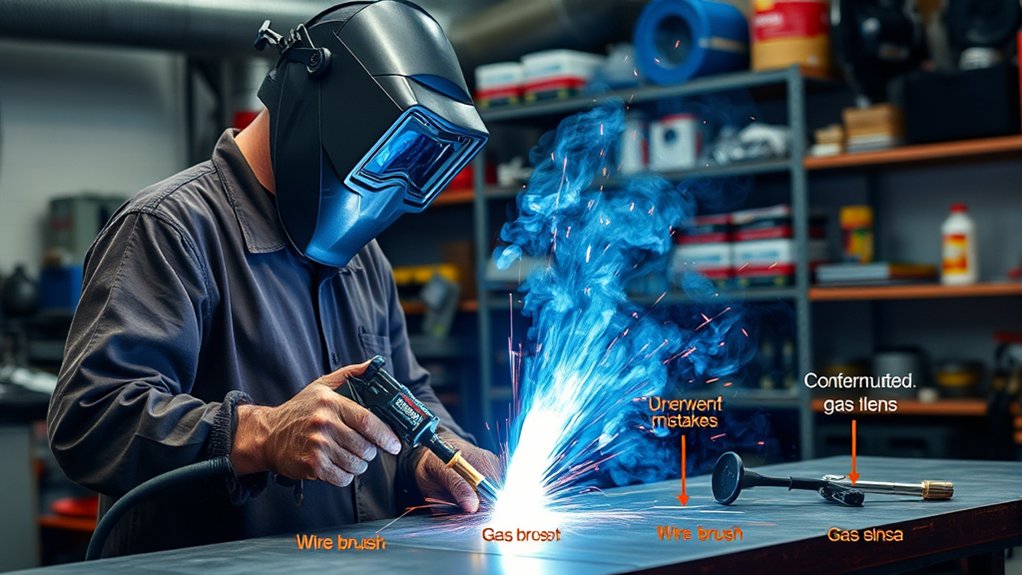
Thin stainless tubing shows mistakes quickly. Stop when the weld color, puddle shape, or arc sound changes. Continuing over a contaminated or overheated area usually makes the repair larger.
Common TIG Welding Mistakes
- Contaminating the tungsten: Stop and regrind it instead of trying to continue.
- Using a long arc: Move the tungsten closer without touching the puddle.
- Using too much torch gas: Return to the manufacturer’s range and check for drafts or leaks.
- Skipping the back purge: Purge butt joints when the root is exposed inside the exhaust.
- Using the wrong filler: Match filler to 304, 316, 321/347, 409, or a dissimilar joint.
- Dwelling at low amperage: Use enough current to form the puddle promptly, then travel.
- Ignoring fit-up: Refit a wide gap rather than trying to bridge it with excess heat.
Troubleshooting Stainless Exhaust TIG Welds
| Problem | Likely Cause | Correction |
|---|---|---|
| Burn-through | Gap too wide, slow travel, or excess heat | Improve fit-up, lower the maximum current slightly, and move sooner |
| Black, crusty root | Air remained in the tube, purge leaked, or purge stopped early | Repair the purge setup and remove the oxidized section before rewelding |
| Blue, gray, or dull face | Poor shielding, draft, long arc, slow travel, or excess heat | Check gas type and leaks, shorten the arc, shield drafts, and increase travel speed |
| Porosity or pinholes | Oil, moisture, gas leak, oxidized filler, or unfilled crater | Clean and dry the joint, fix leaks, keep filler shielded, and taper the stop |
| Undercut | Too much heat, long arc, or insufficient filler at the edge | Shorten the arc, reduce heat input, and place filler at the leading edge |
| Cold or ropey bead | Too little current, oversized filler, or poor torch angle | Use more initial current, smaller filler, and a steadier torch angle |
| Arc wanders | Blunt or contaminated tungsten, long arc, or unstable work connection | Regrind the tungsten, shorten the arc, and clean the work-clamp contact |
Poor Gas Coverage Issues
Start with the full gas path: cylinder valve, regulator, hose, torch connection, collet body or gas lens, cup, and O-rings. A cracked cup, loose fitting, restricted hose, or wind across the joint can cause the same dirty bead as an incorrect flow setting. Miller’s guide to common TIG weld problems recommends checking gas type, flow, leaks, and turbulence when coverage is poor.
- Use clean argon intended for TIG welding.
- Start near the torch manufacturer’s recommended flow rather than opening the regulator fully.
- Keep the tungsten stickout within the gas-lens or cup’s capability.
- Block cross-drafts at the joint while maintaining safe room ventilation.
- Keep the torch over the hot crater until post-flow ends.
- Maintain a separate, vented back purge for the tube interior.
Tips for Wrapping Up Your Exhaust System
Inspect every joint before final installation. Look for complete fusion, smooth tie-in, pinholes, undercut, excessive heat tint, and a clean root. If you cannot see inside the tube, use a borescope where practical. Repair defects before heat cycles and vibration make them worse.
Remove loose oxide and post-weld contamination with stainless-only tools. Heavy heat tint can reduce corrosion resistance and may require mechanical cleaning, pickling, or another qualified post-weld cleaning method. Chemical pickling and passivation products are hazardous, so use them only according to the manufacturer’s instructions and safety data sheet.
Support the exhaust with correctly placed hangers and allow for thermal movement. Do not force misaligned flanges together with bolts or use a hanger to pull a joint into position. After installation, use a low-pressure smoke test or another suitable exhaust-leak test. Do not apply uncontrolled shop-air pressure to a closed exhaust system.
If you use exhaust wrap, choose material rated for the service temperature and inspect the tube periodically. Wrap can trap moisture and hide cracking or corrosion. Sound welds, correct supports, and adequate clearance matter more than wrap alone.
Frequently Asked Questions
How many amps should you use to TIG weld stainless exhaust pipe?
Use wall thickness as the starting point. About 35 to 45 amps is a practical test range for 0.035-inch wall, 45 to 60 amps for 0.049-inch wall, and 60 to 80 amps for 0.065-inch wall. Set the machine near the upper end and control actual heat with the pedal. Always test matching scrap.
Can you TIG weld a stainless steel exhaust?
Yes. TIG is well suited to thin stainless exhaust tubing because it gives you direct control over current, filler, and travel speed. Clean fit-up, correct filler, stable argon shielding, and a vented back purge are the main requirements.
What TIG filler rod should you use for stainless exhaust?
Use ER308L for 304 or 304L tubing, ER316L for 316 or 316L, ER347 for stabilized 321 or 347, and ER409Nb for 409 or 409Ti. ER309L is commonly used for stainless-to-mild-steel joints. Verify the base metal instead of choosing filler by appearance alone.
Is MIG or TIG better for stainless steel exhaust tubing?
TIG usually gives better control and a cleaner bead on thin, visible, custom exhaust joints. MIG is faster and can be effective in production or repair work with the correct stainless wire and shielding gas. The better process is the one that produces full fusion with controlled heat and an acceptable root.
Do you have to back purge stainless exhaust tubing?
Back purging is strongly recommended for full-penetration butt joints because it limits root oxidation and preserves a smoother internal surface. A joint that is designed so the root is not exposed may use a different qualified procedure, but simply skipping purge on an open-root stainless butt weld often produces heavy sugaring.
Can you TIG weld thin stainless exhaust without filler?
You can fuse a clean, tightly fitted joint without filler when the material, alignment, and procedure support it. Filler is still useful for controlling the crater, compensating for small fit-up variation, and adding metal at a vibration-prone joint. Test the exact joint before choosing an autogenous weld.
What color should a stainless TIG exhaust weld be?
A bright silver or light straw surface generally indicates lower oxidation than blue, gray, or black discoloration. Color is only a process clue, not proof of penetration or strength. Inspect the bead shape, tie-in, root, and leak tightness as well.
Sources
- OSHA: Controlling Hazardous Fume and Gases During Welding — stainless-steel fume, hexavalent chromium, argon displacement, and ventilation controls
- OSHA 29 CFR 1926.353 — ventilation and precautions for chlorinated solvents around inert-gas arc welding
- Miller: Guide to TIG Welding Basics — DCEN setup, tungsten preparation, arc length, torch angle, and shielding-gas guidance
- TWI: Avoiding Heat Tint During Welding of Stainless Steels — back purging, root oxidation, and corrosion resistance
- Lincoln Electric: Techalloy Welding Consumables — stainless filler-metal selection for 304, 316, 321/347, 409, and dissimilar joints
- ESAB: Best Gas for Purging Stainless Pipe Welding — argon back-purge purpose and stainless root protection
Conclusion
Clean stainless exhaust welds depend on the full process, not one amperage number. Confirm the alloy and wall thickness, build a tight joint, use DCEN with a sharp tungsten, choose matching filler, and protect both sides with argon. Practice on the same tubing, inspect the root as carefully as the face, and correct purge or heat problems before installing the system.