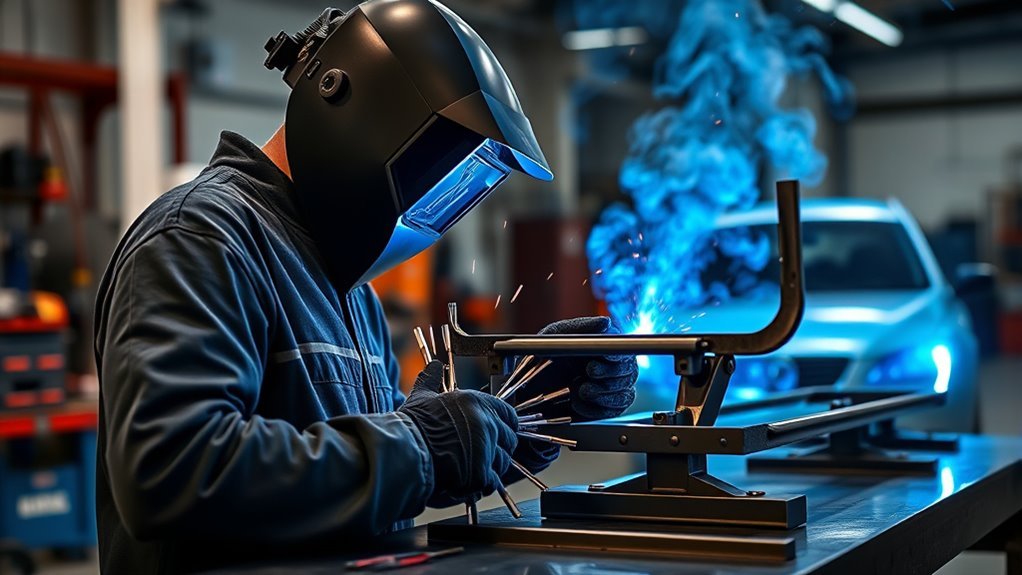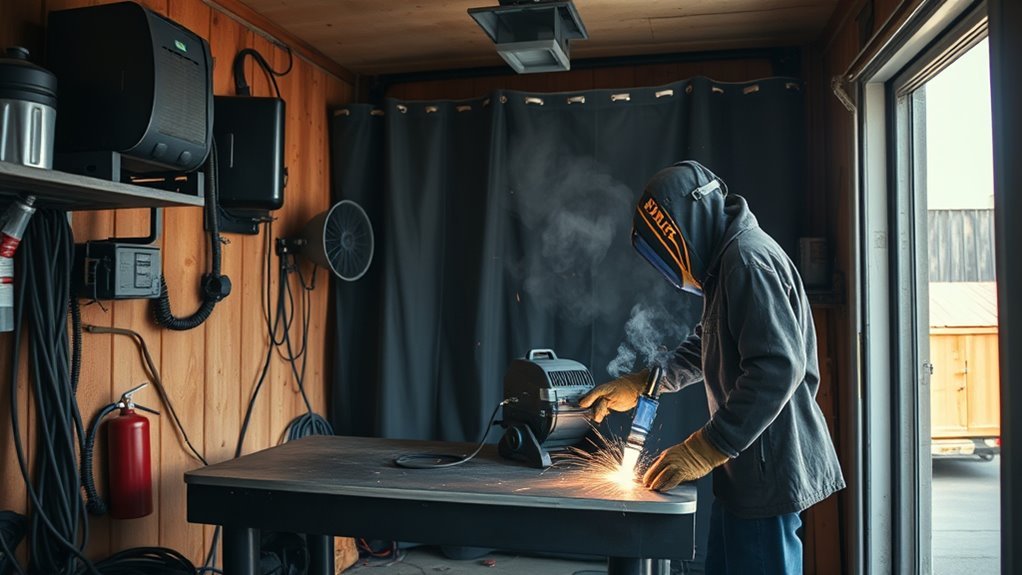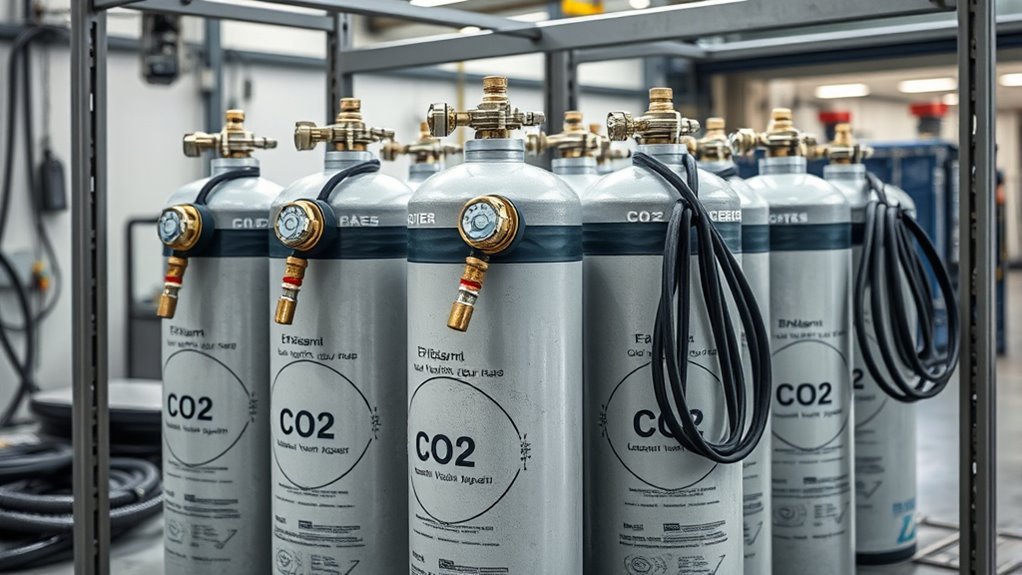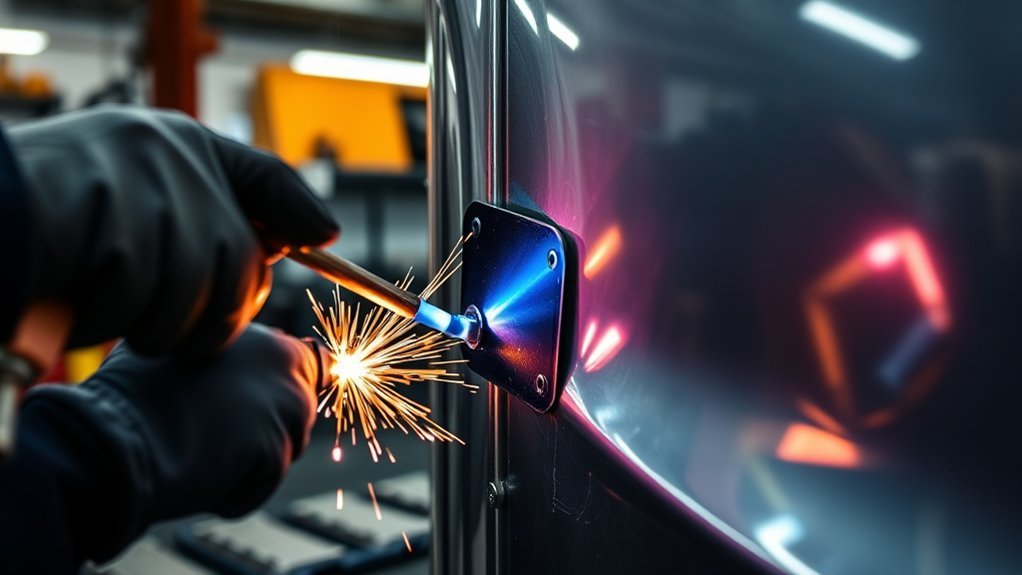
To weld a truck cab corner patch, first confirm the vehicle maker allows the repair method you plan to use. Then remove the trim and fire hazards, cut back to solid steel, fit the patch without forcing it, and use short MIG tack welds or OEM-specified plug welds. Careful fit-up, heat control, weld verification, and corrosion protection matter more than speed.
Quick Answer
Review the truck maker’s repair procedure, make the area fire safe, cut out all weak metal, and clamp the patch to match the door gap and body lines. Use short, spaced MIG tacks on visible seams and OEM-specified plug welds at flanges. Finish with careful grinding, primer, seam sealer, topcoat, and backside cavity wax.
Key Takeaways
- Check OEM body-repair information before choosing a cut line, weld type, hole size, spacing, adhesive, or weld-through primer.
- Cut beyond visible rust until the remaining outer panel and inner structure are clean and solid.
- Use short, widely spaced tack welds instead of one continuous bead on thin visible sheet metal.
- Protect batteries, restraint systems, wiring, fuel and brake lines, interior trim, glass, and vehicle electronics before welding.
- Keep a fire extinguisher ready and watch the repair area, hidden cavities, and the opposite side of the panel for at least 30 minutes after hot work ends.
- Restore corrosion protection with a compatible paint system, seam sealer, underbody coating where required, and cavity wax inside the repaired corner.
At a Glance
| Time Required | Several hours to several days, depending on hidden rust, inner-structure repairs, fit-up, and coating cure times |
| Difficulty | Intermediate to advanced auto-body welding; structural, SRS-adjacent, hybrid, and EV repairs require vehicle-specific training |
| Tools Needed | MIG welder, helmet, safety glasses, gloves, flame-resistant clothing, ventilation or fume extraction, suitable respirator when required, fire extinguisher, welding blankets, grinder, spot-weld cutter, drill, clamps, Clecos, body saw or cut-off wheel, and sanding blocks |
| Cost | Varies by truck, patch-panel quality, hidden damage, coatings, and whether you already own the welding and body tools |
Why Preparation and OEM Repair Information Matter
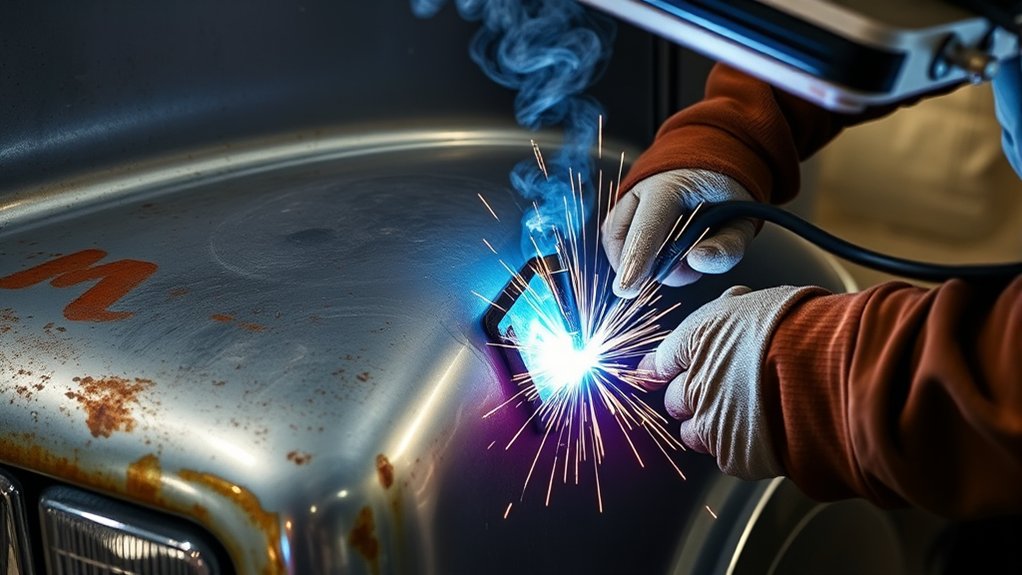
Good cab corner welding starts long before you strike an arc. The patch will only last if the metal is clean, the rust is fully removed, the replacement panel fits correctly, the approved attachment method is followed, and the backside is protected after welding.
Start by identifying the truck’s year, make, model, cab style, and powertrain. Then review the vehicle maker’s body-repair information. The I-CAR OEM Technical Information Matrix shows why this step matters: manufacturers publish different rules for sectioning locations, attachment methods, weld-through primer, foams, sealers, and corrosion protection. Do not assume a repair shown for another truck is acceptable for yours.
Remove paint, undercoating, seam sealer, filler, and rust far enough from the repair area to expose clean steel around the planned cut and weld zones. Contaminated or deeply pitted metal can cause porosity, burn-through, weak fusion, fumes, and corrosion under the repair.
Warning: Cab corner welding is hot work. Follow the OEM battery, SRS, and hybrid or EV disabling procedure. Remove or shield carpet, insulation, wiring, hoses, fuel and brake lines, glass, undercoating, seam sealer, and other combustibles. Keep suitable extinguishing equipment ready, inspect concealed spaces and the opposite side of the panel, and maintain a fire watch for at least 30 minutes after welding or cutting. See OSHA 29 CFR 1910.252 and I-CAR’s vehicle-electronics welding precautions.
Inspect the inner cab corner, rocker edge, floor edge, cab mount area, braces, reinforcements, and drainage paths behind the outer skin. If the inner structure is soft, perforated, detached, or distorted, repair it with the vehicle maker’s approved procedure before installing the outer patch. A cosmetic outer panel cannot restore a damaged structural member.
Check the OEM Repair Procedure Before Cutting
A replacement cab corner may be a separate service panel, part of a larger outer-body assembly, or an aftermarket patch that does not match a factory seam. Before making a cut, confirm all of the following:
- Permitted cut or sectioning location: Use a factory seam or sectioning location only when the vehicle maker allows it.
- Attachment method: Confirm whether the repair calls for GMA/MIG welding, squeeze-type resistance spot welding, plug welds, adhesive, rivets, or a combination.
- Panel material: Identify mild steel, high-strength steel, ultra-high-strength steel, aluminum, or a mixed-material joint. Do not heat, straighten, or weld an unknown material.
- Weld count and spacing: Match the OEM procedure or patch-panel instructions rather than guessing.
- Foam, sealer, and adhesive locations: Restore these materials only with compatible products and at the required stage of the repair.
- Corrosion protection: Confirm where weld-through primer, epoxy or e-coat replacement, seam sealer, undercoating, and cavity wax are required.
Note: Stop and use a qualified collision-repair technician when the approved repair procedure is unavailable, the cut enters structural high-strength steel, the cab mount or restraint-system area is damaged, or the truck is a hybrid or EV that you are not trained to disable.
Essential Tools and Materials for Truck Cab Corner Welding
Truck cab corner repair is thin-sheet-metal work, so choose tools that cut cleanly, hold the panel without stress, control heat, and protect the vehicle. A properly set up MIG welder is a common choice for mild-steel outer panels because it handles short tack welds and plug welds well.
- MIG welder: Use a machine with a stable low-output range for the measured panel thickness.
- Wire: For light-gauge mild-steel body panels, 0.023- or 0.024-inch solid wire is often easier to control. Some machines and thicker flanges may use 0.030-inch wire. ER70S-6 is common, but follow the welder chart, filler-metal data sheet, and OEM procedure.
- Shielding gas: A 75% argon and 25% carbon dioxide blend is commonly used for short-circuit MIG welding on mild-steel sheet. Miller’s sheet-metal welding guidance recommends 0.023- or 0.024-inch wire and an argon-rich 75/25 blend for most light-gauge work.
- Cutting tools: Use a body saw, cut-off wheel, die grinder, aviation snips, or spot-weld cutter as the panel and access require.
- Fit-up tools: Use locking clamps, panel clamps, magnets, Cleco fasteners, a contour gauge, straightedge, scribe, and masking tape.
- Heat-control helpers: A clean copper backing spoon or copper plate can support a small non-structural gap and reduce burn-through.
- Vehicle protection: Use welding blankets, spark-deflection paper, trim-removal tools, and nonflammable shields.
- Finishing supplies: Use the compatible abrasives, cleaner, primer, filler, seam sealer, topcoat, underbody coating, and cavity wax specified by your repair and paint systems.
- Personal protection: Wear a welding helmet, safety glasses, welding gloves, flame-resistant clothing, leather footwear, hearing protection, and respiratory protection selected for the actual fume and coating hazards.
Before welding on the truck, make test welds on clean scrap that closely matches the thickness and coating condition of the original panel and patch. Set polarity correctly, verify gas flow, place the work clamp on clean metal, and adjust voltage and wire speed until the weld is fused without excessive buildup or burn-through.
Pro Tip: Put the work clamp on the same panel and as close to the weld as practical. Keep the current path short, route welding cables away from modules and sensors, and follow the OEM procedure for disconnecting batteries and protecting electronics.
Products Worth Considering

✅【ER70S-6 PROFESSIONAL PERFORMANCE】- Highest manganese-silicon deoxidizers eliminate pre-cleaning! Weld rusty/oily plates smoothly with 100% CO2 gas. Perfect for sheet metal - zero burn-through at high amps (AWS A5.18 Certified).

[9-Inch Heavy Duty Construction] Full 9-inch length provides reach and leverage for welding, sheet metal, and fabrication work.

Exclusive, Patent Pending, Design Provides A Perfectly Beveled 45° Weld-Prepped Edge In 20 Or 18 Gauge Sheet Metal
Inspect, Measure, and Mark the Cab Corner Before Cutting
Do not cut the truck until you know how the replacement patch fits and where the approved repair line belongs. Hold the new cab corner patch over the old panel and compare its shape with the door opening, rocker, lower body line, rear cab seam, and any factory flange. Aftermarket patches often need trimming, reshaping, or light hammer-and-dolly work before they sit correctly.
Park the truck on a level surface and correct any obvious cab or door misalignment before using the gaps as a reference. Record measurements and take clear photos of the door gap, rocker line, body crease, and rear seam. Mark more than one reference line so you can still locate the original contour after the rusty metal is removed.
Open and close the door during test fitting. Check the latch, weatherstrip contact, lower rocker line, and body contour. If rust extends farther than expected, keep trimming until the entire weld edge is solid. Welding to thin, layered, or deeply pitted steel usually causes burn-through and a weak repair.
Cutting the Patch Panel: Step-by-Step Guide
Test-fit the replacement panel before making any cut. Then strip enough coating from the original cab corner to reveal rust perforation, thin edges, old filler, previous welds, and factory attachment points.
- Make the vehicle safe: Follow the OEM disabling procedure, remove nearby trim and insulation, identify hidden lines and wiring, and place fire-resistant protection behind and around the cut.
- Mark the rough cut: Keep the first cut inside the final line so you have room to trim.
- Cut out damaged metal: Use a body saw, cut-off wheel, or die grinder with shallow cuts. Do not cut into inner structure, wiring, hoses, or nearby lines.
- Separate factory flanges correctly: Use a spot-weld cutter or the OEM-specified method where the original panel attaches at a factory seam.
- Repair hidden damage: Remove scale and perforated metal from the inner corner, rocker, floor edge, and reinforcements before fitting the outer patch.
- Trim slowly: Sneak up on the final fit. Remove small amounts, deburr each edge, and test-fit often.
- Preserve drainage: Do not close factory drain paths or trap debris, foam, or rust between layers.
Choose a Butt Seam or Flanged Joint
A butt-welded seam can produce a cleaner visible repair with less double-layer thickness, but it requires accurate trimming and excellent heat control. A flanged or overlapped joint can be easier to clamp and plug weld, but the overlap must be approved for that location and sealed so moisture cannot enter.
For a visible butt seam, aim for an even fit that follows the patch and welder requirements. Do not force a wide gap closed with weld metal. For a factory flange or approved overlap, clean the mating surfaces, apply only the specified weld-through coating, clamp the layers tightly, and duplicate the required attachment pattern.
Note: Body filler cannot correct a patch installed under stress. If the panel must be pushed hard to meet the body line, stop and reshape or retrim it before welding.
Aligning and Tack Welding the Cab Corner Patch
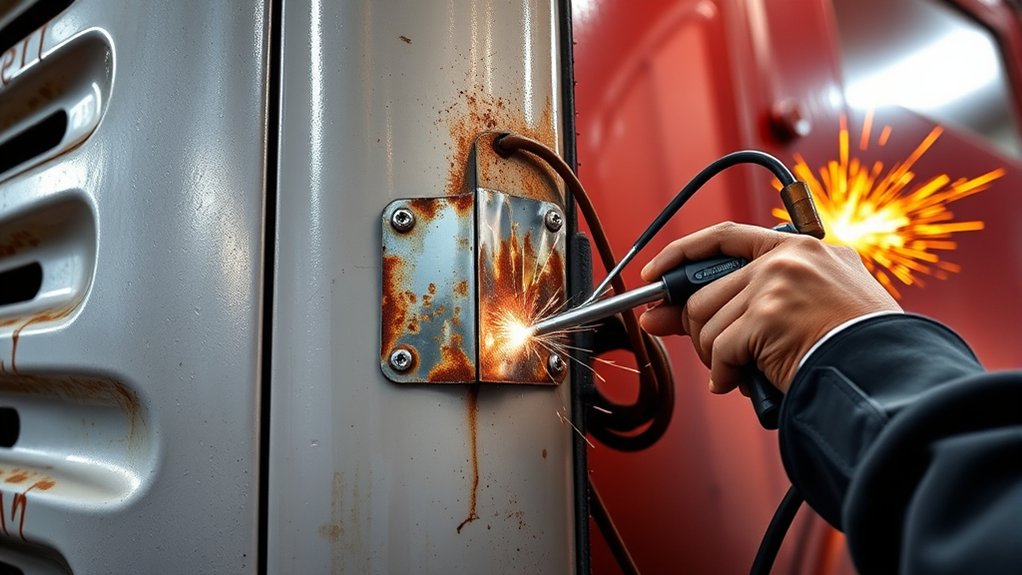
Precise alignment is the difference between a clean repair and a patch that looks wavy after paint. Set the patch in place, align it with the surrounding panels, and secure it with clamps, panel clamps, or Cleco fasteners. Recheck the door gap, rocker edge, rear seam, and body line before the first tack.
For a visible sheet-metal seam, use short tack welds placed far apart. Do not run a continuous bead unless the vehicle maker or an approved repair procedure specifically calls for it. Thin outer panels expand and shrink quickly when heated.
- Place the first tacks at stable reference points that lock the patch into alignment.
- Place each new tack far from the previous hot area.
- Move around the seam in a skip pattern.
- Allow the panel to cool naturally between tacks; do not rush the seam while it is heat-soaked.
- Check the door operation, contour, and seam height as the gaps between tacks become smaller.
- Dress only high tacks when needed for access, then continue until the seam is complete.
Stop if the panel begins to oil-can, crown, sink, or pull the door gap out of position. Find the cause before adding more heat. A forced patch, tight spot, uneven gap, or heavy weld buildup will not correct itself later.
Plug Welding Cab Corner Flanges
Plug welding is used where an approved repair panel attaches to an existing flange and GMA/MIG plug welds are permitted as a replacement for factory spot welds. Common locations include rocker flanges, lower cab edges, and hidden factory seams.
Follow the OEM or patch-panel procedure for hole diameter, hole spacing, edge distance, surface preparation, and weld count. Many general body-repair instructions use holes around 5/16 to 3/8 inch, but that range is not a universal specification. The approved procedure for the exact truck takes priority.
- Prepare clean, flat mating flanges and remove burrs around each hole.
- Apply weld-through primer only where the OEM and product instructions require it.
- Clamp both layers tightly with no gap between them.
- Start the arc on the exposed lower panel in the center of the hole.
- Build the weld outward until the hole is filled and the top panel is fused around the full circumference.
- Let the area cool, then inspect the weld for incomplete fusion, pinholes, cracks, or a loose flange.
A sound plug weld is fused to the lower panel and tied into the top sheet around the hole. A tall button sitting on top, a visible ring around the edge, or a weld that releases during a test coupon check indicates poor fusion.
Warning: Remove paint, rust, ordinary primer, seam sealer, undercoating, foam, oil, and other contamination from the direct weld zone. Welding fumes can contain hazardous metals and gases, and old coatings may create additional hazards. Use effective ventilation or local fume extraction and respiratory protection selected for the exposure. See the NIOSH welding-fume guidance.
Verify Settings and Weld Quality on Test Coupons
Before welding the vehicle, reproduce both the butt-seam tacks and plug welds on matching scrap. Clamp the layers as they will be installed, then inspect the backside for heat pattern and fusion. Cut, bend, or peel the scrap coupon to confirm that the weld tears the surrounding sheet instead of separating cleanly at the joint. Recheck the settings whenever panel thickness, access, wire, gas, extension-cord voltage, or joint design changes.
Smooth Out the Welds Without Thinning the Panel
Once the cab corner patch is fully welded and cool, level the seam without removing the strength you just added. Aggressive grinding can overheat the panel, thin the weld, cut into the parent metal, and create pinholes that appear only after primer or paint.
Essential Grinding Techniques
Start with the least aggressive abrasive that removes the weld efficiently. A 36- to 80-grit flap disc may be useful for initial leveling, while smaller discs, files, and sanding blocks give you more control near body lines and curved surfaces. Keep the tool moving and let the panel cool whenever heat builds.
- Remove only the highest part of the weld bead first.
- Use light pressure and avoid holding the abrasive in one spot.
- Check the seam with your hand, a straightedge, and reflected light.
- Stop before the weld or surrounding sheet becomes thin or low.
- Inspect for pinholes and incomplete areas before applying filler or primer.
- Finish with a sanding block that follows the panel contour.
Proper Filler Application
Body filler is a thin surfacing material, not a substitute for missing metal, poor fusion, a wide gap, or a distorted patch. After the weld is cool, level, and clean, follow one complete paint-system process from the coating manufacturers.
Do not assume every filler can be applied over every epoxy primer. Some systems approve filler over properly cured epoxy within a stated recoat window, while others require filler on prepared bare metal. Read the technical data sheets for the exact filler and primer, and use the sequence both manufacturers permit.
| Step | What to Do |
| Inspect | Confirm the weld is complete, cool, fused, and free of pinholes before coating it. |
| Clean | Remove grinding dust, grease, and residue with the cleaner approved for the coating system. |
| Apply filler thinly | Correct only minor lows and surface irregularities, using the approved bare-metal or epoxy-primer sequence. |
| Block sand | Use a suitable block to feather the repair while preserving the body line and surrounding coating. |
| Prime | Seal exposed metal and prepared filler with the compatible primer before the final surfacing and paint stages. |
Effective Priming Steps
Primer protects prepared surfaces and gives later coatings a stable base. Epoxy primer is commonly used on properly prepared bare steel when the chosen paint system allows it. High-build primer is used later to fill sanding scratches and minor texture, not to replace missing corrosion protection.
- Clean and dry the repair area with products approved by the paint manufacturer.
- Apply the specified corrosion-protective primer to exposed steel within the product’s temperature, film-build, and recoat requirements.
- Apply filler, finishing putty, and seam sealer only in the approved order.
- Use high-build primer where block sanding is needed.
- Guide-coat and block-sand the repair until the contour and body lines are correct.
Preventing Rust After Welding
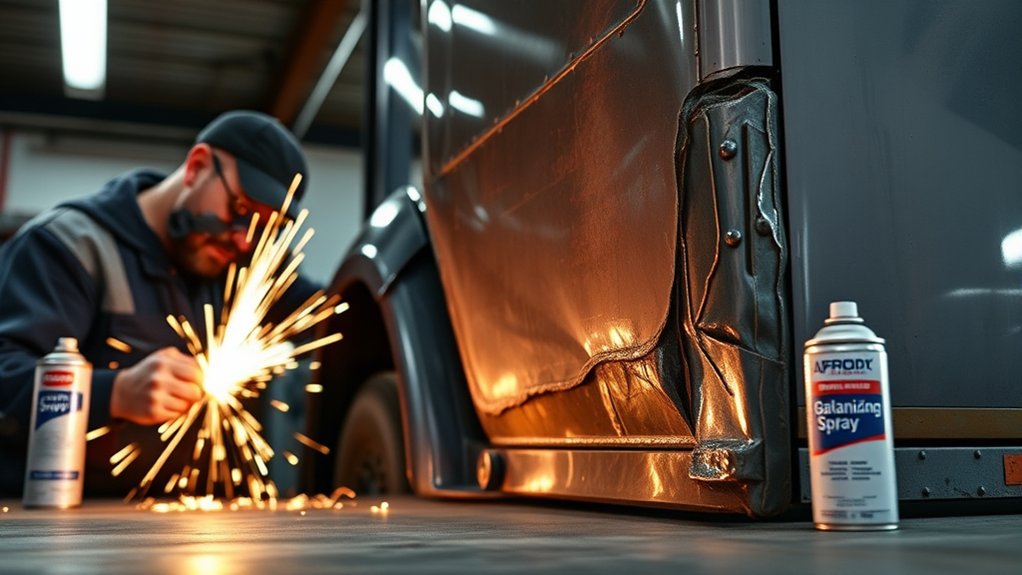
Rust prevention is as important as weld quality. Cab corners collect moisture, road salt, dirt, and condensation, so the repair needs protection on the visible surface, every seam and flange, and the hidden backside.
A zinc-rich weld-through or cold-galvanizing product may be appropriate in a specific flange or coating system, but it is not a universal final coating and should not be sprayed over surfaces that the paint maker requires to be prepared differently. Follow the OEM procedure and product data sheet. Do not substitute a zinc aerosol for primer, seam sealer, topcoat, undercoating, or cavity wax.
The 3M collision-repair corrosion-protection guidance emphasizes restoring protection in non-visible areas with cavity wax and using compatible seam sealers and coatings. Preserve factory drains and apply materials in the order required by the OEM and coating manufacturers.
| Protection Step | Purpose |
| Corrosion-protective primer | Restores protection on prepared bare steel and welded areas as part of the approved paint system. |
| Seam sealer | Blocks water and debris from approved lap joints, flanges, and panel seams. |
| Topcoat and underbody coating | Restore the exterior finish, stone-chip resistance, and weather barrier where the original coating was removed. |
| Cavity wax | Coats hidden backsides, weld flanges, and closed cavities after welding and refinishing. |
| Drain-path check | Confirms that seam sealer, foam, wax, or debris has not blocked the cab corner’s designed water exits. |
A cab corner can look perfect from the outside and still rust again if the weld flange, hidden backside, or drain path is left unprotected.
Final Steps: Priming and Preparing for Paint
After welding the truck cab corner, turn the repaired metal into a stable, paint-ready surface. Clean the area, inspect every weld, seal the approved seams, restore corrosion protection, and build the surface gradually with compatible primers and sanding materials.
Surface Preparation Techniques
Use the cleaner recommended by your paint system before primer. Do not touch cleaned bare metal with oily hands. Mask nearby panels, glass, trim, and openings so overspray and sanding debris stay controlled.
- Clean: Remove dust, oil, adhesive residue, and abrasive debris.
- Inspect: Check for pinholes, missed welds, cracked tacks, low spots, sharp edges, and overheated metal.
- Protect: Apply primer, filler, seam sealer, topcoat, and cavity protection in the approved order.
- Block: Sand with a block that matches the panel shape.
- Check: Use guide coat and reflected light to find waves before color and clearcoat.
Choosing the Right Primer
Use the primer required by the OEM corrosion-protection procedure and the chosen refinishing system. Epoxy primer is commonly used on prepared steel because it can provide a durable barrier, but compatibility, sanding, filler application, seam-sealer timing, and recoat windows vary by product.
High-build primer helps level sanding scratches and minor surface texture. Do not treat it as a substitute for a corrosion-protective primer unless its technical data sheet specifically approves direct application to the prepared substrate.
Final Inspection Steps
Before paint, inspect the repair in bright light and from several angles. Open and close the door. Check the lower rocker line, door gap, rear seam, and cab contour. Use an access opening or inspection camera to confirm the backside is coated and the drain path remains open.
- Confirm every weld is complete and free of visible cracks or pinholes.
- Confirm no prepared bare metal remains exposed.
- Confirm approved seams and overlaps are sealed against water entry.
- Confirm the backside and closed cavities have the specified corrosion protection.
- Confirm drain openings remain clear.
- Confirm the door gap, latch operation, weatherstrip contact, and body line look natural.
- Confirm removed trim, wiring, modules, and restraint-system components are restored according to the OEM procedure.
Troubleshooting Common Cab Corner Welding Problems
| Problem | Likely Cause | Fix |
| Burn-through | Excess heat, long arc time, wide gap, or thin rusty metal | Stop, trim back to stronger metal, improve fit, retune on scrap, shorten tacks, and use clean copper backing only where appropriate. |
| Warping or oil-canning | Too many welds in one area, forced fit, heavy bead, or grinding heat | Stop adding heat, correct fit stress, skip around the seam, allow natural cooling, and grind with lighter pressure. |
| Porosity | Contaminated metal, poor gas coverage, wind, leaking gas path, or excessive gun distance | Remove the porous weld, clean to bare steel, check gas flow and leaks, shield the work from drafts, and retest on scrap. |
| Plug weld sits on top | Arc started on the hole edge, weak clamp pressure, coating in the weld zone, or settings too cold | Clean and reclamp the flange, start on the lower panel, retune on a matching coupon, and follow the specified hole size. |
| Patch does not line up | Panel trimmed too fast, cab or door already misaligned, or patch clamped under stress | Stop welding, recheck measurements and door operation, reshape or retrim the patch, and reclamp it without forcing the contour. |
| Rust returns | Hidden rust remained, backside was left bare, overlap was not sealed, or drain path was blocked | Remove the failed coating and corrosion, repair remaining damage, restore the full coating stack, protect the cavity, and reopen drains. |
| Electrical warning or module fault after welding | OEM disabling steps were missed, current path was too long, or a cable or module was damaged | Stop using the vehicle, follow OEM diagnostic procedures, and have the affected systems inspected by a qualified technician. |
| Smoke or odor after hot work | Smoldering sealer, insulation, foam, debris, or coating inside a concealed cavity | Treat it as a fire emergency, stop work, inspect both sides and hidden cavities, use the extinguisher only when safe, and call emergency services when the source is not immediately controlled. |
Products Worth Considering

Heavy-Duty HSS Spot Weld Cutter : Made from premium High-Speed Steel (HSS) with cutting edge hardness up to 63–66 HRC, this spot weld cutter delivers exceptional durability, sharpness, and strong penetration power for fast and efficient metal cutting

Durable HSS Construction: Our spot weld cutter set is made of HSS for better durability and wear resistance. The double-sided blades ensure long-term use and consistent performance, making it the ideal tool of choice for metal cutting

Separates Spot Welded Panels.
Frequently Asked Questions
What type of welder is best for a truck cab corner patch?
A properly set up MIG welder is a common choice for a mild-steel outer cab corner because it handles short tack welds and plug welds well. The correct process still depends on the panel material, OEM attachment method, access, and technician training.
How do I know if the metal is clean enough to weld?
The direct weld zone should be bright, sound metal with no rust scale, paint, ordinary primer, seam sealer, undercoating, grease, foam, or filler. Cut farther back when the edge is thin, layered, deeply pitted, or perforated.
What MIG wire and shielding gas should I use?
For light-gauge mild-steel body panels, 0.023- or 0.024-inch solid wire with a 75% argon and 25% carbon dioxide blend is a common starting point. Some machines or thicker flanges use 0.030-inch wire. Follow the welder chart, filler-metal data sheet, test-coupon results, and OEM procedure.
What safety gear should I wear while welding?
Wear a welding helmet with the correct shade, safety glasses, welding gloves, flame-resistant clothing, leather footwear, and hearing protection for cutting and grinding. Use ventilation or local fume extraction, plus respiratory protection selected for the actual metal and coating hazards.
How long should I wait before applying body filler?
Wait until the weld and panel are fully cool, then inspect, grind, sand, and clean the repair. The weld does not need to cure, but the filler and primer sequence, surface preparation, temperature, and recoat timing must follow the technical data sheets for the exact products.
Should I butt weld or overlap a cab corner patch?
Use the joint approved for the specific vehicle and repair location. A butt seam can minimize double-layer thickness on a visible area, while an approved flange can simplify clamping and plug welding. Any overlap must be protected and sealed so it does not become a moisture trap.
Can I weld over weld-through primer?
Use weld-through primer only on mating flanges and only when the vehicle maker and primer manufacturer require or permit it. Apply the specified film thickness, allow the stated drying time, and keep the direct fusion area as clean as the procedure requires.
How long should I watch for fire after welding?
OSHA’s general-industry hot-work rule requires a fire watch for at least 30 minutes after welding or cutting when fire-watch conditions exist. A truck cab corner contains concealed seams and cavities, so inspect both sides and hidden areas during and after the repair.
Can I weld a cab corner on a hybrid or electric truck?
Only after following the vehicle maker’s high-voltage disabling, verification, component-removal, and welding procedures. Disconnecting the 12-volt battery alone may not make a hybrid or EV safe. Use a trained technician when you are not qualified for high-voltage work.
Conclusion
Truck cab corner patch welding is a controlled collision-repair process, not a race. Start with the correct OEM information, make the vehicle and work area safe, remove every weak layer, and fit the patch without stress. Tune the welder on matching scrap, use short spaced tacks or approved plug welds, and verify fusion before finishing.
After welding, grind only what is necessary, follow one compatible filler and paint system, seal the approved seams, restore exterior coatings, protect the hidden cavity, and keep the drains open. The repair lasts when the metalwork, fire safety, electronics protection, and corrosion control are all handled with the same care.
Sources
- OSHA 29 CFR 1910.252, General Requirements — hot-work fire prevention, combustible-material control, extinguishing equipment, ventilation, and fire-watch requirements.
- CDC/NIOSH Welding Fumes and Manganese — welding-fume health hazards and exposure concerns.
- I-CAR OEM Technical Information Matrix — vehicle-maker sectioning, attachment, weld-through primer, sealer, and corrosion-protection information.
- I-CAR Vehicle Electronics Precautions for GMA Welding — battery isolation, high-voltage disconnects, work-clamp placement, cable routing, and sensitive electronic components.
- Miller, Successfully Welding Sheet Metal With MIG and TIG — thin-sheet wire size, shielding gas, fit-up, and heat-control guidance.
- 3M Collision Repair Corrosion Protection — cavity wax, undercoating, weld-through primer, seam sealing, and non-visible corrosion protection.