As an Amazon Associate, Garage Welding may earn from qualifying purchases. This does not change the price you pay.
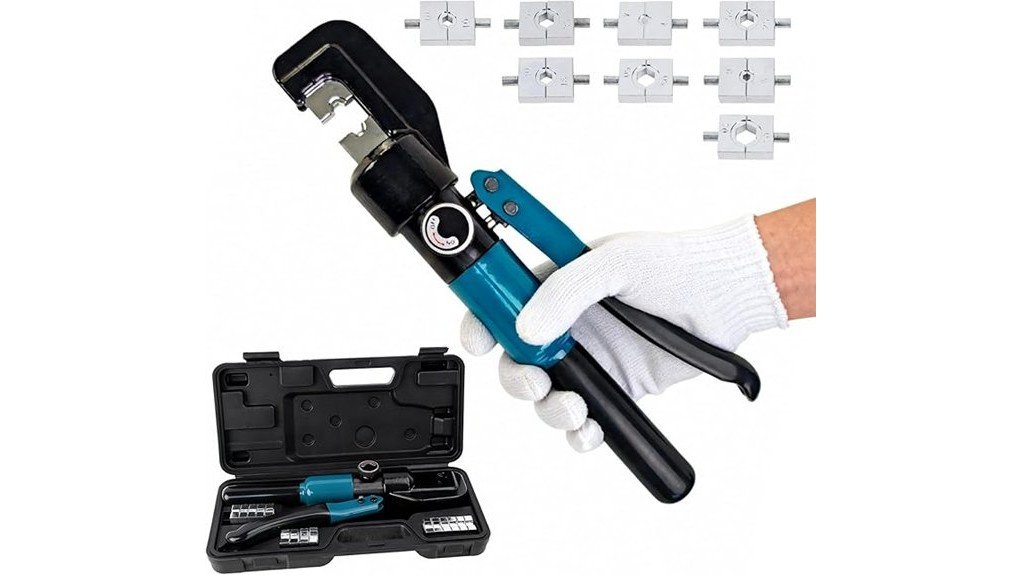
This hydraulic crimping tool is a hand-operated lug crimper with a C-style head and nine die sets, listed for about 12 AWG to 2/0 AWG cables, at roughly 310 mm long and 1.6 kg. It is a practical choice for welders and battery-cable builders who make their own welding leads, and a questionable one if you only need to crimp a lug or two, since a cheaper hammer crimper may do. Check the lug type and the die chart before you order.
Hydraulic Crimping Tool at a Glance
| Item | Per the listing |
|---|---|
| Type | Hydraulic hand crimper with C-style head |
| Cable range | About 12 AWG to 2/0 AWG |
| Dies | Nine die sets |
| Length / weight | About 310 mm / 1.6 kg |
| Extras | Handle return spring; cutter mentioned (confirm) |
| Suggested uses | Battery cables, welding leads, electrical lugs |
Check Current Price on Amazon →
What It Is and Who It Suits
A hydraulic crimper uses a hand pump to push a die onto a lug, squeezing the lug barrel tightly around the cable strands. This gives a gas-tight connection that carries current with low resistance when done correctly.
Welders mostly need this for making or repairing welding leads, ground cables and battery cables. Larger cables like 1/0 and 2/0 are hard to crimp with small pliers.
It suits shop owners, mobile welders and DIY builders who make custom cables. It is overkill for someone who rarely crimps, and it is not meant for small electronics terminals.
How to Check It Fits Your Setup
- Check your cable sizes. Confirm your main sizes (for example 2 AWG, 1/0 or 2/0) are covered by a die set.
- Match the lug type. Dies work for specific lug styles. Copper tubular lugs are common for welding cable; check that the die suits yours.
- Look for the die chart. A chart of which die goes with which cable size should come with the tool; if it does not, ask the seller.
- Consider the head. A C-style head allows side entry in tight spaces, but it must be locked securely before pumping.
- Check the extra claims. The listing mentions stainless fittings and railing cable; do not rely on that without a die designed for it.
Pros and Limitations
Pros
- Covers a broad range of welding and battery cable sizes
- Hydraulic force makes large lugs easier than hand tools
- C-style head for side entry
- Return spring helps one-handed work
Limitations
- Claims beyond cable lugs (railing cable, stainless fittings) are unclear
- Needs the right die and lug combination
- Heavier than a hammer or lever crimper
- Hydraulic seals can leak with age
How to Crimp a Welding Cable Lug Safely
- Cut the cable square and strip only the length the lug barrel needs.
- Insert the strands fully into the lug without bending them back.
- Pick the die marked for that cable size and position the lug barrel centered in the die.
- Pump until the die closes fully. Release only after the tool completes the stroke.
- Pull-test the lug by hand and inspect it for cracks or loose strands.
- Cover with adhesive heat shrink and check the connection for heat after welding.
- Wear safety glasses and keep fingers out of the die area.
Alternatives and Related Guides
- For heavy lead cable, see the heavy-duty welding cable lead reel review.
- For a smaller 2 AWG cable, read the 2 AWG welding battery cable review.
- Want a ready-made lead? See the PAKA Tools welding lead review.
- Pick a ground connection from the Qwork 300 amp ground clamp review.
Frequently Asked Questions
What cable sizes does this hydraulic crimper handle?
The listing says nine die sets cover roughly 12 AWG through 2/0 AWG cable lugs. Match the die to the lug barrel and cable size, and check the manufacturer’s chart for the exact die for each gauge. Do not guess or use the wrong die.
Can I crimp welding cable lugs with it?
It is intended for copper and some aluminum lugs on battery and welding cables. For a safe connection, use lugs rated for your cable size and amperage, strip the correct length and crimp with the matching die. Test the pull on the finished crimp.
Is a hydraulic crimper better than a hammer crimper?
Hydraulic crimpers apply controlled, consistent pressure, giving a tighter, more repeatable crimp than a hammer-style tool. A hammer crimper is cheaper but depends on your strike. For large welding cable, a hydraulic tool is usually easier to use.
Do I still need heat shrink or solder?
Most crimped lugs benefit from adhesive-lined heat shrink to seal out moisture. Soldering is generally not recommended on crimped welding cable lugs since it can stiffen the cable and fail under heat. Follow the lug maker’s instructions.
Final Thoughts
If you build or repair your own welding and battery cables, a hydraulic crimper with a broad die range is a convenient tool. Verify the lug type and die chart so every crimp is done properly.
View Current Listing on Amazon →
See Latest Price and Details →