Disclosure: As an Amazon Associate, we earn from qualifying purchases. If you click a link on this page and make a purchase, we may receive a small commission at no extra cost to you.
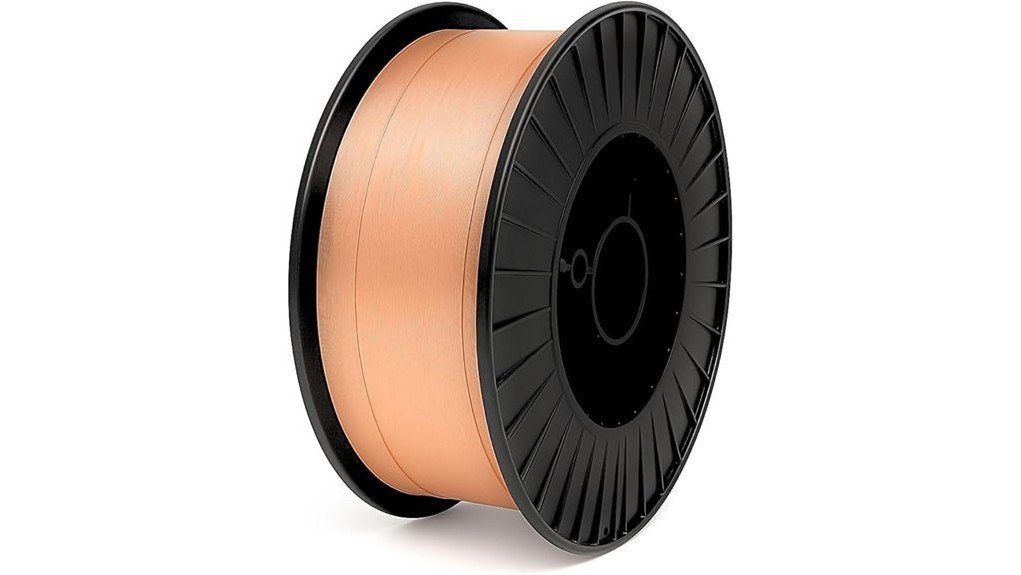
A 33 lb spool can be a smart choice when you weld mild steel often, but only if your feeder accepts the spool and you actually need 0.035-inch solid wire. The Hy-Weld ER70S-6 0.035-inch MIG welding wire is built around that shop-focused format, combining a large 33 lb roll with ER70S-6 mild-steel filler classification. Its main advantages are fewer spool changes, a common wire diameter, and published mechanical-property data, while the biggest limitations are the need for a compatible feeder and shielding-gas setup. This review helps you decide whether those tradeoffs fit your welding work.
Quick Verdict
Rating: 8.5/10
Best For: Frequent mild-steel MIG welding in shops with feeders that accept 33 lb spools and 0.035-inch wire.
Bottom Line: This Hy-Weld spool offers a practical high-capacity format for regular mild-steel fabrication, with ER70S-6 chemistry and published strength data. It is less attractive for occasional welders, small spool-only machines, gasless setups, or stainless and aluminum work.
| Specification | Detail |
|---|---|
| Brand | Hy-Weld |
| Part number | ER70S603533 |
| Product type | ER70S-6 solid MIG welding wire for mild steel |
| Wire diameter | 0.035 inch |
| Spool weight | 33 lb |
| Listing dimensions | 12 × 12 × 5 inches |
| Listed standard | AWS A5.18-05, ER70S-6 |
| Listed chemical composition | C 0.07%, Si 0.86%, Mn 1.53%, P 0.012%, S 0.007% |
| Published yield strength | 450 MPa |
| Published tensile strength | 550 MPa |
| Published elongation | 30% |
| Best use | Regular mild-steel GMAW/MIG work with compatible 0.035-inch feeding equipment |
What Is the Hy-Weld ER70S-6 MIG Welding Wire?
The Hy-Weld product reviewed here is a 33 lb roll of 0.035-inch ER70S-6 mild-steel MIG wire, listed under part number ER70S603533. ER70S-6 is a solid carbon-steel filler classification used for gas-shielded GMAW, commonly called MIG welding. The large spool is aimed more at regular shop use than at occasional repairs with compact hobby machines.
The listing states conformance to AWS A5.18-05 and publishes a yield strength of 450 MPa, tensile strength of 550 MPa, and 30% elongation. Those figures give you more useful buying context than generic claims about strong welds, but actual weld properties still depend on base metal, shielding gas, joint preparation, settings, technique, and procedure.
Key Takeaways
- You get a 33 lb spool, which can reduce spool-change downtime during frequent fabrication work.
- The 0.035-inch diameter is a common shop size for mild-steel MIG work, but your drive rolls, liner, contact tip, and feeder must all support it.
- The listing identifies the wire as ER70S-6 and states AWS A5.18-05 conformance.
- Published mechanical properties include 450 MPa yield strength, 550 MPa tensile strength, and 30% elongation.
- This is solid MIG wire, not self-shielded flux-core wire, so plan around a suitable shielding-gas setup and your welder manufacturer’s instructions.
Who Should Buy It?
Best For
- Fabricators who regularly weld mild steel with 0.035-inch solid wire.
- Shops that want the longer run time of a 33 lb spool.
- Users with a feeder, spool hub, liner, tip, and drive-roll setup sized for this wire.
Skip If
- Your welder accepts only small spools or cannot feed 0.035-inch wire.
- You need gasless flux-core wire for exposed outdoor work.
- You are welding stainless steel or aluminum and need a filler matched to those materials.
Before You Buy: Check your feeder’s spool-size limit before ordering. A 33 lb spool is much larger than common 2 lb or 10 to 11 lb hobby spools, and the wire is useful only if your machine can physically mount and feed it correctly.
What the 0.035-Inch Wire Diameter Means
A 0.035-inch wire sits in a practical range for many shop MIG applications. Compared with thinner wire, it can support productive welding on moderate material thicknesses when your machine has enough output. It is also widely supported by MIG guns, contact tips, liners, and drive-roll systems.
The diameter itself does not guarantee lower spatter or deeper penetration. Those results also depend on voltage, wire-feed speed, shielding gas, stickout, travel speed, joint condition, and transfer mode. The main buying advantage is that 0.035 inch is a useful general-purpose size for welders who already have equipment set up around it.
Mechanical Strengths of ER70S-6: What You Need to Know
The product listing publishes 450 MPa yield strength, 550 MPa tensile strength, and 30% elongation. These numbers describe the filler wire’s stated mechanical performance and help explain why ER70S-6 is commonly chosen for mild-steel fabrication.
Do not treat those figures as a guarantee that every finished joint will reach the same performance. Your base material, welding procedure, gas mix, heat input, joint design, and workmanship matter. For code work or load-bearing fabrication, follow the approved welding procedure and required material documentation rather than relying on a retail listing alone.
Spool Size, Feeding, and Shop Convenience
The biggest practical feature is the 33 lb spool. If you weld often, the extra capacity can mean fewer interruptions to replace wire. That can be useful in fabrication, repair, and repetitive shop work where stopping to change a small spool costs time.
The tradeoff is compatibility. A large spool requires the right hub, cabinet clearance, drive system, and stable feeding path. The listing reports 12 × 12 × 5-inch product dimensions, so check your feeder enclosure and spindle arrangement instead of assuming the roll will fit.
For consistent feeding, use drive rolls intended for solid wire and the correct 0.035-inch liner and contact tip. Excessive drive-roll pressure can deform wire or increase feeding problems, while too little pressure can cause slipping.
How It Performs in Real Use
For General Mild-Steel Fabrication
ER70S-6 is a practical class for general mild-steel GMAW. Its chemistry is designed with deoxidizers that make it more tolerant of normal surface contamination than some lower-deoxidizer solid wires, but you should still remove heavy rust, paint, oil, moisture, and scale where practical. Better joint preparation usually gives you a more predictable arc and weld.
For Longer Shop Runs
The 33 lb roll makes the most sense when wire consumption is steady. You can run longer between spool changes, which is useful for repeated brackets, frames, repairs, or production-style work. If you weld only a few small projects each year, a smaller spool may be easier to store and less likely to sit exposed to moisture for long periods.
For Automatic or Semi-Automatic Feeding
The wire can be used in suitable GMAW feeding systems that accept its diameter and spool format. Smooth performance depends heavily on the entire feed path, so match the drive-roll groove, liner, tip, and tension to 0.035-inch solid wire. A worn liner or mismatched tip can create feeding problems even when the wire itself is sound.
For Outdoor Welding
This is not the easiest choice for exposed windy conditions because solid MIG wire relies on shielding gas. Wind can disturb the gas envelope and increase the risk of porosity. For outdoor work, use proper wind control if the procedure allows it, or consider a process designed for those conditions.
Setup Tips Before You Weld
- Confirm spool fit: Make sure your feeder can mount a 33 lb spool and has enough enclosure clearance.
- Match the feed components: Use a liner, contact tip, and drive-roll groove intended for 0.035-inch solid wire.
- Set tension carefully: Use enough drive pressure to feed reliably without crushing or shaving the wire.
- Follow the welder chart or manual: Start with machine-recommended voltage and wire-feed settings for your material thickness, gas, and joint.
- Keep the gas shield stable: Check gas flow, leaks, nozzle condition, and drafts before welding.
- Prepare the joint: Remove heavy contamination and make sure the joint fit-up is suitable for the weld.
Pro Tip: Before loading the full spool, verify that you have the correct 0.035-inch contact tips and drive-roll setup on hand. A correctly matched feed path can prevent many bird-nesting, slipping, and inconsistent-wire-feed problems.
Compatibility and Safety
This wire is intended for mild-steel MIG/GMAW work. It is not the right filler for aluminum or stainless-steel jobs that require a different alloy. It is also not a substitute for self-shielded flux-core wire when you need a gasless setup.
Welding exposes you to heat, arc radiation, electrical hazards, fumes, sparks, and compressed-gas risks. Use appropriate welding PPE and ventilation, secure gas cylinders correctly, keep flammables away, and follow the instructions for your welder, shielding gas, wire, and workpiece. For structural or code-controlled work, use the specified filler metal and qualified procedure.
Pros and Cons
Pros
- Large 33 lb roll reduces spool-change frequency for regular users.
- Common 0.035-inch diameter fits many shop MIG setups.
- ER70S-6 classification is well suited to general mild-steel fabrication.
- Listing provides concrete mechanical-property data instead of only broad marketing claims.
- Part number ER70S603533 makes the exact variant easier to identify.
Cons
- 33 lb spool will not fit every compact or hobby MIG welder.
- Solid ER70S-6 wire needs a shielding-gas setup, so wind can complicate outdoor use.
- Not intended as a filler for aluminum or stainless-steel welding.
Is It Worth the Price?
This spool makes the strongest value case for buyers who use enough 0.035-inch mild-steel wire to benefit from a 33 lb roll. For a busy garage or fabrication shop, fewer spool changes and a common ER70S-6 specification can make the larger format more convenient than repeatedly buying smaller rolls.
Value drops if your welder cannot accept the spool, if you weld only occasionally, or if much of your work uses stainless, aluminum, or self-shielded flux-core wire. Compare the current cost per pound with smaller spools, but put feeder compatibility ahead of price.
How It Compares to Alternatives
The Forney 42281 is another 33 lb, 0.035-inch ER70S-6 mild-steel wire and may appeal to buyers who prefer a widely distributed welding brand. The ESAB Weld 70S-6 321M096700 and Lincoln Electric SuperArc L-56 ED031411 are also 0.035-inch, 33 lb ER70S-6 options with detailed industrial specification data available from major suppliers.
The Hy-Weld roll makes the most sense when its current price and availability are favorable and the published ER70S-6 specifications meet your procedure. For critical work, compare manufacturer documentation, lot certification, and required approvals rather than choosing only by spool price.
Frequently Asked Questions
What welding machines are compatible with this 0.035-inch ER70S-6 wire?
Use it with a MIG/GMAW feeder that supports 0.035-inch solid wire and can physically accept a 33 lb spool. Your drive rolls, liner, contact tip, spool hub, shielding-gas system, and machine output must also match the job.
Does ER70S-6 wire need shielding gas?
Yes, this is solid MIG/GMAW wire rather than self-shielded flux-core wire. Use the shielding gas and polarity specified by your welder, procedure, and filler-wire documentation.
Can I use this wire for stainless steel or aluminum?
No. This product is identified as ER70S-6 mild-steel wire. Stainless steel and aluminum normally require filler alloys chosen for those base metals and the applicable welding procedure.
Is a 33 lb spool better than a smaller spool?
It is better for frequent welding because it reduces spool changes and can improve cost-per-pound value. A smaller spool may be more practical if you weld infrequently, have limited storage space, or own a compact machine that cannot mount a 33 lb roll.
How should I store ER70S-6 MIG wire?
Keep the spool clean and dry, protected from condensation, moisture, dirt, and corrosive storage conditions. Do not rely on a fixed shelf-life number unless the manufacturer gives one for the exact product and packaging.
Can I use this wire outdoors?
You can weld outdoors only when you can maintain adequate shielding and the procedure allows it. Wind can blow away MIG shielding gas, so exposed outdoor work is often easier with a process designed to tolerate those conditions.
What is the most common setup mistake with 0.035-inch wire?
A common mistake is mixing component sizes, such as using the wrong contact tip, liner, or drive-roll groove. Confirm the complete feed path is matched to 0.035-inch solid wire before troubleshooting the spool itself.
Who should skip this Hy-Weld spool?
Skip it if your welder cannot hold a 33 lb spool, if you need gasless flux-core wire, or if your projects mainly involve stainless steel or aluminum. Occasional users may also prefer a smaller roll that is easier to store and use before corrosion becomes a concern.
The Bottom Line
The Hy-Weld 33 lb ER70S-6 0.035-inch MIG wire is a solid fit for regular mild-steel welding when your feeder is built for a full-size spool. Its strengths are the high-capacity roll, common wire diameter, and published ER70S-6 mechanical properties, while its main limitation is that it requires the right feeder and gas-shielded MIG setup.
Buy it if those specifications match your machine and workload. Skip it if you need a small-spool, gasless, stainless, or aluminum solution.