As an Amazon Associate, Garage Welding may earn from qualifying purchases. This does not change the price you pay.
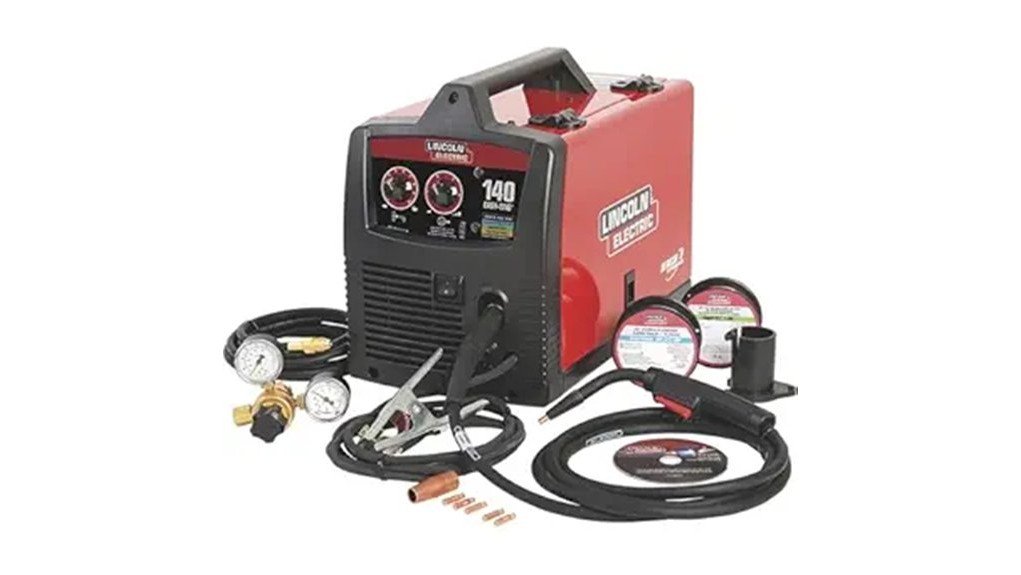
The Lincoln Electric K2697-1 is the Easy MIG 140, a compact 120 V wire-feed welder. According to the listing it delivers 30 to 140 amps and handles mild steel from 24 gauge to 3/16 inch with a 20% duty cycle. It is a sensible pick for home workshops, auto-body and light repair where you want a recognized brand; for thicker steel or all-day welding you want a 240 V machine.
Lincoln K2697-1 Easy MIG 140 at a Glance
| Item | Per the listing | What to verify |
|---|---|---|
| Model | Lincoln Electric K2697-1 (Easy MIG 140) | Check that your listing says K2697-1 |
| Input | 120 V AC | Dedicated outlet and breaker size |
| Output | 30 to 140 A DC | Rated amps at your duty cycle |
| Duty cycle | 20% | Rating is at a specific current. Read the manual |
| Wire speed | 50 to 500 IPM | Matches your wire size |
| Mild steel range | 24 ga. up to 3/16 in. | Multi-pass near the upper limit |
| Size | About 13-3/4 in. high and 10-1/8 in. wide | Weight and handle position |
Check the current price on Amazon →
What It Is and Who It Suits
The Easy MIG 140 is part of Lincoln’s entry-level wire-feed line. Wire-feed welding works two ways. With solid wire and shielding gas (commonly 75/25 argon/CO2 for mild steel) you get cleaner welds with less spatter. With self-shielded flux-core wire you need no gas, which suits outdoor and windy conditions but creates more smoke and slag.
It suits hobbyists, farm and ranch users, restoration and fabrication of sheet steel and light tube. Some listings suggest it can also weld aluminum and stainless steel, but aluminum MIG needs 100% argon, appropriate wire and usually a spool gun or other setup, and stainless needs the correct wire and gas. Treat those as add-ons to confirm against Lincoln’s documentation, not as standard capabilities.
How to Check It Fits Your Shop
- Electrical: a 120 V welder at 140 A draws a lot of current. Check the input current and breaker size in the manual, use a dedicated circuit, and avoid long thin extension cords. See our extension cord guide.
- Material thickness: if you often weld 1/4 in. steel or heavier, this machine is too small. Its stated range tops out at 3/16 in.
- Wire and gas: check wire diameter and spool-size limits in the manual. If you want gas-shielded MIG, confirm whether a regulator and hose are included in your listing. See our ER70S-6 wire review.
- Consumables: check the gun’s contact tip and nozzle sizes and keep spares. See MIG contact tips.
- Aluminum plans: confirm a compatible spool gun or setup in Lincoln’s documentation before buying wire.
View the Lincoln K2697-1 on Amazon →
Pros and Limitations
Pros
- Recognized brand with support and parts available.
- Compact enough to carry and store in a small shop.
- Runs on 120 V household power.
- Continuous wire speed control for fine tuning.
Limitations
- 20% duty cycle limits long welds at higher settings.
- Maximum thickness is 3/16 in. in the listing.
- Needs a good 120 V circuit.
- Gas, regulator and extras may cost more.
Setup and Safety Tips
- Use the correct polarity for solid wire and for flux-core wire; follow the manual’s diagram.
- Wear a welding helmet, leather gloves and non-synthetic clothing. See our helmet review.
- Clean mill scale, rust and paint from the joint. Do not weld galvanized or plated metal without ventilation and a respirator.
- Test on scrap with the chart inside the wire-feed door as a starting point.
- Replace worn tips and keep the liner clean to avoid feeding problems.
Related Guides
- Lincoln Viking 2450 review for a name-brand auto-darkening helmet.
- Forney Easy Weld 140 MP as a multi-process comparison.
- Forney 140 FC-i kit for a flux-core-only alternative.
Verdict
The Lincoln K2697-1 is a good, name-brand starter wire-feed welder for light steel work on 120 V power. Check what is included and its duty cycle, and move up to a 240 V machine if you plan to weld thicker material regularly.
Check Lincoln K2697-1 availability →
Frequently Asked Questions
What thickness can the Lincoln K2697-1 weld?
The listing quotes mild steel from 24 gauge to 3/16 inch. That is the maximum range, with best results on thinner material. Thicker pieces may need beveling and multiple passes, and a 240 volt machine is a better choice for regular heavy work.
Does the Lincoln K2697-1 need shielding gas?
It depends on the wire. Solid wire needs shielding gas, commonly a 75/25 argon and CO2 mix for mild steel. Flux-core wire is self-shielded and needs no gas. Check the manual for the polarity and wire types it supports.
What does a 20 percent duty cycle mean?
Duty cycle is the portion of a ten-minute period the welder can run at a stated current without overheating. At 20 percent that is about two minutes of welding followed by eight minutes of cooling. Lower settings usually allow longer welding.
Can I weld aluminum with the Easy MIG 140?
Not with a standard setup. Aluminum MIG needs 100 percent argon, aluminum wire and usually a spool gun or push-pull gun. Check Lincoln’s documentation for which accessories this model supports before buying any.