As an Amazon Associate I earn from qualifying purchases. Buying through these links costs you nothing extra.
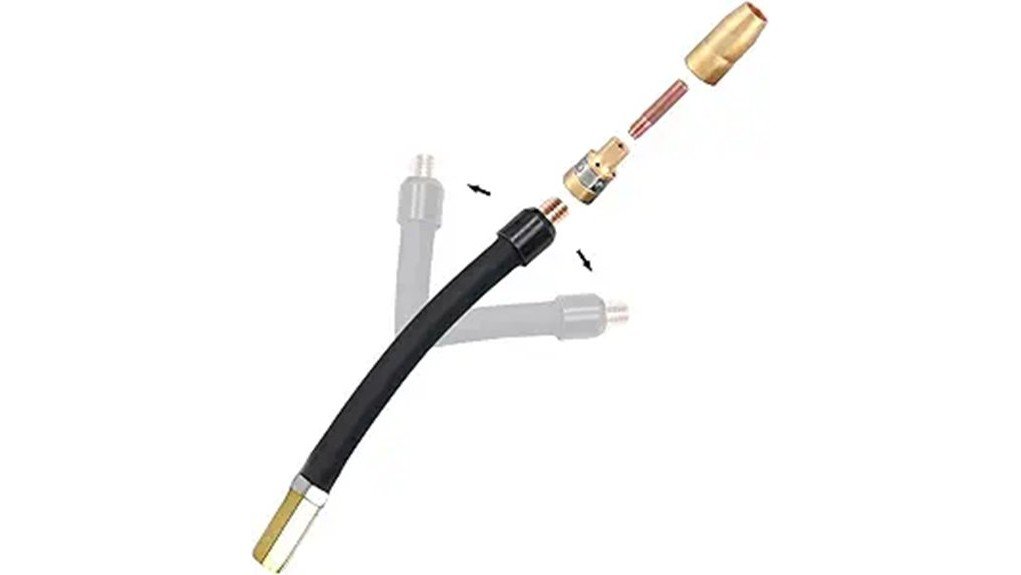
The flexible MIG gun neck reviewed here is a replacement swan neck that, according to its Amazon listing, is intended for Hobart Handler MIG welders (models 135, 140, 175, 180, 190, 210 and 210MVP). It is worth considering if you own one of those machines and want a neck you can bend or rotate to reach awkward joints. Skip it if your gun is a different brand or series, because a neck only works if it matches your gun’s handle and consumables.
Flexible MIG gun neck at a glance
| Item | Per the listing |
|---|---|
| Type | Replacement MIG gun neck (swan neck) with adjustable angle |
| Material | Brass construction |
| Listed compatibility | Hobart Handler 135, 140, 175, 180, 190, 210, 210MVP |
| Listed weight and size | 8.1 oz; 7.52 x 3.9 x 1.14 in (may be shipping dimensions, so check the listing) |
| Supplied parts | Neck, with conductive nozzle and contact nozzle mentioned in the listing; confirm what is in the box |
Specs come from the seller’s listing and can change, so confirm the details on the current page.
What a flexible neck does and who it suits
A standard MIG gun neck is a fixed, curved tube. A flexible or rotating neck lets you change the approach angle without twisting your wrist or the whole gun. That can help on inside corners, close to a wall, or under a frame rail.
It mainly suits hobbyists and small-shop fabricators with a Hobart Handler who find the stock neck awkward in tight spots. It is not a power upgrade. Your wire speed, voltage and technique still decide weld quality.
How to check it fits your setup
Do not rely on the machine name alone. Many guns look similar and use different neck threads and consumable styles. Run through this list before ordering:
- Confirm your exact Handler model and whether the gun is the original one that shipped with it. A previous owner may have swapped it.
- Check the part number or markings on your current neck and compare them with the listing and its Q and A section.
- Check how the neck attaches to the handle (nut, collar or threaded insert) and compare it with photos in the listing.
- Make sure the contact tip, nozzle and diffuser style match the neck. Tip size must match your wire diameter (for example 0.030 or 0.035 in).
- Check the listing’s return policy so you can send it back if it does not seat correctly.
Pros and limitations
Pros
- Adjustable angle can improve access to tight joints.
- Brass is a common, heat-tolerant material for gun necks.
- Replacing a neck is cheaper than replacing a whole gun.
Limitations
- Fit is limited to the listed Hobart Handler models, so it is a poor choice for other brands.
- A flexible neck has more joints than a solid one. Check periodically for looseness, because a loose connection can overheat and give an unstable arc.
- Gas coverage can suffer if the angle is bent so far that the nozzle sits awkwardly. Keep a normal stick-out.
- Long-term durability depends on duty cycle and how often you bend it, and no manufacturer figures are given in the listing.
Installing and using the neck safely
- Unplug the welder and close the gas valve. Let the gun cool completely.
- Remove the nozzle, contact tip and diffuser from the old neck.
- Loosen the neck retaining nut or collar and pull the neck out. Note how the neck seats so you can reverse it.
- Seat the new neck fully and tighten snugly by hand and wrench as the instructions say. Do not over-tighten.
- Refit the diffuser, contact tip and nozzle, and check the wire passes freely.
- Set the angle before you weld, not while the gun is hot.
Always wear a proper auto-darkening or fixed-shade helmet, leather gloves and flame-resistant clothing, and weld with ventilation. Fumes from mild steel, and especially galvanized or coated metal, should not be breathed.
What buyers should look for
Listings for this kind of part usually highlight easy installation and better access. Treat those as claims to verify against your own gun. The key points are correct model match, snug threads, and a stable electrical connection. If the neck gets unusually hot or the wire feeds erratically after install, stop and recheck the seating.
Alternatives and related guides
- If your problem is worn consumables rather than reach, see this contact tip review.
- Need a nozzle for a different machine? Read the Millermatic 252 nozzle review.
- For feeding problems rather than reach, check the MIG liner and conduit review.
- If you want a whole new gun, look at the MIG gun torch review.
Frequently Asked Questions
Which welders does this flexible MIG gun neck fit?
The listing names Hobart Handler 135, 140, 175, 180, 190, 210 and 210MVP machines. Do not assume it fits other brands or older guns. Compare your current neck markings and attachment style with the listing photos, and ask the seller if you are unsure.
Can I use a flexible neck for aluminum or stainless wire?
The neck itself only carries the wire and current. Material choice depends on your machine, wire, liner and shielding gas. Aluminum usually needs 100 percent argon and a suitable liner or spool gun, so check your machine manual rather than relying on the neck.
Does a flexible neck make welds better?
Not by itself. It can help you hold a steadier angle in tight places, which may help bead consistency. Settings, travel speed, stick-out and clean metal still matter most.
Do I need new consumables with a new neck?
Often the existing contact tip, diffuser and nozzle can be reused if the style matches. Inspect them first and replace worn tips. The tip bore must match your wire diameter.
Conclusion
This flexible neck is a sensible repair-and-access upgrade for the Hobart Handler models named in the listing, provided you verify your gun first. For any other machine, look for a neck made for your exact gun.