As an Amazon Associate I earn from qualifying purchases. Buying through these links costs you nothing extra.
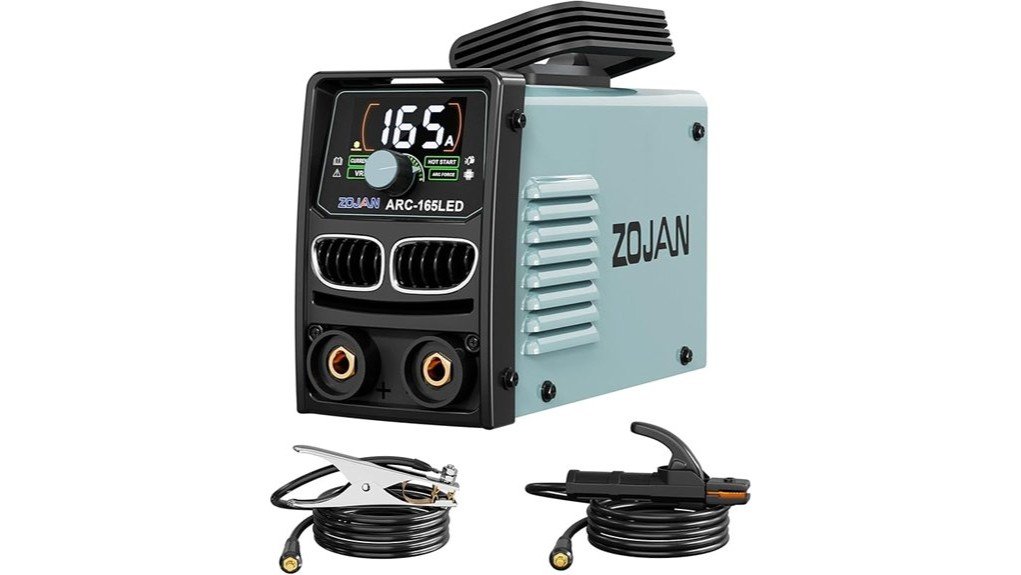
This 165A stick welder is a lightweight IGBT inverter machine, listed at about 8.16 pounds, with Hot Start, Anti-Stick and a digital display. It is aimed at beginners and hobbyists who want a portable stick welder for light repairs and learning. It is worth a look if your work is mostly thin to medium steel; skip it if you need to run big electrodes or weld thick plate daily.
165A Stick Welder at a Glance
| Item | Per the listing | What to verify |
|---|---|---|
| Type | IGBT inverter stick (MMA) welder | Whether it also supports lift TIG |
| Output | 165 A maximum | Maximum depends on the input voltage |
| Weight | About 8.16 lb | Weight with leads may be higher |
| Features | Hot Start, Anti-Stick, digital display | How the display and dials are laid out |
| Electrodes | 6013 and 7018 mentioned | Diameter range and duty cycle |
| Input power | See the listing | Plug type, breaker and extension-cord needs |
What It Is and Who It Suits
Inverter stick welders convert household power to a compact, controlled DC output, which is why a 165A machine can weigh under 10 pounds. Hot Start gives a brief current boost when you strike the arc, helping the electrode ignite. Anti-Stick reduces the current if the rod sticks, so it is easier to break free without the rod glowing red.
This kind of machine suits gate repair, trailer and implement fixes, hobby projects, and learning stick welding on mild steel. The portable size is its main strength. Its weaknesses are the ones every small stick inverter has: limited duty cycle, and limited ability to run large-diameter rods continuously.
How to Check It Fits Your Shop
- Input power: check whether the machine needs 120 V, 240 V or accepts both, and what plug it comes with. Output current is usually lower on 120 V. Do not swap plugs or use adapters to fit a circuit that is not rated for it.
- Breaker and cord: confirm the required breaker size. If you use an extension cord, choose a short, heavy-gauge cord rated above the machine’s input current.
- Electrode range: 6013 and 7018 are named in the listing. Small-diameter rods (around 3/32 to 1/8 in.) are the realistic range for a machine this size. Check the manual for the diameters it supports.
- Duty cycle: look for the duty cycle at your working amperage. A rating at 165 A is usually a low percentage.
- Accessories: check whether the electrode holder, ground clamp and cables are included, and whether the lead connectors are standard.
Pros and Limitations
Pros
- Very portable for an arc welder.
- Hot Start and Anti-Stick are helpful for learners.
- Digital display makes it easier to repeat amperage settings.
- Works with common mild-steel electrodes.
Limitations
- Low-cost inverters have limited duty cycle and thermal cutoffs can interrupt long welds.
- Maximum current may not be available on a standard household outlet.
- Brand support and parts availability can be uneven for lesser-known machines. Check the return and warranty terms on the listing.
- Stick welding on thin sheet metal takes practice because burn-through is easy.
Using It Safely and Getting Better Welds
- Use a helmet with a shade of about #10 to #13 for typical stick work, and check the filter’s chart. See our welding helmet review and welding gloves review.
- Keep 7018 rods dry. Moisture in low-hydrogen electrodes hurts weld quality. 6013 is more forgiving for general work.
- Start with a clean surface, a good ground clamp connection and the amperage recommended on the electrode box.
- Do not weld near flammables or on coated or galvanized metal without ventilation.
- Let the machine rest if the overheat light comes on, and keep vents clear of dust.
Related Guides
- Our stick welder settings chart and stick welder not arcing guide help with setup and troubleshooting.
- Sunstac stick welder review compares another budget inverter.
- Menshine 120A arc welder if you want something smaller.
- E6013 welding rod review and E7018 rod review for electrodes.
Verdict
The 165A stick welder is a practical, portable starter machine for light fabrication and repairs. Confirm the input voltage, duty cycle and what is included before you buy. Treat it as a hobby-grade machine rather than a production welder.
Frequently Asked Questions
What electrodes can a 165A stick welder use?
The listing mentions 6013 and 7018 electrodes. E6013 is easy to run on clean mild steel, while E7018 is a low-hydrogen rod that needs to be kept dry. Check the manual for the diameter range, and avoid 6010, which needs a DC machine built for it, unless the manual lists it.
Does Hot Start help beginners?
Yes. Hot Start gives a short current boost at the start of the arc, which helps the electrode ignite instead of sticking or stuttering. Anti-Stick also lowers current if the rod freezes to the work. Neither replaces practice, but both reduce early frustration.
Can I weld thick steel with a 165A stick welder?
You can weld thick steel in multiple passes, but a small inverter runs out of duty cycle quickly, especially on 120 volts. For regular work on plate over about 1/4 inch, a machine with a higher duty cycle and 240 volt input is the better choice.
Is it safe to use outdoors?
Use it outdoors only when dry. Do not weld in rain or on wet ground, and keep the machine off wet surfaces. Wind is fine for stick welding because the rod provides its own shielding, but protect the welder from moisture and dust.