As an Amazon Associate, Garage Welding may earn from qualifying purchases. This does not change the price you pay.
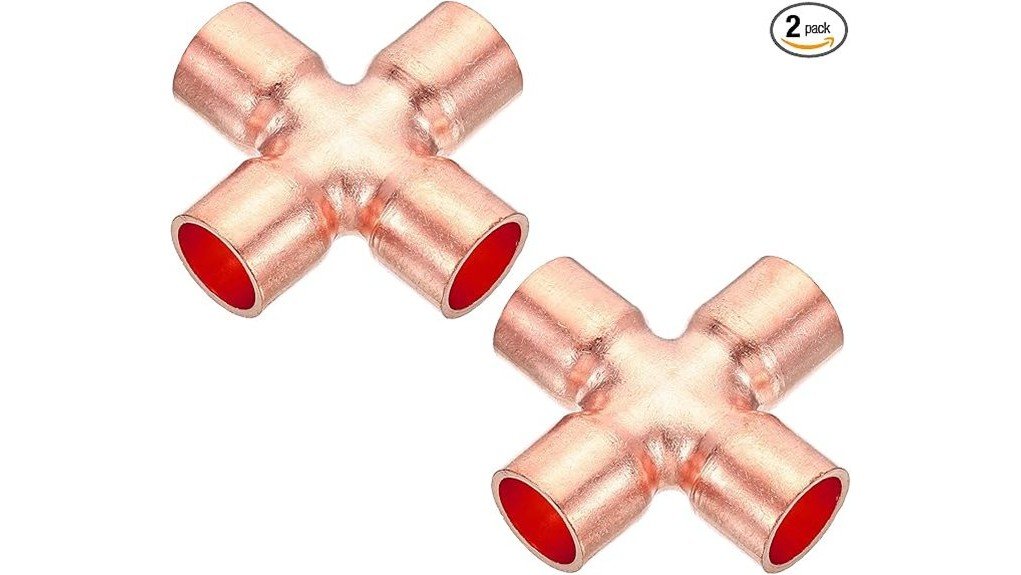
The PATIKIL copper union cross pipe fitting is a small four-way copper fitting that joins four pipe runs at one point. It suits refrigeration-style tubing projects, hobby plumbing, copper art or fixtures, and similar jobs if you confirm the tube size first; it is not a fitting to trust blindly for gas lines or drinking-water supply.
This review is based on the seller’s Amazon listing, and it focuses on the one thing that causes most returns with copper fittings: matching the fitting size to your tube.
Quick specs at a glance
| Item | Detail |
|---|---|
| Item | Four-way copper cross fitting (solder or braze type) |
| Listed inner diameter | 1/2 in (about 12.7 mm) |
| Listed outer diameter | About 15 mm |
| Listed overall size | About 45 x 45 mm |
| Listed weight | About 1.6 oz |
| Listed uses | Plumbing, HVAC and refrigeration style piping (confirm for your use) |
| Not stated in the listing | Pressure rating, lead-free status, approvals for potable water or fuel gas |
What it is and who it suits
A cross fitting has four openings arranged at 90 degrees, so one body can connect two straight runs that intersect, or feed four branches from a single junction. A copper version is normally joined by soldering or brazing, with the tube sliding into each socket.
It fits people who:
- Work with copper tube in small refrigeration, cooling or air-line style builds and need an intersection point.
- Build copper frames, racks, lamps or garden structures where a four-way joint is useful.
- Need a spare cross fitting for repairs and already know their tube size.
If you are working on household plumbing, check local code first. Many places require fittings that are listed as lead-free for drinking water, and the listing does not make that claim.
How to check it fits your tube
This is the most important section. Copper tube is sold two main ways: plumbing tube is sized by a nominal figure (a nominal 1/2 in water pipe has an outside diameter of 5/8 in), while refrigeration tube is sized by actual outside diameter (1/2 in tube is 1/2 in OD). A fitting whose socket is listed as 1/2 in inner diameter points to tube with a 1/2 in (12.7 mm) outside diameter, not standard nominal 1/2 in water pipe.
- Measure the outside diameter of your tube with calipers.
- Compare it with the listed 12.7 mm inner diameter. The tube should slide in with a small, even gap for solder or braze filler.
- Check the socket depth in the listing photos so the tube can seat fully on all four sides.
- Confirm all four runs are the same tube size; this fitting is a straight cross, not a reducing one.
- If anything is unclear, message the seller before you buy or test-fit with a short piece of tube.
Pros and limitations
Pros
- One body replaces several smaller fittings when you need four branches at one point.
- Copper conducts heat well and is easy to join with common torch tools.
- Small and light, which suits compact assemblies.
Limitations
- No pressure rating or approval is stated, so do not assume it is suitable for fuel gas, high-pressure refrigerant or potable water.
- Dimensions are listed loosely; the true socket size must be checked on the part.
- A four-way joint concentrates heat needs; it is harder to solder evenly than a simple coupling.
- Soft solder may not be appropriate for every use. Refrigerant circuits normally call for brazing.
Joining and safety tips
Good joints depend on clean metal and even heat.
- Cut tube square, deburr the ends, and clean the tube and sockets with abrasive cloth until bright.
- Apply the correct flux for your filler. Use lead-free solder for anything touching drinking water.
- Heat the fitting body, not the filler, and let capillary action draw the filler into each socket. Work around all four openings.
- For refrigeration or higher temperature joints, braze with a suitable filler and nitrogen purge if the circuit requires it.
- Pressure-test the finished assembly at a safe level before putting it into service.
Wear safety glasses and gloves, keep a fire extinguisher nearby, ventilate the area because flux fumes are irritating, and keep flame away from flammable material. If you are not trained for gas or refrigerant work, hire a licensed pro; those jobs are regulated for good reason.
Alternatives and related guides
- PATIKIL 1/4 in copper coupling: a smaller straight coupling for joining two tube ends
- Copper pipe extension joint connectors: straight connectors for extending a copper run
- Straight copper coupling fittings: another coupling option when you do not need four branches
- Male pipe fitting review: for threaded transitions rather than soldered joints
Frequently Asked Questions
What tube size does a 1/2 in inner diameter cross fitting take?
A socket listed as 1/2 in inner diameter should accept tube with a 1/2 in (12.7 mm) outside diameter, which is how refrigeration tube is sized. Standard 1/2 in nominal water pipe has a larger 5/8 in outside diameter, so measure your tube before ordering.
Can I use this fitting for natural gas or propane?
Do not assume so. The listing mentions gas but gives no pressure rating or approval, and fuel gas piping is governed by local code. Ask a licensed gas fitter, and use only parts that are rated and approved for that service.
Do I solder or braze this fitting?
Either can work depending on the application. Soft solder suits many low-pressure water or craft jobs, while refrigeration and higher temperature use normally call for brazing. Follow the rules for your system and clean the joints well.
Is this copper cross fitting lead-free?
The listing does not state it. If the fitting will carry drinking water, buy fittings that are clearly marked as lead-free for potable use, and use lead-free solder. For crafts, frames or non-potable use this is less of a concern.
Final verdict
The PATIKIL copper union cross pipe fitting is a practical way to build a four-way junction in copper tube, provided you match the socket to your tube’s outside diameter and respect the limits of an unrated part. Measure first, join carefully, and keep it away from regulated gas or potable work unless it is properly approved.