Disclosure: As an Amazon Associate, we earn from qualifying purchases. If you click a link on this page and make a purchase, we may receive a small commission at no extra cost to you.
Cracked plastic trim, broken tabs, and split plastic panels can be frustrating because glue alone does not always give the repair enough support. The 1400PCS Plastic Welding Kit is built for hot-staple plastic repairs, giving you multiple staple shapes and thicknesses for different crack patterns. This review will help you decide if the kit has enough variety, durability, and usability for your repair work. Its biggest strength is the large stainless steel staple assortment, but you still need to match the staple style to the plastic part and use proper heat safety.
Quick Verdict
Rating: 8/10
Best For: DIY users and repair-focused buyers who need a large set of hot staples for plastic cracks, corners, and small broken areas.
Bottom Line: The 1400PCS Plastic Welding Kit is worth considering if you want a large staple supply with flat, wave, and corner options. It is not the best fit if you need confirmed brand specs, waterproof storage, or a repair method for every plastic type.
| Specification | Detail |
|---|---|
| Product Name | 1400PCS Plastic Welding Kit |
| Product Type | Plastic repair hot-staple kit |
| Count or Quantity | 1400 total pieces |
| Staple Types | Flat staples, wave staples, and corner staples |
| Supported Staple Thicknesses | 0.02-inch and 0.03-inch flat staples, plus 0.02-inch and 0.03-inch wave staples |
| Staple Material | Stainless steel |
| Heating Claim | Designed to reach working temperature in about two seconds |
| Best Use | Plastic crack repair, corner reinforcement, and small plastic restoration jobs |
| Storage Note | Organized kit layout is supported, but the case is not confirmed as waterproof or weather-resistant |
What Is the 1400PCS Plastic Welding Kit?
The 1400PCS Plastic Welding Kit is a hot-staple plastic repair kit made for reinforcing damaged plastic surfaces. Instead of relying only on adhesive, you heat a metal staple and embed it across a crack or weak area to add mechanical support.
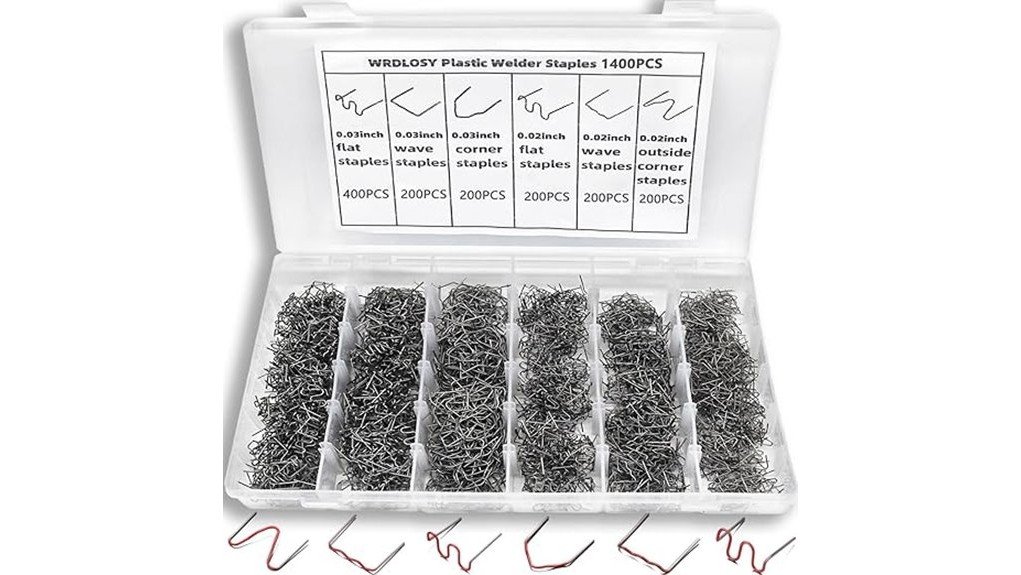
The kit includes six staple types: 0.02-inch flat staples, 0.03-inch flat staples, 0.02-inch wave staples, 0.03-inch wave staples, and corner staples. This variety helps you choose a staple shape based on the repair area, such as a straight crack, curved section, or corner break.
The stainless steel staples are designed for durability and corrosion resistance. Each staple also includes a notch that helps with removing excess material after welding, which can make the finished repair cleaner when you work carefully.
Before You Buy: This kit is best for reinforcing plastic cracks and broken sections, not for every plastic repair. It should not be used as the only fix for safety-critical parts, load-bearing structural parts, fuel-contact parts, or electrical components unless the repair method is approved for that use.
Who Should Buy It?
Best For
- DIY users repairing cracked plastic trim, housings, tabs, or panels.
- Buyers who want a large 1400-piece staple supply for repeated repairs.
- Users who need multiple staple styles for straight cracks, wave reinforcement, and corner damage.
Skip If
- You need a confirmed waterproof or weather-resistant storage case.
- You are repairing a part where heat could damage nearby wiring, paint, seals, or sensors.
- You need a cosmetic-only repair with no visible staple marks or surface finishing work.
Key Features and Benefits
Large 1400-Piece Staple Assortment
The main appeal of this kit is the large 1400-piece quantity. That count gives you enough staples for practice pieces, small repairs, and repeat jobs without running out after only a few cracks.
The larger assortment also helps if you are learning hot-staple repair. You can test different staple shapes on scrap plastic before touching the final part, which reduces the chance of choosing the wrong staple for the crack.
Six Staple Types for Different Repairs
The included flat, wave, and corner staples give you more flexibility than a single-shape staple kit. Flat staples make sense for simple straight cracks, while wave staples can add extra grip across irregular or longer split areas. Corner staples are useful when damage sits near an edge or angled section.
The 0.02-inch and 0.03-inch sizes give you a choice between lighter reinforcement and heavier support. Thicker staples may feel stronger in some repairs, but thinner staples can be easier to place in smaller or more delicate plastic areas.
Stainless Steel Staple Construction
The staples are made from stainless steel, which helps resist corrosion better than plain steel. That matters if you are repairing plastic items used in garages, outdoor areas, or places where moisture may be present after the repair.
Stainless steel does not make the repair indestructible. The final result still depends on the plastic type, crack shape, heat control, staple spacing, and how much stress the part will face after repair.
Rapid Heating for Faster Work
The article-supported heating claim is that the tool reaches working temperature in about two seconds. Fast heating can make small repairs feel more efficient because you spend less time waiting between staple placements.
Quick heat also means you need steady control. Pressing too long can sink a staple too deep, distort the plastic, or leave more finishing work after the repair.
Notched Staples for Cleaner Trimming
Each staple includes a notch for removing excess material after welding. This is useful because hot-staple repairs often leave staple legs that need to be clipped or cleaned up.
A notched design can help make the removal step easier, but you may still need sanding, trimming, or surface finishing if the visible side of the plastic matters.
Pro Tip: Test the staple size and heating time on scrap plastic first. Start with the smallest staple that gives enough support, then move to a thicker or wave staple only if the crack needs more reinforcement.
Materials, Compatibility, and Safety
This kit is most useful for plastic surfaces that can accept a heated staple without melting too aggressively, cracking further, or releasing unsafe fumes. The original article mentions polyethylene and polypropylene applications, but real results can vary by plastic thickness, age, flexibility, and surface condition.
Use the tool in a well-ventilated area and avoid breathing fumes from heated plastic. Keep the heated tip away from skin, clothing, fuel, solvents, foam, upholstery, wiring, sensors, and painted surfaces. Let the repaired area cool before testing strength or trimming the staple ends.
For automotive work, avoid using hot staples as a shortcut on parts tied to crash safety, fuel handling, airbags, seat belts, or electrical protection. In those cases, follow the vehicle service information or ask a qualified repair professional.
How It Performs in Real Use
For Straight Plastic Cracks
For a simple straight crack, the flat staples are the easiest starting point. They bridge the damaged area and add support across the split. This can be useful on plastic panels, housings, covers, or small broken sections where the repair does not carry major load.
For Curved or Irregular Breaks
Wave staples are better suited to uneven cracks because the shape gives more contact across the damaged area. They can help when the break is not perfectly straight or when the plastic has a curved surface.
For Corners and Edges
Corner staples are helpful when the damage sits on an angled area, edge, or corner. This is where standard flat staples may not sit as neatly. You still need to align the broken parts before embedding the staple, or the repair may lock the part in the wrong position.
For Outdoor or Garage Repairs
The stainless steel staples make the kit more suitable for repairs that may face moisture than plain steel staples. Still, the carrying case is not confirmed as waterproof or weather-resistant, so store the kit in a dry area when you are not using it.
How to Use It Correctly
Start by cleaning the plastic surface so dirt, oil, and loose material do not interfere with the repair. Align the cracked pieces before placing any staples. If the part is warped or under tension, the staple may hold poorly or the crack may reopen nearby.
Choose the staple style based on the damage. Use flat staples for basic cracks, wave staples for irregular splits, and corner staples for angled breaks. Heat the staple only as needed, then press it into the plastic with steady control. Do not force it through the visible side unless that is part of your repair plan.
After the staple cools, remove or trim the excess ends at the notch. Check the repair from both sides when possible. For visible surfaces, expect to do extra finishing work if you want a smoother appearance.
Common Mistakes to Avoid
- Using too much heat: Overheating can deform thin plastic or weaken the surrounding area.
- Choosing the wrong staple: A flat staple may not support a corner break as well as a corner staple.
- Skipping alignment: If the crack is not lined up first, the staple can lock the damage in place.
- Repairing unsafe parts: Do not rely on this method for safety-critical automotive or electrical parts unless approved for that application.
- Storing the kit in damp areas: The staples are stainless steel, but the case itself is not confirmed as weather-resistant.
Pros and Cons
Pros
- Large 1400-piece count gives you plenty of staples for practice and repeated repairs.
- Six staple types support straight cracks, irregular breaks, and corner damage.
- Stainless steel staples help resist corrosion after the repair.
- Fast heating claim of about two seconds can speed up small repair jobs.
- Notched staple design helps with trimming excess material after welding.
Cons
- Brand, model, warranty, and detailed tool specs were not confirmed from a reliable external source.
- The carrying case is not confirmed as waterproof or weather-resistant.
- Plastic repair results depend heavily on heat control, plastic type, and correct staple placement.
Customer Experience and Support
The original article notes that users appreciate the organized layout and the support team’s quick response time, with inquiries typically addressed within 24 hours. That type of support can be helpful if you are new to plastic welding and need help understanding the kit.
The included documentation also matters because hot-staple repair depends on technique. Clear instructions can help you choose the right staple, control heat, and avoid damaging the plastic part during your first repair.
Because external verification was limited, you should still check the current Amazon listing for the latest included parts, support terms, and seller-specific details before buying.
Is It Worth the Price?
The 1400PCS Plastic Welding Kit looks like a strong value for the price if your main goal is staple variety and a large supply for repeated plastic repairs. The flat, wave, and corner staples make it more useful than a small kit with only one or two staple shapes.
It makes the most sense for buyers who repair plastic items often enough to use the larger staple count. It is less compelling if you only need one small repair or if you need verified premium specs, confirmed warranty coverage, or a weather-resistant storage case.
Before you decide, compare the current listing details with your repair needs. Pay close attention to the included tool, staple count, staple types, and any seller notes about support or storage.
How It Compares to Alternatives
Compared with smaller plastic welding kits, this one stands out because of the large 1400-piece staple assortment and the mix of flat, wave, and corner staples. Smaller kits may be enough for one-time repairs, but they may not give you as much room to practice or match the staple to the crack shape.
Compared with glue-only plastic repair, hot staples add mechanical reinforcement across the damaged area. Glue may look cleaner on some visible surfaces, while this kit is better when strength across a crack matters more than a perfectly hidden repair.
Frequently Asked Questions
Are the staples compatible with all plastic welding tools?
The article describes these staples as compatible with various plastic welding tools, but it does not confirm universal compatibility. Check your tool’s staple size and connection style before buying replacement or add-on staples.
What types of plastic can be repaired with this kit?
The original article mentions polyethylene repairs and polypropylene applications. Results can still vary by plastic thickness, condition, and heat sensitivity, so test on a hidden or scrap area when possible.
How long do the staples last after welding?
The stainless steel staples are designed for durability and corrosion resistance. The real lifespan depends on the plastic part, stress level, environment, staple placement, and whether the repaired area is used within reasonable limits.
Can you use these staples for outdoor repairs?
The stainless steel staples make outdoor use more practical because they resist corrosion better than plain steel. Store the kit indoors or in a dry area because the carrying case is not confirmed as waterproof or weather-resistant.
Is the carrying case waterproof?
No waterproof or weather-resistant case claim is confirmed in the article. Treat the case as an organizer for the staples and tool, not as weatherproof storage.
Which staple type should you use first?
Start with a flat staple for a straight crack, a wave staple for an irregular split, and a corner staple for an angled break or edge repair. Use the smallest staple that gives enough support so you do not add extra heat or bulk.
Can this replace glue or plastic filler?
Not always. Hot staples add support across a crack, while glue or filler may still be useful for sealing, smoothing, or cosmetic finishing. For visible repairs, you may need sanding or finishing after the staple repair.
Who should skip this plastic welding kit?
Skip it if you need verified professional-grade specs, confirmed waterproof storage, or a repair method for safety-critical parts. It is better for general plastic repair practice and non-critical reinforcement jobs.
The Bottom Line
The 1400PCS Plastic Welding Kit is recommended with caveats for buyers who want a large stainless steel staple assortment for general plastic crack repairs. Its main strength is the six-type, 1400-piece staple selection, while its main limitation is the lack of externally verified brand, warranty, and storage-case details. Skip it if your repair is safety-critical, highly cosmetic, or requires confirmed professional specifications before purchase.