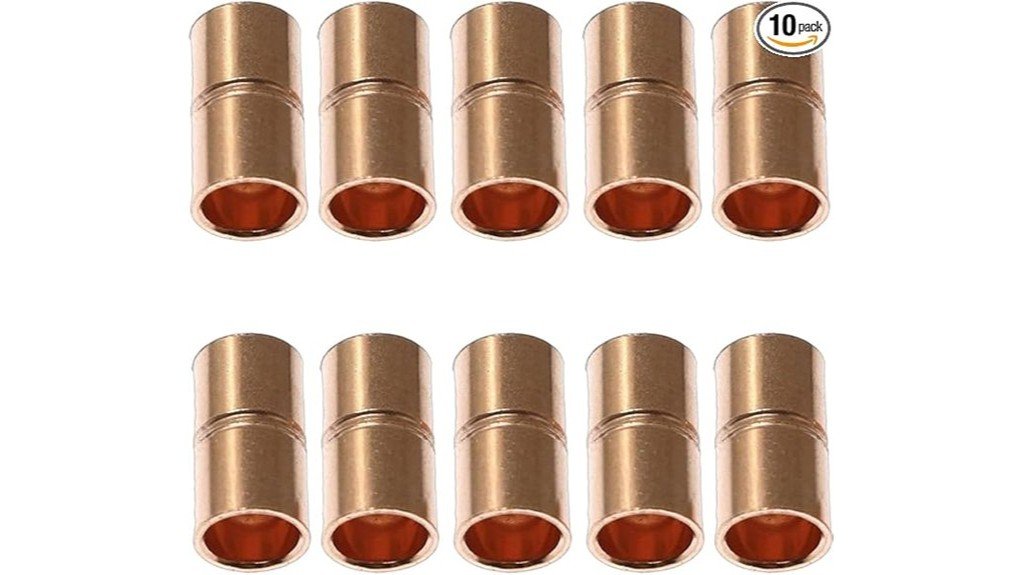
The Wvapzwr set of 1/4 inch copper coupling fittings is a 10-pack of short straight couplers with a 6.35 mm inner diameter, a rolled tube stop and a listed length of 16 mm. It is meant for small copper tubing joints in HVAC and refrigeration repair work. It is the wrong buy if your tubing is a different size or you need a fitting with a stated pressure rating. The Wvapzwr 10-pack 1/4 inch copper coupling fittings are used for small copper line repairs.
Quick Facts
| Item | Detail (per the listing) |
|---|---|
| Brand | Wvapzwr |
| Pack | 10 straight couplings |
| Inner diameter | 6.35 mm (1/4 inch) |
| Length | 16 mm (about 0.63 in) |
| Wall thickness | 0.7 mm |
| Design | Straight coupler with a rolled tube stop |
| Material | Copper |
| Not stated | Pressure rating, temperature rating, refrigerant approval |
What These 1/4 Inch Copper Coupling Fittings Are For
A straight coupling joins two pieces of tube of the same size end to end. The rolled tube stop gives each tube a set insertion depth so the ends do not butt up inside the fitting. The listing names air conditioning, refrigeration, HVAC and hydraulic lines as uses.
The listing does not give a pressure or temperature rating, so do not assume these suit high-pressure or code-controlled systems. Check your equipment documentation and local code first.
Check Size and Joining Method
- Measure the outside diameter of your tubing. The fitting’s 6.35 mm inner diameter is meant for 1/4 inch OD tube.
- Confirm the tube is round and free of dents; a slight mismatch gives a poor joint.
- Decide how you will join it. Copper couplings like this are normally soldered or brazed; refrigerant lines are generally brazed, so follow your system’s requirements.
- Make sure your work follows local code. Refrigerant work in many places requires certification.
Making a Good Joint
- Cut the tube square and remove burrs inside and out.
- Clean the tube end and the fitting with fine abrasive until bright.
- Apply flux if your filler requires it, push the tube to the stop and heat evenly.
- Let the joint cool without disturbing it, then clean off flux residue and pressure test as required.
Our guides on brazing HVAC copper pipe without soldering and brazing HVAC copper lines without leaks cover the technique in more detail.
Pros and Limitations
Pros
- Ten fittings keep spares in the truck or shop.
- Simple straight design with a rolled stop for tube depth.
- Compact size for tight areas.
Limitations
- 1/4 inch only; it will not adapt sizes or change direction.
- No pressure, temperature or refrigerant approval is listed.
- Thin 0.7 mm wall means heat control matters when joining.
Compared With the HINZIC Set
We also reviewed the HINZIC LP6138-M copper couplings, which are listed with a slightly thicker 0.8 mm wall. Both are the same nominal size, so compare the listing details and price. For filler metal, see our BCuP-2 brazing rods review.
Frequently Asked Questions
What size tube do these couplings fit?
They are listed with a 6.35 mm (1/4 inch) inner diameter, so they fit 1/4 inch outside diameter tubing. Measure your tube before ordering.
Should I solder or braze these fittings?
Both methods are used on copper couplings. Refrigerant lines are normally brazed, so follow your system requirements and local code.
Can I use them for hydraulic lines?
The listing mentions hydraulic use but gives no pressure rating, so do not use them on high-pressure lines without checking the ratings.
Do the fittings have a tube stop?
Yes. The listing says they have a rolled tube stop that sets the insertion depth.
Bottom Line
A handy set of small copper couplers for 1/4 inch tubing. Confirm tube size and the joining method, and do not use them where a rated fitting is required.