You can cleanly slice 1-inch steel at 8–12 ipm with the Plasma Cutter 62i, and sever up to 1-1/4 inch at 3–5 ipm—if amperage, gas flow, and duty cycle are dialed to spec. Expect minimal dross and tight kerf when air quality and postflow are controlled, especially on CNC. But output stability, THD on generators, and consumable condition can swing results more than you think—so here’s what actually governs your cut limits.
Key Specifications and Power Requirements
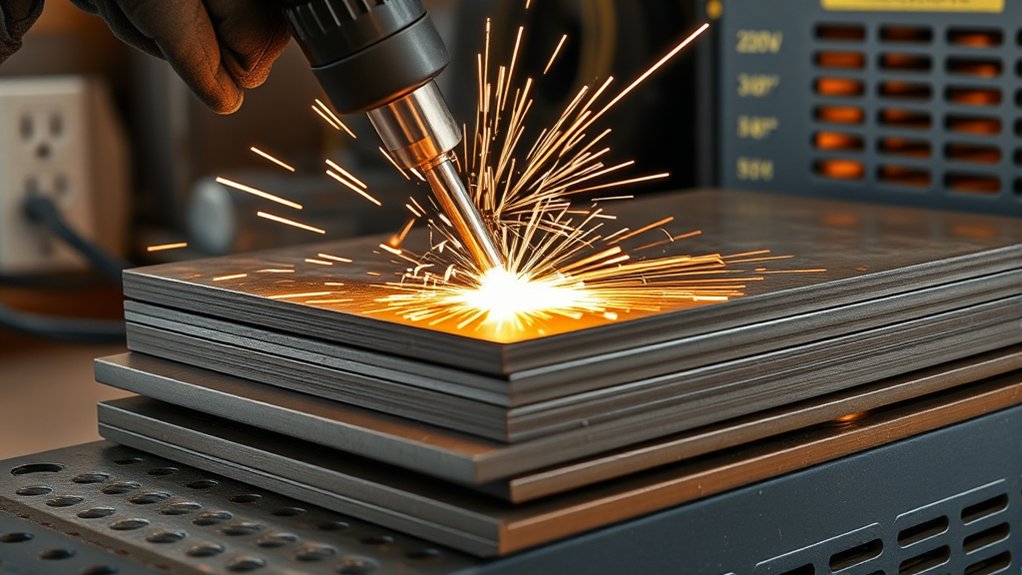
Precision matters: the PowerPlasma 62i delivers a clean cut up to 1.0 in at 8–12 ipm, severance up to 1.25 in at 3–5 ipm, and a pierce capability to 0.5 in. You can plan process routes with confidence because these metrics anchor your cutting precision under typical shop conditions.
To sustain nameplate performance, size your generator correctly: the unit needs a minimum of 10,000 surge watts and operates efficiently on clean power rated at 11,000 watts with ≤5% THD. That specification controls power quality, stabilizes arc voltage, and reduces consumable wear, directly affecting power consumption and cut consistency.
Size your generator right: minimum 10,000 surge watts, 11,000 clean watts at ≤5% THD for stable, consistent cuts.
Don’t overlook air quality. The supplied water trap isn’t sufficient for moisture-laden air; use a separate dryer to prevent arc instability, dross, and nozzle erosion.
Align your setup—generator capacity, low-THD output, dry compressed air—to hit stated speeds and thicknesses reliably. When you do, you’ll maintain repeatable kerf geometry and minimize rework.
Clean Cut vs. Severance: What to Expect
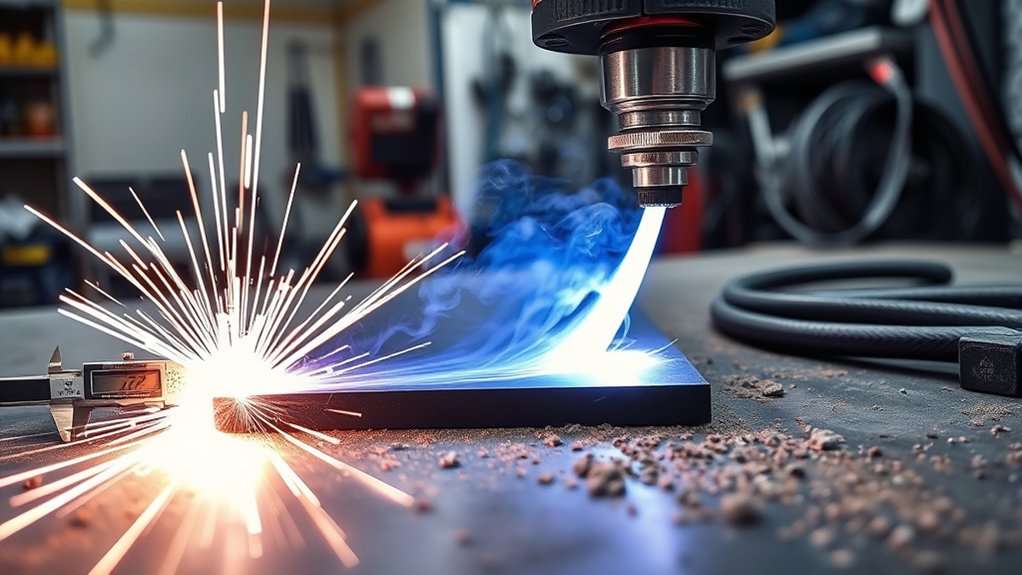
Although both modes use the same torch and consumables, “clean cut” and “severance” define different quality targets and feed rates for the PowerPlasma 62i. You’ll choose based on edge quality tolerance, required kerf, and post‑processing.
Clean cut targets square edges with minimal dross; severance cuts prioritize through‑cutting when finish quality is secondary.
- Clean cut capacity: up to 1 in at 8–12 ipm, delivering tight kerf and low heat‑affected zone when amperage and standoff are tuned.
- Severance capacity: up to 1-1/4 in at 3–5 ipm, acceptable for extraction or prep where grinding is expected.
- Pierce capability: reliably pierces 1/2 in plate; for thicker stock, edge‑start to protect consumables and maintain arc stability.
- Practical example: 3/16 in steel at ~50 A and ~45 ipm demonstrates headroom for quality cuts on thinner materials.
Adjust amperage and travel speed to keep arc lag minimal and maintain perpendicularity.
Use consistent gas flow, correct standoff, and steady motion to hold repeatable results in either mode.
Real-World Cut Speeds by Material Thickness
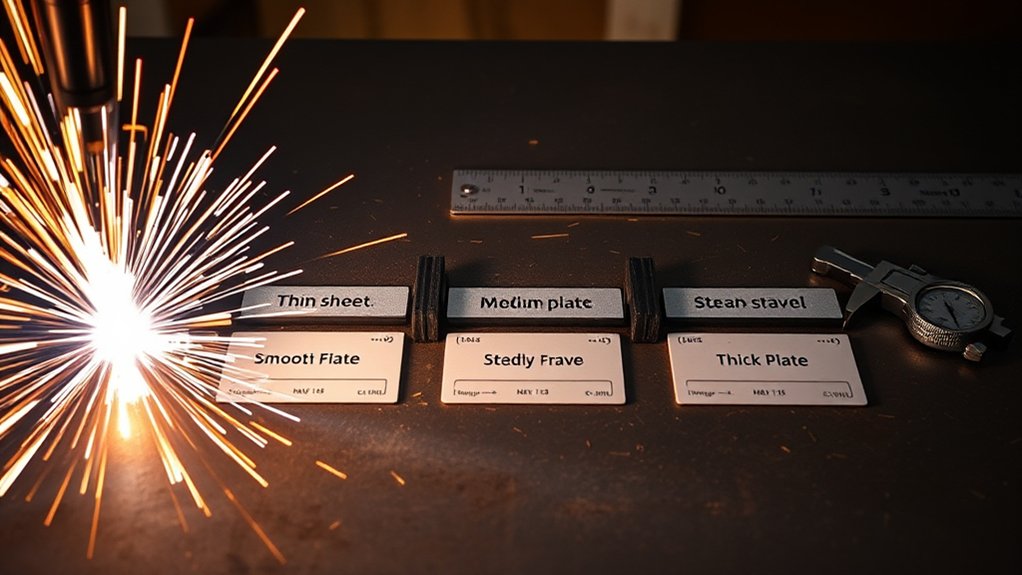
You’ll set expectations with data-backed speed ranges: on 1/8-inch steel, target fast travel in the 35–60 ipm band with proper amperage and standoff.
For 1/4-inch, tune to ideal settings around 40–55 A and 18–30 ipm, adjusting gas flow and torch height to maintain kerf quality per manufacturer specs.
At 3/8-inch, prioritize productivity with 25–15 ipm and higher amperage, using steady standoff and lead-ins to control dross and maintain cut continuity.
1/8-Inch Speed Ranges
Even with variations in material and setup, real-world data for the PowerPlasma 62i shows clear speed bands by thickness: expect clean cuts up to 1 inch at roughly 8–12 ipm, and severance to 1-1/4 inches at 3–5 ipm.
You’ll validate these ranges by matching cutting techniques to material types and observing arc stability, kerf width, and dross.
- 1/8 inch: run about 155 ipm at 45 A for fast, continuous cuts; monitor kerf taper and adjust standoff.
- 3/16 inch: target near 45 ipm at ~50 A; maintain steady torch angle to keep slag minimal.
- 1/4 inch: expect moderate speeds; tune travel to retain puddle coherence and edge squareness.
- 1 inch: hold 8–12 ipm for clean cuts; at 1-1/4 inches, reduce to 3–5 ipm for severance only.
These bands align with practical duty-cycle and arc energy constraints.
1/4-Inch Optimal Settings
Start with thickness, then match amperage and ipm to stay within the 62i’s clean-cut and severance envelopes. Use ideal amperage settings to hold kerf, dross, and bevel inside acceptable limits, then tune cutting speed variations to maintain arc stability.
For 3/16 in steel, 50 amps at ~45 ipm delivers clean edges. At 1/4 in, expect 60 amps near 40 ipm; adjust ±5 ipm for finish vs. speed.
For 1 in clean cuts, target 8–12 ipm at full output, watching arc lag and slag line as quality indicators. Reserve 3–5 ipm for 1-1/4 in severance to avoid arc dropout and excessive bevel.
When piercing up to 1/2 in, pierce first, then shift to your established travel speed to protect consumables and maintain cut geometry.
3/8-Inch Productivity Tips
Although every shop setup varies, real-world productivity with the PowerPlasma 62i tracks closely to thickness-based speed bands: target 45 ipm at 50 A on 3/16 in steel for clean edges; plan ~40 ipm at 60 A on 1/4 in and adjust ±5 ipm to balance finish vs. throughput; hold 8–12 ipm at full output for 1 in clean cuts, watching arc lag and slag line for quality control; and reserve 3–5 ipm for 1-1/4 in severance to prevent arc dropout and excessive bevel.
Use these inch techniques to standardize outcomes across inch thickness ranges and surfaces, including painted or dirty stock with pilot arc.
1) Verify standoff with a drag shield: 1.5–2.0 mm.
2) Maintain 90° torch angle; correct bevel immediately.
3) Tune air: 70–75 psi dynamic, dry.
4) Log tip wear; replace consumables proactively.
Generator Use and THD Considerations
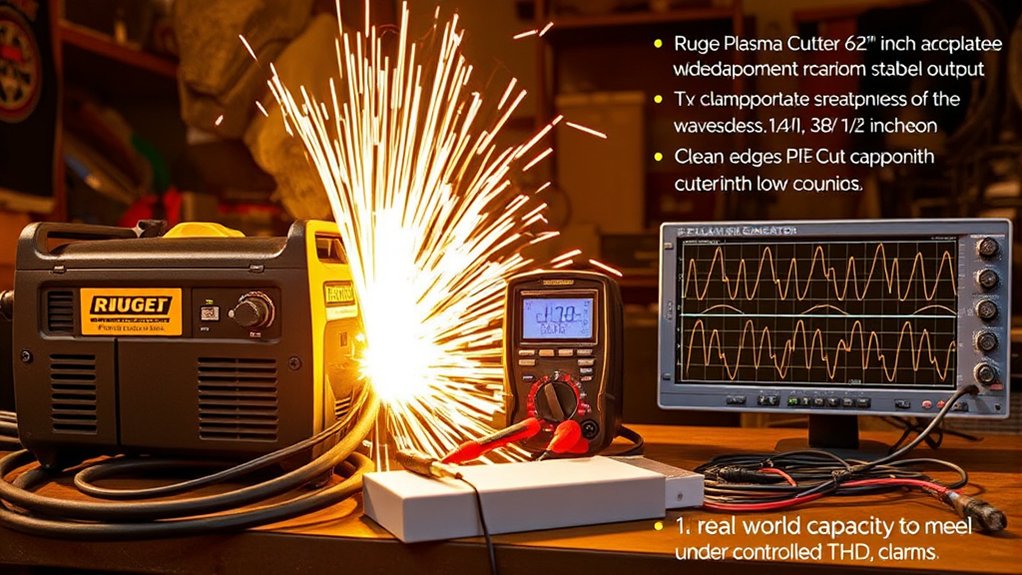
When powering the PowerPlasma 62i from a generator, you need clean, sufficient capacity: target at least 10,000 surge watts (11,000 watts preferred) and verify Total Harmonic Distortion at 5% or less. This guarantees generator compatibility and minimizes THD impact on arc stability, pilot reliability, and internal electronics.
Undersized or “dirty” sources sag under load, causing nuisance shutdowns and erratic cutting. Select an inverter generator or a unit explicitly rated ≤5% THD at the receptacle. Confirm the rating at the output, not just at the alternator.
Undersized or dirty power causes shutdowns. Use an inverter or ≤5% THD at the receptacle.
Size the generator for peak draw during arc start and kerf changes; 11 kW surge capacity provides headroom for transient loads. Avoid economy modes that throttle voltage during rapid duty-cycle alterations.
Use a correctly rated cord, shortest practical length, 240 V, with conductor gauge sized for current and distance to maintain voltage within ±10%.
Before cutting, reference the 62i manual for approved limits, grounding, and overcurrent protection to keep the machine within design specifications.
Air Quality, Postflow, and Consumable Life
You’ll get the best results by feeding the 62i clean, dry air—use a dedicated dryer in addition to the stock trap to meet ISO 8573-1 Class 2–4 moisture levels and set pressure via the color-coded LED guide.
Set the adjustable postflow to cool the torch for 20–60 seconds after each cut; longer cycles protect electrodes and nozzles during high-amperage or long cuts.
Inspect consumables regularly and replace at defined wear thresholds, leveraging the IGBT-stable arc to extend life and maintain consistent cut quality.
Dry Air Requirements
Because plasma cutting relies on a clean, stable air supply, the PowerPlasma 62i performs best with air that’s dry, oil-free, and regulated to the specified pressure, aided by an external air dryer beyond the onboard water trap.
You’ll protect cut quality and consumable life by prioritizing air quality and disciplined moisture management. The stock water trap isn’t enough; specify a refrigerated or desiccant dryer, followed by a fine coalescing filter, and verify pressure at the torch with the digital readout.
- Target ≤10% relative humidity at the cutter inlet; purge lines before critical cuts.
- Maintain 90–120 psi supply with stable flow; confirm set pressure digitally.
- Inspect filters daily; drain separators after each session.
- Reference the manual for required dryness class and best practices.
Postflow Timing Tips
Although the pilot arc lets you cut through scale and rust, you’ll protect consumables and cut quality by pairing clean, dry air with correctly set postflow on the PowerPlasma 62i. Use an external air dryer; the onboard trap won’t scrub all moisture.
Verify pressure with the color‑coded LED guide, then make postflow adjustments based on arc‑on time and material thickness.
Apply cooling techniques: increase postflow after long cuts or on thicker plate to keep the nozzle and electrode below thermal fatigue thresholds; reduce slightly for thin, intermittent cuts to avoid needless air use.
Start with the factory baseline, then fine‑tune in 2–3 second increments. Inspect consumables regularly; mushrooming, pitting, or discoloration indicate insufficient postflow or wet air.
Stable pressure plus dry air equals consistent performance.
Maximizing Consumables Lifespan
Even with a robust torch design, consumable life on the PowerPlasma 62i hinges on clean, dry air, proper postflow, and controlled input power quality.
You’ll extend service intervals when you pair disciplined consumable maintenance with data-driven settings and clean power.
- Specify air quality: use a dedicated refrigerated or desiccant dryer plus a fine coalescing filter; the stock water trap isn’t sufficient. Target <10% RH at the torch.
- Set postflow with the adjustable timer: 20–30 seconds after thick cuts; 10–15 seconds for light work. Cooldown reduces thermal cycling and nozzle deformation.
- Verify generator THD ≤5%. High THD accelerates component stress and shortens consumable life.
- Practice electrode care: inspect tip, orifice, and electrode face every shift; replace on pitting, ovality, or >0.5 mm recession. Use the 3‑second pilot arc tip saver to limit idle wear.
CNC Package Capabilities and Setup Notes
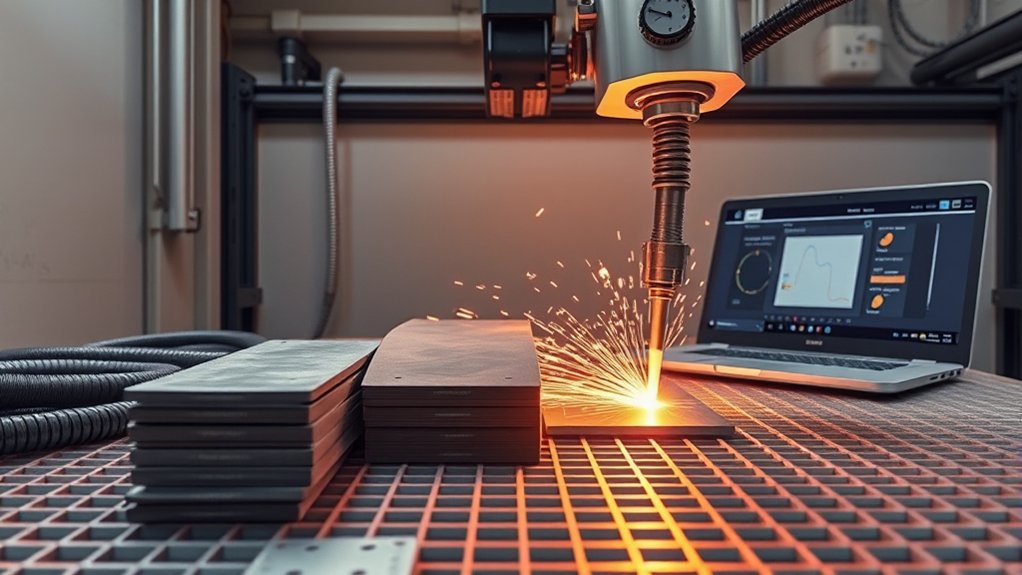
While compact, the PowerPlasma 62i CNC package delivers precise, repeatable results for complex profiles, leveraging IGBT power electronics for stable output and clean kerfs up to its 1 1/4 in maximum severance.
You’ll see CNC precision in tight tolerances and consistent arc characteristics that support automated cutting of nested parts without dimensional drift.
For setup, connect the PT 60 torch and work clamp to the CNC table, route the 20-foot lead to avoid drag-chain pinch points, and verify torch height control clearance.
Supply clean, dry air and set pressure according to your cut chart; stable inlet pressure is critical to kerf quality and edge angularity.
Use the pilot arc to initiate on painted, rusty, or scaled surfaces, minimizing restarts and motion pauses that degrade cut fidelity.
Confirm arc OK/signaling compatibility with your motion controller and validate pierce delay, cut speed, and THC parameters with test coupons before production to lock in repeatable results.
Safety Gear and Essential Accessories
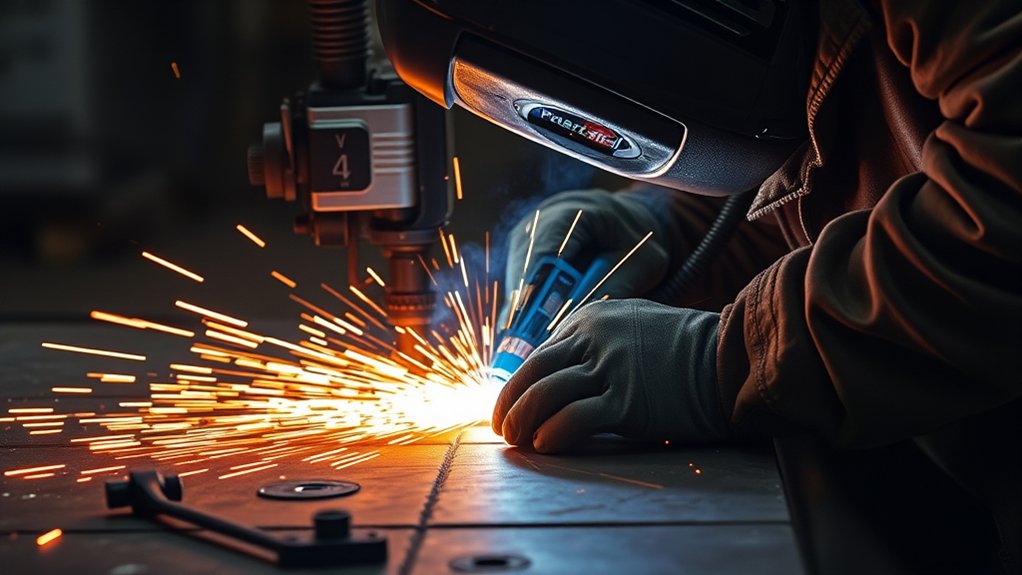
Protection starts with standards-compliant PPE and a few must-have safeguards to keep the PowerPlasma 62i operation within safe limits.
Protection starts with standards-compliant PPE and safeguards to keep PowerPlasma 62i within safe limits.
You’ll work cleaner, faster, and safer when you apply disciplined safety precautions and choose protective gear that aligns with recognized standards and the cutter’s arc output and spark plume.
- Wear a safety helmet with UV/IR-rated lens and face coverage; it shields you from arc radiation and ejected sparks during plasma cutting, reducing exposure risk.
- Use leather gloves with heat and cut resistance; they protect against hot slag and sharp edges when handling coupons and freshly cut parts.
- Select flame-resistant coveralls; FR fabrics limit ignition and reduce burn severity from spatter and dross, supporting consistent hazard control.
- Fit safety glasses with proper shade lenses and side shields; they block intense light and intercept flying debris before it reaches your eyes.
Stage a charged, accessible fire extinguisher nearby for rapid response.
Keep your PPE inspected, clean, and replaced on a defined interval.
Frequently Asked Questions
How Loud Is the 62I During Typical Cutting Operations?
You’ll typically measure 92–98 dBA at 1 meter during cutting. That noise level affects operator comfort and communication. Use NRR 25–30 dB hearing protection, follow OSHA/NIOSH exposure limits, and consider barriers, distance, and duty cycle to reduce exposure.
Can the 62I Run on Extension Cords Safely?
Yes—but only if you respect extension cord safety and power requirements. You’ll use a 10–12 AWG cord, under 50 ft, rated 20A+, with minimal voltage drop; verify nameplate amperage, duty cycle, and NEC derating before cutting.
What Ambient Temperatures Affect Performance or Duty Cycle?
You’ll see performance degrade as ambient temperature rises above 40°C; the duty cycle derates per IEC/EN 60974-1 curves. Below 10°C, condensation risk increases. Keep intake air clean, guarantee rated airflow, and monitor thermal cutback indicators continuously.
How Quickly Are Consumables and Torches Available for Replacement?
You can source replacement parts within 1–3 business days from major distributors; torches may take 3–7. You’ll track consumable lifespan by arc-on hours and pierce counts; plan reorder points at 70–80% usage to maintain uptime.
Is There a Mobile App or Bluetooth Support for Monitoring?
No native app or Bluetooth support exists. You’ll monitor via the front panel and standard I/O. For mobile connectivity, use third-party BLE/IoT gateways to log current, voltage, duty cycle, and alarms, correlating data to cutting efficiency empirically.
Conclusion
You’ve seen the 62i’s real-world chops: clean cuts to 1 in at 8–12 ipm, severance to 1-1/4 in at 3–5 ipm, provided amperage, air quality, and postflow align with spec. Keep THD low if you’re on a generator, and match consumables to duty cycle to maintain kerf geometry and minimize dross. With CNC-ready control, it’s plug-and-verify—like bringing a smartphone to a blacksmith shop—standards-compliant, data-backed, and ready to turn drawings into dependable parts.