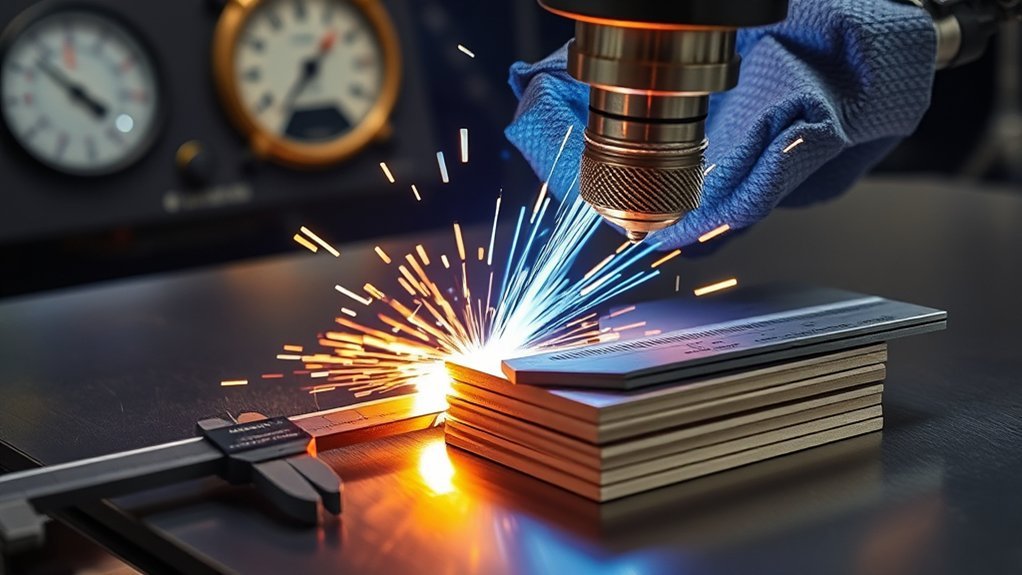
A 220V or 240V supply gives a plasma cutter more input power than a 120V outlet, but it does not create one universal amperage-by-thickness rule. The correct output amperage comes from the cutter’s model-specific cut chart, consumable rating, metal type, cut goal, and air requirements. Start with the manufacturer’s numbers, make a test cut, and then fine-tune speed or height in small steps.
Quick Answer
On a 220–240V plasma cutter, voltage does not determine the correct output amperage. Install the specified consumable, open that model’s cut chart, and use its listed current, speed, standoff, and air settings. A 45A process may cut several thicknesses at 45A simply by changing travel speed.
Key Takeaways
- Treat “220V” as the input supply class; output amperage is a separate specification.
- Use the exact cut chart for the cutter, torch, consumable, metal, thickness, and cutting method.
- Do not rely on a universal “add 10 amps per 1/8 inch” formula; many systems use one rated current across several thicknesses and change speed instead.
- Size the circuit, plug, conductors, and extension cord from the nameplate and manual—not from the output dial or material thickness.
- Clean, dry air, sound consumables, correct torch height, and steady travel speed often matter as much as the selected amperage.
At a Glance
| First Step | Identify the exact cutter, torch, consumable, metal, thickness, and whether the cut is handheld or mechanized. |
| Primary Controls | Current, travel speed, torch height or drag technique, air pressure and flow, and pierce method. |
| Circuit Rule | Follow the machine’s rated input current, specified overcurrent protection, plug, conductor, and extension-cord requirements. |
| Safety Priority | Use suitable eye, face, hearing, hand, body, and respiratory protection; control fumes and remove fire hazards. |
How to Set Plasma Cutter Amperage Correctly
- Read the data plate and manual. Confirm input voltage, phase, maximum input current, rated output range, duty cycle, and required circuit protection.
- Install the correct consumable. Nozzles and cartridges are designed for specific current ranges and processes. Do not exceed their rating.
- Find the exact cut-chart row. Match metal, thickness, consumable, handheld or mechanized use, and the desired best-quality or production-speed column.
- Set air supply before cutting. Verify both pressure and available flow while the torch is flowing air. Static pressure alone can look acceptable even when the compressor or hose cannot keep up.
- Make a test coupon. Use scrap of the same alloy and thickness. Check whether the arc fully exits the bottom, the edge is reasonably square, and dross is light.
- Adjust one variable at a time. Change speed first when the current is fixed by the consumable. Change current only within the manufacturer’s allowed range, then recheck speed and air.
Warning: Plasma cutting creates intense arc radiation, molten metal, noise, electric-shock risk, fire hazards, and airborne metal fume. Never cut a closed or uncleaned container. Remove combustibles, provide suitable ventilation or local exhaust, and follow the cutter’s safety manual before operating the torch.
Understanding 220V Power and Plasma Cutter Input Limits
In North American shops, people often say “220V,” although many single-phase circuits are nominally 240V. Product labels may show a range such as 200–240V. The key point is that input voltage and input current describe what the machine draws from the electrical supply, while output amperage describes the cutting arc.
Those numbers are not interchangeable. For example, the current Hypertherm Powermax45 SYNC specifications list a 9–45A output range, yet the 200–240V single-phase model draws about 40A at 200V and 33A at 240V at rated output. Its manual specifies a 50A time-delay fuse for that input range. This is a model example, not a circuit recommendation for every 45A cutter.
Read the manual’s electrical table before choosing a receptacle, breaker, conductors, disconnect, or extension cord. A different 45A machine may use a different topology, efficiency, plug, or overcurrent-protection requirement. Local electrical rules also apply, so use a qualified electrician when a new branch circuit or wiring change is needed.
Warning: Never install a larger breaker on undersized wiring to stop nuisance trips. The breaker or fuse, conductor size, receptacle, plug, grounding method, and machine instructions must work as one system.
Long or undersized extension cords can reduce voltage at the cutter and limit cut capacity. Use the shortest cord practical and the gauge specified for the exact machine, voltage, and length. Do not run the cutter and a large compressor from an overloaded shared circuit.
Amperage-to-Thickness Guidelines for Common Metals
There is no reliable universal chart that says every 1/8-inch increase in steel needs another 10 amps. Plasma systems are designed around a power supply, torch, nozzle or cartridge, gas process, and tested travel speed. The Powermax SYNC cut-chart guide, for example, lists a 45A mild-steel process across sheet and plate thicknesses; the main change is travel speed, with edge starts required above the process’s pierce range.
Use these broad classes only to understand machine categories—not as final settings:
| Output Class | Common Role | What Sets the Real Limit |
|---|---|---|
| 20–30A | Thin sheet, fine-feature processes, compact cutters | Specific nozzle or cartridge, minimum stable current, and cut speed |
| 35–45A | General repair and light fabrication | Rated cut capacity, air flow, consumable, and duty cycle |
| 50–65A | Faster medium-stock cutting and heavier plate | Manufacturer’s recommended, maximum, pierce, and severance ratings |
Mild steel, stainless steel, and aluminum of the same thickness do not necessarily use the same speed or edge-start rule. Stainless can show more discoloration and a different dross pattern. Aluminum moves heat quickly and can produce a different kerf and cut face. Use the metal-specific row in the cut chart rather than applying a steel setting to every conductive metal.
Note: “Recommended cut,” “maximum cut,” “pierce capacity,” and “severance” are not synonyms. A severance rating means the machine can separate the metal slowly; it does not promise a square, fabrication-ready edge.
Matching Tip Size and Consumables to Amp Settings
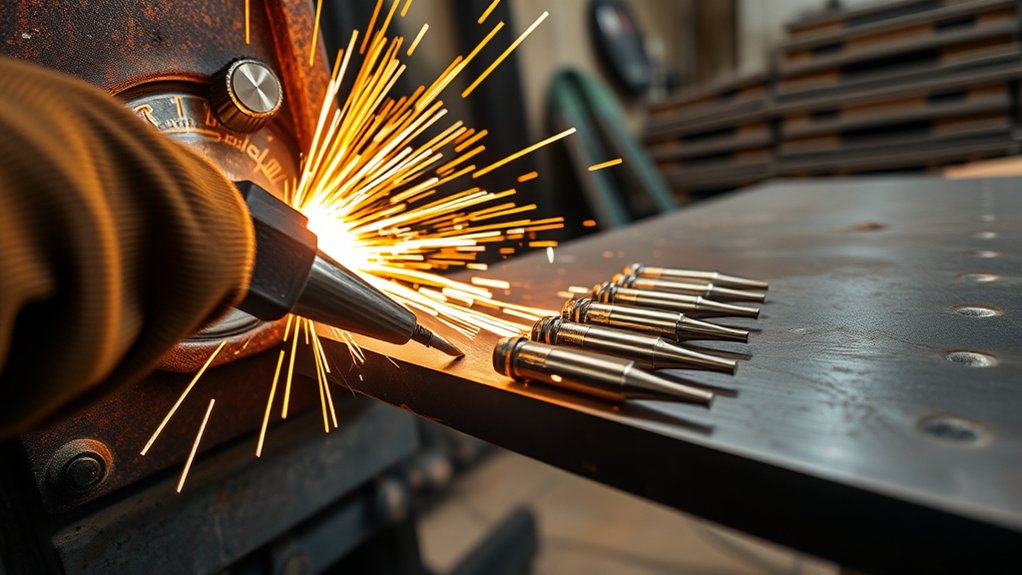
The consumable set shapes and constricts the plasma arc. Traditional torches may use a nozzle, electrode, swirl ring, retaining cap, and shield. Newer systems may combine those parts into a current-specific cartridge. Either way, match the process and amperage to the consumable markings and manual.
A low-amp or fine-cut setup can reduce kerf on thin material, but it must be used only within its published range. A standard 45A or 65A consumable may be designed to stay at its rated current while the operator changes speed for thickness. Running a high-current nozzle far below its intended range can produce a soft, unstable arc; exceeding a nozzle’s rating can rapidly enlarge the orifice and damage cut quality.
| Consumable Choice | Best Use | Main Check |
|---|---|---|
| Fine-cut or fine-feature | Thin sheet and small details | Published current range, speed, and torch height |
| Standard shielded cutting | General handheld or mechanized work | Correct current and shield or drag method |
| Extended-reach or specialty | Restricted access or special geometry | Its separate capacity and cut chart |
Inspect the nozzle orifice for an oval shape, nicks, or enlargement. Check the electrode according to the manufacturer’s wear limit. Replace damaged parts as a matched set when the manual requires it, and keep consumables clean and dry.
Pro Tip: Record the material, thickness, process current, consumable part number, air pressure and flow, travel speed, torch height, and result. A shop log turns successful test cuts into repeatable settings.
Duty Cycle Considerations at Different Amp Levels
Duty cycle is the percentage of a 10-minute period that the arc can remain on under the manufacturer’s stated test conditions without overheating the power supply. It is tied to a specific output current, input configuration, and ambient temperature—not just to the machine’s marketing amperage.
Amperage determines available arc power, but duty cycle determines how long that power can be used before the machine must cool.
As one current model example, the Powermax45 SYNC operator manual lists 50% duty cycle at 45A, 60% at 41A, and 100% at 32A at 40°C (104°F). A 50% rating means up to five minutes of arc-on time in a 10-minute interval under those conditions, followed by cooling time.
Real work may be easier or harder on the machine than the laboratory test. Ambient heat, blocked airflow, long arc stretch, dust, input-voltage drop, and repeated long cuts can reduce practical headroom. Keep the intake and exhaust clear. If the temperature indicator comes on, leave the power supply running so its fan can cool the unit, and wait until the fault clears.
20–30A Settings: Best Practices for Thin Sheet Cutting
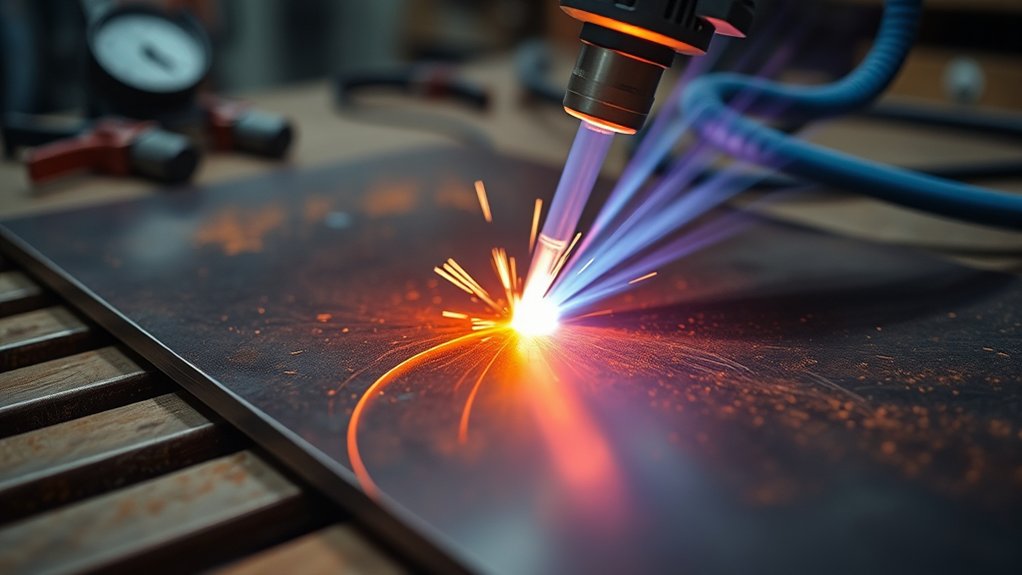
A 20–30A setting is useful only when the cutter and installed consumable support that range. It may suit thin sheet, fine-feature cutting, patch panels, tabs, and light stainless or aluminum. On some modern cartridge systems, however, a dedicated fine-cut process may call for 30A, 40A, or 45A depending on thickness; on a standard 45A process, the chart may keep current at 45A and use much higher travel speed for thin sheet.
Use the Fine-Cut Chart, Not a Generic Formula
Find the chart for the exact fine-cut nozzle or cartridge. Confirm minimum and maximum thickness, current, cut height or drag method, and recommended speed. Thin material can be cut badly at low amperage when the torch moves too slowly, just as it can be overheated at high amperage.
For polished stainless or aluminum, test on scrap and keep heat input low enough to limit discoloration or distortion. Remove protective film only as directed by its manufacturer, and never cut coatings that can release hazardous fumes without identifying the coating and controlling exposure.
Speed and Kerf Control
Watch the spark stream. In a sound manual cut, sparks generally pass through the plate and trail slightly behind the torch. Sparks spraying back toward the operator can mean the torch is moving too fast, the current is too low, the air supply is weak, or the work clamp connection is poor.
Moving too slowly can widen the kerf, round the top edge, increase heat, and create low-speed dross. Moving too fast can leave a hard bead or incomplete separation at the bottom. Keep the torch square and maintain the drag or standoff method specified for that consumable.
Secure Fixturing Methods
Thin sheet moves as it heats. Support it on clean slats or a suitable cutting table and use low-profile clamps or weights outside the cut path. Magnetic fixtures work only on ferromagnetic metals and can interfere with some layouts, so keep them clear of the torch path and molten spray.
| Method | Use | Caution |
|---|---|---|
| Low-profile clamps | Prevent sliding and lift | Keep clear of the torch and current path |
| Weights on supported areas | Reduce flutter | Do not trap hot cutouts |
| Cutting-table slats | Support the sheet while allowing arc exit | Replace heavily slagged or uneven slats |
35–45A Settings: Medium-Thickness Performance and Speed
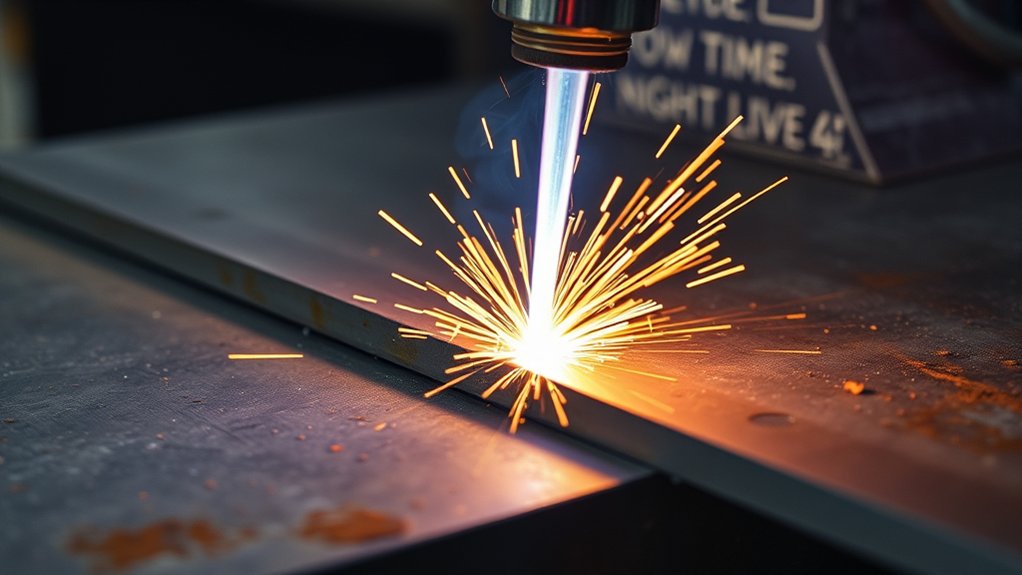
The 35–45A class covers many garage and light-fabrication machines, but the correct thickness range is model-specific. A capable 45A process can cut brackets, flat bar, repair plates, trailer parts, and medium plate. It may also use the full 45A process on much thinner stock while increasing travel speed.
Products Worth Considering
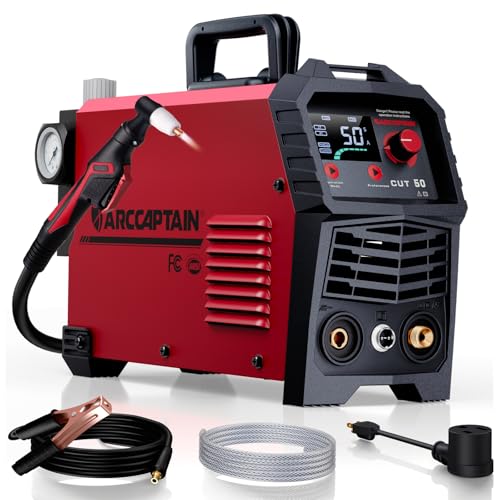
【Powerful Cutting Ability】Switch effortlessly between 110V and 220V for home or workshop use. Achieve professional 1/2" clean cuts on steel, aluminum, and copper with advanced LGBT technology. Perfect for DIY projects and heavy-duty tasks. Recommended maximum cutting thickness: 12mm @ 35A / 110V / 55 PSl; 18mm @ 50A / 220V / 75 PSI. Note: Requires compressed air (compressor sold separately).

Includes 10pcs 56576 Electrode + 10pcs 56811 Tip / Nozzle

Compatible with Titanium 45: specifically engineered compatible with Harbor Freight Titanium 45 Plasma Cutters and IPT-45 cutting torches; These consumables ensure a perfect fit and smooth installation
Manufacturer Example: One 45A Process Across Several Thicknesses
The Powermax45 SYNC mechanized mild-steel chart uses a 45A process for 10-gauge, 1/4-inch, 3/8-inch, and 1/2-inch steel. Its listed best-quality speeds decrease as thickness rises. This directly shows why a fixed “amps per 1/8 inch” table can mislead.
| Mild-Steel Thickness | Process Current | Best-Quality Speed | Pierce Note |
|---|---|---|---|
| 10 GA | 45A | 95 in/min | Charted pierce height and delay |
| 1/4 in | 45A | 46 in/min | Charted pierce height and delay |
| 3/8 in | 45A | 33 in/min | Charted pierce height and delay |
| 1/2 in | 45A | 18 in/min | Within the charted pierce range |
These values are a manufacturer example for a specific mechanized setup, not a substitute for another cutter’s chart. Handheld speed will vary with operator control, and a different torch or consumable can use different numbers.
Cut Speed vs. Quality
When current is fixed by the process, speed becomes the main tuning control. Slow travel adds heat and low-speed dross. Fast travel increases arc lag and can leave uncut metal. Check the nozzle, work clamp, air supply, and standoff before assuming that more amperage is the answer.
For repeat jobs, lock down current, consumable, pressure and flow, material, torch angle, and speed. CNC users should also record pierce height, cut height, delay, arc voltage, and whether an edge start is required.
50–65A Settings: Maximum Capacity and Severance Cuts
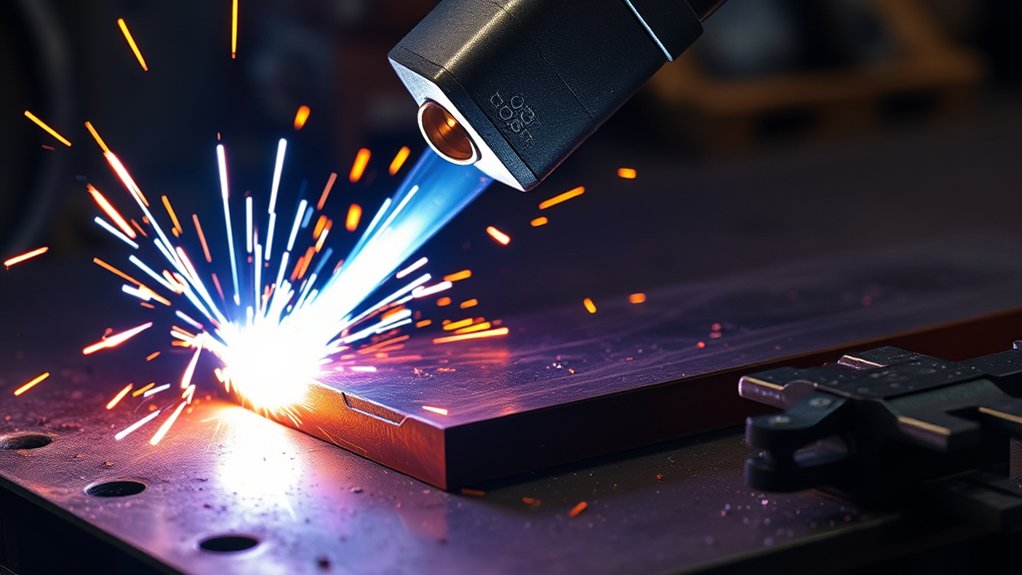
A 50–65A cutter can provide faster travel on medium stock and greater capacity on thick plate, but the amp number alone does not define a clean-cut limit. Compare the manufacturer’s recommended, maximum, pierce, and severance ratings.
For a current model example, the Powermax65 SYNC lists recommended cutting at 3/4 inch and 20 in/min, a slower 1-inch cut at 10 in/min, 5/8-inch pierce capacity, and 1-1/4-inch handheld severance at 5 in/min. Another 65A machine can have different limits.
Near maximum capacity, expect slower travel, more bevel, a wider kerf, and more cleanup. Use an edge start when the chart calls for one instead of trying to pierce plate beyond the rated pierce thickness. Piercing too thick can blow molten metal back into the shield and nozzle.
High-current work also demands stable air flow and adequate duty cycle. Pressure can look correct at rest but collapse during flow if the compressor, filter, regulator, or hose is undersized. Follow both the required inlet pressure and the stated flow rate.
Products Worth Considering
![ARCCAPTAIN iControl CUT65 MP [CNC] Non-HF Plasma Cutter Machine, 65 Amp](https://m.media-amazon.com/images/I/512VnwHLmyL._SL500_.jpg)
[NON-HF BLOWBACK PILOT ARC] Uses a non-HF blowback pilot arc start to reduce electromagnetic interference, ideal for CNC systems. The non-contact arc cuts easily through rusty, painted, or expanded metal. Delivers up to 65A on 240V for smooth, clean cuts up to 32mm on steel, stainless steel, copper, and more.

Powerful Cutting: This VEVOR plasma cutter delivers a maximum output current of 65A for powerful cutting. It supports clean cuts up to 1/2" (12mm) at 110V and 9/16" (14mm) at 220V, with a maximum cutting thickness of 5/8" (16mm) at 110V and 3/4" (20mm) at 220V

Plasma Cutting Thickness: The STC650P plasma cutter with advanced IGBT inverter technology, the 50/60 Hz high-frequency pilot arc plasma cutter supports dual voltage inputs of 110V and 220V and operates at a 60% duty cycle. At 110V, the current range is 15-40A. At 220V, the current range is 15-65A. Maximum cutting thickness is 12mm at 40A and 60PSI on 110V, and 20mm at 65A and 70PSI on 220V. (Note: This machine must be used with a circuit breaker rated at 40 amps or higher and a dedicated circuit; otherwise, the circuit breaker will trip!)
Managing Heat, Warping, and Cut Quality at High Amps
Heat input depends on current, speed, arc length, pierce time, and how long the torch stays near one area. High amperage is not automatically harmful when the chart pairs it with the right speed. Problems begin when the process delivers too much energy to one location or the arc cannot eject molten metal cleanly.
Travel Speed Tuning
Use dross and spark direction as clues, but compare them with the manufacturer’s troubleshooting guidance. Low-speed dross often appears as a thick, easy-to-remove deposit; high-speed dross tends to be a thinner, hard bead. A worn nozzle, incorrect height, low current, or poor air can imitate a speed problem.
| Cut Symptom | Likely Direction | First Checks |
|---|---|---|
| Wide kerf, rounded top, heavy heat | Too slow, too much energy, or too little standoff | Speed, height, current, nozzle condition |
| Hard bottom bead, strong arc lag | Too fast or insufficient energy at the cut | Speed, current, air flow, work clamp |
| Uneven bevel | Torch not square, worn nozzle, or height error | Torch angle, nozzle orifice, cut height |
Fixturing Thin Sheets
Support thin stock close to the cut without blocking the arc exit. Plan the sequence so heat is spread across the sheet instead of concentrated in one corner. On CNC work, use short lead-ins, correct pierce delay, and a stable torch-height control setup. For manual cutting, avoid pausing at corners and keep the lead arranged so it does not pull the torch off line.
Do not use vacuum equipment unless it is specifically designed for hot cutting and the material or fumes involved. Molten metal, sparks, and hot dust can create a fire or filtration hazard in unsuitable vacuum systems.
Electrical Circuit and Breaker Sizing for 220V Plasma Cutters
Do not choose a breaker from the cutter’s output setting or from the thickness you plan to cut. Use the electrical section of the manual and the machine data plate. Confirm input voltage, phase, rated input current, specified fuse or breaker type, plug, conductor size, grounding, and permissible extension-cord length.
A 45A cutting arc does not mean the machine belongs on a 45A branch circuit. Input and output current are different electrical quantities.
A manufacturer may permit reduced output on a smaller electrical service, but only when the manual gives a specific derating method. For example, the Powermax45 SYNC manual states that a 230V unit on a 20A breaker should be limited to about 19A output. Do not assume that another plasma cutter has the same option.
For generators, match the exact manual. The same Powermax45 SYNC manual recommends 10kW for full 45A output with full arc stretch, lists 8kW at 45A with limited arc stretch, and 6kW for 30A output. Generator waveform quality, condition, altitude, temperature, and other connected loads still matter.
Have a qualified electrician install or verify fixed wiring. Do not adapt plugs in a way that removes the equipment grounding conductor, and do not share a heavily loaded circuit with other high-draw equipment.
Sample Cut Charts: Steel, Stainless, and Aluminum
A useful cut chart includes more than amperage. It may list material, thickness, consumable, cut height, initial pierce height, pierce delay, best-quality speed, production speed, arc voltage, kerf width, and gas flow. Handheld manuals may simplify these values, while mechanized guides give more detail.
| Metal | What to Match | Common Adjustment Focus |
|---|---|---|
| Mild steel | Thickness and exact air-plasma process | Speed, dross, bevel, and edge-start limit |
| Stainless steel | Alloy family, gas process, and charted speed | Discoloration, dross, and heat input |
| Aluminum | Thickness, consumable, air flow, and edge-start rule | Speed, bevel, molten spray, and surface condition |
Do not copy a chart from a different brand or torch just because the amperage is the same. A 45A nozzle from one platform can have a different orifice, gas flow, standoff, and speed from another. The correct chart is the one published for your exact process.
Troubleshooting Poor Plasma Cut Quality
When the machine is set to the charted current but the cut is poor, check the system in a fixed order. Begin with the consumable and work clamp, then air quality and flow, torch position, speed, input power, and duty cycle. Change one variable at a time.
| Problem | Likely Causes | Next Step |
|---|---|---|
| Heavy bottom dross | Wrong speed, incorrect current, worn nozzle, or poor height | Compare with the dross guide and adjust one variable |
| Wide kerf or rounded top | Travel too slow, current too high for the process, or low standoff | Verify chart, speed, height, and consumable rating |
| Beveled edge | Torch angle, worn orifice, wrong height, or wrong cut direction | Square the torch and inspect the nozzle |
| Arc sputters or hisses | Moisture, oil, low flow, damaged consumable, or weak work connection | Drain and filter air; inspect hose, consumable, and clamp |
| Arc does not fully sever | Too fast, insufficient current, low input voltage, poor air, or capacity exceeded | Use the exact chart and confirm recommended versus severance capacity |
| Breaker trips | Wrong circuit, shared load, undersized cord, excessive arc stretch, or electrical fault | Stop and compare the installation with the manual; have wiring checked |
Note: Dirty or wet compressed air is a common cause of unstable cutting and short consumable life. Use the filtration and air-quality level specified by the manufacturer, drain the compressor, and service filters on schedule.
Frequently Asked Questions
Can I run a plasma cutter from a generator, and what specs are required?
Yes, when the cutter manual permits generator use. Match voltage, phase, continuous power, surge behavior, grounding, and the manufacturer’s output limit for each generator size. As one example, the Powermax45 SYNC manual lists 10kW for full 45A with full arc stretch, 8kW for 45A with limited arc stretch, and 6kW for 30A. Use the figures for your own model.
How does air quality or moisture affect cut performance and consumable life?
Water, oil, and dirt can destabilize the arc, damage internal parts, enlarge or erode the nozzle, increase dross, and shorten electrode life. Supply clean, dry, oil-free air at the pressure and flow specified by the cutter. Drain the compressor and maintain filters or dryers.
What personal protective equipment is recommended beyond a welding helmet?
Use safety glasses under suitable shaded face protection, flame-resistant clothing that covers exposed skin, dry leather gloves, hearing protection, and protective footwear. Select the lens shade from the cutter safety manual and applicable rules. Use local exhaust or suitable respiratory protection when ventilation and exposure assessment require it.
Are there EMI or RFI interference concerns with nearby electronics or CNC controllers?
Yes. Plasma equipment can disturb computers, controls, sensors, communications, and medical implants. Follow the manufacturer’s grounding and electromagnetic-compatibility instructions, keep cutting and work leads close together, separate power from signal wiring, use suitable shielding, and keep sensitive equipment away from the arc system.
How do I safely transport and store the plasma cutter and consumables?
Disconnect input power, let the machine cool, protect the torch trigger and tip, coil leads without sharp bends, and secure the power supply upright. Store it in a clean, dry area within the manual’s temperature limits. Keep consumables clean, labeled, and protected from impact, oil, and moisture.
Should I use maximum amperage for every cut?
No. Use the current specified for the installed process. Some standard processes stay at their rated maximum across several thicknesses, while fine-cut processes use lower settings. Maximum machine output is not automatically correct for every consumable or cut.
Why does my plasma cutter trip the breaker on 220V?
Possible causes include the wrong branch circuit, a shared load, an undersized or long extension cord, excessive arc stretch, low input voltage, a duty-cycle problem, or a machine fault. Stop cutting and compare the installation with the manual. Never increase breaker size without verifying the entire circuit.
Is 220V the same as 240V for a plasma cutter?
“220V” is often used informally for the 220–240V class, but the data plate controls. Use the exact permitted input range and frequency shown by the manufacturer. Never assume a machine labeled only for another voltage or phase can use your receptacle.
What is the difference between a clean cut and a severance cut?
A recommended or clean cut is made at a useful speed with better edge quality. A severance cut is the thickest material the machine can separate at a much slower speed, usually with more bevel and dross. Do not plan precision parts from a severance rating.
Conclusion
The safest and most accurate way to set a 220–240V plasma cutter is to stop treating voltage or material thickness as a universal amperage formula. Match the exact cutter, torch, consumable, metal, thickness, and cut method to the manufacturer’s cut chart. Then confirm air flow, circuit capacity, speed, and torch height with a test coupon.
A 45A process may remain at 45A from sheet through 1/2-inch plate while speed changes sharply. A 65A machine may have separate recommended, pierce, maximum, and severance limits. Use those distinctions, watch duty cycle, keep air clean and dry, and change one variable at a time. That approach gives cleaner edges, longer consumable life, and fewer electrical or thermal problems.
Sources
- Hypertherm Powermax45/65/85/105 SYNC Cut Charts Guide, Revision 4 — model-specific current, speed, height, pierce, kerf, and gas-flow data.
- Hypertherm Powermax45 SYNC Operator Manual, Revision 3 — input current, circuit protection, duty cycle, extension cords, generators, air, and troubleshooting.
- Hypertherm Powermax65 SYNC Specifications — recommended, pierce, and severance capacity example for a 65A system.
- Hypertherm Safety and Compliance Manual — plasma-arc, eye, skin, noise, fume, fire, electrical, and electromagnetic safety.
- OSHA Welding, Cutting, and Brazing: Hazards and Solutions — official overview of fume, radiation, burn, shock, and fire hazards.
- OSHA Fact Sheet: Controlling Hazardous Fume and Gases During Welding — ventilation and airborne metal-fume controls relevant to plasma cutting.