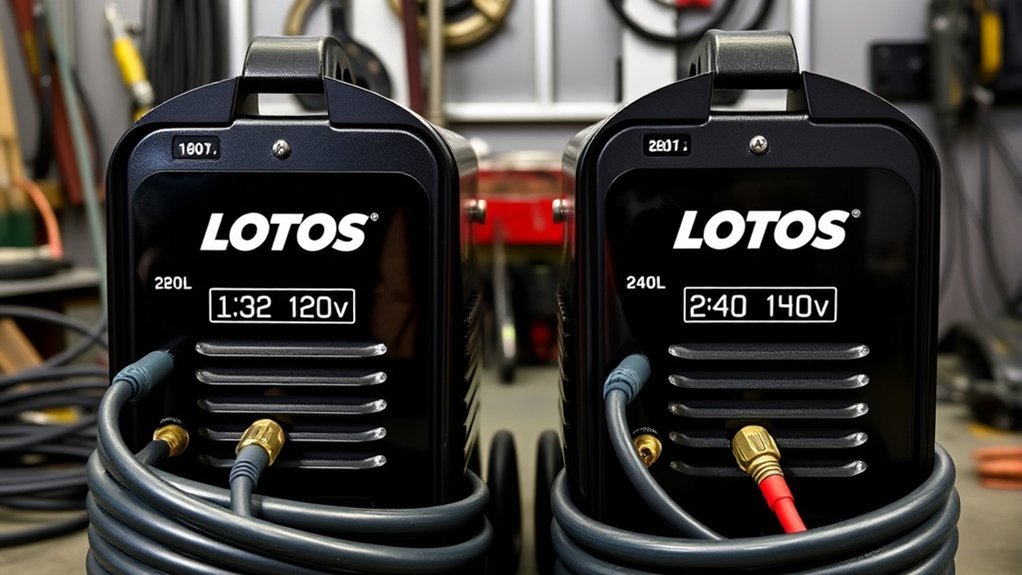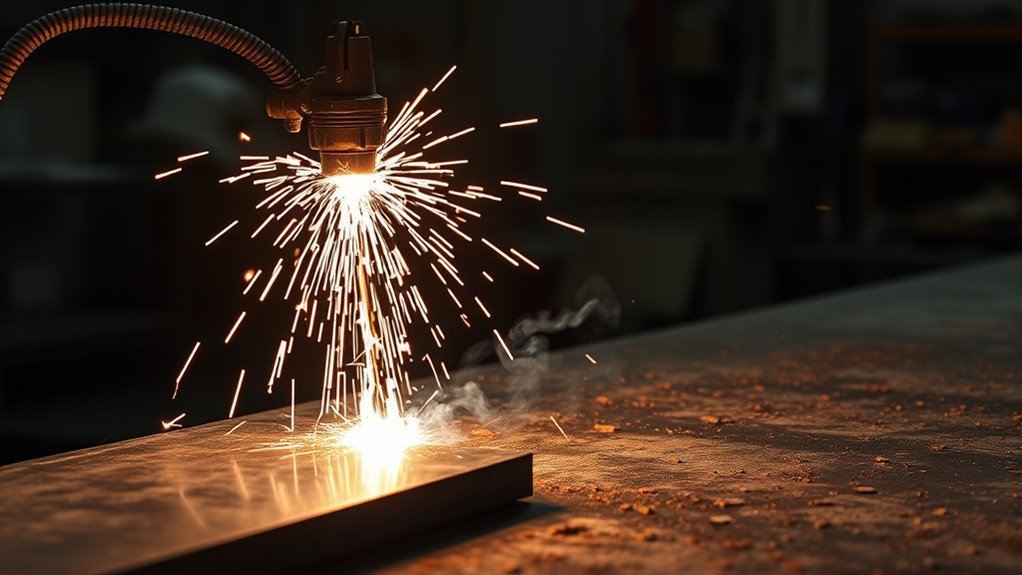
When you run a plasma cutter on a 220V or 240V circuit, you usually get more usable cutting power, better duty cycle, and steadier performance than the same class of machine on 110V. The real cutting limit, though, is not voltage alone. It depends on output amperage, rated cut capacity, severance capacity, air pressure, consumable condition, ground connection, travel speed, and the metal you are cutting.
Quick Answer
Most 220V plasma cutters in the 40A to 65A range clean-cut about 1/2 inch to 3/4 inch mild steel. Some can slowly cut 1 inch or more as a maximum or severance cut, but that edge is rougher and slower. Always compare the machine’s rated cut, severance cut, pierce rating, duty cycle, and air requirements before buying.
Key Takeaways
- A 220V outlet helps the machine deliver stronger output, but amperage and cut rating decide thickness.
- A clean cut is not the same as a severance cut. Severance is the slow, rough maximum cut.
- A 45A class cutter often handles about 5/8 inch rated cutting, while a 65A class cutter can reach about 3/4 inch rated cutting and 1 inch at slower speeds, depending on the model.
- Dry, oil-free air, correct standoff, fresh consumables, and a strong work clamp can matter as much as the voltage.
- Use shaded eye and face protection, fire-safe setup, ventilation, and a dry work area every time you cut.
At a Glance
| Time Required | 10 to 20 minutes to check the cut chart, set air pressure, inspect consumables, and make a test cut |
| Difficulty | Beginner for thin sheet; intermediate for thick plate and long cuts |
| Tools Needed | 220V/240V plasma cutter, air compressor, dry air filter, work clamp, fresh consumables, PPE, scrap test piece |
| Cost | No extra cost if your circuit and air supply are ready; filters, tips, electrodes, and dryers may add $20 to $150+ |
Understanding 220V Plasma Cutters
A 220V plasma cutter is a cutter designed to run on a higher-voltage input circuit than a small 110V unit. In many North American shops, people say “220V” even when the actual supply is closer to 230V or 240V. That higher input lets the machine draw enough power to produce higher output amperage without overloading a small household circuit.
That does not mean every 220V plasma cutter cuts the same thickness. A 40A machine, a 45A machine, and a 65A machine may all plug into a 220V or 240V supply, but their output current, duty cycle, torch design, and air demand can be very different.
For a real-world reference, the Hypertherm Powermax45 SYNC is a 9A to 45A machine with 200V to 240V single-phase input options. Its listed recommended cut is 5/8 inch at 20 ipm, with 1-1/8 inch listed as hand severance at 5 ipm. A larger Hypertherm Powermax65 SYNC is a 20A to 65A machine with a recommended cut of 3/4 inch at 20 ipm, 1 inch at 10 ipm, and 1-1/4 inch hand severance at 5 ipm.
Note: The best number on a spec sheet is usually not the best number for clean production work. Look for the rated or recommended cut first, then severance and pierce ratings after that.
Advantages of Higher Voltage in Plasma Cutting
Higher input voltage helps most plasma cutters maintain stronger output under load. You get better performance because the machine has access to more input power, not because the voltage alone melts thicker steel.
On dual-voltage machines, the same cutter may run on 110V for thin sheet and 220V for thicker plate. At 110V, the machine may limit output amperage to protect the circuit. At 220V or 240V, it can often deliver its full rated output, which improves cut speed, arc stability, and duty cycle.
Improved Cutting Efficiency
When the cutter has enough input power, the arc is easier to keep stable. A stable arc helps reduce dross, taper, and hesitation marks. It also lets you travel at the speed listed in the cut chart instead of crawling along and overheating the edge.
This is especially useful on 3/8 inch, 1/2 inch, and thicker mild steel. If the machine is underpowered for the plate, you may still separate the metal, but the cut will be slower, rougher, and harder on consumables.
Enhanced Power Output
A 220V circuit allows many cutters to reach higher amperage settings. Higher amperage can cut thicker metal, but only if the rest of the setup supports it. You still need the correct nozzle, electrode, swirl ring or cartridge, air pressure, and travel speed.
Duty cycle also matters. A machine rated at 50% duty cycle at full power can cut for 5 minutes in a 10-minute period before it needs cooling time. A machine rated at 100% duty cycle at a lower amperage can keep cutting at that lower output without planned cooling breaks. For long cuts, production work, or repeated thick-plate cuts, duty cycle can matter more than the headline maximum thickness.
Maximum Thickness Capabilities of 220V Plasma Cutters
The maximum thickness a 220V plasma cutter can cut depends mainly on amperage. For mild steel, a small 30A to 40A cutter may be best for sheet metal and lighter plate. A 45A to 50A cutter is often a strong choice for 1/2 inch to 5/8 inch work. A 60A to 65A cutter moves into thicker plate and may handle 3/4 inch clean cuts and 1 inch cuts at slower travel speeds, depending on the model.
Use the chart below as a practical starting point, then confirm the exact cut chart in your machine’s manual.
| Output Class | Typical Clean-Cut Range | Possible Maximum / Severance Range | Best Use |
|---|---|---|---|
| 30A to 40A | Sheet metal to about 3/8 inch | Often around 1/2 inch, depending on model | Auto body, brackets, thin plate, HVAC metal |
| 45A to 50A | About 1/2 inch to 5/8 inch | Up to about 7/8 inch to 1-1/8 inch on some machines | General fabrication, farm repair, shop work |
| 60A to 65A | About 3/4 inch on many professional units | Around 1 inch to 1-1/4 inch on some machines | Thicker plate, repair shops, production cutting |
| 80A to 100A+ | Heavy plate, depending on machine | Higher severance ratings with slower speed | Industrial work, CNC tables, heavy fabrication |
Products Worth Considering

[Powerful Cutting Ability] Dual voltage 110/220V good for home, workshop and hardware shop use. Professional performance 1/2” clean cuts on Iron, Steel aluminum and copper with Inverter IGBT technology. Very powerful for DIY and heavy duty project. The Maximum cutting thickness is recommended to 9/16” (14mm)@35A 110V 50PSI; 4/5” (20mm)@60A 220V 65PSI. Dry and compressed air is required. Power breaker up to 40A@110V 35A; Up to 30A@220V 60A.

3-IN-1 CUTTING MODES: Supports plate cutting, expanded-metal cutting, and rust removal — one machine for virtually every metal project. Expanded-metal mode maintains a steady arc on mesh materials for cleaner, uninterrupted cuts. Rust-clean mode quickly removes corrosion, rust, or coatings without grinding, saving time and reducing prep work. Perfect for home, workshop, or DIY use.

[Powerful Cutting Ability] Dual voltage 110/220V good for home, workshop and hardware shop use. Professional performance 1/2” clean cuts on Iron, Steel aluminum and copper with Inverter IGBT Technology. Very powerful for DIY and heavy duty project. The Maximum cutting thickness is recommended to 12mm@35A 110V 50PSI; 22mm@60A 220V 65PSI. Dry and compressed air is required. Power breaker up to 40A@110V 35A; Up to 30A@220V 60A.
Clean Cut vs Severance Cut vs Pierce Rating
A clean cut, sometimes called a recommended or rated cut, is the thickness the machine can cut with good edge quality at a usable speed. This is the number you should use for buying decisions.
A severance cut is the thickest material the cutter can separate. It is usually slower, rougher, and may leave more dross. Severance is useful in repair or demolition, but it is not the same as a clean production cut.
A pierce rating tells you how thick the machine can start a cut from the middle of the plate. Pierce thickness is usually lower than edge-start thickness because the arc must blow molten metal back out of the starting hole.
Buy for the clean-cut rating you need every week, not the severance rating you might use once.
Speed and Efficiency of Plasma Cutting at 220V
Cut speed drops as metal gets thicker. A cutter that moves quickly through 1/4 inch steel may need a much slower travel speed on 1/2 inch or 3/4 inch plate. If you move too fast, the arc trails behind, the cut may not go through, and sparks will blow back toward the torch. If you move too slowly, the edge overheats and dross builds up.
The right speed produces sparks that exit mostly from the bottom of the cut and trail slightly behind the torch. On thick plate, listen for a steady arc and watch for a clean kerf. If the arc sputters, check air pressure, moisture, consumables, work clamp contact, and extension-cord size before blaming the cutter.
- Set amperage for the metal: Use the cut chart and consumables meant for that amperage.
- Set air pressure and flow: Plasma cutters need clean, dry, oil-free air or the arc becomes unstable.
- Control torch height: Too high widens the kerf and weakens the cut; too low can damage the tip.
- Match travel speed: Follow the cut chart, then adjust after a test cut.
Pro Tip: Before cutting expensive material, make one test cut on scrap of the same thickness. Check the bottom edge, dross, bevel, and spark direction. A one-minute test can save a plate and a set of consumables.
Selecting the Right Plasma Cutter for Your Needs
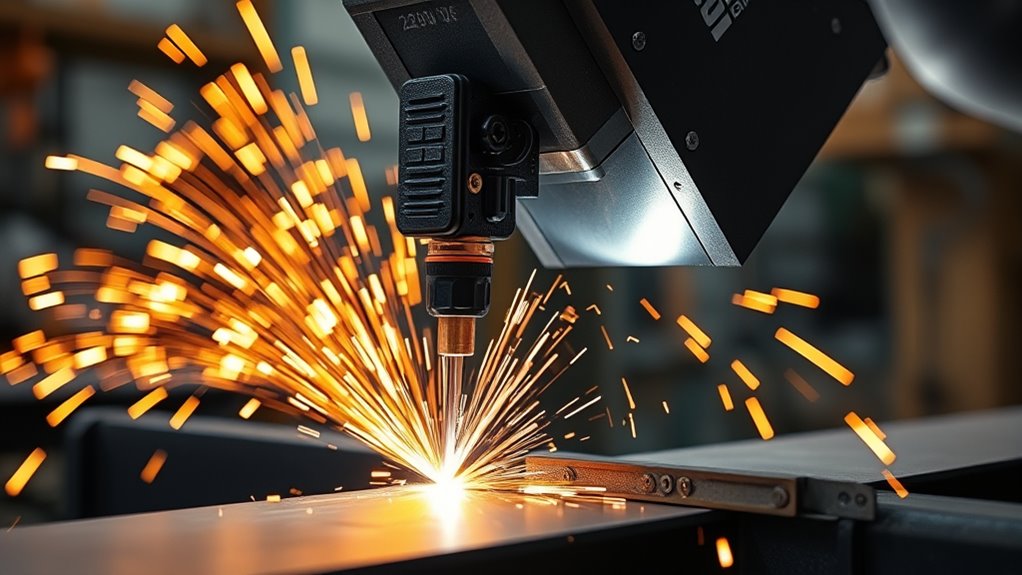
Choose a plasma cutter by the metal you cut most often, not by the thickest plate you can imagine cutting someday. If you mostly cut 1/8 inch to 1/4 inch material, a smaller 220V cutter may be easier to control and cheaper to run. If you often cut 1/2 inch or thicker steel, buy a machine with extra clean-cut capacity so you are not always working at the limit.
When comparing models, check these details:
- Rated or recommended cut: The most useful thickness number.
- Severance cut: The slow maximum cut, not the daily-use rating.
- Pierce rating: Important for CNC tables and interior cutouts.
- Duty cycle: Critical for long cuts or repeated thick-plate work.
- Air requirement: Check pressure and flow, not just compressor tank size.
- Consumables: Match tips, electrodes, shields, or cartridges to the amperage and process.
- Input power: Confirm breaker, plug, wiring, extension cord, and generator compatibility.
- Service and parts: A machine is easier to own when torches and consumables are easy to buy.
Products Worth Considering
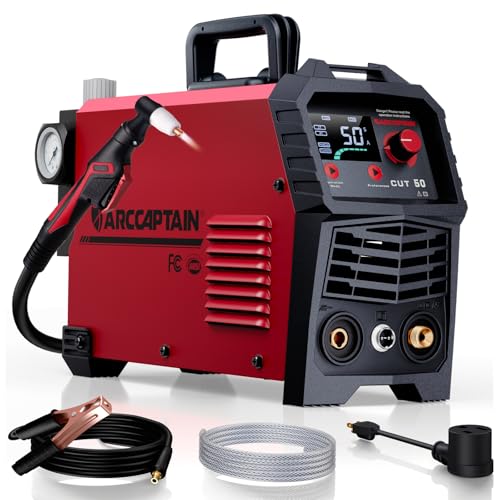
【Powerful Cutting Ability】Switch effortlessly between 110V and 220V for home or workshop use. Achieve professional 1/2" clean cuts on steel, aluminum, and copper with advanced LGBT technology. Perfect for DIY projects and heavy-duty tasks. Recommended maximum cutting thickness: 12mm @ 35A / 110V / 55 PSl; 18mm @ 50A / 220V / 75 PSI. Note: Requires compressed air (compressor sold separately).
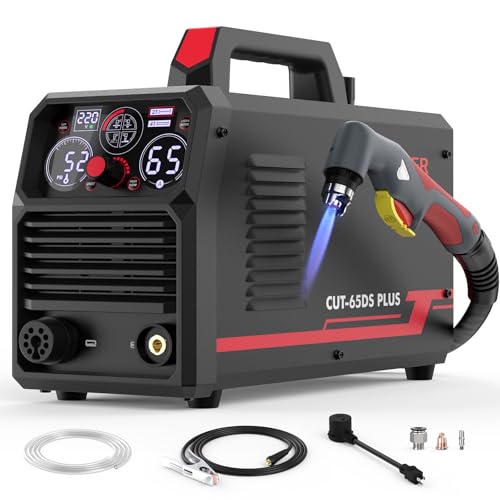
4 FUNCTIONS IN 1 MACHINE: Plate cutting, grid cutting, gouging, and marking give you more ways to handle fabrication, repair, and shop work. Plate Cutting delivers clean cuts on steel, stainless steel, and other conductive metals. Grid Cutting helps maintain a stable arc across grating and perforated metal. Gouging removes welds, rust, and damaged material. Marking creates clear guide lines for layout, hole positioning, and assembly.
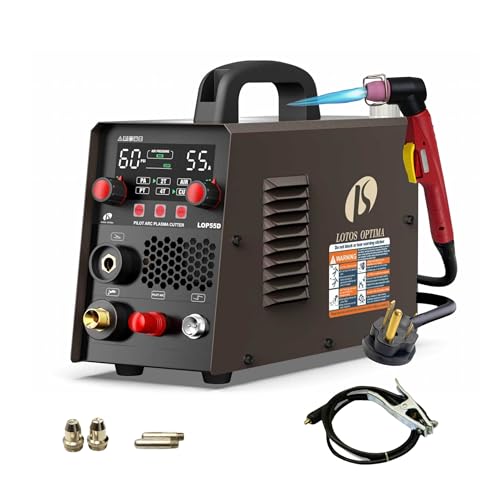
55A Heavy-Duty Cutting Power (Shop/DIY): Robust IGBT inverter delivers up to 1/2" (13 mm) clean cut and 3/4" (19 mm) sever cut on steel, stainless, aluminum, and copper with exceptionally smooth edges and less dross.
Air Compressor and Dry Air Requirements
Air quality has a major effect on plasma cutting. Moisture, oil, or low flow can cause double-arcing, sputtering, rough edges, and short consumable life. Use a compressor that can maintain the cutter’s required pressure and flow while cutting, not just while idle.
For example, Hypertherm lists clean, dry, oil-free air or nitrogen for several Powermax systems. The Powermax45 SYNC lists a recommended gas inlet flow rate of 400 scfh, or 6.7 scfm, at 90 psi. The Powermax65 SYNC lists 450 scfh, or 7.5 scfm, at 85 psi for cutting. Your cutter may need different numbers, so check the manual before you size the compressor.
When to Size Up
Size up if you cut near the top of your current machine’s rating every week, need long continuous cuts, want cleaner edges on thicker plate, or plan to add a CNC table. A bigger cutter running comfortably below its limit often gives cleaner results than a smaller cutter pushed to maximum output all day.
Comparing Plasma Cutting to Other Methods
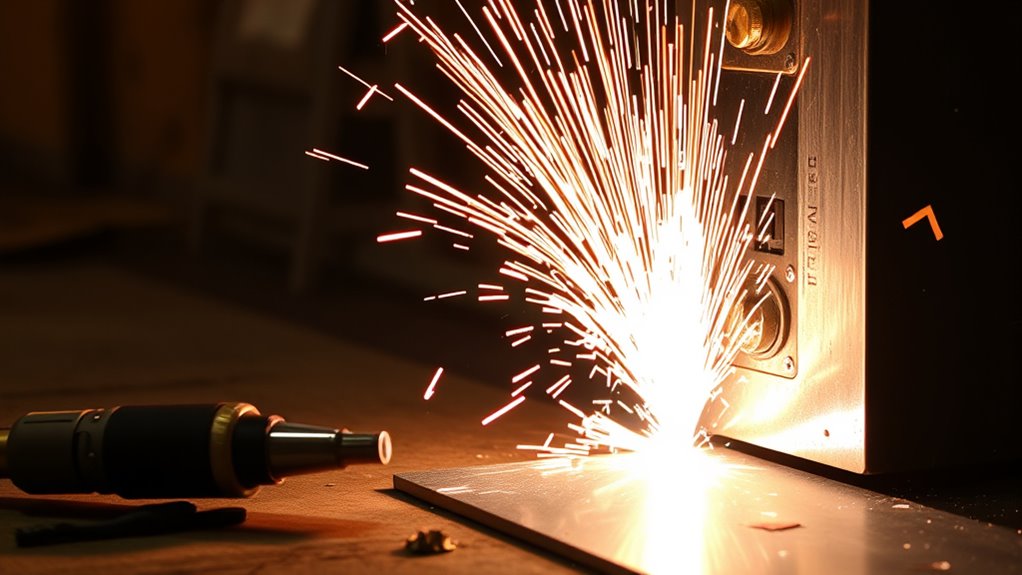
Plasma cutting is fast, flexible, and useful on conductive metals such as mild steel, stainless steel, aluminum, copper, and brass. It works well for curved cuts, rough fabrication, repair work, and general shop projects.
Compared with oxy-fuel cutting, plasma usually starts faster, does not need preheating, and works well on stainless steel and aluminum. Oxy-fuel can still be a good choice for very thick carbon steel, especially when edge precision is less important.
Compared with an abrasive saw or grinder, plasma is faster on sheet and plate and can make curves or internal shapes. Compared with laser cutting, plasma is usually cheaper and more portable, but laser cutting can be more precise on thin sheet. Compared with waterjet cutting, plasma is faster and more affordable for many shops, while waterjet is better when you need no heat-affected zone.
| Method | Best For | Main Limitation |
|---|---|---|
| Plasma cutting | Fast cuts on conductive metals | Needs dry air, consumables, and arc-safe setup |
| Oxy-fuel | Very thick carbon steel | Slower setup and not ideal for stainless or aluminum |
| Abrasive saw or grinder | Straight cuts, small jobs, low equipment cost | Slow on plate and poor for curves |
| Laser | Precise thin-sheet cutting | Higher equipment cost |
| Waterjet | No heat-affected zone and mixed materials | Higher setup cost and slower on many shop cuts |
Safety Considerations for High-Voltage Plasma Cutting
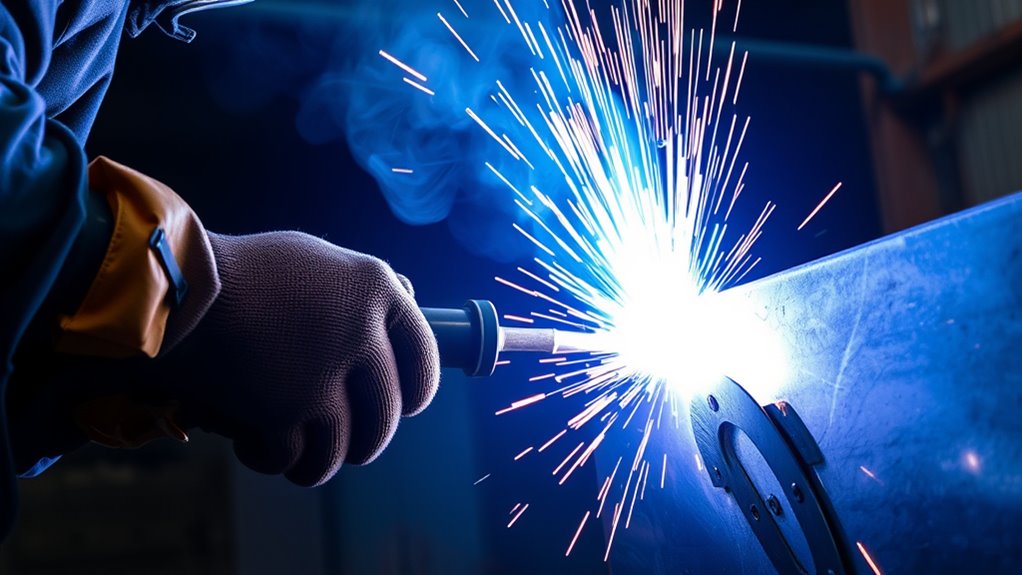
Plasma cutting combines electricity, compressed air, hot metal, sparks, bright arc radiation, fumes, and sharp edges. Treat it as hot work every time, even on a small home project.
Warning: Do not plasma cut in damp conditions, near flammable liquids, near hidden combustibles, or on closed containers. Keep the work dry, ground the workpiece correctly, remove combustibles, and keep suitable fire-extinguishing equipment nearby.
Use shaded eye and face protection suitable for plasma arc cutting. OSHA 1910.133 requires appropriate eye and face protection for flying particles, molten metal, and injurious light radiation, and it lists minimum protective shade numbers for plasma arc cutting when the arc is visible. Wear safety glasses under a shaded face shield or helmet, plus gloves, flame-resistant clothing, hearing protection, and closed leather footwear.
Ventilation matters too. Cutting coated, painted, galvanized, stainless, or manganese-containing steel can release harmful fumes. CDC/NIOSH notes that welding fumes are metal fumes and that manganese exposure can vary by wire, rods, flux, base metal, and confined-space conditions. Use local exhaust or outdoor airflow, and use a properly selected respirator when ventilation alone is not enough.
| Safety Aspect | Recommendation | Purpose |
|---|---|---|
| Eye and face protection | Use shaded plasma-rated protection and safety glasses underneath | Protects against arc radiation, sparks, and flying metal |
| Electrical safety | Keep the work dry, inspect cables, and clamp to clean metal | Reduces shock risk and improves arc stability |
| Fire prevention | Move combustibles, shield fixed hazards, and maintain fire watch where needed | Prevents sparks and hot slag from starting a fire |
| Ventilation | Use local exhaust, outdoor airflow, or respiratory protection as needed | Reduces exposure to metal fumes and gases |
| Torch control | Use the correct standoff, shield, and cutting guide when needed | Improves cut quality and lowers accidental arc contact risk |
OSHA 1910.252 also gives hot-work fire-prevention rules, including moving combustibles, shielding fire hazards, keeping fire-extinguishing equipment ready, and using fire watchers when conditions require them.
Maintenance and Longevity of 220V Plasma Cutters
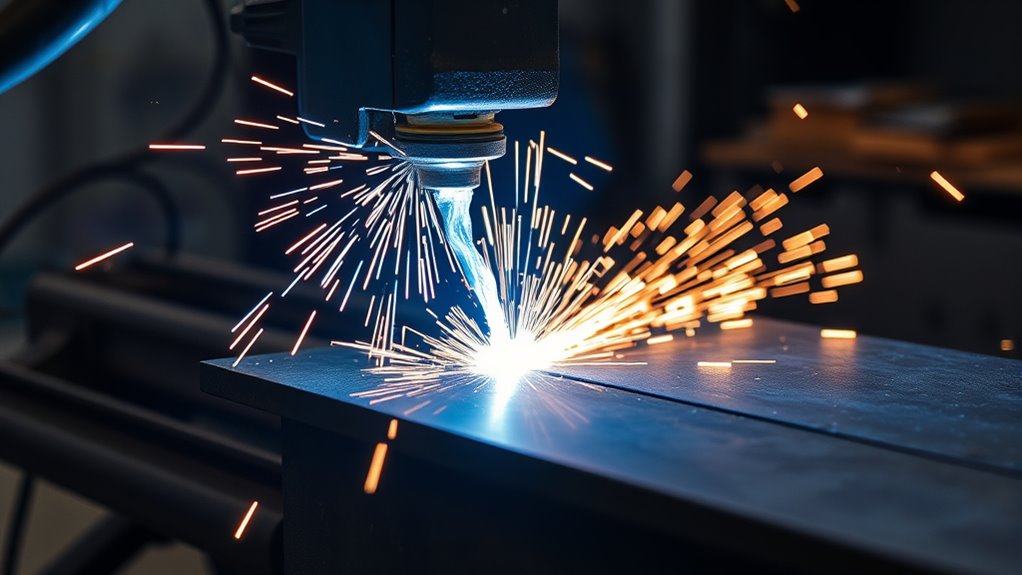
Regular maintenance keeps a 220V plasma cutter cutting at its rated capacity. A neglected cutter may struggle on metal it should cut easily, even when plugged into the right circuit.
Clean, dry air and fresh consumables are the two simplest ways to improve cut quality before you change machines.
- Replace worn consumables: Inspect the electrode, nozzle, shield, retaining cap, cartridge, and swirl parts based on your torch design. Worn parts create wider kerfs, rough starts, and angled cuts.
- Control moisture: Drain the compressor tank, use a water separator, and add a dryer if your shop air is humid. Wet air shortens consumable life and weakens the arc.
- Check the work clamp: Clamp to clean metal, not paint, rust, scale, or a loose table slat. A poor ground path causes hard starts and inconsistent cutting.
- Inspect cables and plugs: Look for heat damage, loose fittings, cracked insulation, and undersized extension cords.
- Keep airflow clear: Clean dust from vents and give the machine enough space for cooling.
- Follow duty cycle limits: If the thermal light comes on, let the cutter cool instead of forcing it back into the cut.
Troubleshooting Poor Cutting Performance
If your 220V plasma cutter will not cut its rated thickness, start with the basics. Confirm the machine is actually on the 220V or 240V input, not a reduced-output 110V setup. Check that amperage is high enough for the metal. Make sure air pressure stays steady while cutting. Replace worn tips or electrodes. Clean the work-clamp area. Slow your travel speed, and keep the torch at the correct height.
If the cut still fails, inspect the material. Heavy mill scale, rust, paint, coatings, and air gaps can reduce cut quality. Expanded metal, stacked plate, and dirty scrap can be harder to cut than clean flat plate of the same thickness.
Frequently Asked Questions
How thick can a 220V plasma cutter cut?
Most 220V plasma cutters in the 40A to 65A range clean-cut about 1/2 inch to 3/4 inch mild steel. Some can sever 1 inch or more, but severance cuts are slower and rougher. Check the rated cut, severance cut, and pierce rating for your exact model.
What metals can be cut with a 220V plasma cutter?
You can cut conductive metals such as mild steel, stainless steel, aluminum, copper, and brass. The cut quality and speed change by metal type, thickness, surface condition, air/gas setup, and amperage.
How does a plasma cutter work at 220V?
The 220V or 240V input supplies power to the machine. The cutter then creates an electric arc and forces gas through the torch to form a hot plasma stream. That plasma melts the metal, while the airflow blows molten metal out of the kerf.
Is 220V plasma cutting suitable for beginners?
Yes, if you start on thin clean steel, use the right PPE, read the manual, and practice on scrap. Beginners should learn torch height, travel speed, air pressure, and work-clamp placement before attempting thick plate.
What accessories are needed for 220V plasma cutting?
You need the correct torch consumables, a strong work clamp, a compressor that meets the cutter’s air-flow requirement, dry-air filtration, shaded eye and face protection, gloves, flame-resistant clothing, and fire-extinguishing equipment.
Can 220V plasma cutters cut non-metal materials?
No, not in the normal plasma-cutting process. Plasma cutters need an electrically conductive workpiece to complete the cutting arc. For non-metal materials, use a tool such as a saw, router, laser, or waterjet, depending on the material.
Why does my 220V plasma cutter leave heavy dross?
Heavy dross usually comes from the wrong travel speed, worn consumables, poor air quality, incorrect amperage, bad work-clamp contact, or too much torch standoff. Make a test cut, adjust speed, and inspect the bottom edge before changing multiple settings at once.
Conclusion
A 220V plasma cutter can be a major upgrade when you need cleaner, faster cuts on thicker metal. For most shop users, the useful clean-cut range is about 1/2 inch to 3/4 inch mild steel in the 40A to 65A class, with thicker severance cuts possible at slower speeds. The smartest choice is not the machine with the biggest headline number. It is the cutter whose rated cut, duty cycle, air demand, torch setup, and safety requirements match the work you actually do.
Sources
- Hypertherm Powermax45 SYNC specifications — backs up 45A output range, input voltage, duty cycle, cut capacity, air supply, and gas flow requirements.
- Hypertherm Powermax65 SYNC specifications — backs up 65A output range, recommended cut, 1-inch cut speed, severance rating, duty cycle, and air demand.
- OSHA 1910.133 Eye and Face Protection — backs up eye/face protection and filter shade guidance for plasma arc cutting.
- OSHA 1910.252 Welding, Cutting, and Brazing General Requirements — backs up fire prevention, combustibles, shields, extinguishers, and fire watch guidance.
- CDC/NIOSH Welding Fumes and Manganese — backs up fume, manganese, confined-space exposure, and ventilation concerns.