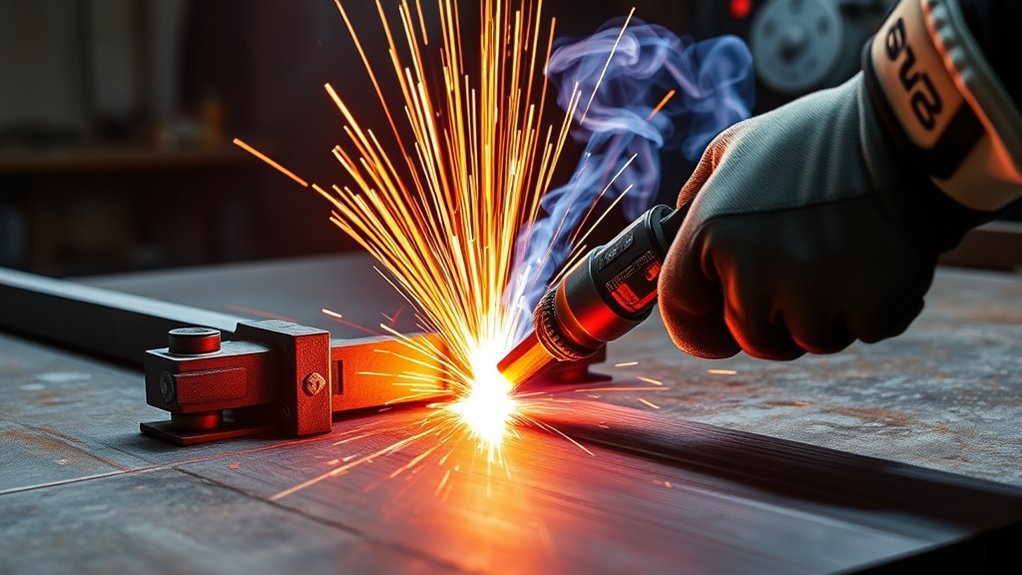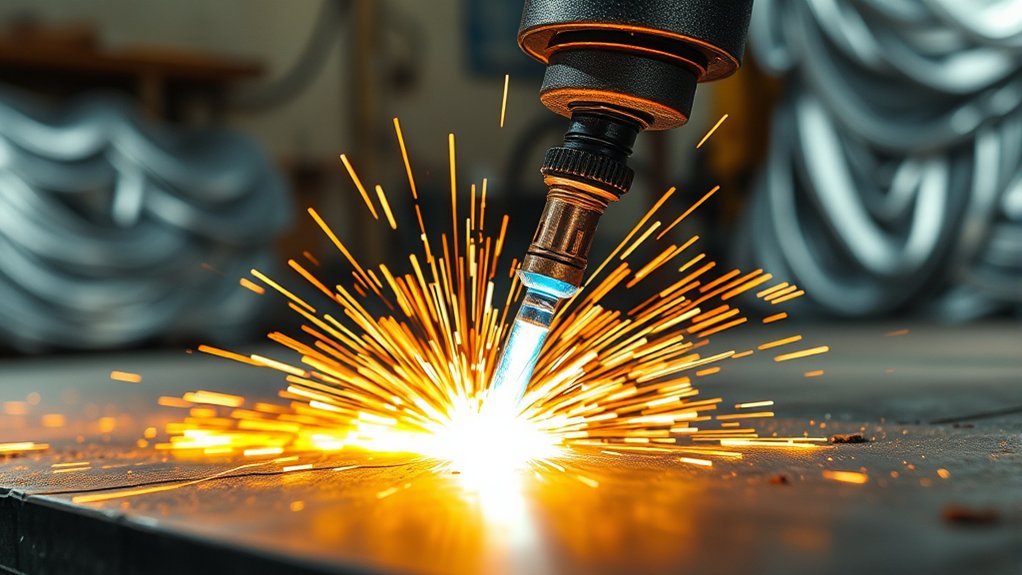
A 50 amp plasma cutter can handle useful fabrication work, but the amp number alone does not tell you the true cut thickness. Input voltage, machine design, metal type, air delivery, consumables, torch height, and travel speed all affect the result. Use the manufacturer’s rated-cut chart as your final limit, especially when you need a square edge instead of a rough severance cut.
Quick Answer
Many dual-voltage 50 amp plasma cutters clean-cut about 1/2 in (12 mm) mild steel on 240V, while 120V operation may limit output to about 40 amps and roughly 1/4 in (6 mm). Aluminum and stainless ratings are often lower. Always separate rated cut, pierce, and severance capacity before choosing a machine.
What’s in This Article
- Rated Cut vs. Severance and Pierce Capacity
- Recommended Thickness Ranges for 50 Amp Plasma Cutters
- Steel Cutting Performance at 120V vs. 240V
- Aluminum Cutting Performance and Best Practices
- Stainless Steel and Other Conductive Metals
- Duty Cycle and Its Impact on Cutting Thickness
- Air Pressure, Flow, and Gas Quality Requirements
- Tip and Electrode Selection for Clean Cuts
- Travel Speed, Torch Height, and Technique Guidelines
- Common Mistakes That Reduce Cut Capacity
- Plasma Cutting Safety for Full-Output Work
- Generator Size for a 50 Amp Plasma Cutter
- Frequently Asked Questions
Key Takeaways
- Treat 1/2 in mild steel on 240V as a common planning figure for budget 50 amp units, not a universal guarantee.
- A professional 40–45 amp system may outperform a cheaper machine labeled 50 amps because torch design, arc voltage, and power quality matter.
- Do not assume aluminum has the same clean-cut rating as mild steel; check the material-specific chart.
- Measure air pressure while air is flowing, and size the compressor by delivered SCFM at the required pressure.
- Use torch-specific consumables and cut-chart speeds instead of generic tip-hole or inches-per-minute rules.
Rated Cut vs. Severance and Pierce Capacity
Manufacturers use several thickness ratings, and they do not describe the same finish. Compare the right number before you decide whether a cutter is large enough.
- Rated or recommended cut: The thickness the machine can cut at a stated speed with a usable, reasonably square edge.
- Maximum cut: A slower cut that may still be serviceable but usually has more bevel and dross.
- Severance cut: The thickest material the arc can separate. Expect slow travel, a wider kerf, heavy dross, and cleanup.
- Pierce capacity: The thickness the torch can start through from the top. It is often lower than edge-start capacity because molten metal blows back toward the torch during the pierce.
Note: “110V/220V” is common product language, but North American nominal service is usually 120V/240V. The machine’s manual and nameplate control which input voltage and circuit it accepts.
Published ratings show why output amps alone are not enough. The PrimeWeld CUT50DP lists a 1/2 in mild-steel single-pass capability at 240V and up to 1/4 in plate at 120V, where output is limited to 40 amps. The 40 amp Miller Spectrum 625 X-TREME publishes a 5/8 in mild-steel rating but lower ratings for stainless steel and aluminum. The 45 amp Hypertherm Powermax45 SYNC publishes a 5/8 in recommended cut, a 1/2 in pierce rating, and a much slower 1-1/8 in severance rating.
| Published Example | Output | Key Capacity | What It Shows |
|---|---|---|---|
| PrimeWeld CUT50DP | 50A on 240V; 40A on 120V | 1/2 in steel on 240V; up to 1/4 in plate on 120V | Dual-voltage machines may reduce output on the lower-voltage circuit. |
| Miller Spectrum 625 X-TREME | 40A | 5/8 in mild steel; 1/2 in stainless; 3/8 in aluminum | Material and machine design can matter more than the marketing amp number. |
| Hypertherm Powermax45 SYNC | 45A | 5/8 in recommended; 1/2 in pierce; 1-1/8 in severance | Rated, pierce, and severance numbers answer different questions. |
Recommended Thickness Ranges for 50 Amp Plasma Cutters
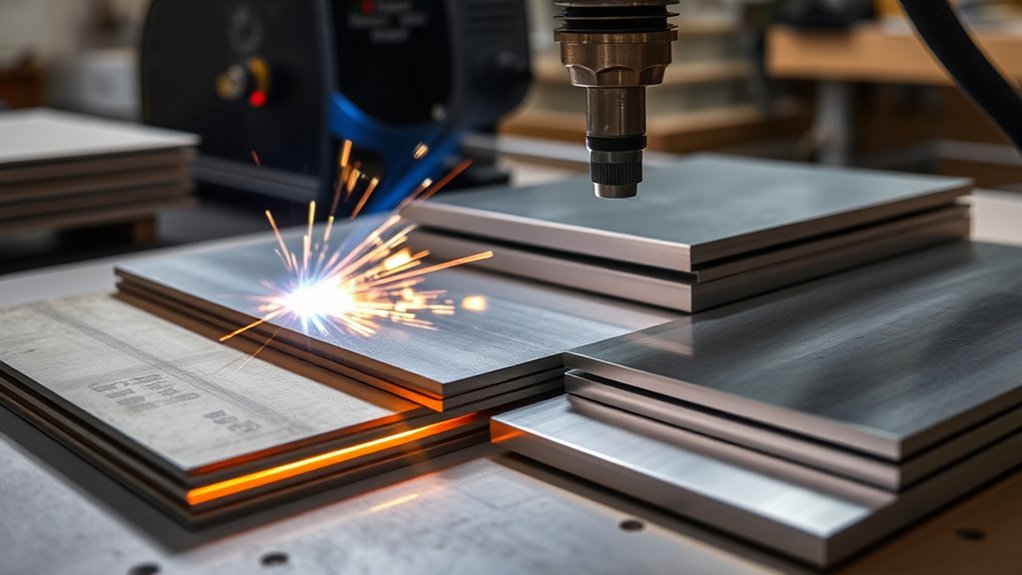
For planning purposes, many budget 50 amp air-plasma cutters are best matched to mild steel up to about 1/2 in (12 mm) on 240V. Some professional 40–45 amp systems publish 5/8 in (16 mm) rated capacity, while lower-cost machines may use 5/8 in as a severance limit instead.
On 120V, a dual-voltage machine may not deliver its full 50 amp output. One common design limits output to 40 amps and publishes about 1/4 in (6 mm) plate capacity. Other machines may perform differently, so do not transfer one model’s rating to another.
Use these practical rules when comparing machines:
- Choose the rated or recommended capacity for routine fabrication.
- Keep your normal material thickness below the machine’s top rating when edge quality and speed matter.
- Use severance capacity only for occasional separation work where cleanup is acceptable.
- Check the pierce rating when starting inside a plate instead of from an edge.
- Confirm whether the published number applies to mild steel, stainless steel, or aluminum.
Cut speed must match the specific metal, thickness, amperage, torch, and consumable set. Thin sheet needs lower amperage or faster movement to control kerf width and distortion. Near the rated limit, you normally use full output and a slower cut-chart speed.
Check the nozzle, electrode, swirl ring, retaining cap, work clamp, and torch standoff before an important cut. Worn or mismatched parts spread the arc, increase bevel, and reduce repeatability.
Steel Cutting Performance at 120V vs. 240V
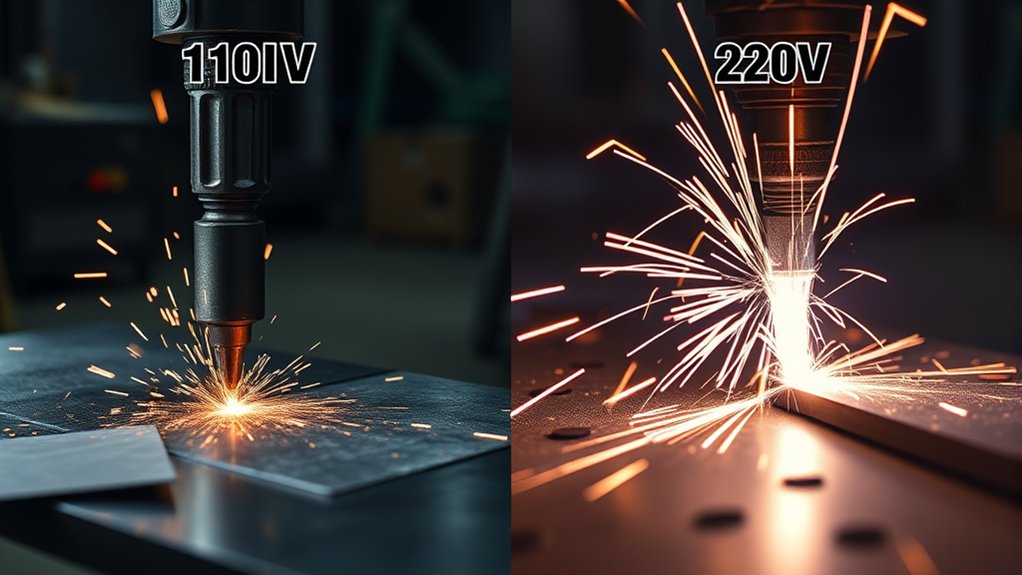
Input voltage affects a dual-voltage cutter only as the machine’s design specifies. Some units deliver full rated output on both inputs when connected to a large enough circuit. Others reduce maximum output on 120V. The PrimeWeld example limits output to 40 amps on 120V and reaches 50 amps on 240V.
Do not confuse the cutter’s 50 amp plasma output with the wall-circuit amperage. Output current flows through the torch arc, while input current depends on voltage, efficiency, power factor, and load. Use the breaker, receptacle, plug, and conductor sizes in the manual.
| Metric | 120V Mode | 240V Mode |
|---|---|---|
| Maximum output | May be reduced; 40A on the cited CUT50DP example | Full 50A on the cited CUT50DP example |
| Published example capacity | Up to about 1/4 in plate | About 1/2 in steel in one pass |
| Duty cycle | Model-specific; voltage alone does not set it | Model-specific; check the rating at maximum output |
| Best use | Sheet metal, light repair, and portable work | Thicker plate, faster travel, and steadier full-output work |
Warning: Do not improvise adapters, undersized extension cords, plugs, or breaker changes. Follow the cutter manual and local electrical code, and have a qualified electrician install a required 240V circuit.
Aluminum Cutting Performance and Best Practices
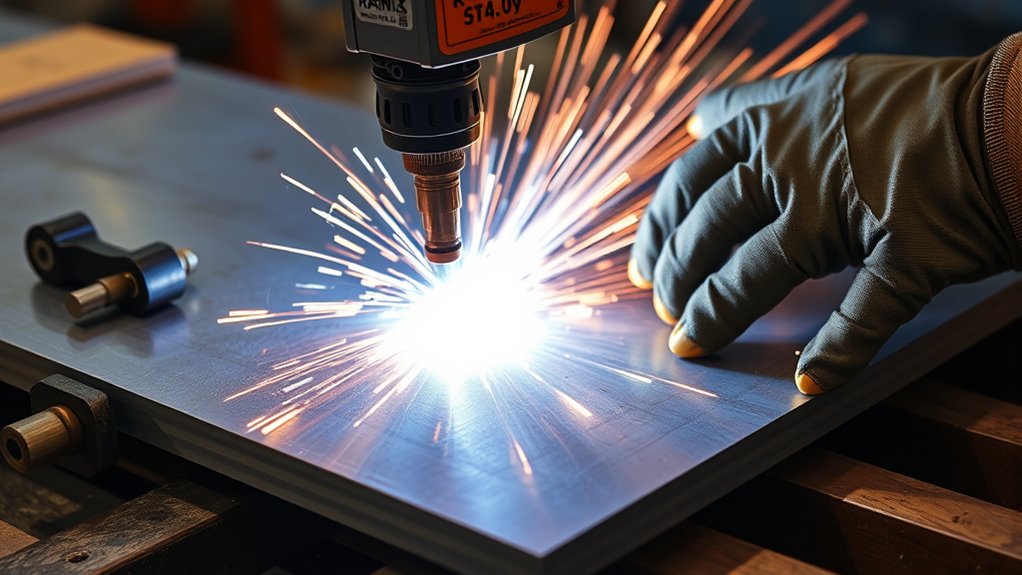
Plasma can cut aluminum because aluminum conducts electricity, but you should not assume its clean-cut rating matches mild steel. For example, Miller rates its 40 amp Spectrum 625 X-TREME for 5/8 in mild steel but 3/8 in aluminum. A different 50 amp machine may publish another figure.
For thin aluminum, reduce amperage and use the matching lower-amperage consumable when the torch manufacturer provides one. This helps control kerf width, edge rounding, and heat distortion. As thickness increases, move toward the cutter’s full rated output and follow the material-specific cut chart.
Keep the torch square to the work, maintain the specified standoff, and use a smooth travel rate. Aluminum often rewards a brisk, steady cut. Moving too slowly increases heat input and low-speed dross, while moving too fast can leave an incomplete cut or hard high-speed dross.
Use clean, dry, oil-free air at the pressure and flow required by the machine. Moisture and oil shorten consumable life and make the arc less consistent.
Pro Tip: Make a short test cut in an offcut from the same aluminum alloy and thickness. Check the bottom dross, kerf width, and edge angle before cutting the finished part.
Stainless Steel and Other Conductive Metals
A 50 amp air-plasma cutter can cut stainless steel, copper, brass, and other electrically conductive metals, but each material produces a different edge. Stainless ratings may be lower than mild-steel ratings, and air plasma can leave an oxidized or discolored cut face that needs cleanup before welding or corrosion-sensitive service.
Remove paint, plating, oil, and unknown coatings before cutting whenever possible. Coatings can contaminate the cut and create hazardous fumes. Clamp the work lead to clean, bare metal close to the cut so the arc has a reliable current path.
Duty Cycle and Its Impact on Cutting Thickness
Duty cycle tells you how long the cutter can operate at a stated output and ambient temperature before it needs to cool. It does not directly change the machine’s rated thickness, but it controls how much thick material you can cut without thermal shutdown.
Duty cycle is usually expressed as a percentage of a 10-minute period. A 30% duty cycle at 50 amps means up to 3 minutes of arc time followed by 7 minutes of cooling under the test conditions. A 60% rating means 6 minutes of arc time and 4 minutes of cooling.
Do not apply a generic duty-cycle number to every 50 amp cutter. PrimeWeld publishes 60% at maximum output for the CUT50DP, while Hypertherm publishes 50% at 45 amps for the Powermax45 SYNC at 40°C (104°F). Machine design and test temperature matter.
Thicker plate increases arc-on time because travel is slower. Long cuts can also push the air compressor toward its own duty-cycle limit. Track both machines during production work, keep cooling vents clear, and allow the cutter to complete its post-flow cycle.
Hot shop conditions can reduce available run time. Very cold conditions may also fall outside the machine’s permitted operating range. Use the manual’s ambient-temperature limits instead of assuming cold metal automatically increases cut capacity.
Air Pressure, Flow, and Gas Quality Requirements
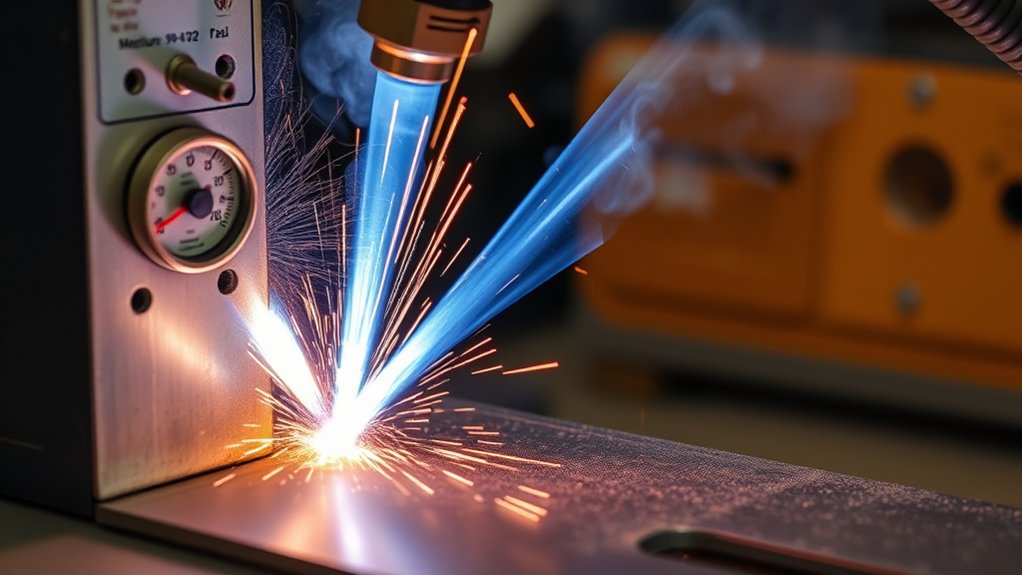
Set air delivery by the machine manual and verify it while air flows through the torch. Static pressure can look correct and then collapse as soon as the solenoid opens or the arc starts.
Published requirements vary. PrimeWeld lists 40–75 PSI and 5 CFM at 80 PSI for the CUT50DP. Hypertherm lists 6.7 SCFM at 90 PSI for the Powermax45 SYNC. These examples show why a universal “4.5 PSI” setting is not credible for a 50 amp air-plasma cutter; 4.5 bar is about 65 PSI, and confusing bar with PSI would leave the torch severely under-supplied.
Choose a compressor by its delivered CFM or SCFM at the required pressure, not by tank size or peak horsepower. A compressor rated only at the cutter’s minimum demand may run continuously and still sag during a long cut. PrimeWeld recommends extra capacity and suggests roughly 1.5 to 2 times the plasma system’s airflow requirement for frequent or thick-plate work.
| Check | What to Verify | Why It Matters |
|---|---|---|
| Dynamic pressure | Pressure with test air or torch airflow active | Reveals regulator, hose, fitting, and compressor pressure drop |
| Delivered airflow | SCFM or CFM at the required PSI | Keeps the plasma jet focused and clears molten metal |
| Air quality | Clean, dry, and oil-free air | Protects the electrode and nozzle from rapid wear |
| Restrictions | Hose diameter, quick couplers, filters, leaks, and clogged elements | Prevents hidden flow loss even when the tank gauge looks normal |
Drain the compressor tank, service the water separator, and use a suitable coalescing filter or dryer when moisture is a problem. Do not raise pressure beyond the approved range to compensate for worn consumables or poor technique.
Pro Tip: Use the cutter’s air-test function, when equipped, and read pressure at the machine while air is moving. A regulator reading taken with no flow can hide a major pressure drop.
Products Worth Considering
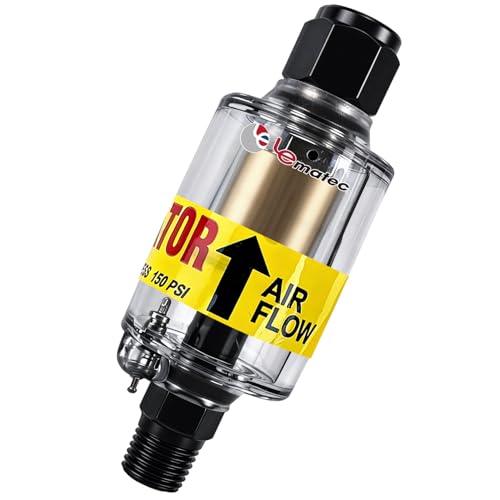
Moisture Protection: 1-micron reusable element removes air compressor oil and water from compressed air systems; essential for precise spray painting and plasma cutting

【Industrial Performance】The air drying system features two rugged 3/4“ NPT air ports and 1/4” NPT gauge ports to handle high-pressure environments (up to 240 PSI) for a variety of industrial applications. Note: To prevent air leakage, please wrap the sealing tape around the threads appropriately before connecting the screws.

3/8" NPT Piggyback Air Filter/Regulator Combo
Tip and Electrode Selection for Clean Cuts
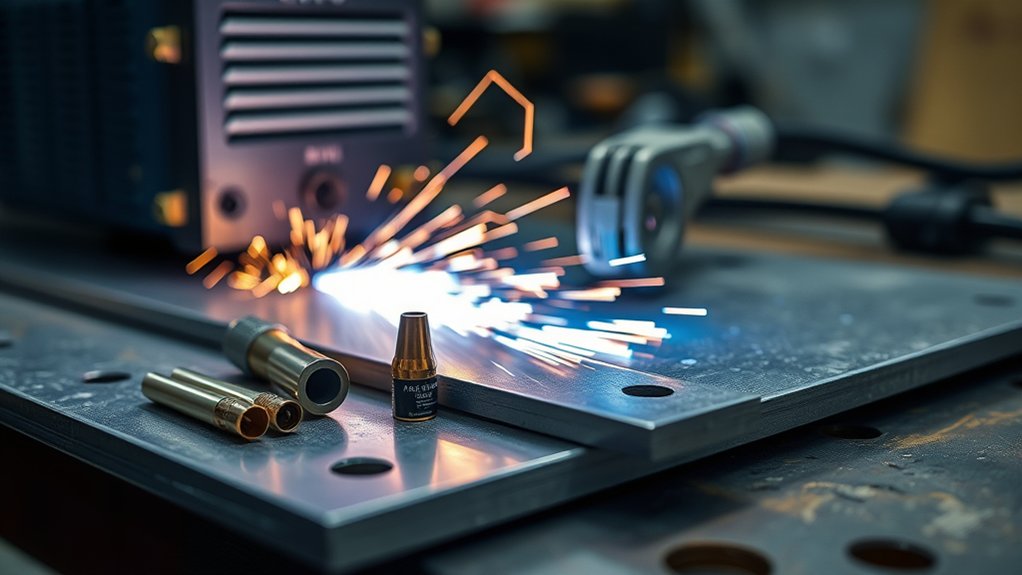
Clean cuts depend on a matched nozzle, electrode, swirl component, retaining cap, and shield. Select consumables by the torch manufacturer’s part number and amperage chart. Generic statements such as “use a 1/16 in tip at 50 amps” are not reliable across different torch families.
Products Worth Considering

[Achieve Precise Cuts] PT31 Plasma Cutting Consumables – Your Essential Tool for Efficient Cutting! Whether you're working with sheet metal, steel, or any other material, superior cutting performance ensure clean, accurate, and smooth cuts.

GOUGING CONSUMABLES:The gouging consumables can only be used in gouging mode.Incorrect usage can accelerate the wear of the accessories or even cause them to become unusable.

Fit for: SG-55 AG-60 plasma cutter torch head.
Matching Tip Size
Use the nozzle or tip rated for the selected current. A lower-amperage consumable can produce a narrower kerf on sheet metal, but running it above its rating can enlarge or distort the orifice. A tip made for much higher current may produce a soft, wide arc when used too low.
Do not drill, file, or gauge the orifice to make a generic tip fit a target amperage. Use genuine or correctly specified compatible parts for the exact torch.
Electrode Wear Signs
Inspect the electrode insert for a pit or crater and check the nozzle for an oval hole, nicks, or heavy spatter. Replace parts when they reach the torch maker’s wear limit. The Miller plasma-cutting guidance recommends regular inspection and replacing the tip and electrode together for consistent cut quality.
| Indicator | Likely Effect | Action |
|---|---|---|
| Deep electrode pit | Hard starting and wandering arc | Replace at the manual’s wear limit |
| Oval or enlarged nozzle hole | Wide kerf, bevel, and dross | Replace the nozzle and inspect the electrode |
| Blocked swirl holes or dirty cap | Poor gas swirl and unstable arc | Clean or replace as the torch manual allows |
| Wrong amperage consumable | Overheated tip or unfocused arc | Install the correct torch-specific set |
Arc Start Quality
Arc-start quality depends on correct assembly, clean air, a sound work connection, and healthy consumables. Most hand-torch consumable stacks set the internal electrode-to-nozzle spacing automatically when assembled. Do not try to “reset” the gap by bending, shimming, or modifying parts.
Finger-tighten the retaining cap unless the manual specifies otherwise. Overtightening can damage threads or prevent internal parts from moving as designed. Turn off and disconnect input power before inspecting or changing torch parts.
Travel Speed, Torch Height, and Technique Guidelines
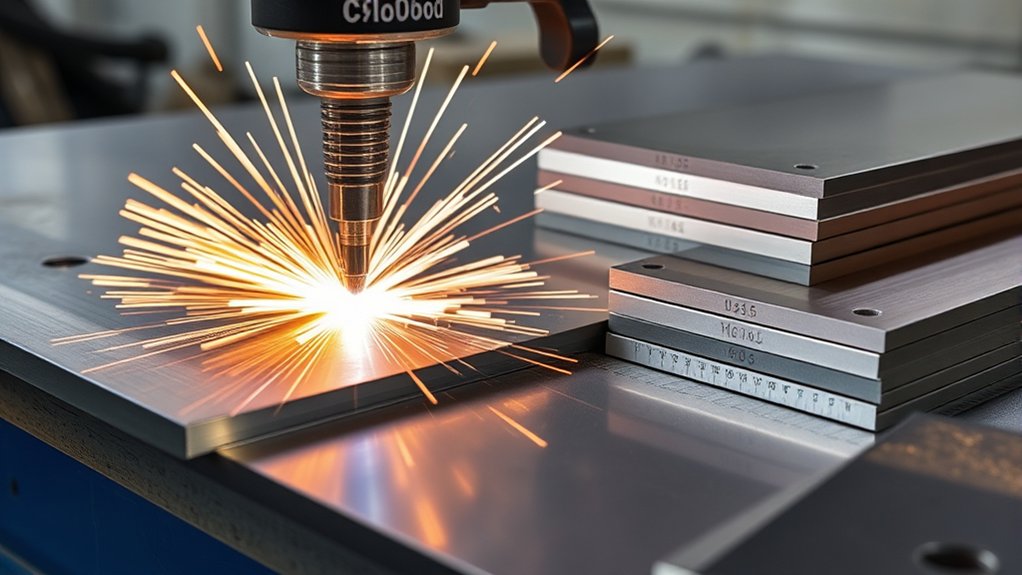
Use the manufacturer’s cut chart for the starting amperage, speed, standoff, and pierce delay. A fixed 30–60 inches-per-minute rule cannot cover every 50 amp cutter, material, and thickness.
For a normal handheld cut, keep the torch close to 90 degrees to the plate. If the system is designed for drag cutting, rest the drag shield on the work. If it requires a standoff, many small systems use about 1/16 to 1/8 in, but the torch manual is the final standard.
Once the arc penetrates, move smoothly and watch the sparks below the plate. Miller advises adjusting travel so sparks exit the bottom; at a proper speed, the arc trails opposite the direction of travel. If sparks spray back toward the torch, you are usually moving too fast or lack enough cutting power. If they fall nearly straight down, you may be moving too slowly.
Use an angled torch only where the procedure calls for it, such as starting a pierce to direct blowback away from the nozzle or leaning slightly at the end to finish the cut. A continuous 5–15 degree lead angle is not a universal rule for straight cutting.
| Cut Symptom | Likely Cause | First Adjustment |
|---|---|---|
| Sparks spray backward or the cut does not fully penetrate | Travel too fast, output too low, weak air, or thickness beyond capacity | Slow slightly and verify full output, air, and consumables |
| Heavy, easy-to-remove bottom dross | Travel too slow and excessive heat input | Increase speed in small steps |
| Thin, hard bottom dross with trailing lines | Travel too fast or insufficient energy | Reduce speed slightly or confirm amperage and voltage |
| Wide kerf, rounded top edge, or excess top spatter | Torch too high, worn nozzle, or excessive current for the consumable | Correct standoff and inspect the consumables |
| One side of the cut is more beveled | Torch not square, worn nozzle, or normal swirl-side behavior | Square the torch and place the best edge on the finished part |
Make short test cuts before production. Change one variable at a time, then record the amperage, pressure, consumable, standoff, and speed that produced the best edge.
Common Mistakes That Reduce Cut Capacity
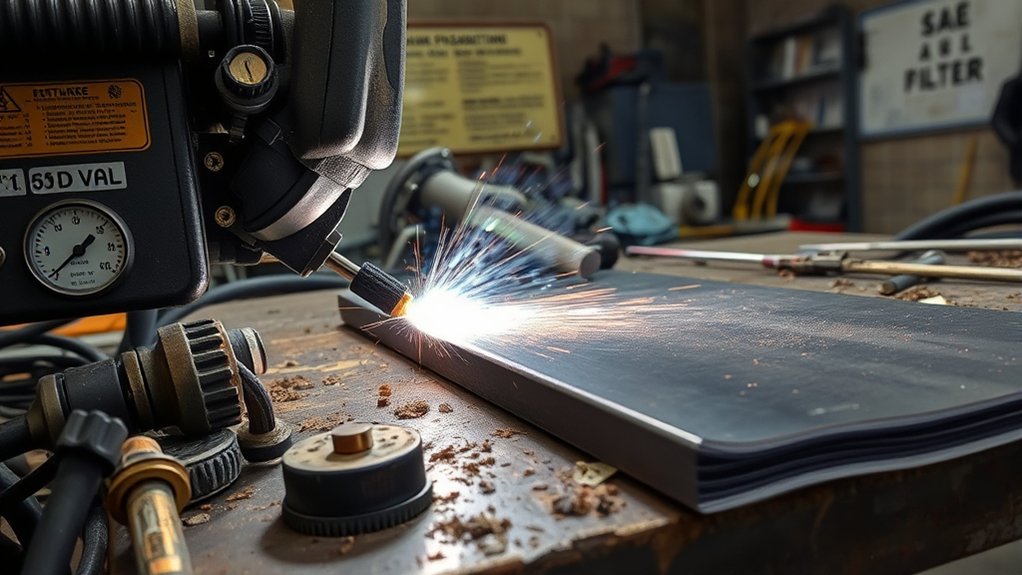
When a cutter struggles below its published rating, check the full system before blaming the power source. A weak electrical supply, restricted air, a poor work connection, wrong consumables, or poor technique can each make a healthy machine act underpowered.
Wrong Tip Size
Use the consumable set rated for the selected amperage and torch. A tip that is too small can overheat and distort. A tip intended for much higher current can spread the arc and widen the kerf at lower settings.
Inadequate Air Supply
Check dynamic pressure and delivered SCFM. A long narrow hose, restrictive quick coupler, clogged filter, leaking fitting, or small compressor can reduce flow even when the tank pressure looks high.
- Test pressure with air moving through the machine.
- Drain water and maintain filters and separators.
- Use hoses and fittings that meet the manual’s minimum size.
- Confirm the compressor can sustain the required airflow, not just reach the pressure once.
- Watch compressor temperature and duty cycle during long cuts.
Worn Consumables
Replace a distorted nozzle, deeply pitted electrode, cracked cap, or damaged swirl part. A worn nozzle can start an arc yet still produce a wide kerf, heavy bevel, and reduced effective thickness.
Poor Work Connection
Attach the work clamp to clean, bare metal as close to the cut as practical. Paint, rust, mill scale, oil, and a clamp placed through loose parts can increase resistance and cause unstable transfer from the pilot arc to the cutting arc.
Starting a Pierce Beyond the Rating
Edge-start thick plate when possible. Piercing at or beyond the rated limit throws molten metal back at the nozzle and can damage consumables. Use the published pierce limit, correct pierce height, and proper delay on a CNC table.
Plasma Cutting Safety for Full-Output Work
Plasma cutting exposes you to hot metal, ultraviolet and infrared radiation, electrical current, fumes and gases, noise, and fire hazards. OSHA’s hot-work PPE guidance identifies all of these hazards for plasma arc cutting.
- Wear eye and face protection with the filter shade specified by the cutter manual and applicable safety rules.
- Use flame-resistant clothing, leather gloves, hearing protection, and suitable footwear.
- Keep flammables, fuel, pressurized containers, and bystanders away from sparks and hot slag.
- Never cut a sealed tank, drum, pipe, or container that may hold pressure, vapor, or combustible residue.
- Do not use the cutter in rain, standing water, or wet clothing.
- Provide local exhaust or effective ventilation, especially when cutting stainless steel, galvanized metal, painted material, or plated parts.
- Remove coatings and solvent residue before cutting. Never let chlorinated-solvent vapors enter the cutting area.
Warning: Plasma cutting creates airborne metal fume. OSHA requires adequate ventilation for welding and cutting, with stricter controls for confined spaces and metals or coatings containing lead, cadmium, zinc, mercury, or other hazardous materials. Do not cut unknown coatings without identifying the hazard first.
What Size Generator Do You Need for a 50 Amp Plasma Cutter?
There is no universal generator size for every 50 amp plasma cutter. Size the generator from the manufacturer’s stated input or engine-drive requirement, not from the 50 amp torch-output number.
As a professional example, Hypertherm specifies a 12.5 kVA (10 kW) engine drive for full 45 amp output from the Powermax45 SYNC. PrimeWeld lists 5.9 kVA rated power for the CUT50DP on 220V but does not publish the same generator recommendation on its product page. That difference is why a blanket 10–12 kW rule can be either excessive or insufficient for a particular machine.
Choose a generator that provides the required voltage, continuous kW or kVA, receptacle, and surge margin. For inverter equipment, also follow any manufacturer limit for waveform quality or total harmonic distortion. Do not operate other heavy loads from the generator while assuming the cutter still has full capacity.
Frequently Asked Questions
Can a 50 amp plasma cutter clean-cut 1/2 in steel?
Many budget 50 amp machines publish about 1/2 in mild-steel capacity on 240V, but the result depends on the exact machine, air supply, consumables, and technique. Use the rated or recommended cut number, not the severance number, when edge quality matters.
Can a 50 amp plasma cutter cut 3/4 in steel?
Some professional 40–45 amp systems can sever 3/4 in steel or more, but many budget 50 amp units cannot make a clean 3/4 in cut. Check the model’s severance rating and expect slow travel, heavy dross, bevel, and cleanup.
What is the difference between a clean cut and a severance cut?
A clean or rated cut is made at a useful speed with an edge suitable for normal fabrication. A severance cut only separates the material. It is slower and usually leaves more bevel, a wider kerf, and heavier dross.
What generator size is needed for a 50 amp plasma cutter?
Use the cutter manufacturer’s generator or engine-drive specification. One current 45 amp professional system calls for 12.5 kVA or 10 kW at full output, while other 50 amp machines list lower input kVA. Output amps alone cannot determine generator size.
How does ambient temperature affect duty cycle and cut performance?
Duty-cycle ratings are tied to a stated test temperature, often 40°C (104°F) on professional equipment. Hotter conditions can shorten available run time. Temperatures below the permitted operating range can also cause faults, so follow the machine’s environmental limits.
Can a CNC table increase a plasma cutter’s thickness capacity?
A CNC table does not add amperage. It can help the cutter reach its published capacity more consistently by controlling travel speed, torch height, pierce height, and pierce delay. It cannot make an underpowered arc clean-cut material beyond the machine’s rating.
What extension cord gauge and length are safe for full output?
Use an extension cord only when the cutter manual permits it. Follow the manufacturer’s conductor-size and maximum-length table, keep the cord as short as practical, use copper conductors and the correct grounding connection, and never use a cord with a lower current rating than the circuit and machine require.
Do consumable brands change cut thickness and lifespan?
Consumable fit, orifice accuracy, electrode material, and manufacturing consistency affect arc shape and service life. Use genuine or correctly specified compatible parts for your torch. A poorly fitting or distorted tip can reduce effective capacity even when the machine still starts an arc.
A 50 amp plasma cutter commonly handles about 1/2 in mild steel on 240V, but that number is only a starting point. Check the material-specific rated cut, pierce, and severance figures for your exact model. Then verify the input circuit, dynamic air pressure, delivered SCFM, consumables, work connection, torch height, and travel speed with a test cut before committing to the finished part.
Sources
- PrimeWeld CUT50DP specifications — dual-voltage output, published cut thickness, duty cycle, air pressure, airflow, and rated input power.
- Miller Spectrum 625 X-TREME specifications — material-specific mild-steel, stainless-steel, and aluminum capacity.
- Hypertherm Powermax45 SYNC specifications — recommended, pierce, and severance capacity; duty cycle; airflow; and engine-drive requirement.
- Miller plasma cutting tips — standoff, spark direction, travel speed, and consumable inspection.
- OSHA hot-work PPE guidance — plasma cutting hazards and protective equipment categories.
- OSHA 29 CFR 1910.252 — ventilation and controls for welding and cutting fumes, confined spaces, and hazardous metals or coatings.