Most TIG power supplies lack the high-frequency start voltage and gas-flow dynamics a plasma arc needs, so you can’t just bolt on a cutter head and expect safe, reliable operation. You’ll face incompatible voltages, inadequate gas delivery, and missing arc-control electronics that create serious shock and fire hazards. Before you consider improvising, you should understand the specific electrical and pneumatic changes required — and why many shops choose a different route instead.
Why a TIG Power Supply Isn’t Built for Plasma Cutting
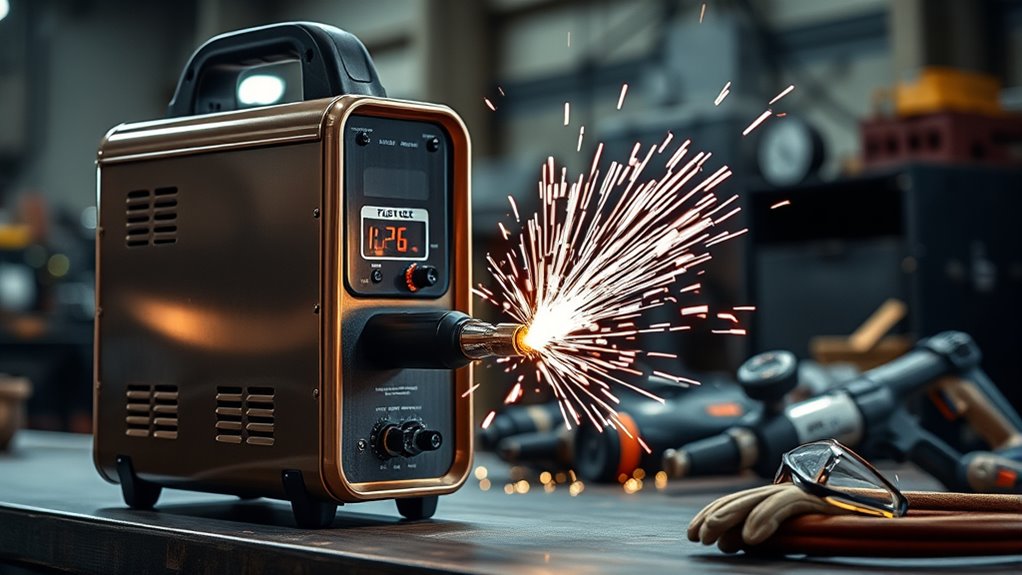
Because plasma cutting depends on much higher open-circuit voltages, you can’t simply substitute a TIG power supply and expect safe, effective operation.
You’ll encounter TIG limitations immediately: typical TIG supplies run around 70–80 V OC and are engineered for steady low-current welding, not the ~380 VDC ionization thresholds plasma requires.
The internal circuitry, insulation, and protective components in TIG units aren’t rated for the transient high-voltage stress or arc-starting pulses plasma systems demand.
TIG units’ circuitry, insulation, and protections aren’t built to handle the transient high-voltage spikes plasma cutting requires.
You also face incompatible gas flow and pressure control: plasma requirements include controlled ionizing gas delivery and response times that TIG torches and regulators don’t provide.
From a safety standpoint, attempting adaptation increases electrocution and equipment-failure risk because TIG protective circuits, grounding, and creepage distances weren’t designed for plasma voltages.
Don’t improvise conversions; they’ll likely damage the welder and won’t produce reliable plasma cutting performance.
Follow correct equipment selection to meet functional and safety obligations.
Electrical and Gas Requirements for Safe Plasma Operation
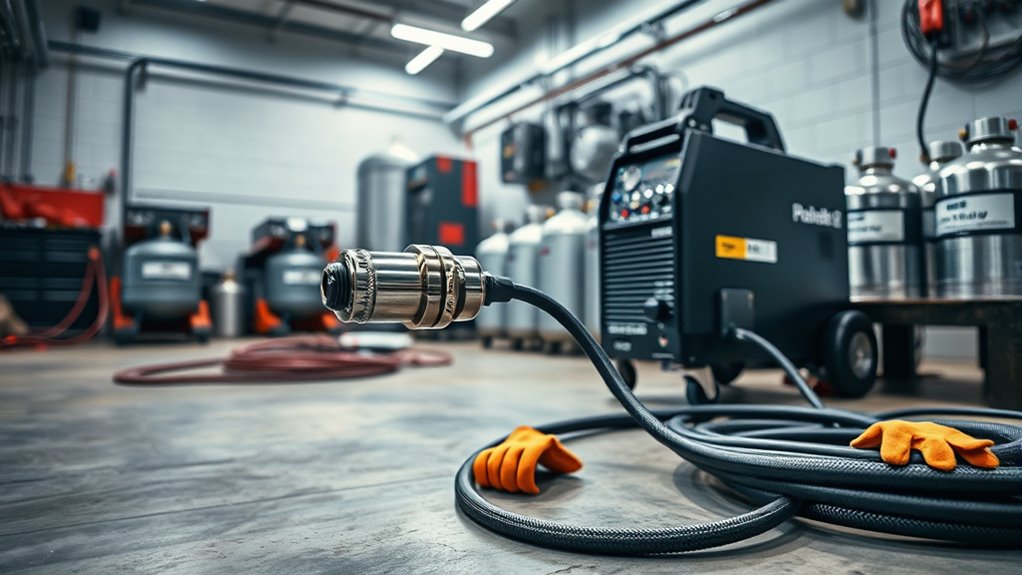
Having established that TIG power supplies lack the voltage and circuitry for plasma cutting, you now need to address the specific electrical and gas requirements that make plasma systems different.
Plasma cutting demands an open circuit voltage near 380 VDC and stable voltage regulation to sustain arc initiation and length; typical TIG OCV (~70 V) is insufficient. You must guarantee the power supply delivers correct polarity, high-voltage insulation, and overcurrent protection tailored to plasma duty cycles.
Equally critical is compressed gas management: plasma cutters require a constant, metered gas flow (often shop air) with a regulator, dryer/filter, and a flowmeter to prevent nozzle erosion and poor cut quality.
Regularly test voltage output and gas flow under load and verify grounding integrity. Use appropriate PPE, maintain ventilation to control fumes, and follow high-voltage lockout/tagout procedures.
If you can’t meet these electrical and gas specifications precisely, don’t attempt conversion.
Practical Risks and Costs of Converting an Econotig
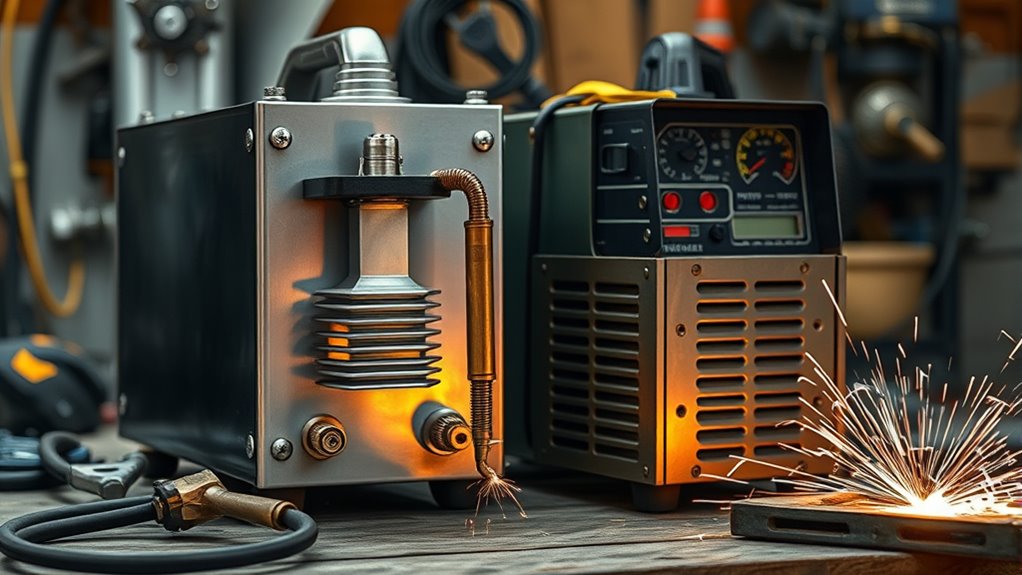
If you try to convert an Econotig into a plasma cutter, you’ll quickly run into prohibitive technical and safety issues: TIG power supplies are built for low open-circuit voltages (~70 V) and different control topologies, whereas plasma cutting needs roughly 380 VDC OCV, robust voltage regulation, and insulation designed for high-voltage switching.
You’ll face conversion challenges including redesigning the inverter, adding high-voltage rectification, HV insulation, and control electronics for pilot arc and current sensing. That work demands specialist parts, safety interlocks, and PCB/layout changes that risk permanent damage to the welder if done incorrectly.
From a cost analysis perspective, parts, labor, and testing cost far more than entry-level dedicated plasma units; the safety mitigation (grounding, PPE, enclosures) adds more expense. Electrocution and fire hazards increase without professional design and certification.
Practically, selling or trading the Econotig and buying a purpose-built plasma cutter yields better safety, performance, and return on investment than attempting a conversion.
Viable Alternatives: Dedicated, Dual‑Purpose, and Budget Options
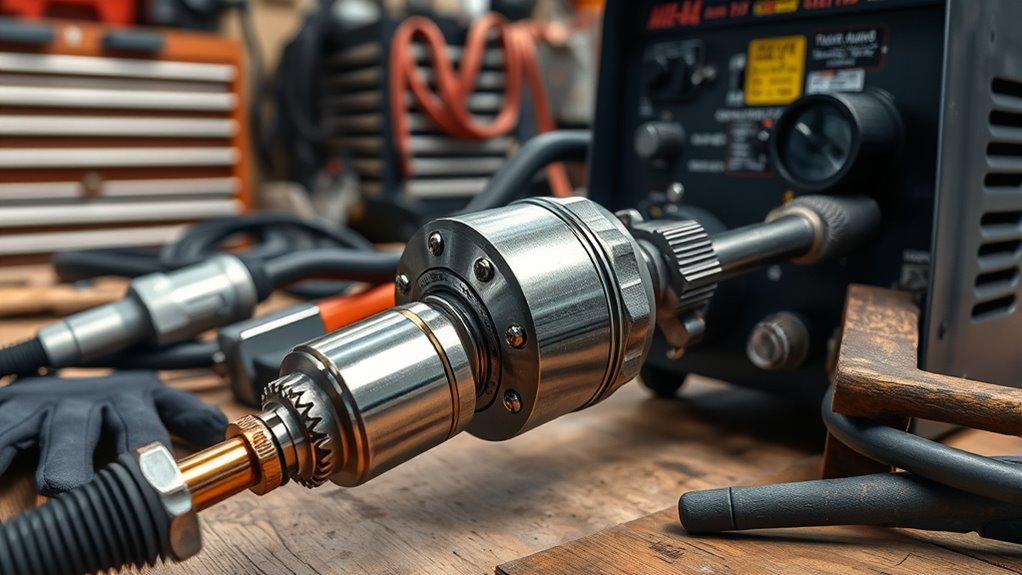
When you need cutting capability without the hazards and expense of converting a TIG machine, choose purpose-built equipment: dedicated plasma cutters, dual‑purpose (plasma/TIG) units, or compact budget models each meet distinct needs while preserving safety and performance.
You’ll get consistent cutting parameters, correct duty cycles, and certified components when you buy a dedicated plasma device instead of modifying a TIG welder.
- Dedicated plasma for clean, repeatable cuts — engineered consumables, airflow control, and safety interlocks.
- Dual‑purpose (plasma/TIG) multi process machines — single footprint, shared power supply, designed switching, factory wiring.
- Compact budget cutters — portable, lower amp outputs for hobbyists; verify duty cycle and torch insulation.
- Shop integration — match cooling, ventilation, and PPE to the tool’s specifications; avoid ad‑hoc adapters.
Choose equipment that meets electrical, thermal, and safety standards.
That reduces fire, electrical shock, and equipment failure risks while maintaining workflow efficiency and code compliance.
Best Practices for Welding and Cutting in Confined or Hard‑to‑Reach Spaces
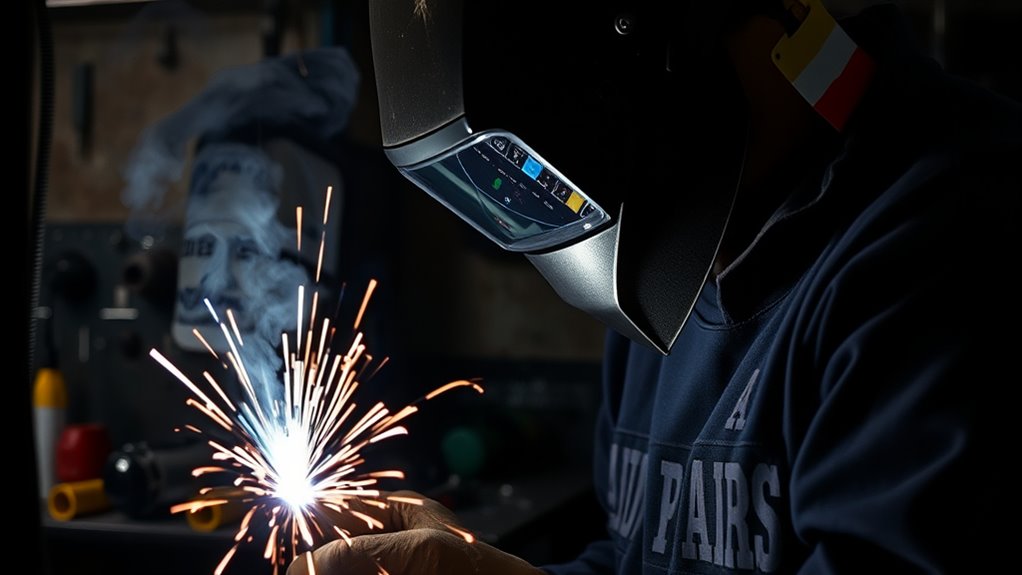
Dedicated and purpose-built cutting tools are the right choice for controlled shop work, but you’ll often face jobs that put welders and cutters into confined or hard-to-reach spaces where equipment choice alone isn’t enough.
You must treat these areas as OSHA-defined confined spaces: verify size, access limits, and permit requirements before entry. Use ventilation techniques aggressively — position portable fume extractors or local exhaust close to the arc to capture weld fumes at source and maintain compliance.
Select advanced safety equipment: high-quality helmets with improved lens technology, insulated gloves, and flame-resistant clothing sized for restricted movement.
Employ remote-control welding systems (for example, ArcReach-style controls) to minimize trips to power sources and reduce time spent in the hazard zone. Conduct pre-job environmental assessments to identify trip, entrapment, and fume accumulation risks, document controls, and brief personnel.
If ventilation or access can’t be assured, postpone work or use remote cutting methods; never compromise confined-space protocols for speed.
Frequently Asked Questions
Can a TIG Torch Be Modified Into a Plasma Torch Without Voiding Warranties?
No — you can’t safely convert a TIG torch into a plasma torch without voiding warranties. TIG modification risks include electrical, thermal, and control incompatibilities; warranty considerations demand manufacturer approval or using dedicated plasma equipment for safety.
How Does Plasma Cutting Affect Nearby Electronics and Sensors?
Plasma cutting generates strong electromagnetic interference that can upset or damage nearby electronics and sensors; you should use robust electronic shielding, maintain distance, ground equipment, and employ ferrite filters and transient suppressors to reduce radiated and conducted disturbances.
Can I Plasma-Cut Stainless Without Special Consumables?
You can’t reliably plasma-cut stainless without special consumables; think of sparks as guided missiles. Use correct plasma cutting techniques, consider stainless steel considerations like alloying and oxide formation, and prioritize appropriate nozzles, shielding, and safety procedures.
Are Compressed Air Filters/Oilers Necessary for Plasma Cutting?
Yes — you need compressed air filters/oilers for plasma cutting. You’ll maintain compressed air maintenance to protect consumables, guarantee plasma cutting efficiency, reduce moisture/contaminant damage, and minimize unpredictable arc behavior and safety hazards.
What’s the Lifespan Difference Between Tig-Derived and Factory Plasma Torches?
Like a clock, factory plasma torches usually outlast TIG-derived units by roughly 2–5×; you’ll extend torch longevity with strict maintenance practices, calibrated consumables, proper cooling, and routine inspections to guarantee safe, reliable operation.
Conclusion
You shouldn’t convert a TIG power supply into a plasma cutter: it lacks the high-voltage ignition, pilot arc control, and gas flow architecture required for safe plasma cutting. You’d increase shock risk, fire risk, and equipment damage. Choose a certified plasma cutter for cutting, a TIG for precision welding, or buy a dual-purpose/portable unit for both tasks. Prioritize proper ventilation, correct gas mixes, and trained operators—reduce risk, meet standards, and protect personnel and assets.