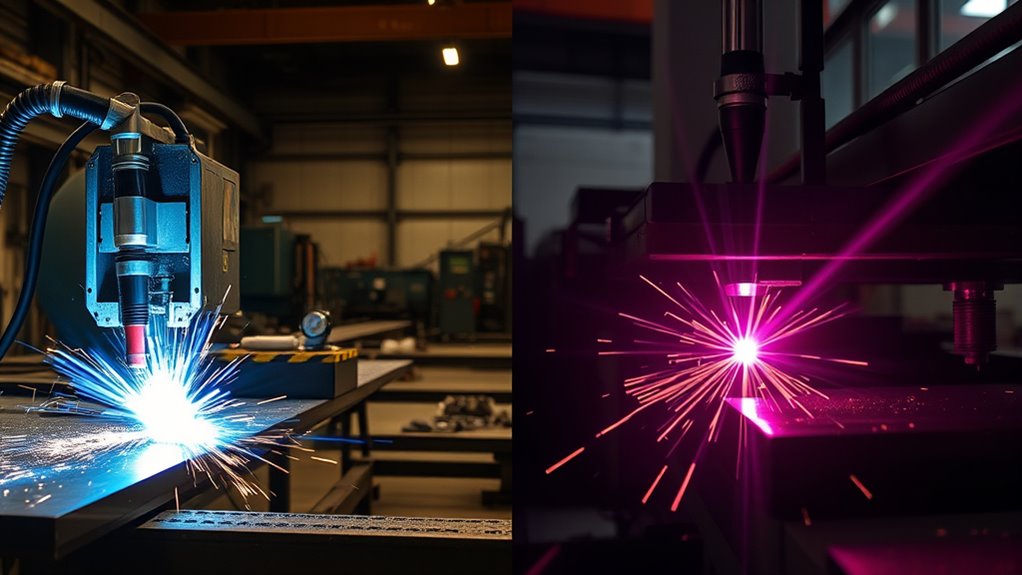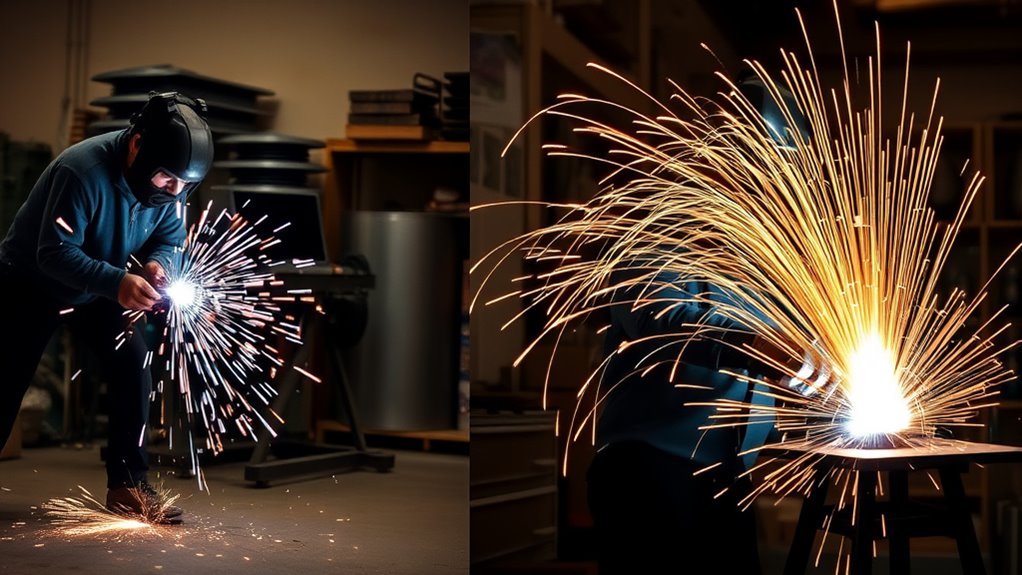
Choosing between a plasma cutter and a metal inert gas (MIG) welder comes down to the job you need to do. A plasma cutter removes metal; a MIG welder joins it. This guide compares their materials, setup needs, operating costs, learning curves, safety concerns, and best uses so you can choose the right tool for your shop.
Quick Answer
Choose a plasma cutter for fast, controlled cuts in electrically conductive metal. Choose a MIG welder for joining steel, stainless steel, or aluminum with the correct wire, gas, and accessories. Most fabrication shops eventually use both, but your first purchase should match the task you perform most often.
Key Takeaways
- A plasma cutter cuts conductive metals; a MIG welder creates welded joints.
- Plasma cutting usually needs suitable electrical power plus clean, dry compressed air.
- Gas-shielded MIG welding needs wire, shielding gas, a regulator, and protection from wind.
- Machine capacity, duty cycle, consumables, and utility needs matter more than a single advertised maximum.
- Both processes produce intense light, hot metal, fumes, sparks, and fire hazards that require proper controls.
What’s in This Article
- Understanding Plasma Cutting and MIG Welding
- Key Differences in Function and Application
- Power, Air, Gas, and Workspace Requirements
- Material and Thickness Considerations
- Cut Quality, Weld Quality, and Cleanup
- Cost and Investment Analysis
- Skill Requirements and Safety Measures
- Common Mistakes to Avoid
- Industry-Specific Applications
- Technological Innovations and Future Trends
- Making the Right Choice for Your Project
- Frequently Asked Questions
- Conclusion
- Sources
Understanding Plasma Cutting and MIG Welding
A plasma cutter uses an electric arc to ionize a flowing gas and create a plasma arc. The high-speed arc melts electrically conductive metal, and the gas stream blows the molten material out of the kerf. Plasma cutting works on materials such as mild steel, stainless steel, aluminum, copper, and brass. Hypertherm’s explanation of plasma cutting technology describes the same melt-and-eject process.
A MIG welder, formally called gas metal arc welding (GMAW), feeds a consumable wire electrode through the welding gun. The arc melts the wire and the edges of the workpieces to form a weld pool. An external shielding gas protects that pool from the surrounding air. Miller’s MIG welding basics show how wire, shielding gas, voltage, wire-feed speed, and joint conditions work together.
The processes therefore solve opposite problems. A plasma cutter separates metal. A MIG welder joins metal. Neither tool is a direct replacement for the other.
Key Differences in Function and Application
Plasma cutters and MIG welders both use an electrical arc, but their outputs, accessories, and results differ. The table below gives a practical side-by-side comparison.
| Feature | Plasma Cutter | MIG Welder |
|---|---|---|
| Main job | Cuts and removes metal | Joins metal with a weld bead |
| Typical work | Profiles, curves, holes, trimming, demolition, gouging | Frames, panels, brackets, repairs, assemblies |
| Materials | Electrically conductive metals | Commonly steel; stainless steel and aluminum with the correct setup |
| Key utilities | Electricity and usually compressed air | Electricity, wire, and usually shielding gas |
| Consumables | Electrodes, nozzles, shields, cartridges, filters | Wire, contact tips, nozzles, liners, gas |
| Outdoor use | Generally practical if the area is dry and fire-safe | Gas-shielded MIG needs wind protection; self-shielded flux-cored wire is often better in wind |
| Finished result | A cut edge that may need dross removal or grinding | A welded joint that may need spatter cleanup or finishing |
Distinct Metalworking Roles
Plasma cutters suit tasks that require material removal. You can cut curves, notches, sheet-metal patterns, brackets, and damaged sections. A guide, template, circle attachment, or CNC table can improve repeatability.
MIG welders suit fabrication and repair. You can tack parts, fill joints, attach brackets, patch panels, and build frames. The continuously fed wire makes the process productive once the machine is set correctly.
Tool-Specific Material Compatibility
Plasma cutting depends on an electrical path through the workpiece, so it is limited to conductive materials. It does not properly cut wood, glass, masonry, or most plastics. Coatings, rust, and paint may not stop every pilot-arc machine from starting, but they can reduce ground quality and release hazardous fumes.
MIG welding is most straightforward on clean mild steel. Stainless steel requires compatible wire and shielding gas. Aluminum requires an aluminum-capable machine, suitable filler wire, pure argon in common setups, and a feed system that can handle soft wire. A spool gun or push-pull system is often used, but the correct setup depends on the machine and application.
Precision and Efficiency Balance
Plasma cut quality depends on the torch, consumables, amperage, gas flow, travel speed, torch height, and condition of the work clamp. MIG weld quality depends on joint preparation, wire type and diameter, polarity, shielding gas, voltage, wire-feed speed, stickout, travel angle, and operator control.
- Use plasma when the finished operation is a cut, opening, profile, or removed section.
- Use MIG when the finished operation is a fused joint or repair.
- Use guides or CNC controls when repeatable plasma shapes matter.
- Use test coupons when dialing in MIG settings for an unfamiliar joint or material.
Power, Air, Gas, and Workspace Requirements
The machine purchase is only part of the setup. Confirm the electrical circuit, plug type, input voltage, output range, duty cycle, extension-cord limits, ventilation, and fire-safe working area before buying either tool.
| Requirement | Plasma Cutter | MIG Welder |
|---|---|---|
| Input power | Match the machine’s rated voltage, amperage draw, and plug | Match the machine’s rated voltage, amperage draw, and plug |
| Air or gas | Most air-plasma systems need enough clean, dry air at the pressure and flow listed in the manual | Solid-wire MIG normally needs the specified shielding gas, regulator, hose, and secured cylinder |
| Ground/work connection | A clean, secure work connection supports stable cutting | A clean, secure work connection supports a stable arc |
| Ventilation | Control smoke and fumes from the base metal and coatings | Control welding fumes without pulling shielding gas away from the arc |
| Fire control | Protect the area below and beyond the cut from sparks and molten metal | Remove combustibles and watch for sparks, hot slag, and heat transfer |
Note: Moisture and oil in compressed air can shorten plasma-consumable life and reduce cut quality. Follow the machine’s pressure, flow, filtration, and air-quality requirements; Hypertherm explains why clean plasma-cutting air matters.
Material and Thickness Considerations
Material type and thickness affect both processes, but the ratings are not directly comparable. A plasma cutter has cut-capacity ratings. A MIG welder has an output range, recommended wire sizes, material guidance, and a duty-cycle rating at specific amperage and voltage.
Products Worth Considering

6-IN-1 Multifunctional Welder Machine: This 6-in-1 multi welder supports FLUX MIG, GAS MIG, PLASMA CUTTING, HF TIG, and STICK,SPOT welding, provide a comprehensive solution for a wide range of welding and cutting tasks, suitable for both home DIY and industrial projects.

【5-in-1 Multifuntion Welder】The AWT welder offers 5 processes: FLUX MIG, GAS MIG,HF TIG,PLASMA CUTTING,and STICK welding, providing a complete solution for various welding and cutting applications. With 110/220V dual voltage, MIG welder perfect for home DIY , farm work and construction sites.

9-IN-1 WELDER:ARCCAPTAIN MIG205MP MIG welder has 9 welding modes: Gas MIG/Gasless MIG/Cut/DC HF TIG/DC Lift TIG/MMA Stick/Clean/Spot Welding/Spool Gun Aluminum Welding (Need to buy extra spool gun). This multiprocess welder perfectly handles all your needs—from home DIY and garage projects to outdoor repairs, farm equipment, and road maintenance and repairs.
How to Read Plasma Cut Capacity
Manufacturers may list recommended, quality, production, or severance thicknesses. A severance rating describes the machine’s ability to cut through material slowly; it does not promise the edge quality or speed you would expect in normal production. Compare the cut speed and quality rating at the thickness you actually use.
How to Read MIG Welding Capacity
Do not judge a MIG welder by input voltage alone. Check its rated output, duty cycle, wire-size range, supported transfer modes, and the manufacturer’s material-thickness chart. Joint type, fit-up, position, beveling, preheat requirements, and the number of passes also affect whether a weld can be made soundly.
Choose by the thickness and quality you need most often, not by the largest number printed on the box.
Plasma-cut edges may have dross, bevel, oxidation, or a heat-affected layer. Remove loose dross and contamination before welding. For load-bearing or fatigue-sensitive parts, follow the applicable drawing, procedure, code, or engineer’s requirements for edge preparation and inspection.
Warning: Do not use an advertised maximum thickness as a structural-welding or cut-quality guarantee. Read the full rating conditions in the operator’s manual, and do not make critical repairs without the required procedure, inspection, and qualified personnel.
Cut Quality, Weld Quality, and Cleanup
A clean plasma cut and a strong MIG weld are different quality goals. Plasma cutting is judged by edge angle, kerf width, dross, surface roughness, dimensional accuracy, and heat effects. MIG welding is judged by fusion, penetration, bead profile, porosity, undercut, overlap, cracks, and whether the joint meets its service requirements.
Plasma Cut Quality Factors
- Consumable condition: Worn electrodes and nozzles can widen the arc and reduce accuracy.
- Travel speed: Moving too slowly or too quickly can increase dross and edge bevel.
- Torch height and angle: Incorrect standoff or a tilted torch changes the cut face.
- Air supply: Low pressure, low flow, moisture, or oil can destabilize the arc.
- Piercing method: Piercing material beyond the machine’s limits can damage consumables and the torch.
MIG Weld Quality Factors
- Surface preparation: Remove oil, loose rust, paint, moisture, and incompatible coatings from the weld zone.
- Correct settings: Match voltage and wire-feed speed to the wire, gas, joint, position, and thickness.
- Gas coverage: Leaks, drafts, blocked nozzles, and excessive gun angle can cause porosity.
- Technique: Control stickout, travel speed, work angle, and aim point.
- Inspection: A smooth-looking bead is not proof of adequate fusion or strength.
Cost and Investment Analysis
Purchase price varies widely by output, duty cycle, brand, power requirements, torch or gun package, and included accessories. Instead of assuming one process is always cheaper, compare the total cost to make the machine usable in your shop.
| Cost Area | Plasma Cutter | MIG Welder |
|---|---|---|
| Machine package | Power source, torch, work lead, starter consumables | Power source, gun, work lead, drive rolls, starter tips |
| Required extras | Air compressor if not built in, filter/dryer, electrical circuit, guides | Wire, gas cylinder, regulator/flowmeter, cart, spool gun when required |
| Wear items | Electrodes, nozzles, shields or cartridges, filters | Wire, contact tips, nozzles, liners, drive-roll wear, gas refills |
| Finishing | Grinding wheels, flap discs, edge dressing | Spatter cleanup, grinding, wire brushing, finishing |
| Downtime risk | Air problems or worn consumables can stop clean cutting | Feed problems, empty gas, worn tips, or low duty cycle can interrupt work |
Duty cycle is especially important for repeated or long jobs. It states how many minutes in a ten-minute period a machine can operate at a specified output before cooling is required. Compare duty cycle at the amperage you expect to use, not at a lighter setting. Miller’s duty-cycle guide explains how the percentage relates to operating time.
- Buy the plasma cutter first when frequent cutting, trimming, or part profiling takes most of your shop time.
- Buy the MIG welder first when repair, assembly, or fabrication makes up most of your work.
- Rent or outsource occasionally when one process is rare and the supporting utilities would be costly.
- Plan for consumables so a worn tip, empty cylinder, or missing cartridge does not stop the job.
Skill Requirements and Safety Measures
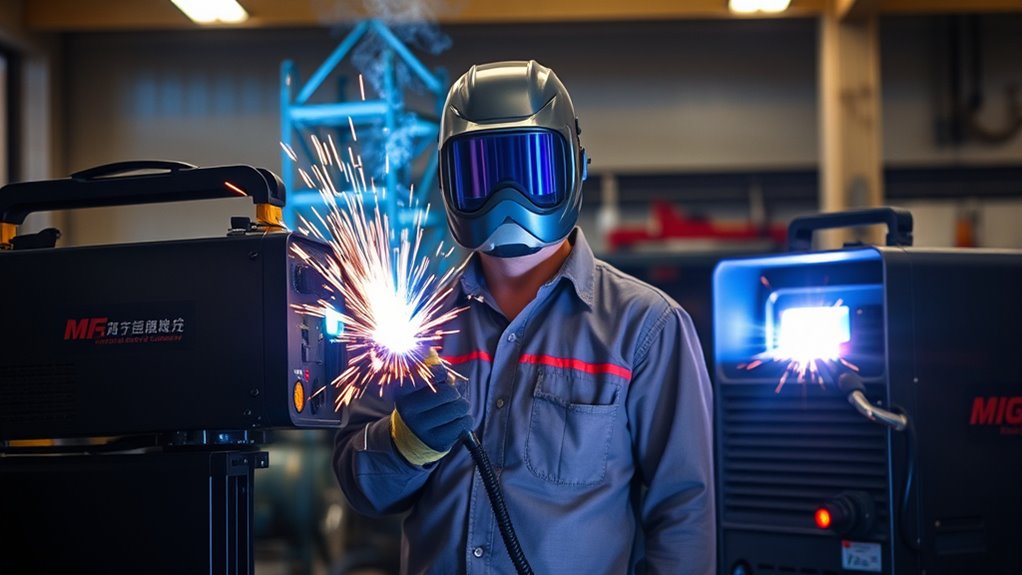
Both tools can be learned, but neither is safe to use casually. Plasma cutting requires stable torch movement, correct standoff, suitable cut speed, a secure work connection, and proper air supply. MIG welding requires joint preparation, wire and gas selection, machine setup, puddle control, and inspection.
OSHA identifies metal fumes, ultraviolet radiation, burns, eye damage, electrical shock, and other hazards in welding and cutting. Use process-appropriate eye and face protection, flame-resistant clothing, welding gloves, hearing protection, and protective footwear. Screen nearby people from arc light and flying sparks.
Skill Level Varies
Plasma cutting may produce a separated part quickly, but a square, low-dross edge takes practice. You must learn how speed, torch height, cut direction, air quality, and consumable wear affect the result.
MIG welding is often approachable for beginners because wire feeds automatically, but producing a sound structural weld requires more than making a bead that looks smooth. Practice on matching scrap, break or cut test coupons when appropriate, and use qualified procedures for critical work.
Safety Gear Necessity
Select the filter shade and eye protection required for the process and amperage. Cover exposed skin because arc radiation can cause eye and skin injury. Keep a suitable fire extinguisher available, remove combustibles, and inspect hidden spaces where sparks or heat can travel.
Warning: Never cut or weld a tank, drum, pipe, wheel, or closed container that may contain pressure, fuel, solvent, flammable vapor, or an unknown residue. Do not heat painted, plated, galvanized, or chemically cleaned metal until you identify the coating and control the specific fume and fire hazards. OSHA’s general welding and cutting requirements address ventilation, coatings, confined spaces, and hot-work precautions.
| Safety Concern | Plasma Cutting | MIG Welding |
|---|---|---|
| Arc and eye hazards | Use the shade and face protection specified for plasma arc cutting | Use a welding helmet with the proper shade for the amperage and process |
| Hot material | Cut parts, dross, and dropouts remain hot | Workpieces, tacks, and nearby metal remain hot |
| Fumes | Base metal and coatings determine the hazard | Base metal, wire, coatings, and shielding process determine the hazard |
| Fire path | Sparks and molten metal can travel below and beyond the cut | Sparks and heat can enter gaps, walls, upholstery, and undercoating |
| Special equipment | Inspect torch parts, leads, air line, and work clamp | Secure gas cylinders upright and inspect leads, gun, hose, and regulator |
Common Mistakes to Avoid
- Buying by amperage alone: Compare real cut or weld performance, duty cycle, utilities, and the manufacturer’s rating conditions.
- Ignoring the supporting equipment: A plasma cutter may need a larger compressor and dryer; MIG may need a cylinder, regulator, and specialized feed equipment.
- Working over contaminated metal: Oil, paint, zinc, plating, solvent residue, and moisture can create defects and hazardous fumes.
- Using worn consumables: Damaged plasma parts reduce cut quality; worn MIG tips and liners cause unstable feeding.
- Skipping test pieces: Verify settings and technique on matching scrap before working on the final part.
- Confusing appearance with strength: A neat weld can still lack fusion, and a clean-looking cut can still be unsuitable for a critical edge.
- Exceeding duty cycle: Let the machine cool as required instead of repeatedly forcing thermal shutdowns.
Industry-Specific Applications
Many shops use both tools in one workflow. A fabricator may plasma-cut a bracket, clean the edge, fit the part, tack it, and then MIG-weld it into an assembly.
- Automotive: Plasma cutting can remove damaged sheet metal or trim replacement pieces. MIG welding can attach patches and brackets when the repair procedure permits it. Protect fuel systems, wiring, batteries, electronics, glass, trim, seam sealer, and hidden insulation from heat and sparks.
- General fabrication: Plasma cutting produces tabs, gussets, profiles, and holes. MIG welding assembles those parts into gates, carts, racks, frames, and fixtures.
- Construction: Plasma cutters can shape conductive metal components; MIG welders can join approved assemblies under the applicable welding procedure and site rules.
- Maintenance and repair: Plasma gouging or cutting can remove failed metal. MIG welding can rebuild or replace parts when the material, joint, and service conditions are suitable.
- Manufacturing: CNC plasma tables create repeatable blanks, while automated MIG systems produce repeated joints under controlled parameters.
Note: Vehicle structures, pressure-containing parts, lifting points, wheels, suspension components, and other safety-critical parts may require approved repair procedures, certified materials, qualified welders, and inspection. Do not improvise these repairs from a general comparison guide.
Technological Innovations and Future Trends
Modern machines increasingly use digital controls to simplify setup and improve repeatability. MIG welders may offer preset or synergic programs that link wire-feed speed and voltage. Plasma systems may offer pilot-arc starting, process-specific consumables, gouging modes, expanded-metal modes, and interfaces for CNC control.
Automation is already common in production. CNC plasma systems use digital part files and programmed cut parameters. Robotic or mechanized MIG systems control torch path, travel speed, position, and welding parameters for repeated joints.
These features reduce setup time, but they do not remove the need for correct materials, consumables, utilities, safety controls, and inspection. A preset is a starting point, not proof that a weld or cut meets the job’s requirements.
| Feature | Practical Benefit | Limit |
|---|---|---|
| Digital or synergic MIG settings | Faster starting settings | Still requires fine-tuning and sound technique |
| Pilot-arc plasma start | Easier starts on expanded, painted, or imperfect surfaces | Does not remove fume, grounding, or surface-prep concerns |
| CNC plasma | Repeatable shapes and nesting | Needs motion control, extraction, software, and setup |
| Robotic MIG | Repeatable production joints | Needs consistent fit-up, programming, guarding, and process control |
Making the Right Choice for Your Project
Start with the finished result. If you need to separate metal, cut an opening, profile a part, or remove a damaged section, choose a plasma cutter. If you need to attach parts, repair a joint, or build an assembly, choose a MIG welder.
Then confirm the material, thickness, desired quality, power supply, compressor or gas needs, duty cycle, workspace, and training requirements. A machine that fits the metal but overloads your circuit or exceeds your compressor’s capacity is not a workable choice.
Products Worth Considering
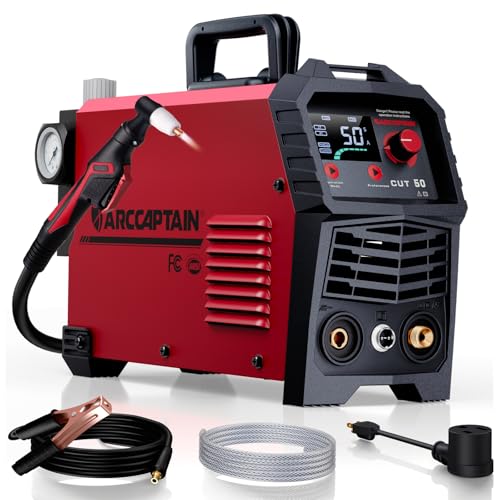
【Powerful Cutting Ability】Switch effortlessly between 110V and 220V for home or workshop use. Achieve professional 1/2" clean cuts on steel, aluminum, and copper with advanced LGBT technology. Perfect for DIY projects and heavy-duty tasks. Recommended maximum cutting thickness: 12mm @ 35A / 110V / 55 PSl; 18mm @ 50A / 220V / 75 PSI. Note: Requires compressed air (compressor sold separately).

【Non-Touch Pilot Arc Function】The ARCCAPTAIN 55A plasma cutter features a pilot arc function. It utilizes a high-frequency non-touch arc starting mode. The torch head does not need to touch the metal plate, reducing energy consumption during non-cutting work, minimizing electrode burning, and extending service life. NOTE: Do not switch voltages until the screen turns off and the fan stops.

[Powerful Cutting Ability] Dual voltage 110/220V good for home, workshop and hardware shop use. Professional performance 1/2" clean cuts on Iron, Steel aluminum and copper with Inverter IGBT Technology. Very powerful for DIY and heavy duty project. The Maximum cutting thickness is recommended to 1/2" @35A 110V 50PSI; 2/3" @50A 220V 65PSI. Dry and compressed air is required. Power breaker up to 60A@110V 35A; Up to 50A@220V 50A.
Choose a Plasma Cutter When
- You frequently cut conductive sheet, plate, tubing, or fabricated parts.
- You need curves, holes, profiles, fast trimming, or damaged-part removal.
- You have suitable electrical power and an adequate clean, dry air supply.
- You can control sparks, fumes, hot dropouts, and material below the cut.
Choose a MIG Welder When
- You mainly build, repair, tack, or assemble metal parts.
- You want a productive process for common steel fabrication.
- You can supply the correct wire, gas, polarity, and accessories for the material.
- You can protect shielding gas from drafts and inspect the finished joint.
What About Combination Machines?
Read the process list carefully. Some multiprocess welders combine MIG, flux-cored, stick, and TIG functions. Many machines marketed as three-in-one plasma units combine plasma cutting with TIG and stick welding but do not include a wire feeder for true MIG welding. A combination machine can save space, but one failure may remove several processes from service, and each function may have lower output or fewer features than a dedicated machine.
Pro Tip: List your five most common jobs from the past year. Buy the machine that completes the greatest number of those jobs without outsourcing, then add the second process when its time savings justify the full setup cost.
Frequently Asked Questions
Can a plasma cutter weld metal?
No. A plasma cutter melts and ejects metal from a cut path. It does not feed filler wire or create a controlled weld joint. Some units combine plasma cutting with separate TIG or stick functions, but the plasma torch itself is still a cutting tool.
Can a MIG welder cut metal?
A MIG welder is not designed for clean cutting. Excessive heat may burn through thin metal, but the result is uncontrolled and can damage the part. Use a plasma cutter, saw, shear, nibbler, or grinder suited to the material and cut.
Which tool should a beginner buy first?
Buy the tool that matches your most frequent task. A MIG welder usually offers more value when you mainly build and repair. A plasma cutter is the better first purchase when cutting shapes and removing metal consume most of your time.
Can a plasma cutter cut aluminum and stainless steel?
Yes. Both are electrically conductive and can be plasma-cut with a machine rated for the material and thickness. Cut appearance, dross, edge chemistry, gas choice, and finishing needs can differ from mild steel.
Can a MIG welder weld aluminum?
Yes, when the machine supports aluminum and you use the correct filler wire, drive system, liner or spool gun, shielding gas, polarity, and settings. Do not assume every small MIG welder can feed aluminum wire reliably.
How do plasma-cut edges affect metal fatigue?
The process does not automatically make a part fail from fatigue. However, edge notches, roughness, cracks, excessive bevel, or unsuitable heat effects can create stress raisers in parts exposed to repeated loading. Dress and inspect critical edges according to the design and applicable procedure.
Can MIG welders be used outdoors?
Yes, but wind can remove shielding gas and cause porosity in gas-shielded MIG welds. Use a safe wind screen without blocking ventilation. Self-shielded flux-cored wire is often more practical in windy field conditions when the machine and job support it.
What maintenance does a plasma cutter require?
Inspect and replace worn consumables, keep the torch clean, check leads and the work clamp, drain the compressor, maintain filters and dryers, and verify gas pressure and flow. Follow the operator’s manual because torch parts and replacement limits vary by system.
Are there lower-waste options for MIG welding?
Reduce waste by selecting the correct wire and gas, maintaining the wire-feed path, fitting joints accurately, using test coupons, and avoiding rework. Repairing a suitable part may also use less material than replacing an entire assembly, but safety-critical repairs still need the correct procedure and inspection.
How do plasma cutters handle non-metal materials?
Standard plasma cutting requires an electrically conductive workpiece, so it is not the right process for wood, glass, masonry, or most plastics. Those materials may burn, crack, melt, or release hazardous fumes. Use a cutting method designed for the material.
Can one combination machine replace both tools?
Only if it specifically includes both plasma cutting and MIG welding with the output, duty cycle, wire-feed system, torch, gun, and accessories your work requires. Many plasma combination machines include TIG and stick welding rather than MIG, so check the process list carefully.
Conclusion
Choose a plasma cutter when your main goal is to cut, trim, profile, or remove conductive metal. Choose a MIG welder when your main goal is to join parts, make repairs, or build assemblies. Before buying, compare the real material range, quality rating, duty cycle, electrical supply, compressor or shielding-gas needs, consumables, safety controls, and total setup cost. For shops that regularly fabricate parts, the two tools work best as complementary processes rather than competitors.
Sources
- OSHA: Welding, Cutting, and Brazing—Hazards and Solutions — overview of fumes, ultraviolet radiation, burns, eye damage, electrical shock, and PPE.
- OSHA 29 CFR 1910.252: General Requirements — ventilation, coatings, confined spaces, hot metal, and welding/cutting precautions.
- Hypertherm: Plasma Cutting Technology — plasma arc operation, conductive materials, and mechanized cutting.
- Hypertherm: Air Quality and Plasma System Performance — effects of moisture and contamination in compressed air.
- Miller Electric: MIG Welding Basics for Mild Steel — wire, shielding gas, voltage, wire-feed speed, and technique.
- Miller Electric: Duty Cycle—What It Is and Why It Matters — duty-cycle meaning and machine selection.