Choosing the wrong metal-cutting process can slow production, increase cleanup, and leave an edge that does not suit the next step. Plasma cutting is usually the better choice for fast, controlled cuts on electrically conductive metals, while oxy-fuel cutting remains a practical option for thick carbon steel and field work.
Quick Answer
Choose plasma for thin to medium conductive metals when speed, detail, and lower cleanup matter. Choose oxy-fuel for thick carbon steel, remote field work, and jobs where a torch setup is more practical. The crossover is not fixed, so compare machine capacity, available power or gases, edge requirements, and total labor cost.
Key Takeaways
- Plasma cuts electrically conductive metals, including mild steel, stainless steel, aluminum, copper, and brass.
- Standard oxy-fuel cutting is mainly suited to carbon steel and compatible low-alloy steels.
- Plasma is generally faster on thin and medium material because it does not need a long preheat cycle.
- Oxy-fuel remains useful for very thick carbon steel and jobs without suitable electrical power or compressed air.
- Use the machine’s recommended cut rating, not its maximum severance rating, when planning routine work.
- Compare equipment, consumables, gases, electricity, cylinder costs, cleanup, and operator time before choosing.
Understanding Plasma Cutting and Oxy-Fuel Cutting
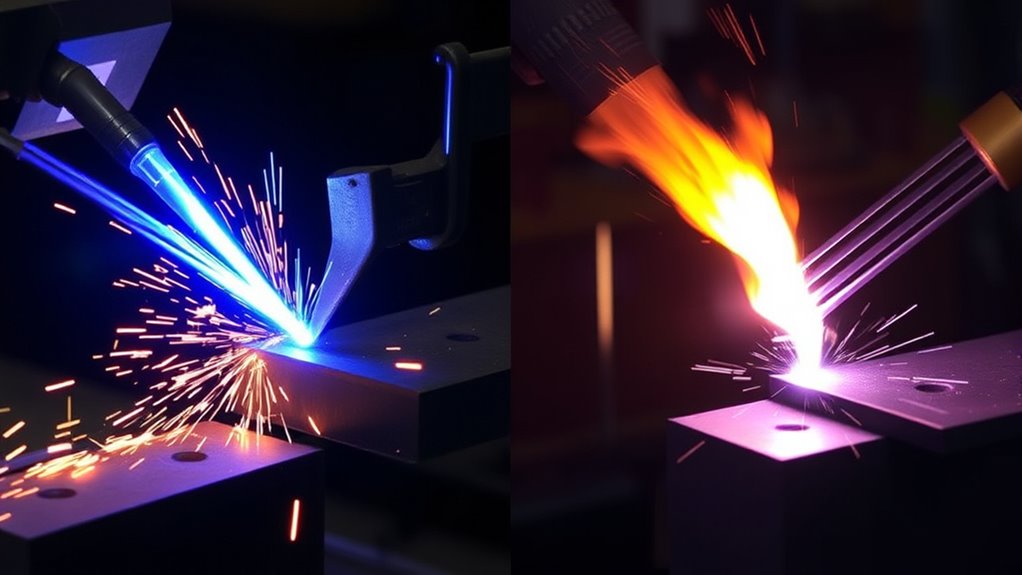
Plasma and oxy-fuel remove metal in different ways. That difference controls which materials they can cut, how quickly they work, and how much heat enters the plate.
How Plasma Cutting Works
Plasma arc cutting sends gas through a narrow torch nozzle and energizes it with an electric arc. The ionized gas becomes a concentrated plasma jet that melts the workpiece while the high-speed gas blows molten metal out of the kerf.
Because the arc must transfer electrical energy to the workpiece, plasma only cuts electrically conductive materials. Common examples include mild steel, stainless steel, aluminum, copper, brass, and titanium. The machine, consumables, amperage, gas, and travel speed must still match the metal and thickness.
How Oxy-Fuel Cutting Works
Oxy-fuel cutting uses oxygen and fuel gas, such as acetylene or an approved alternative fuel, to preheat steel. Once the steel reaches the proper temperature, a stream of cutting oxygen reacts with the iron and blows the resulting oxides from the cut.
This chemical reaction is why standard oxy-fuel cutting is mainly used on carbon steel and compatible low-alloy steels. It is not a normal cutting process for aluminum, copper, brass, stainless steel, or cast iron, even though some of those materials are ferrous or electrically conductive.
Note: Fuel gas supplies the preheat flame, but the cutting oxygen performs most of the actual steel-removal work. Use only the torch tips, regulators, hoses, pressures, and lighting procedure approved for your chosen fuel gas.
Comparing Cutting Thickness Capabilities
Material thickness often determines which process is practical, but there is no universal crossover point. A small handheld plasma cutter and a high-amperage mechanized plasma system have very different capacities.
As a broad industrial guide, process-selection guidance from Hypertherm places plasma in a wide middle range and oxy-fuel primarily in very thick carbon steel. Those ranges are useful for comparison, but the cut chart for the exact machine should control your decision.
- Thin sheet and plate: Plasma usually offers better control, faster starts, a narrower kerf, and less risk of broad heat distortion.
- Medium-thickness conductive metal: Plasma is often the most productive choice when the machine has enough output and the shop can supply the required power and air or process gas.
- Carbon steel around one to two inches: Either process may work. Compare actual cut speed, edge quality, pierce capacity, duty cycle, and cleanup instead of relying on thickness alone.
- Very thick carbon steel: Oxy-fuel often becomes more practical because it can cut heavy plate without the high electrical power required by large plasma systems.
- Stainless steel or aluminum at any thickness: Standard oxy-fuel is not a direct substitute. Use a plasma system rated for the material or another suitable process.
Recommended, Pierce, and Severance Capacity
Plasma specifications may list several different thickness ratings. They are not interchangeable.
- Recommended or rated cut capacity: The thickness the machine can cut at a useful speed with acceptable edge quality. This is the most important rating for routine work.
- Pierce capacity: The maximum thickness where the torch can start a cut in the middle of the plate. Edge-starting may allow a thicker cut.
- Severance capacity: The maximum thickness the machine can separate slowly. Expect a rougher edge, slower travel, and more cleanup.
Miller’s plasma-selection guidance also distinguishes normal rated cutting from maximum severance cutting. Size a machine for the material you cut most often rather than buying around an occasional maximum cut.
Evaluating Cutting Speed and Efficiency
Cut speed affects labor, heat input, distortion, consumable life, cleanup, and the number of parts you can finish in a shift.
Plasma normally moves faster on thin and medium steel and can begin cutting without heating the full starting area first. That advantage becomes important when a job contains many short cuts, holes, starts, or repeated CNC shapes.
Oxy-fuel requires preheating before the oxygen jet can maintain the cut. The delay is noticeable on thin plate and jobs with many pierces, but it may matter less during long cuts through heavy carbon steel.
Do not judge productivity by travel speed alone. Include layout time, preheat, piercing, repositioning, consumable changes, slag removal, grinding, straightening, and preparation for welding or paint.
Pro Tip: Make test cuts on scrap from the same material and thickness. Record the settings, cut time, cleanup time, and consumable condition so you can compare the real cost of both processes.
Plasma vs. Oxy-Fuel Cost
Cost depends on more than the purchase price. Include equipment, utilities, cylinder ownership or rental, consumables, labor, cleanup, maintenance, and downtime.
Plasma Costs
A plasma system may require a larger initial investment, especially when it includes a computer numerical control table, torch-height control, fume extraction, or a high-output power supply. Handheld systems also need suitable electrical service and a compressor that can deliver the required volume of clean, dry air.
Plasma consumables include electrodes, nozzles, shields, retaining caps, and sometimes specialty gases. Correct settings and dry air can extend consumable life, while moisture, oil, excessive piercing, poor standoff, and wrong amperage can shorten it.
Oxy-Fuel Costs
An oxy-fuel torch can have a lower equipment entry cost, but a complete setup also includes oxygen and fuel cylinders, regulators, hoses, check valves or flashback protection where specified, torch handles, cutting attachments, tips, a cart, and safe storage.
Ongoing costs include cylinder fills or exchanges, cylinder rental where applicable, tip maintenance, leak-related losses, preheat gas, oxygen consumption, and added cleanup. Oxy-fuel may still be economical for thick carbon steel because the equipment is simple and does not require a high-amperage power source.
- Initial investment: Compare complete working systems, not a bare torch or power supply.
- Utilities: Plasma uses electricity and air or process gas; oxy-fuel uses oxygen and an approved fuel gas.
- Labor: Faster cutting can be offset by slow layout, handling, grinding, or poor part fit.
- Consumables: Plasma consumables wear with arc starts and operating conditions; oxy-fuel tips need cleaning and can be damaged by backfire or contamination.
- Downtime: Include cylinder changes, compressor problems, worn consumables, tip cleaning, and machine maintenance.
Material Compatibility for Plasma and Oxy-Fuel
Material type matters as much as thickness. Plasma works on electrically conductive metals, while standard oxy-fuel cutting depends on the rapid oxidation of suitable steel.
- Mild and carbon steel: Both processes can work. Thickness, speed, edge requirements, and available equipment determine the better option.
- Low-alloy steel: Oxy-fuel may work when the alloy supports a stable oxidation reaction, but the steel grade and downstream requirements should be checked first.
- Stainless steel: Plasma is suitable with the correct consumables and gas process. Standard oxy-fuel does not produce a normal clean cut.
- Aluminum: Plasma is suitable when the machine is rated for aluminum. Standard oxy-fuel cutting is not suitable.
- Copper and brass: Plasma can cut these conductive metals when the system has sufficient capacity and the manufacturer approves the process.
- Cast iron: Conventional oxy-fuel cutting is generally unsuitable because the material does not sustain the same clean cutting reaction as carbon steel.
If your work includes mixed metals, plasma offers much greater flexibility. If your work is dominated by thick carbon steel, oxy-fuel may provide the simpler and more economical solution.
Cut Quality, Kerf, and Heat-Affected Zone
A cut can separate the metal and still be unsuitable for assembly or welding. Evaluate the full edge rather than looking only at whether the torch penetrated the plate.
- Kerf: The width of material removed by the cut. A narrower kerf allows smaller details and tighter part spacing.
- Angularity: The amount the cut face leans away from square. Excessive bevel can create poor fit-up.
- Dross or slag: Re-solidified material attached to the bottom or top edge.
- Heat-affected zone: The area beside the cut whose properties were changed by heat.
- Distortion: Warping caused by uneven heating and cooling.
- Surface condition: Oxide, nitrides, scale, or contamination that may need removal before welding or coating.
Plasma often produces a narrower kerf, smaller heat-affected zone, and cleaner edge on thin or medium material. However, poor speed, wrong amperage, incorrect torch height, worn consumables, or wet air can create dross and bevel.
Oxy-fuel can produce a square, smooth edge on carbon steel when the tip, preheat, oxygen flow, torch angle, and travel speed are correct. It usually puts more heat into thin plate and may leave heavier slag or wider distortion when the setup is poorly matched.
Shop Setup, Portability, and Fuel-Gas Choices
Products Worth Considering

Powerful Flame Temperature Heat up to 5252°F (2900°C)

Complete Kit: Ideal for HVAC & Light Duty Brazing - Designed specifically for light-duty brazing and welding jobs, this kit is your go-to tool for HVAC repairs, metal crafts, and other precision tasks. Its portable design is perfect for on-the-go professionals

POWERFUL CUTTING: The lightweight oxy-acetylene cutting set, equipped with a 3-101 cutting nozzle, can easily cut 6" carbon steel and weld up to 2". It supports the use of multiple gases, These gas torch kits are all easy to use and allow you to cut, weld, braze and solder with precision and efficiency
Plasma Shop Requirements
Most air-plasma systems need suitable electrical input, a clean work clamp connection, and compressed air that meets the manufacturer’s pressure, flow, and quality requirements. A compressor that reaches the correct pressure but cannot maintain the required airflow may cause an unstable arc and poor consumable life.
Moisture and oil in the air supply can damage consumables and reduce cut quality. Use the filtration and drying equipment specified by the plasma manufacturer. Check input voltage, circuit capacity, generator rating, duty cycle, extension-cord limits, and grounding before field use.
Oxy-Fuel Field Use
Oxy-fuel does not need electrical power or a compressor, which can make it useful for demolition, scrap work, maintenance, and remote carbon-steel cutting. However, oxygen and fuel cylinders are heavy, must be secured, and create transportation, storage, leak, and fire-control responsibilities.
Acetylene and alternative approved fuels require compatible tips and operating procedures. Fuel choice can change preheat time, gas use, tip design, and cost. Never assume that a tip or pressure setting for one fuel is safe for another.
Determining the Best Choice for Your Needs
Choose the process by working through material type, normal thickness, edge requirements, available utilities, portability, production volume, and total labor cost.
| Criteria | Plasma Cutting | Oxy-Fuel Cutting |
|---|---|---|
| Best material fit | Electrically conductive metals, including carbon steel, stainless steel, aluminum, copper, and brass | Carbon steel and compatible low-alloy steels |
| Typical thickness advantage | Thin through medium plate; heavy plate with suitable industrial equipment | Very thick carbon-steel plate |
| Speed | Usually faster on thin and medium material, with quick starts and pierces | Slower on thin plate because preheating is required; practical on heavy steel |
| Edge and cleanup | Often narrower kerf and less cleanup when settings and consumables are correct | Can produce a good edge on carbon steel but often adds more heat and slag |
| Utilities | Electricity plus clean, dry compressed air or approved process gas | Oxygen and approved fuel-gas cylinders, regulators, hoses, and tips |
| Portability | Portable when adequate power and air are available | Works without electrical power, but cylinders are heavy and require safe transport |
| Operator learning curve | Often easier to produce an acceptable basic cut after proper training | Requires flame adjustment, preheat control, tip selection, and steady torch technique |
| Best uses | Sheet metal, mixed-metal repair, CNC parts, detailed shapes, and production work | Heavy carbon-steel plate, demolition, scrap work, and remote field cutting |
Products Worth Considering

BUILT-IN AIR COMPRESSOR: With this plasma cutter machine, you're ready to cut as soon as you connect it to a power source, no additional air compressor needed. Designed for effortless outdoor work, it also offers compatibility with external compressors for versatile use

COMPLETE BUILT-IN AIR SYSTEM: Equipped with an integrated high-performance air pump, this plasma cutter eliminates the need for an external air compressor—simply plug into power and start cutting with no extra equipment or complicated setup required

[55A 110V/220V Cutting Power]: The SILATU STC550P plasma cutter delivers up to 55A of cutting power with advanced IGBT inverter technology. Use 110V at 15-40A for home garage and lighter-duty jobs, or switch to 220V at 15-55A for thicker metal and more demanding projects. Maximum cutting capacity reaches 1/2" (12mm) at 110V/40A and 7/10" (18mm) at 220V/55A under recommended air pressure (Note: For circuit protection, this machine must be used with 40A circuit breaker)
Choose Plasma When
- You regularly cut stainless steel, aluminum, copper, brass, or mixed conductive metals.
- You need fast cuts, repeated holes, detailed shapes, or CNC automation.
- You work with thin sheet that could distort under a broad preheat flame.
- You want less secondary grinding when the process is correctly set.
- You have adequate electrical input and clean, dry air or approved process gas.
Choose Oxy-Fuel When
- You mainly cut thick carbon steel.
- You work in locations without suitable electrical power or compressed air.
- You need a torch that can also perform approved heating or brazing tasks with the correct attachments.
- Fine detail, narrow kerf, and minimal heat input are less important than thickness capacity.
- Your shop can transport, secure, inspect, and store compressed-gas cylinders safely.
Common Cut Problems and Troubleshooting
Plasma Cutting Problems
- Heavy soft dross: Travel may be too slow, amperage may be too high, or the torch may be too close.
- Hard narrow dross: Travel may be too fast, amperage may be too low, or the torch may be too far from the work.
- Excessive bevel: Check travel direction, torch angle, consumable wear, torch height, and whether the machine is undersized.
- Unstable arc or short consumable life: Inspect air quality, pressure, flow, work-clamp contact, consumables, and input power.
- Failure to pierce: Confirm the material is within the pierce rating rather than only the severance rating.
Hypertherm’s plasma dross troubleshooting guidance identifies cutting speed, amperage, and torch standoff as major variables.
Oxy-Fuel Cutting Problems
- Cut will not continue: The plate may not be fully preheated, travel may be too fast, or the oxygen jet may be restricted.
- Heavy slag: Check travel speed, tip size, oxygen flow, torch angle, and tip cleanliness.
- Rounded or melted top edge: Preheat may be excessive or the torch may be moving too slowly.
- Irregular drag lines: Check tip condition, gas flow, torch steadiness, and travel speed.
- Popping or backfire: Stop safely and inspect the tip, seating surfaces, pressures, hoses, and torch according to the equipment manual.
Safety Risks to Check Before Cutting
Both processes create extreme heat, sparks, molten metal, fumes, ultraviolet and infrared radiation, noise, and fire hazards. Plasma also adds electrical hazards, while oxy-fuel adds compressed oxygen, flammable gas, hose, regulator, and flashback hazards.
Warning: Never cut a closed container or a tank, drum, pipe, or vessel that previously held fuel, oil, solvent, gas, or another hazardous material unless trained personnel have cleaned, vented, tested, and approved it under a formal hot-work procedure. An apparently empty container can still explode.
- Inspect the workpiece: Identify paint, plating, galvanizing, lead, cadmium, chromium, oil, sealants, and other coatings before heating the metal.
- Control fumes: Use suitable source extraction or ventilation. Do not assume an open door or household fan provides enough control.
- Protect eyes and skin: Wear safety glasses beneath a cutting shield or goggles with the shade specified by the equipment manual and applicable safety requirements.
- Wear protective clothing: Use gloves, hearing protection, suitable footwear, and flame-resistant clothing that covers exposed skin.
- Protect nearby people: Use noncombustible screens and control the path of sparks and molten metal.
- Prepare for fire: Remove combustibles, check hidden spaces, keep the correct extinguisher ready, and follow workplace fire-watch procedures.
- Check plasma equipment: Inspect the power cord, torch lead, work lead, clamp, consumables, air line, and input circuit. Keep the work area dry and follow lockout procedures before servicing.
- Check oxy-fuel equipment: Inspect cylinders, valves, regulators, hoses, connections, check valves, flashback arrestors where specified, torch seating surfaces, and tips.
- Keep oxygen clean: Never allow oil or grease on oxygen cylinders, valves, regulators, fittings, hands, or gloves. Do not use oxygen as a substitute for compressed air.
- Secure cylinders: Keep cylinders upright and secured, protect valves during transport, and follow applicable separation and storage rules.
- Test for leaks safely: Use an approved leak-detection solution and the manufacturer’s procedure. Never search for a gas leak with a flame.
OSHA’s general welding and cutting requirements address fire prevention, eye protection, protective clothing, ventilation, and hazardous coatings. Its separate oxygen-fuel gas standard covers cylinder storage, oxygen cleanliness, regulators, hoses, manifolds, and operating practices.
Safety Disclaimer: This article is for informational purposes only and does not replace hands-on training, an equipment manual, a workplace hazard assessment, or professional safety guidance. Follow the manufacturer’s instructions, applicable regulations, hot-work procedures, and local fire rules before cutting metal.
Frequently Asked Questions
What safety precautions are necessary for plasma and oxy-fuel cutting?
Wear safety glasses, a properly shaded cutting shield or goggles, gloves, hearing protection, flame-resistant clothing, and suitable footwear. Control fumes, remove combustibles, protect nearby people, and inspect the equipment before use. For oxy-fuel, keep oxygen parts free of oil and grease, secure cylinders, test for leaks safely, and follow the approved lighting and shutdown sequence.
Can plasma or oxy-fuel cutting be automated for industrial applications?
Yes. Plasma commonly pairs with CNC tables, torch-height controls, nesting software, and robotic systems for fast, detailed production cutting. Mechanized oxy-fuel systems remain useful for repeated cuts through thick carbon-steel plate and can mount several torches on one gantry when the equipment is designed for that use.
How do environmental factors affect plasma and oxy-fuel cutting?
Moisture, oil, dirty air, unstable power, wind, rust, coatings, and poor gas flow can reduce cut quality. Plasma needs a stable electrical supply and clean, dry air or process gas. Wind can disturb an oxy-fuel preheat flame, while damaged or dirty tips can distort the oxygen jet. Follow the equipment limits for rain, cold, heat, altitude, and generator use.
What maintenance is required for plasma and oxy-fuel equipment?
For plasma, inspect the electrode or cartridge, nozzle, shield, retaining cap, torch, work clamp, leads, air filter, and moisture-control system. For oxy-fuel, inspect cylinders, regulators, hoses, connections, check valves, flashback arrestors where fitted, torch seats, valves, and tips. Replace damaged parts instead of attempting unapproved repairs.
Are there differences in edge quality between plasma and oxy-fuel cuts?
Yes. Plasma usually provides a narrower kerf, lower heat input, and less cleanup on thin and medium conductive metal when the settings are correct. Oxy-fuel can produce a good square edge on carbon steel, especially on thick plate, but operator technique and preheat control have a strong effect. Either process can leave slag, bevel, or a poor weld surface when set incorrectly.
Which cutting method is better for beginners?
Many beginners find plasma easier because the arc starts quickly and the operator does not have to adjust a preheat flame. Oxy-fuel requires more practice with tip selection, flame adjustment, preheating, torch angle, travel speed, and cutting oxygen. Neither process is safe to learn by trial and error without training and the equipment manual.
Can an oxy-fuel torch cut stainless steel or aluminum?
Not with the standard oxy-fuel cutting process used for carbon steel. Stainless steel and aluminum do not support the same clean oxidation reaction. Plasma can cut both because they conduct electricity, although the machine, amperage, gas, consumables, and speed must suit the material.
Which process is more portable?
Oxy-fuel can operate without electrical power or a compressor, which helps at remote sites, but the cylinders are heavy and require secure transport and storage. A handheld plasma cutter may be lighter, but it still needs adequate electrical power and compressed air or approved bottled gas. The better field option depends on the utilities and transport available.
Sources
- Hypertherm: Plasma Cutter Technology — plasma operation, conductive materials, speed, and process characteristics.
- Hypertherm: Choosing a Cutting Process — material, thickness, quality, cost, and process-selection comparisons.
- Miller: Selecting and Operating a Handheld Plasma Cutter — rated and severance capacity, equipment selection, and operating factors.
- Hypertherm: Plasma Dross Troubleshooting — effects of speed, amperage, standoff, and consumable condition.
- OSHA 29 CFR 1910.252 — fire prevention, protective clothing, eye protection, ventilation, and general cutting safety.
- OSHA 29 CFR 1910.253 — oxygen-fuel cylinders, regulators, hoses, storage, cleanliness, and operating procedures.
Conclusion
Your best cutting method depends on the metal, normal thickness, required edge, available utilities, portability, and total job cost. Choose plasma cutting for conductive metals when you value speed, detail, quick piercing, and lower cleanup. Choose oxy-fuel cutting for very thick carbon steel or remote work where suitable power and compressed air are unavailable. Check the equipment manual and cut chart, test the setup on scrap, and use the process that delivers the safest acceptable edge with the least total labor.