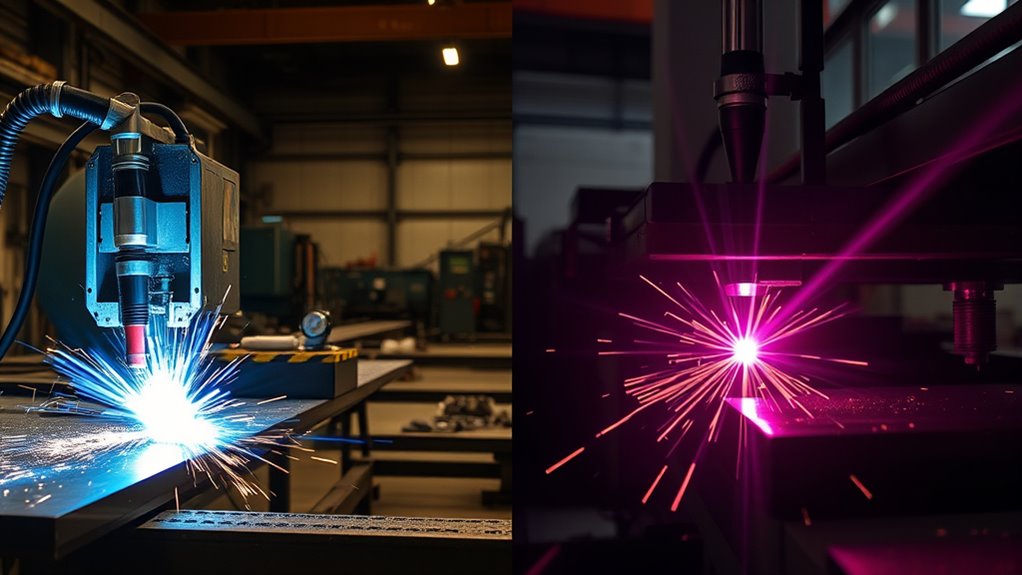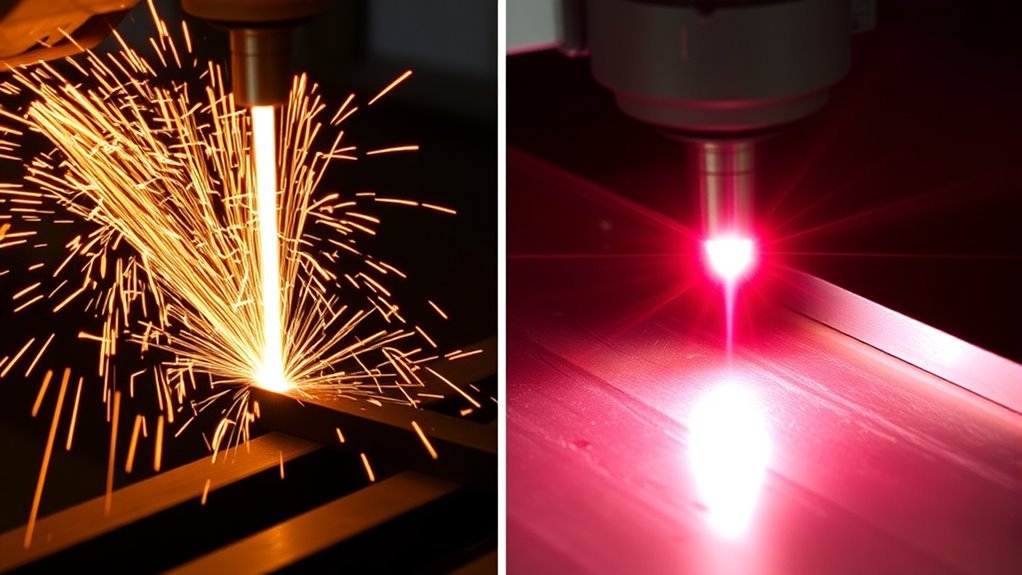
Choosing between a plasma cutter and a laser cutter comes down to what you cut most often, how tight the finished part needs to be, and how much cleanup you can accept. Plasma cutting is usually the practical choice for conductive metal plate, repair work, and lower-cost fabrication. Laser cutting is usually the better choice when you need fine detail, narrow kerf, cleaner edges, repeatable CNC accuracy, or the ability to cut certain non-metal materials.
Quick Answer
Choose a plasma cutter for thicker conductive metals, lower upfront cost, and fast shop work. Choose a laser cutter for thinner sheet, tighter detail, cleaner edges, engraving, and materials beyond metal. For most fabrication shops, plasma wins on heavy plate value, while laser wins on precision and finish.
Key Takeaways
- Plasma cutters cut electrically conductive metals such as mild steel, stainless steel, aluminum, brass, and copper.
- Laser cutters offer tighter detail, narrower kerf, and cleaner edges, especially on thin sheet and intricate parts.
- Plasma is often more cost-effective for thick plate, repairs, structural parts, and rough fabrication.
- Laser cutting can handle metals and many non-metals, but the right laser type, power, extraction, and material settings matter.
- Both processes require proper PPE, ventilation, fire control, and training before use.
Plasma Cutter vs Laser Cutter at a Glance
| Best for | Plasma: thick conductive metal, repair work, fabrication, rough cutting Laser: thin sheet, fine detail, clean edges, engraving, repeat parts |
| Material range | Plasma: conductive metals only Laser: metals and many non-metals, depending on laser type and material safety |
| Cut quality | Plasma: wider kerf, more bevel or dross possible Laser: narrower kerf, smoother edges, less finishing on suitable materials |
| Cost profile | Plasma: lower entry cost and simpler consumables Laser: higher equipment, extraction, optics, service, and facility costs |
Understanding Plasma Cutting Technology
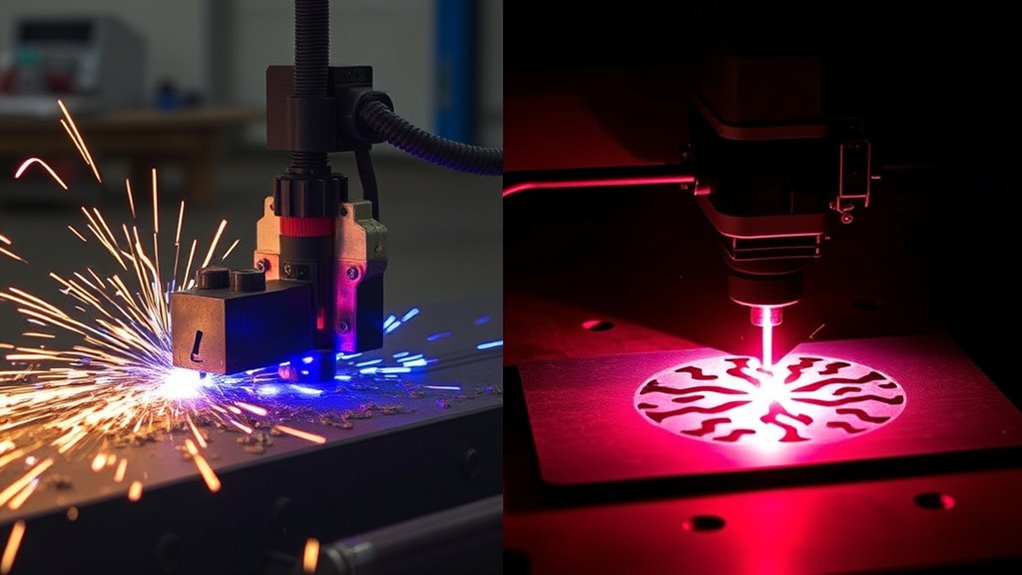
Plasma cutting uses an electric arc and a high-velocity stream of gas to melt and blow metal out of the cut. Because the arc must pass through the workpiece, plasma cutting is used on electrically conductive materials, including mild steel, stainless steel, aluminum, copper, and brass.
The process is popular in fabrication shops because it can cut metal quickly without the high machine cost of a large industrial laser. You can use handheld plasma cutters for repair work, farm jobs, auto fabrication, and shop cutting. CNC plasma tables add repeatability for brackets, gussets, signs, frames, and production parts.
Plasma is not a clean-room precision process. It usually creates a wider kerf than laser cutting, and the edge may show bevel, dross, or heat tint if amperage, speed, standoff, air quality, and consumables are not set correctly. Still, when you need to cut thicker conductive plate at a practical cost, plasma is often the better value.
Pro Tip: Plasma cut quality depends heavily on torch height, travel speed, dry air, ground connection, and consumable condition. If the edge suddenly gets rough or the dross increases, check those items before blaming the machine.
Exploring Laser Cutting Technology
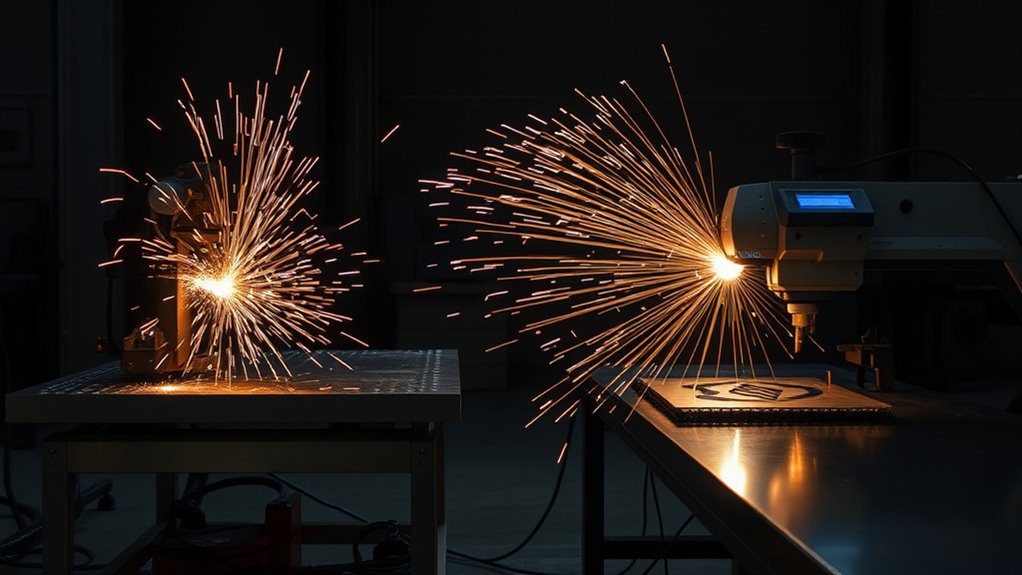
Laser cutting uses a focused laser beam to heat, melt, burn, or vaporize material along a programmed path. Assist gas then clears the cut. Industrial systems can cut metals, while CO2 and other laser systems are also used for many non-metal materials such as acrylic, wood, paper, leather, fabric, glass, and ceramics when the machine and material are compatible.
Laser cutting is strongest when the job needs a narrow kerf, small details, clean edges, repeatable shapes, or minimal tool wear. The laser beam is contact-free, so there is no physical cutting tool pressing into the workpiece. That helps reduce mechanical distortion and makes laser cutting useful for intricate parts, prototypes, signage, electronics, medical components, and precision sheet-metal work.
Industrial laser capability varies widely. A small CO2 craft laser, a diode engraver, and a high-power fiber laser are not the same kind of machine. Power level, wavelength, optics, assist gas, bed size, motion system, software, chiller, filtration, and material choice all affect what the laser can cut safely and cleanly.
Warning: Never laser-cut unknown plastics, PVC, vinyl, or coated materials unless the manufacturer confirms they are safe for your exact laser and exhaust system. Some materials can release toxic or corrosive fumes.
Precision and Accuracy
Laser cutting usually beats plasma cutting for fine detail. The focused beam can create a narrow kerf and smooth edge, especially on thinner sheet. That makes it easier to hold small features, tight inside corners, slots, tabs, and decorative patterns.
That does not mean every laser cutter holds the same tolerance. Real-world accuracy depends on the machine frame, motion control, optics, nozzle condition, material flatness, part geometry, thermal effects, and operator setup. A well-tuned industrial laser can be very accurate, but it is better to treat published tolerance numbers as machine-specific specs, not universal promises.
Material Versatility
Laser cutting is more versatile than plasma when you include non-metal materials. Plasma needs an electrically conductive workpiece, while many laser systems can cut or engrave selected woods, acrylics, paper products, fabrics, leather, glass, ceramics, and metals.
Fiber lasers are common for metal cutting, especially steel, stainless steel, aluminum, and many non-ferrous metals. CO2 lasers are common for acrylic, wood, paper, fabric, and some plastics. Diode lasers are often used for engraving and light cutting, but they are far more limited than industrial metal-cutting lasers.
Cutting Speed
Cutting speed depends on power, material, thickness, gas, nozzle, cut quality target, and contour shape. Plasma can be very fast on thicker conductive plate because it removes molten metal aggressively. Laser cutting is often faster on thin sheet, small profiles, and high-detail production because it needs less cleanup and can maintain a narrow, controlled cut.
If you compare speed, do not compare only inches per minute. Compare the full job time: loading, piercing, cutting, part removal, slag cleanup, edge grinding, rejected parts, and operator attention.
Comparing Cutting Precision and Accuracy
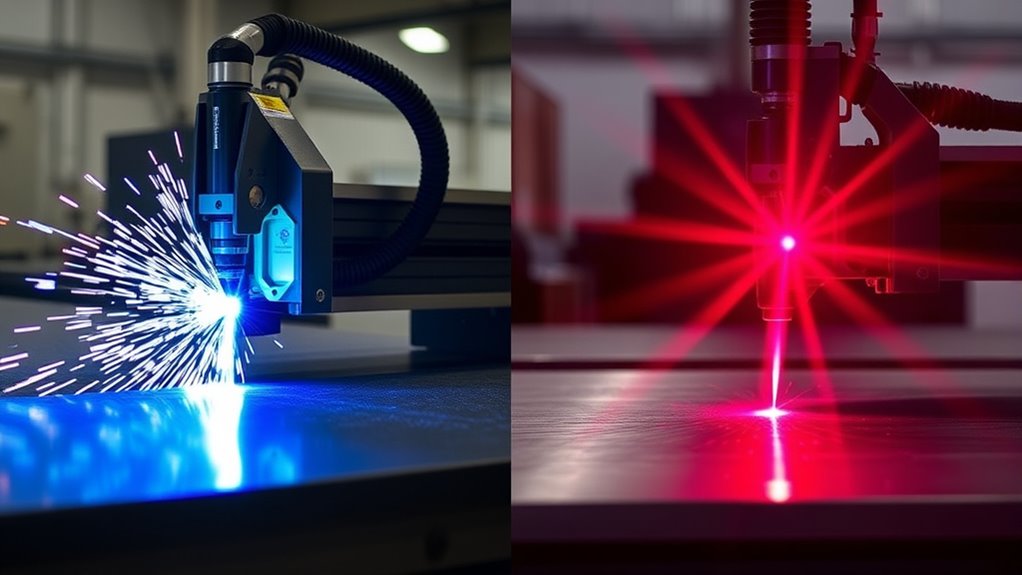
When you need the cleanest edge and tightest geometry, laser cutting is usually the stronger option. It creates a smaller heat input zone and a narrower cut path on suitable materials. That reduces wasted material and often removes the need for grinding or heavy deburring.
Plasma cutting is less precise, but it is not automatically crude. A high-definition CNC plasma system with good consumables, torch height control, and dry air can produce clean, repeatable parts for many fabrication jobs. The difference is that plasma edges are more likely to show taper, dross, and a wider kerf than laser-cut parts.
| Factor | Laser Cutter | Plasma Cutter |
|---|---|---|
| Kerf width | Usually narrower | Usually wider |
| Edge finish | Smooth on suitable materials and settings | May need grinding, chipping, or deburring |
| Small details | Excellent for fine slots, tabs, and curves | Better for larger profiles and less delicate geometry |
| Heat effect | Lower and more localized on many thin materials | Higher visible heat tint and wider affected edge possible |
| Best fit | Precision sheet, detailed parts, signs, production parts | Thick conductive metal, brackets, repair, fabrication |
For precision parts, judge the cutter by the finished edge and tolerance after cleanup, not by the cutting speed alone.
Evaluating Speed and Efficiency
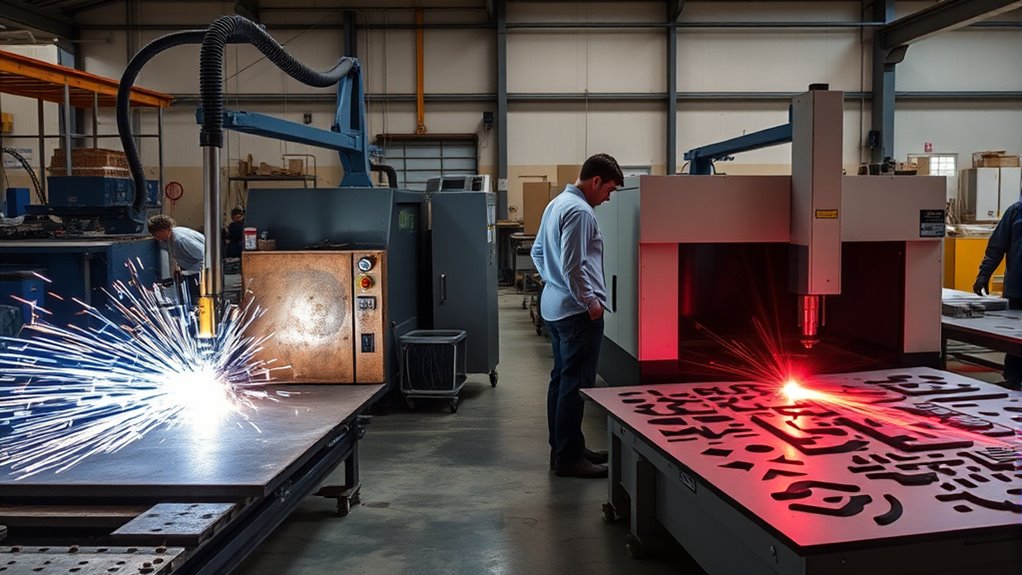
Speed is not one fixed number. A cutter that moves quickly in a straight line may still be slower overall if it creates heavy cleanup or poor part fit. A slower cut may be more efficient if it leaves a finished edge that goes straight to bending, welding, painting, or assembly.
Comparison of Cutting Speed
Plasma cutting often has the speed advantage on thicker conductive metal. It removes molten metal with a strong gas stream and can move through plate quickly when the amperage, nozzle, and travel speed match the material.
Laser cutting often has the advantage on thin sheet and intricate shapes. It can move fast through thinner material while maintaining cleaner edges and small details. It also works well in automated production where nesting, repeatability, and low post-processing time matter.
- For thick conductive plate: plasma is often faster and cheaper per cut.
- For thin sheet: laser often gives faster finished-part workflow.
- For detailed profiles: laser usually keeps better shape accuracy.
- For rough repair work: handheld plasma is usually more practical.
Efficiency in Material Handling
Material handling includes nesting, kerf loss, cleanup, part removal, and scrap. Laser cutting usually wastes less material because the kerf is narrower. That matters when you cut expensive stainless, aluminum, brass, copper, or decorative sheet.
Plasma cutting can create more slag and a larger kerf, but it may still be more efficient for heavy fabrication. If the part will be welded, ground, or coated anyway, the extra edge cleanup may be acceptable.
Note: For production work, calculate efficiency by finished parts per hour, not just cut speed. Include piercing time, edge cleanup, rejected parts, and operator handling.
Examining Material Compatibility
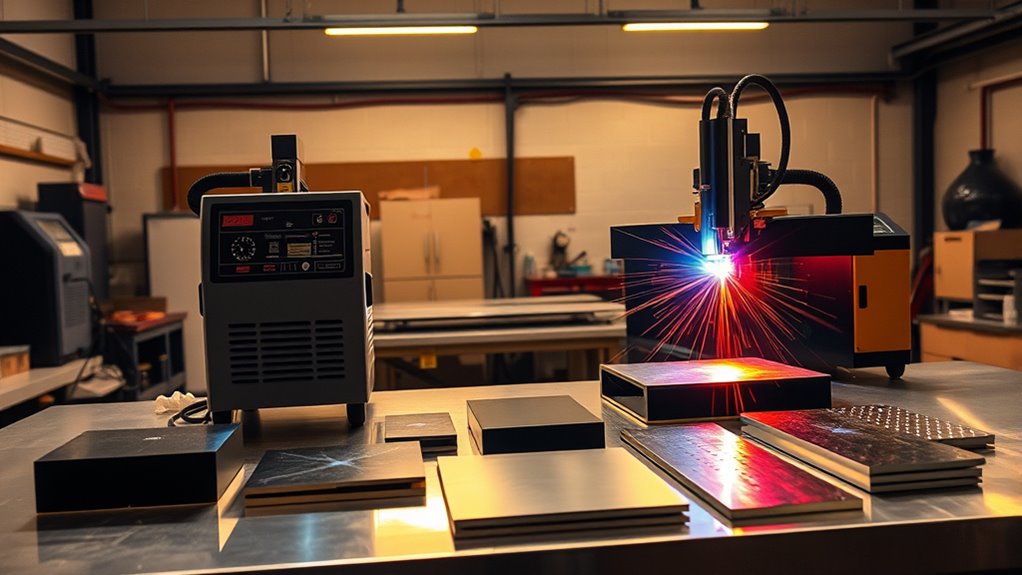
Material compatibility is one of the biggest differences between plasma and laser cutting. Plasma needs a conductive workpiece, so it is mainly a metal-cutting process. Laser cutting is broader, but the safe material list depends on the laser type and the machine’s exhaust system.
| Material | Plasma Cutter | Laser Cutter |
|---|---|---|
| Mild steel | Excellent, especially on plate | Excellent with the right power and assist gas |
| Stainless steel | Good, but edge cleanup may be needed | Excellent for clean sheet and precision parts |
| Aluminum | Good with proper settings | Good with suitable laser type and power |
| Copper and brass | Possible because they are conductive | Requires proper fiber-laser setup because reflectivity can be challenging |
| Wood, acrylic, paper, fabric | No | Yes on compatible laser systems with proper ventilation |
| PVC, vinyl, unknown plastics | No | Avoid unless the material is confirmed safe by the machine and material manufacturer |
Key Considerations
- Conductivity: Plasma cutting needs conductive metal. Laser cutting does not, but the laser type must match the material.
- Thickness: Plasma is often the better value on thick plate. Laser shines on thinner sheet and detailed parts.
- Finish: Laser usually leaves a cleaner edge. Plasma may need grinding, deburring, or slag removal.
- Safety: Both processes produce heat, light, sparks, and fumes. Laser material selection needs extra care.
Analyzing Cost and Operational Expenses
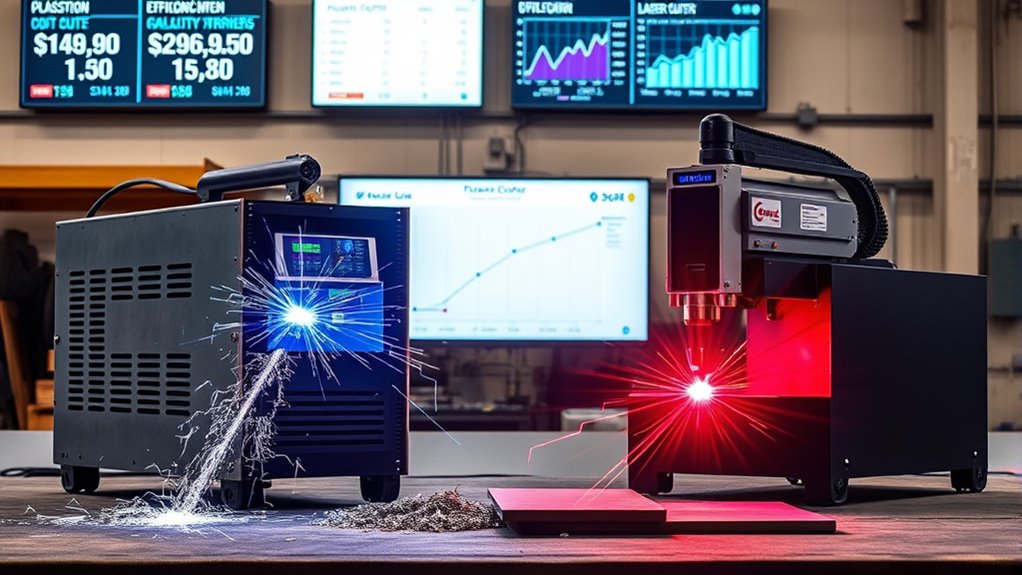
Plasma cutting usually has the lower entry cost. A handheld plasma cutter or basic CNC plasma table costs far less than a professional laser cutting system. Consumables such as electrodes, nozzles, swirl rings, shields, and air filters are also easier for many shops to manage in-house.
Laser cutting has a higher ownership cost. Industrial laser systems may require a chiller, assist gas, extraction, filtration, optics, protective enclosure, software, service support, and more controlled shop conditions. That higher cost can make sense when the laser reduces labor, produces parts with less finishing, improves nesting efficiency, or supports high-volume production.
| Cost Factor | Plasma Cutter | Laser Cutter |
|---|---|---|
| Upfront equipment | Lower | Higher |
| Consumables | Frequent but simple | Less frequent cutting-tool wear, but optics and service matter |
| Facility needs | Compressed air, ventilation, fire-safe work area | Ventilation, filtration, enclosure, assist gas, cooling, laser safety controls |
| Labor after cutting | More cleanup possible | Less cleanup on suitable materials |
Plasma usually wins on purchase price. Laser can win on finished-part cost when precision, nesting, and reduced cleanup save enough time and material.
Products Worth Considering

[Powerful Cutting Ability] Dual voltage 110/220V good for home, workshop and hardware shop use. Professional performance 1/2" clean cuts on Iron, Steel aluminum and copper with Inverter IGBT Technology. Very powerful for DIY and heavy duty project. The Maximum cutting thickness is recommended to 1/2" @35A 110V 50PSI; 2/3" @50A 220V 65PSI. Dry and compressed air is required. Power breaker up to 60A@110V 35A; Up to 50A@220V 50A.

POWERFUL CUTTING THICKNESS: This plasma cutter handles 1/2" (12mm) steel at 120V/35A and 5/8" (16mm) at 240V/60A. Dual voltage auto-detection (10-35A@120V / 30-60A@240V) with PSI guidance (70-75 PSI / 0.48-0.52MPa). Optimized for quick, efficient cuts in automotive repairs and metal fabrication
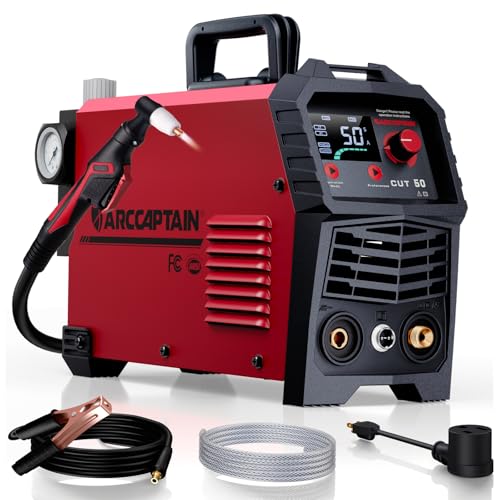
【Powerful Cutting Ability】Switch effortlessly between 110V and 220V for home or workshop use. Achieve professional 1/2" clean cuts on steel, aluminum, and copper with advanced LGBT technology. Perfect for DIY projects and heavy-duty tasks. Recommended maximum cutting thickness: 12mm @ 35A / 110V / 55 PSl; 18mm @ 50A / 220V / 75 PSI. Note: Requires compressed air (compressor sold separately).
Assessing Cutting Thickness and Applications
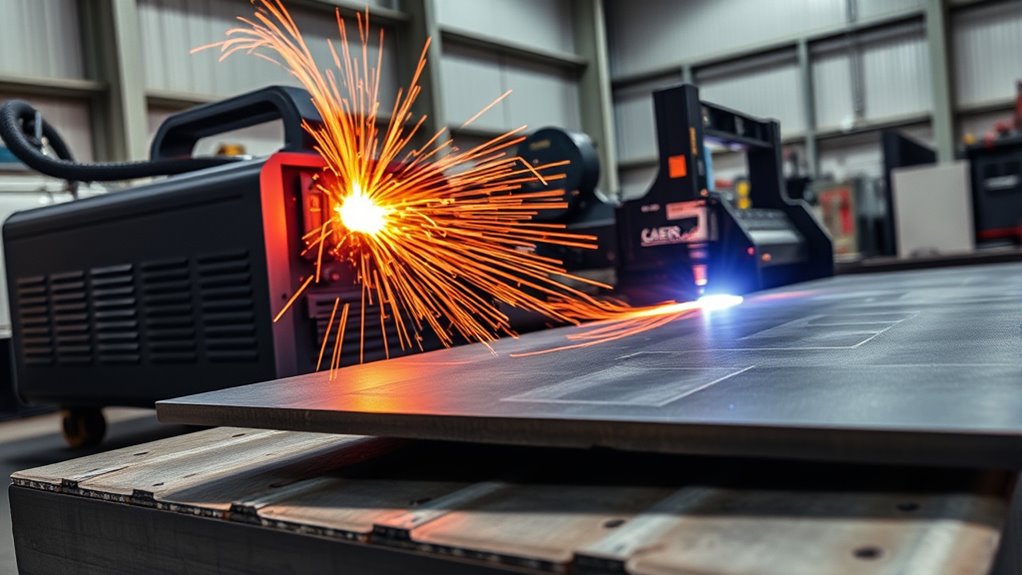
Thickness is where plasma cutting often makes the most sense. If you mainly cut conductive metal plate, structural brackets, repair patches, gussets, base plates, or heavy shop parts, plasma gives strong capability for the money.
Laser cutting is ideal when the material is thinner, the profile is detailed, or the edge must be clean enough to use with little finishing. It is commonly used for precision sheet-metal parts, enclosures, signs, decorative panels, prototypes, electronics, medical parts, and high-repeat production.
- Choose plasma for thick conductive metal: It is fast, rugged, and cost-effective for fabrication and repair.
- Choose laser for clean thin-sheet work: It produces narrow kerf, fine detail, and smooth edges on suitable materials.
- Choose laser for non-metal cutting: Use the correct laser type and only approved materials.
- Choose plasma for portability: Handheld plasma is far easier to move to a vehicle, farm repair, trailer, or jobsite.
Safety, Ventilation, and Training
Both cutting methods create serious hazards. Plasma cutting involves an electric arc, bright light, sparks, molten metal, hot work, fumes, compressed air, and electrical risk. Laser cutting adds beam hazards, reflections, enclosure requirements, fumes, fire risk, and material-specific hazards.
For plasma cutting, use a welding helmet or proper shaded eye protection, flame-resistant clothing, leather gloves, hearing protection when needed, and good ventilation. Keep flammable material away from the cutting area and have a fire extinguisher nearby. Follow your machine manual and workplace hot-work procedures.
For laser cutting, use the machine only as designed. Do not bypass covers, interlocks, extraction, shields, or emergency stops. Match protective eyewear to the laser wavelength and optical density when eyewear is required. Use proper fume extraction, especially when cutting plastics, coated materials, painted metal, or composites.
Warning: Do not operate a plasma cutter or laser cutter without training, PPE, ventilation, and fire controls. Industrial lasers and plasma systems can cause permanent eye injury, burns, fire, electrical injury, and harmful fume exposure.
Maintenance and Consumables
Plasma cutters need regular consumable replacement. Electrodes, nozzles, shields, swirl rings, retaining caps, ground clamps, air filters, and torch leads affect cut quality. Wet or dirty compressed air can shorten consumable life and create rough edges.
Laser cutters need a different kind of maintenance. Lenses, mirrors, protective windows, nozzles, bed slats, filters, chillers, extraction systems, alignment, and software all matter. Industrial fiber lasers may not use a physical cutting tool, but optics and assist-gas systems still need careful upkeep.
If you want a machine that is easier to service in a small shop, plasma is usually simpler. If you want highly repeatable finished parts and have the budget for service, extraction, and setup, laser cutting can be worth the added complexity.
Which Cutter Should You Choose?
Use this simple decision guide before buying or outsourcing your cutting work:
- Choose plasma if you cut mostly steel, stainless, or aluminum plate and can accept some edge cleanup.
- Choose plasma if budget, portability, repair work, or thick metal capability matters more than fine detail.
- Choose laser if you need precise repeatable parts, small holes, tight slots, and smooth edges.
- Choose laser if you cut thin sheet, signage, decorative panels, prototypes, or approved non-metal materials.
- Outsource laser cutting if you only need occasional high-precision parts and cannot justify the machine, ventilation, and maintenance costs.
For many shops, the best answer is not either-or. A plasma cutter handles rough and heavy work, while outsourced or in-house laser cutting handles precision parts. The right choice is the one that lowers your total finished-part cost while meeting your quality and safety needs.
Products Worth Considering

【Non-Touch Pilot Arc Function】The ARCCAPTAIN 55A plasma cutter features a pilot arc function. It utilizes a high-frequency non-touch arc starting mode. The torch head does not need to touch the metal plate, reducing energy consumption during non-cutting work, minimizing electrode burning, and extending service life. NOTE: Do not switch voltages until the screen turns off and the fan stops.


CUTTING THICKNESS UP TO 20MM: Featuring a brand-new MCU technology upgrade, the plasma cutter machine has a high degree of internal integration, combining full digitalization for more precise control of cutting parameters such as current and voltage. This results in better cutting effects and improved stability. Cutting thickness: Quality 12mm (1/2"), maximum 20mm (3/4").
Frequently Asked Questions
What safety precautions are necessary for plasma and laser cutters?
For plasma cutting, use proper shaded eye protection, flame-resistant clothing, gloves, hearing protection when needed, ventilation, and fire control. For laser cutting, follow the laser class requirements, use approved enclosures and interlocks, run fume extraction, and use laser eyewear only when it matches the machine’s wavelength and hazard rating.
How does maintenance differ between plasma and laser cutters?
Plasma cutters use more frequent consumables, including electrodes, nozzles, shields, and air filters. Laser cutters need cleaner optics, good extraction, nozzle care, bed cleaning, cooling-system checks, and sometimes more specialized service. Plasma maintenance is usually simpler for small shops, while laser maintenance is more controlled and technical.
Can plasma or laser cutters be used for non-metal materials?
Laser cutters can cut or engrave many non-metal materials when the laser type, power, and ventilation system are suitable. Plasma cutters are generally limited to conductive metals because the process needs an electrical path through the workpiece.
What environmental impact do plasma and laser cutters have?
Both processes use energy and can create fumes, dust, scrap, filters, and consumable waste. Plasma may create more slag and metal cleanup waste. Laser cutting may require extraction filters, assist gas, and more power depending on the system. Good nesting, proper ventilation, filter maintenance, and scrap recycling reduce the impact.
Are there specific training requirements for operating plasma and laser cutters?
Yes. Operators should be trained on the exact machine, PPE, ventilation, fire prevention, material limits, emergency shutoff, and maintenance checks. Laser operators also need training on laser class hazards, interlocks, beam exposure, fume extraction, and safe material selection.
Is a plasma cutter or laser cutter better for a home garage?
A plasma cutter is usually better for a home garage if you mainly cut metal for repairs, brackets, fabrication, or hobby projects. A desktop laser can be useful for engraving and cutting approved non-metals, but metal-cutting lasers are usually too expensive and facility-heavy for most home garages.
Which cutter gives cleaner edges?
Laser cutters usually give cleaner edges on suitable materials, especially thin sheet and detailed profiles. Plasma cutters can produce good edges too, but they are more likely to leave dross, bevel, and a wider kerf that may need finishing.
Conclusion
When comparing a plasma cutter vs laser cutter, the better choice depends on the finished part you need. Pick plasma cutting if you want a rugged, lower-cost way to cut conductive metal, especially thicker steel, stainless, or aluminum. Pick laser cutting if you need tight detail, narrow kerf, clean edges, repeatable CNC parts, engraving, or approved non-metal cutting. For the best decision, compare total finished-part cost, not just machine price or cutting speed.
Sources
- TRUMPF: Laser Cutting — supports laser cutting process, material range, kerf, cutting gas, and laser process factors.
- OSHA Technical Manual: Laser Safety — supports laser hazard, eyewear, interlock, and laser-safety guidance.
- OSHA 29 CFR 1910.252: Welding, Cutting, and Brazing — supports hot-work, fire prevention, ventilation, and cutting safety context.
- OSHA 29 CFR 1910.133: Eye and Face Protection — supports eye and face protection requirements for cutting and radiant-energy hazards.
- NIOSH: Welding and Cutting Safety — supports fume, ventilation, and worker health considerations for welding and cutting operations.