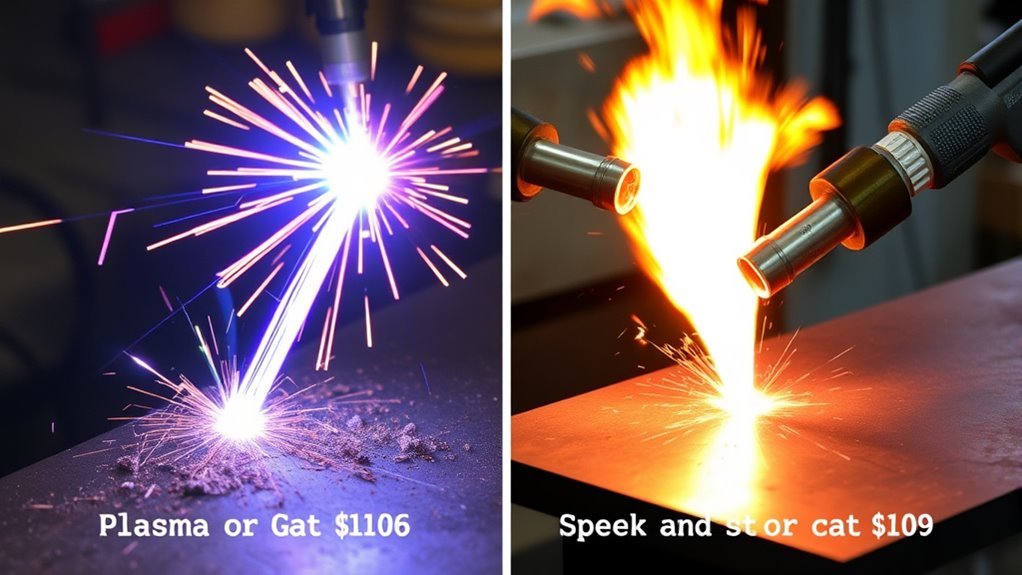
Plasma welding and TIG welding both use a tungsten electrode and shielding gas, but they solve different problems. Plasma welding focuses the arc through a nozzle for fast, repeatable, deep welds in controlled production. TIG welding gives you direct puddle control, clean beads, and excellent results on thin, detailed, or cosmetic work.
Quick Answer
Choose plasma welding when you need speed, repeatability, deep penetration, and automation on production parts. Choose TIG welding when you need fine manual control, clean bead appearance, thin-material control, or precise work on stainless steel, aluminum, copper alloys, titanium, and small assemblies.
Key Takeaways
- Plasma welding uses a constricted arc, so it is strong for automated, repeatable welds with high travel speed and deep penetration.
- TIG welding, also called GTAW, gives you better manual control and is often the better choice for visible, thin, or delicate welds.
- Do not use thickness alone to choose a process. Fit-up, joint design, code requirements, base metal, heat input, and production volume matter just as much.
- Both processes need clean material, correct shielding gas, proper PPE, and ventilation or fume extraction when fumes and gases may build up.
Warning: Welding can expose you to ultraviolet radiation, hot metal, electric shock, shielding-gas displacement, and hazardous fumes. Follow the welder manual, your welding procedure specification, local code rules, and OSHA guidance for ventilation, PPE, and confined-space work.
Understanding Plasma Welding and TIG Welding
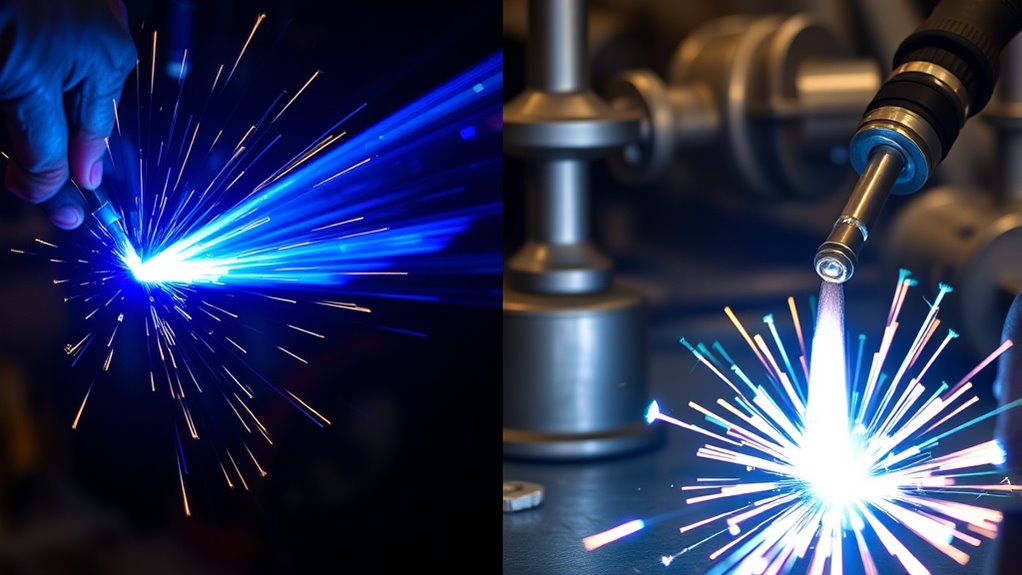
Plasma welding, or plasma arc welding, is closely related to TIG welding, but the torch design is different. The tungsten electrode sits inside the torch body, and the arc is forced through a small nozzle. That nozzle constricts the arc and creates a narrow, concentrated heat source.
This tight arc can give plasma welding deep penetration, a narrow bead, and a small heat-affected zone when the setup is tuned correctly. It is common in automated or semi-automated production where the same weld must be repeated many times.
TIG welding, or gas tungsten arc welding, uses a non-consumable tungsten electrode with an inert shielding gas such as argon or helium. You can weld with or without filler rod, depending on the joint. Because the arc is open and easy to see, TIG gives you excellent control over puddle size, filler placement, and bead shape.
That control is why TIG is widely used for stainless steel, aluminum, copper alloys, titanium, thin sheet, tubing, repair work, and visible welds where appearance matters. It is slower than many production processes, but it can produce very clean results in skilled hands.
Plasma Welding vs TIG Welding: Quick Comparison
| Factor | Plasma Welding | TIG Welding |
|---|---|---|
| Arc shape | Constricted, narrow, high-energy arc | Open, stable arc with direct puddle visibility |
| Best strength | Repeatable penetration in production | Precise manual control and clean finish |
| Typical use | Automated seams, tubes, aerospace parts, medical parts, precision production | Thin sheet, tubing, repair, custom work, visible welds, artistic metalwork |
| Speed | Often faster when automated and repeated | Usually slower, especially when filler is hand-fed |
| Equipment cost | Higher due to torch, nozzle, cooling, gas control, and automation needs | Lower entry cost, but high-skill work still needs quality equipment |
| Learning curve | More setup and parameter control | More hand coordination and puddle control |
Core Principles and Mechanisms
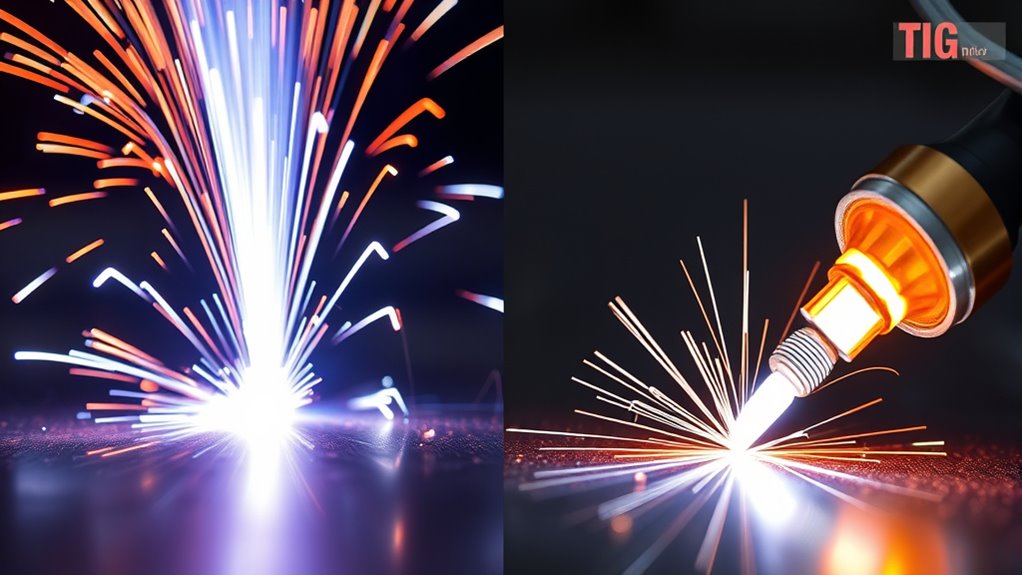
The main difference is arc control. Plasma welding narrows and stiffens the arc with a nozzle. TIG welding leaves the arc more open, which gives the operator a clear view and more direct control over the puddle.
Both processes can make high-quality welds, but they reach that result in different ways. Plasma welding depends heavily on torch setup, orifice condition, gas flow, current, and travel speed. TIG welding depends heavily on hand control, tungsten preparation, arc length, filler timing, and shielding coverage.
Plasma Arc Formation
In plasma welding, gas passes through the torch and becomes ionized by the electric arc. The nozzle constricts that ionized gas, which creates a focused plasma stream. This arc can be transferred to the workpiece for welding, or used as a pilot arc during starting and setup.
- It can create deep, narrow penetration when the joint and settings are correct.
- It can reduce thermal spread compared with a wider arc.
- It supports automated travel and repeatable production welds.
- It requires clean nozzles, stable gas flow, and accurate torch height.
- It can be used in microplasma, melt-in, or keyhole modes depending on current and application.
TIG Electrode Function
In TIG welding, the tungsten electrode creates the arc but does not melt into the weld when used correctly. The electrode must be selected, shaped, and sized for the material, amperage, and current type. A clean tungsten tip helps keep the arc stable and lowers the chance of contamination.
The shielding gas protects the hot tungsten and molten puddle from oxygen and moisture in the air. Argon is the most common shielding gas for TIG, while helium or argon-helium mixes may be used when more heat input is needed.
Pro Tip: If a TIG arc wanders, starts hard, or leaves black contamination near the weld, check tungsten condition, gas coverage, cup size, stickout, and drafts before changing amperage.
Heat Input Control
Heat input decides bead shape, penetration, distortion, and metallurgical quality. Plasma welding controls heat through current, plasma gas flow, shielding gas flow, nozzle size, torch height, and travel speed. TIG welding controls heat through amperage, arc length, travel speed, filler addition, pulsing, and foot-pedal or fingertip control.
- Plasma welding can localize heat well, but poor fit-up or the wrong gas flow can still cause defects.
- TIG welding can be gentle on thin material, but slow travel can overheat the part.
- Both processes need clean base metal and stable shielding to prevent porosity and oxidation.
- Both can distort thin parts if travel speed, fixturing, and heat input are not controlled.
Equipment Setup and Components
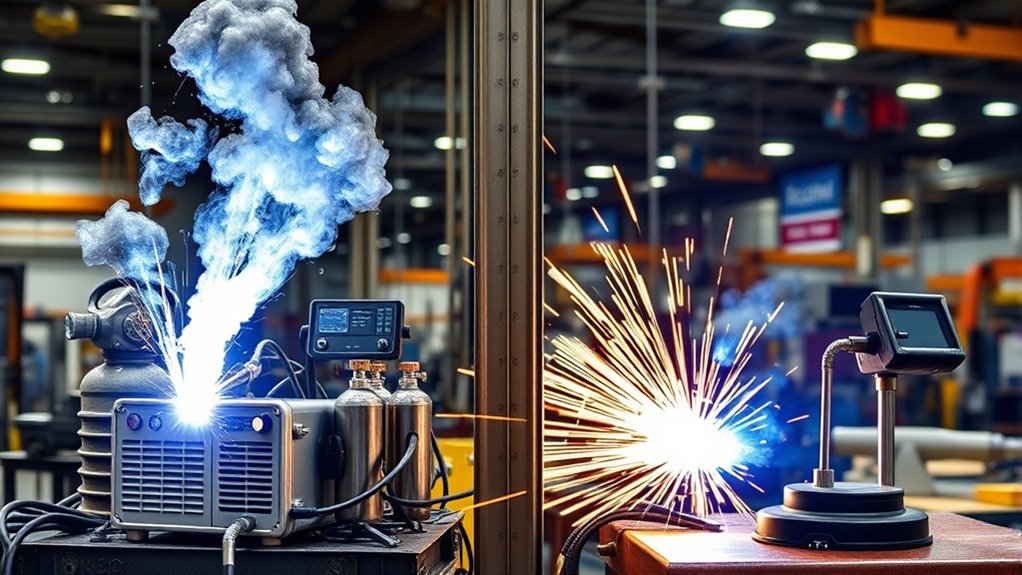
A plasma welding setup is usually more complex than a TIG setup. It uses a plasma torch, tungsten electrode, constricting nozzle, power supply, plasma gas, shielding gas, and often water cooling. Automated systems may also include torch-height control, fixturing, travel carriages, rotary positioners, and seam tracking.
A TIG setup is simpler. It includes a TIG torch, tungsten electrode, cup or gas lens, constant-current power source, shielding gas, ground clamp, and often a foot pedal or fingertip control. Water cooling is helpful for higher-amperage TIG, but many light-duty TIG torches are air-cooled.
The practical difference is setup time. Plasma welding may take longer to tune at the start, but it can repay that time in repeatable production. TIG welding is faster to set up for one-off work, repair, and short runs, but the weld speed depends heavily on the operator.
Products Worth Considering

Complete 123-Piece Set:All necessary TIG torch accessories and consumables for WP-17, WP-18, and WP-26 torches.

Complete TIG Torch Kit - 71pcs Tig Welding Torch accessories (consumables) kit. This set includes all the essential TIG torch accessories and consumables, so you can get started on your welding projects right away.
Process Parameters and Control
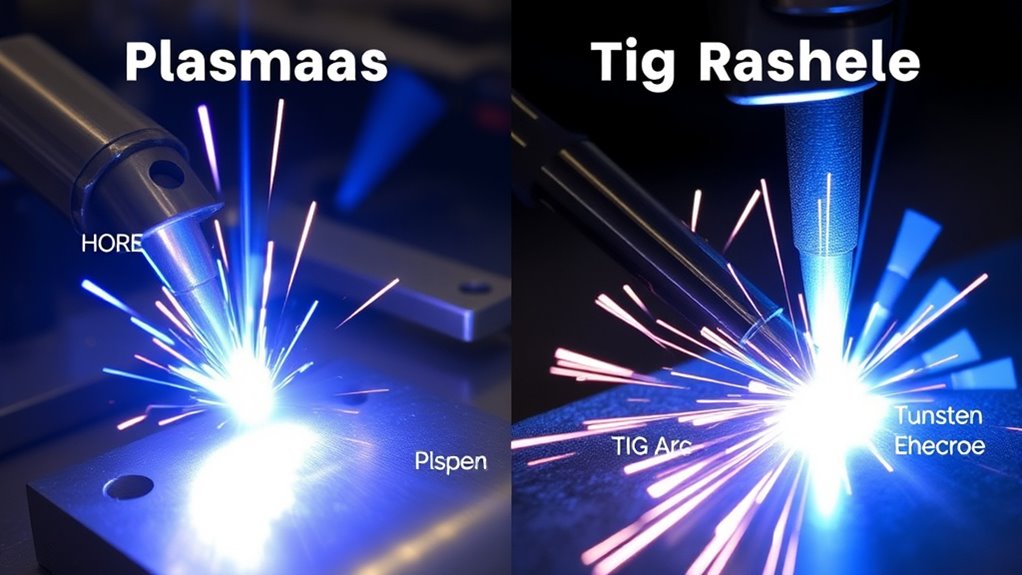
Plasma and TIG welding both reward careful setup. Small changes in current, arc length, gas flow, or travel speed can change the weld profile. The best settings come from the machine manual, filler-metal data, base-metal thickness, joint design, and a tested welding procedure.
For plasma welding, the key controls are current, plasma gas flow, shielding gas flow, nozzle orifice size, torch-to-work distance, and travel speed. If one of these is wrong, the arc can lose focus, undercut the joint, fail to penetrate, or overheat the part.
For TIG welding, the key controls are amperage, tungsten size and grind angle, cup size, shielding gas flow, arc length, filler diameter, travel angle, and travel speed. You also need to keep filler metal inside the gas shield so it does not oxidize before it reaches the puddle.
- Current: Controls heat and penetration in both processes.
- Gas flow: Protects the puddle, but too much flow can create turbulence and pull in air.
- Travel speed: Affects bead width, penetration, and distortion.
- Fit-up: Plasma keyhole welding is less forgiving of gaps and mismatch than many TIG jobs.
- Cooling: High-duty-cycle plasma and TIG work often needs water-cooled torches.
Material Compatibility and Thickness Considerations
TIG welding is highly versatile. It works well on stainless steel, carbon steel, aluminum, magnesium, copper alloys, nickel alloys, and titanium when the right current type, shielding gas, filler, and cleaning steps are used. It is especially useful on thin sheet, tubing, root passes, and small parts that need a neat finish.
Plasma welding can also weld many metals that are weldable by TIG, but it is chosen most often when the job needs repeatable penetration, a narrow weld, or automated production. It is common in tube mills, precision seams, aerospace parts, bellows, sensors, medical parts, and other controlled production work.
Thickness rules should be treated as a starting point, not a law. TIG is often the better manual choice for thin material and cosmetic welds. Plasma can work on very thin material in microplasma mode and on thicker joints in keyhole mode. The right choice depends on joint access, required penetration, distortion limits, code requirements, and production volume.
When to Choose Plasma Welding
Choose plasma welding when your main need is repeatability. It makes sense when the same weld will be made many times and you can control fit-up, fixturing, torch travel, and gas flow.
- You need deep, narrow penetration in a controlled joint.
- You are building production parts, not doing occasional repair work.
- You want a process that works well with automation.
- You need a smaller heat-affected zone than a wider arc may produce.
- You can justify the higher equipment, setup, and maintenance cost.
Plasma welding is not the easiest choice for casual shop work. If you cannot control joint fit, torch position, and parameter repeatability, TIG may be easier to manage.
When to Choose TIG Welding
Choose TIG welding when the weld needs to be clean, controlled, and visually neat. TIG is also the better choice when you are repairing a part, making a one-off weld, or working in a tight area where a complex plasma setup is not practical.
- You need a smooth, visible bead with minimal spatter.
- You are welding thin sheet, tubing, small brackets, or detailed parts.
- You need direct control over filler metal and puddle size.
- You are welding aluminum or stainless steel in a small shop setting.
- You need a flexible process for repair, fabrication, or prototype work.
TIG is slower and skill-heavy, but that is also its strength. A skilled operator can adjust puddle size, travel speed, filler timing, and heat input in real time.
Speed and Efficiency in Welding Processes
Plasma welding is usually faster when the job is repeatable and the system is properly automated. Its focused arc can reduce the need for multiple passes on some joints, and its consistent torch travel helps keep cycle times predictable.
TIG welding is usually slower because the operator controls the torch, arc length, travel speed, and filler rod by hand. That slower pace can be a benefit when the weld needs careful control, but it can limit throughput on long seams or high-volume jobs.
Comparing Process Speeds
Speed is not only about inches per minute. It also includes setup, fit-up, cleaning, inspection, rework, and finishing. Plasma welding may have a longer setup time, but it can be faster over a large batch. TIG may win on a one-off part because you can set up quickly and adjust as you go.
- Plasma is usually faster for controlled production seams.
- TIG is usually faster to deploy for repairs, prototypes, and small batches.
- Plasma may reduce rework when automation keeps the weld consistent.
- TIG may reduce finishing when the bead appearance is important.
Efficiency in Material Handling
Material handling can decide the real cost. Plasma welding works best when parts can be fixtured consistently. TIG welding works well when the operator needs to move around the part, adjust to imperfect fit-up, or weld a short joint that does not justify automation.
If your shop handles many identical parts, plasma welding may improve efficiency. If your shop handles mixed repairs and custom jobs, TIG welding usually gives more flexibility.
Weld Quality and Aesthetic Differences
Both plasma and TIG welding can produce high-quality welds. The difference is what kind of quality you need. Plasma welding is often judged by penetration consistency, bead repeatability, and low distortion in production. TIG welding is often judged by bead appearance, puddle control, cleanliness, and fit on delicate parts.
TIG welding is often the better choice when the weld will be seen. Plasma welding is often the better choice when the same precise weld must be repeated many times.
TIG welds are known for clean, smooth beads with little spatter when the material is clean and the shielding gas is stable. Plasma welds can be narrow and consistent, but the result depends on accurate machine setup and stable part fit-up.
- For appearance: TIG usually has the edge.
- For repeatability: plasma often has the edge in automated production.
- For low distortion: either process can work if heat input is controlled.
- For code work: follow the approved welding procedure, not a general rule of thumb.
Cost, Maintenance, and Consumables
TIG welding normally has a lower entry cost. A quality TIG machine, torch, gas cylinder, regulator, tungsten, cups, collets, and filler rods can handle a wide range of jobs. Consumable cost is manageable, but skill time can be expensive.
Plasma welding usually costs more to buy and maintain. The torch, nozzle, cooling system, gas controls, automation hardware, and fixturing add cost. Nozzle and orifice condition also matter, so maintenance has a direct effect on weld quality.
The best budget choice depends on volume. For a few custom welds, TIG is usually more practical. For thousands of repeatable welds, plasma welding may lower the cost per part after the setup is proven.
Products Worth Considering

Comes with lift TIG torch, E6013 welding rods and welding gloves, capable of either Stick welding or Lift TIG welding.
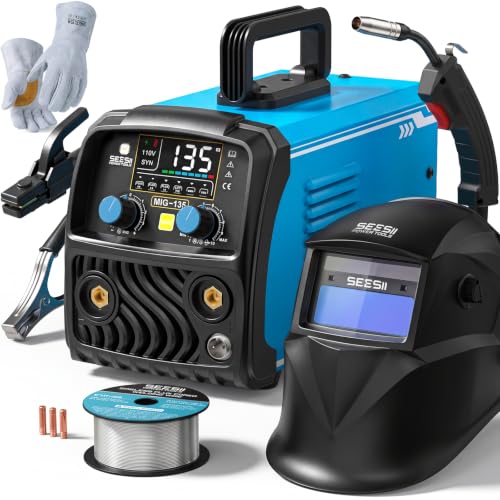
Complete Welding Kit: This all-in-one kit delivers the SEESII 135A welder, an auto-darkening helmet, and heat-resistant gloves together. Open the box, gear up, and weld immediately. Save your time, money, and hassle, no extra purchases needed.

3-in-1 Multi Process Welder: Designed to handle Gasless MIG welder, MMA, and Lift TIG perfectly, this 110V welding machine is a garage essential for home DIY and fast farm repairs.(Lift TIG Torch NOT included)
Operator Skill Requirements and Training
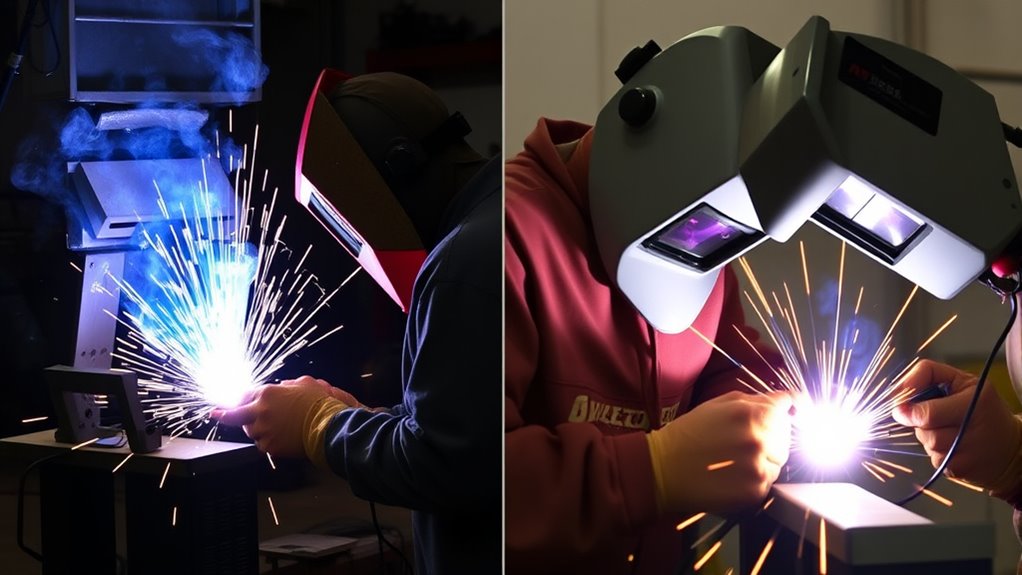
Plasma welding and TIG welding both require training, but the skill emphasis is different. TIG welding demands hand coordination. Plasma welding demands process control.
Skill Development Necessity
For TIG, you need to learn arc length, torch angle, puddle control, filler timing, foot-pedal control, and tungsten preparation. Small mistakes show up quickly as undercut, overheating, porosity, or tungsten contamination.
For plasma welding, you need to understand current, gas flow, nozzle condition, torch height, travel speed, fixturing, and how a keyhole or melt-in mode behaves. The operator may touch the torch less, but setup errors can still ruin a weld.
- TIG training focus: hand control, puddle reading, filler feeding, and heat control.
- Plasma training focus: parameter setup, gas control, torch maintenance, and repeatability.
- Both processes: cleaning, shielding, PPE, and inspection are non-negotiable.
Training Program Importance
A good training program should include safety, machine setup, gas handling, material preparation, weld symbols, inspection basics, and defect troubleshooting. For production work, training should also cover the approved welding procedure specification and how to document settings.
Certification may be required for aerospace, pressure, structural, medical, or other regulated work. In those cases, the process choice must match the code, the procedure, and the qualification requirements.
Practical Applications and Industry Use Cases
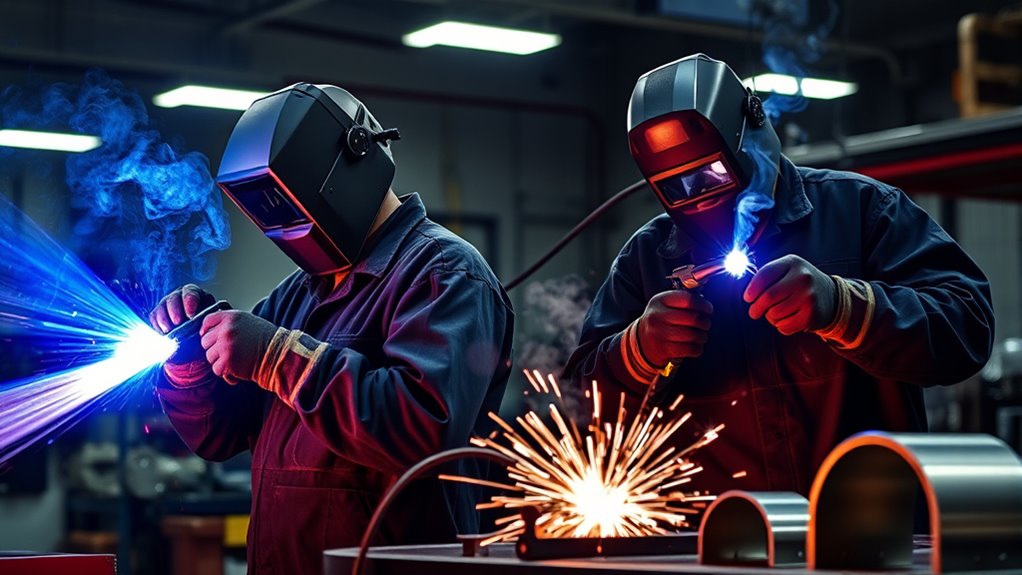
Plasma welding is common where precision and repeatability matter more than flexible hand control. You may see it in aerospace components, medical devices, sensors, bellows, tube seams, battery components, and automated stainless or nickel-alloy parts.
TIG welding is common in repair, fabrication, motorsports, food-grade stainless work, aerospace tubing, aluminum parts, custom exhaust work, artistic metalwork, and high-end furniture. It is also useful for root passes and thin-wall tube work where the operator needs direct control.
- Aerospace: plasma for repeatable production welds; TIG for precision tube and repair work.
- Medical devices: plasma for tiny, repeatable welds in controlled fixtures.
- Automotive and motorsports: TIG for aluminum, stainless, titanium, exhaust, and custom fabrication.
- Artistic metalwork: TIG for clean bead appearance and fine control.
- Industrial production: plasma when automation and repeatability justify the setup.
Safety and Workplace Controls
Both processes create arc radiation, heat, electrical hazards, and possible fume or gas hazards. Even when TIG or plasma welding looks cleaner than stick or flux-core welding, you still need proper ventilation, eye protection, gloves, flame-resistant clothing, and safe gas handling.
OSHA notes that welding fumes may contain metals and gases, and that exposure can depend on the process, base metal, filler metal, location, air movement, work practices, and ventilation controls. Shielding gases such as argon and helium can also displace oxygen in enclosed or confined spaces.
- Use local exhaust ventilation when fumes may enter your breathing zone.
- Do not weld in confined spaces without proper testing, ventilation, and permits.
- Keep solvents, paint, oil, and coatings away from the weld zone.
- Use a helmet lens shade suitable for the amperage and process.
- Protect nearby workers from arc flash with screens or curtains.
- Use respiratory protection when engineering controls do not keep exposure at safe levels.
Future Trends and Technological Developments
Plasma and TIG welding are both moving toward better monitoring, automation, and data control. Automated TIG systems, orbital TIG, hot-wire TIG, and plasma welding cells can track current, voltage, travel speed, gas flow, and weld quality more closely than manual processes alone.
Real-time monitoring is also becoming more important. Cameras, sensors, and software can help detect arc instability, penetration changes, and bead shape problems before they turn into rejected parts. This matters most in industries where every weld must be consistent, traceable, and inspectable.
| Trend | Why It Matters |
|---|---|
| Automated TIG and plasma cells | Better repeatability on production welds |
| Real-time monitoring | Earlier detection of penetration and bead problems |
| Improved gas control | Cleaner shielding and lower wasted gas |
| Data logging | Better traceability for code and quality systems |
Frequently Asked Questions
Is plasma welding better than TIG welding?
Plasma welding is better for repeatable production welds, automation, and deep, narrow penetration. TIG welding is better for manual control, thin materials, repair work, and welds where appearance matters. The better choice depends on the part, not just the process name.
Can plasma welding be used for artistic applications like TIG welding?
Yes, plasma welding can be used for precise metalwork, especially with thin material and controlled fixtures. TIG is usually preferred for artistic work because the operator can see and shape the puddle more directly, add filler by hand, and control the final bead appearance.
Which process is better for thin stainless steel?
TIG is often the easier choice for thin stainless steel in a small shop because it gives strong puddle control and a clean finish. Microplasma can also weld very thin stainless parts, but it makes more sense when the setup is controlled and the weld is repeated many times.
How do maintenance requirements differ between plasma and TIG welding equipment?
Plasma welding usually needs more torch and nozzle maintenance because the constricting orifice must stay clean and accurate. TIG maintenance is simpler, but you still need clean cups, collets, gas lenses, torch parts, cables, and properly prepared tungsten electrodes.
What safety precautions are unique to plasma welding compared to TIG?
Plasma welding often uses higher arc energy, tighter torch components, and more complex gas control, so torch cooling, nozzle condition, shielding, and automation guarding need close attention. Both TIG and plasma welding require eye protection, flame-resistant clothing, ventilation, and safe gas handling.
Does plasma welding cost more than TIG welding?
Usually, yes. Plasma welding equipment, torch parts, gas controls, cooling, and automation can cost more than a basic TIG setup. However, plasma welding may lower cost per part in high-volume production because it can reduce cycle time and improve repeatability.
Are there environmental differences between plasma and TIG welding?
There is no simple rule that one is always cleaner. Fume and gas exposure depends on the base metal, filler, current, coatings, ventilation, work location, and gas use. The safer approach is to clean the material, control fumes at the source, and verify ventilation for the actual job.
Conclusion
Plasma welding and TIG welding are not direct substitutes in every job. Plasma welding is best when you need controlled, repeatable, high-speed welds in production. TIG welding is best when you need flexible manual control, clean bead appearance, and precise work on thin or detailed parts.
Use plasma welding when automation, penetration, and repeatability justify the extra setup. Use TIG welding when skill, visibility, and fine heat control matter most. For critical work, always follow the approved welding procedure, material requirements, and inspection standard.
Sources
- OSHA Welding, Cutting, and Brazing — workplace standards, hazards, and safety resources.
- OSHA Fact Sheet: Controlling Hazardous Fume and Gases during Welding — fumes, gases, ventilation, and exposure controls.
- Miller: Selection and Preparation Guide for Tungsten Electrodes — tungsten selection and preparation for TIG/GTAW work.
- Arc Plasma Torch Modeling — technical background on arc plasma torch behavior.
- Effect of Shielding Gas Composition and Welding Speed on Autogenous Welds — study on shielding gas and welding speed effects.
- Multiphysics Modelling of Gas Tungsten Arc Welding on Ultra-Thin-Walled Titanium Tubing — research on GTAW heat input and thin titanium tubing.