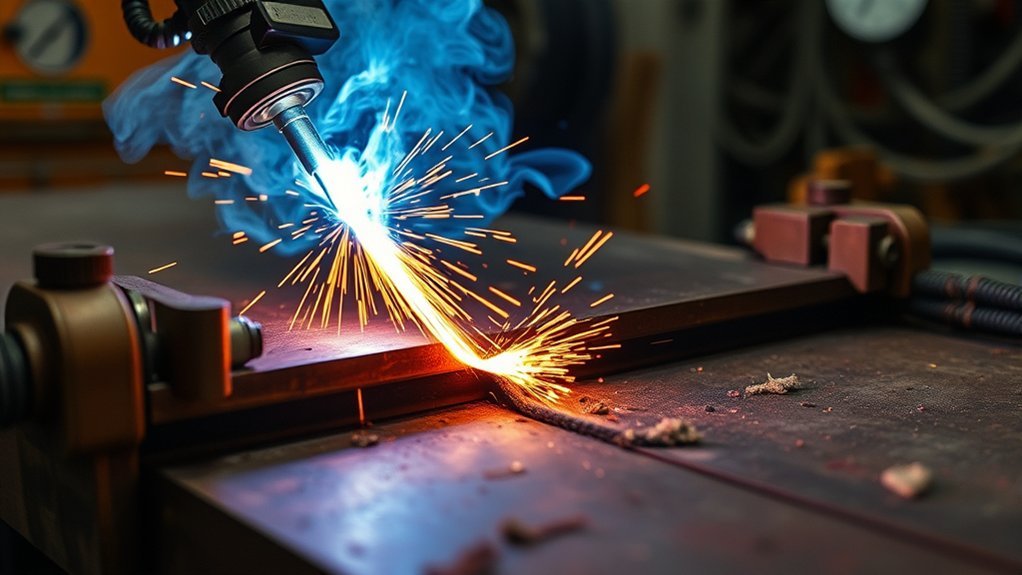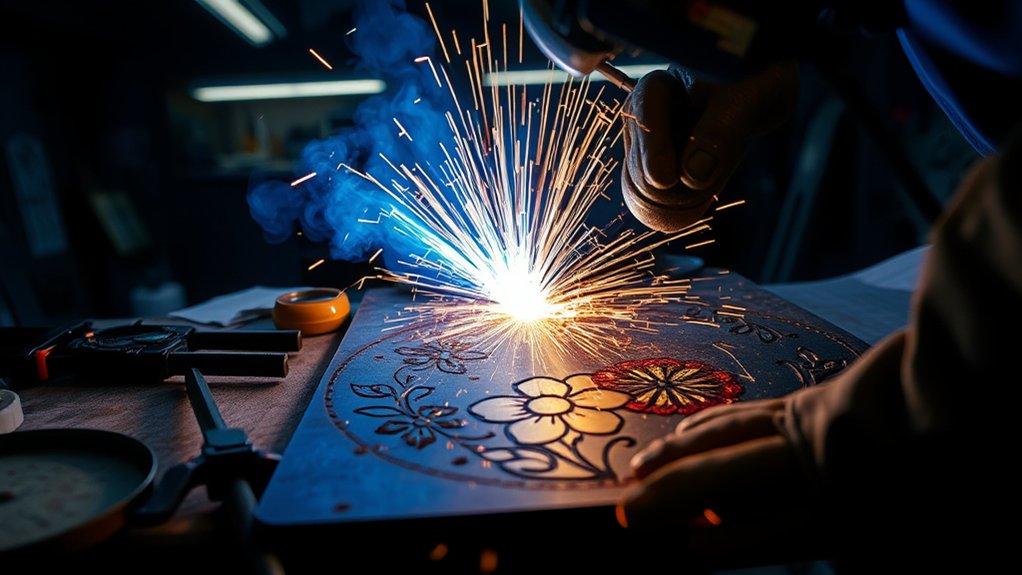
Plasma-cut metal art starts with a clear design, the right consumables, and a setup that matches your machine. You can cut freehand for organic lines or follow a template for repeatable shapes. The cleanest results come from testing on scrap, keeping the torch square during normal cuts, controlling heat, and finishing every edge before you display or sell the piece.
Last updated: July 20, 2026
Quick Answer
To make plasma-cut metal art, draw or transfer your design, choose conductive sheet metal within your cutter’s rated capacity, install the correct consumables, and test the settings on scrap. Keep the torch square for normal cuts, cut interior details before the outer profile, control heat, deburr the edges, then apply a compatible patina or protective finish.
Key Takeaways
- Use the amperage, air pressure, consumables, cut height, and speed listed in your machine’s manual or cut chart.
- Hold the torch perpendicular to the work for ordinary cuts. Angle it only for a rolling pierce, bevel, flush cut, or gouging operation.
- Cut holes and interior details before the outside profile so the workpiece stays stable.
- Use local exhaust, proper eye protection, flame-resistant clothing, gloves, hearing protection, and safe hot-work practices.
- Plan for kerf width, heat distortion, bridges in stencil-style designs, and enough material around small details.
At a Glance
| Time Required | About 1 to 4 hours for a small piece, depending on design detail and finish |
| Difficulty | Beginner to intermediate |
| Tools Needed | Plasma cutter, compatible air supply, work clamp, PPE, marker or chalk, template or guide, clamps, grinder, abrasives, and finishing supplies |
| Cost | Varies by metal size, consumables, abrasives, finish, and whether you already own the cutter |
Warning: Plasma cutters create an intense arc, ultraviolet and infrared radiation, hot sparks, molten metal, noise, fumes, and electric-shock hazards. Read your machine manual before use. Never cut a sealed container, unknown coated metal, or material contaminated with fuel, oil, flammable solvent, or chlorinated cleaner.
Plan the Design and Cut Order
Start with the final size, mounting method, and viewing distance. A wall piece viewed from across a room can use wider lines and larger openings. Small tabletop art needs stronger bridges and more space around fine details because narrow sections can melt, warp, or break during cleanup.
Draw directly on clean metal with soapstone, chalk, or a paint marker, or print a full-size pattern. For stencil-style letters and shapes, add bridges so enclosed centers do not fall out. Mark the waste side of every line, then decide which side of the kerf must remain accurate.
- Cut interior holes first: The full sheet supports the work while you cut small features.
- Cut the outer profile last: This prevents the part from shifting or dropping through the table too early.
- Allow for kerf: The plasma arc removes a strip of metal. Make a test cut and measure the kerf when tight fit or symmetry matters.
- Plan lead-ins: Start pierces in waste areas when possible so the pierce mark does not damage the finished edge.
- Limit heat buildup: Alternate between distant areas instead of making several close cuts in a row.
Pro Tip: Make a cardboard or thin plywood mockup before cutting expensive sheet. It helps you check proportions, bridges, hanging points, and negative space without wasting metal.
Freehand vs. Template Cutting for Metal Art
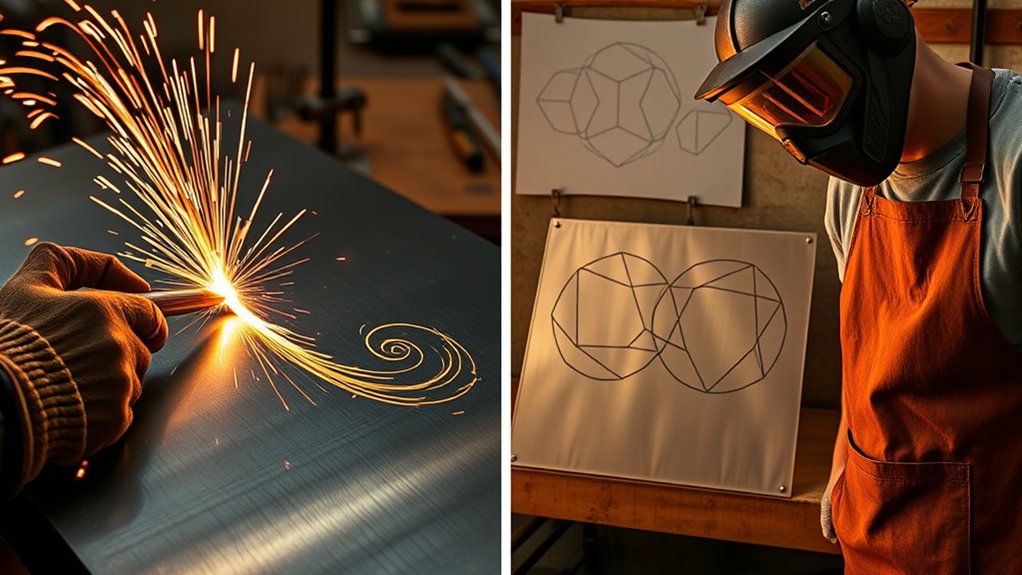
Freehand cutting gives each piece a handmade look. Sketch the design on the plate, brace your forearms, and dry-run the path with the trigger off. Curves look smoother when you pull the torch toward your body and move your whole upper body instead of steering only with your wrist.
Templates help when you need repeatable shapes, straight edges, circles, or matching parts. Use a nonflammable steel guide or a manufacturer-approved torch guide. Clamp it securely and account for the distance between the guide surface and the center of the plasma arc. That offset changes with the torch cap or guide attachment.
A blended method works well for metal art. Use guides for the main outline and repeated geometry, then add freehand scrolls, texture, and distressed edges. If you use a CNC plasma table, create clean vector paths, remove duplicate lines, close open contours, add bridges, and cut small internal features before large contours.
Choosing the Right Plasma Cutter and Accessories
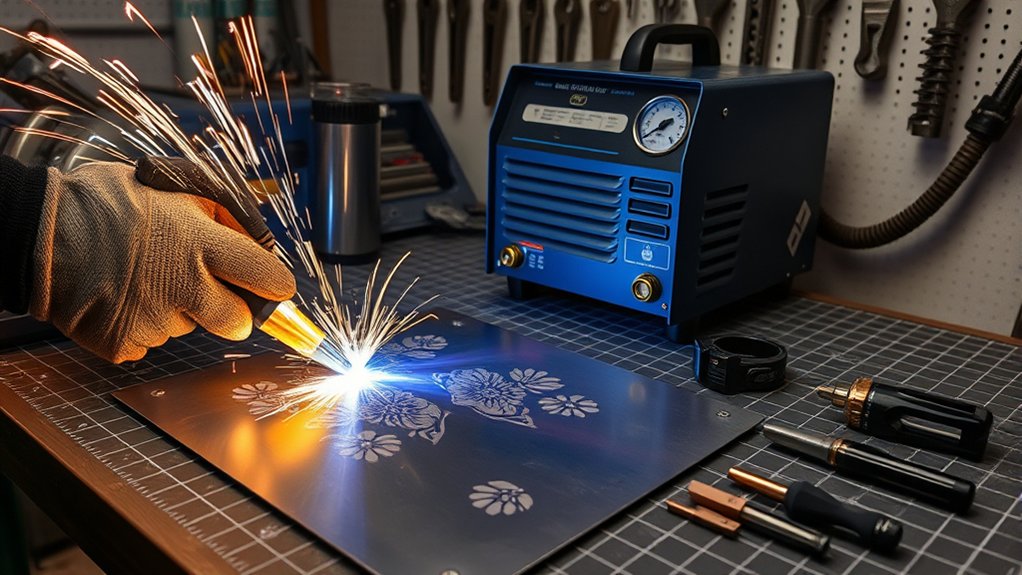
Choose a cutter by its recommended cut capacity, not its maximum severance rating. The recommended rating reflects a useful cutting speed and better edge quality. The severance rating describes a much slower separation cut that may need heavy cleanup.
For portable work, the dual-voltage Hypertherm Powermax30 XP is rated for recommended cuts up to 10 mm (3/8 inch), with a slower recommended cut listed for 12 mm (1/2 inch). On 120-volt input, its output and cut speed are lower. For more capacity and handheld or mechanized use, the current Powermax45 SYNC has a recommended 16 mm (5/8 inch) cut capacity. The older Powermax45 XP was discontinued in March 2024, although Hypertherm still supports it with parts and service.
Those examples do not replace your own manual. Check these items before buying or setting up any plasma cutter:
- Input power: Confirm voltage, phase, circuit capacity, plug, and extension-cord limits.
- Air requirements: Match the required flow and pressure, not pressure alone. Use clean, dry, oil-free air when the manual specifies it.
- Duty cycle: A higher duty cycle matters if you will make many long cuts without cooling breaks.
- Consumables: Use the nozzle, electrode, shield, swirl ring, retaining cap, or cartridge listed for the amperage and cutting process.
- Guides: A straightedge, circle guide, drag shield, stand-off guide, or CNC interface can improve repeatability.
- Fume control: Plan local exhaust or a downdraft or water table that is approved for your materials and process.
| Check | Good Sign | Problem Sign |
|---|---|---|
| Arc sound | Steady and even | Popping, sputtering, or repeated arc loss |
| Kerf | Narrow and consistent | Wide, tapered, or wandering |
| Dross | Minimal and easy to remove | Heavy globules or a hard bottom bead |
Products Worth Considering

The suitable plasma torch: Plasma spring guide AG60 / SG55 WSD60 plasma cutting torch

Standard size plasma torch double pointed spacer guide for: PT-60 / PT-40

Compatible with AG60 / AG-60 / SG55 / SG-55 plasma cutting torches, widely used for most standard plasma cutting jobs.
Metals and Materials: What You Can Cut and Combine
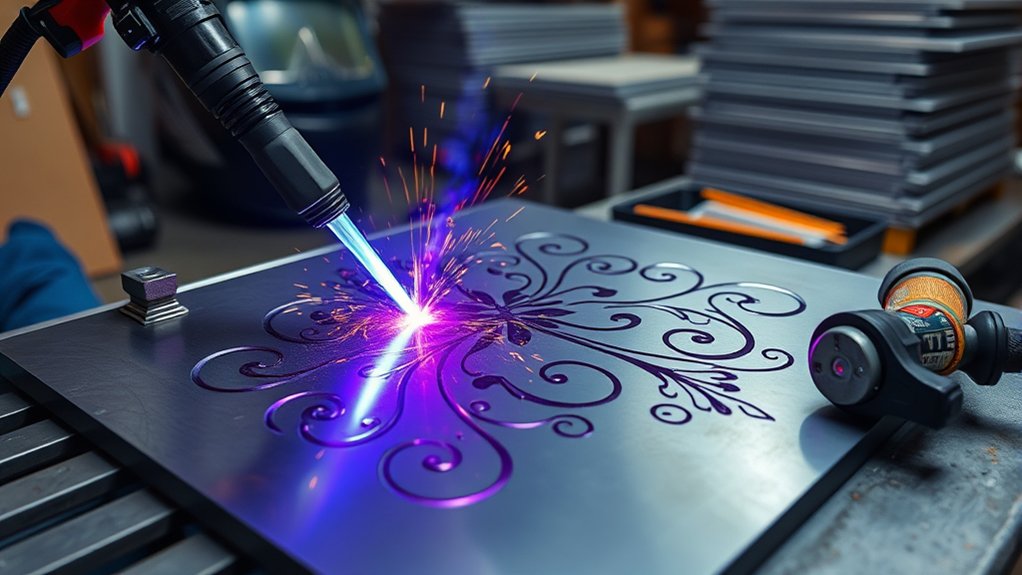
A plasma cutter can cut electrically conductive metal, including mild steel, stainless steel, aluminum, copper, and brass. Cut quality varies with the machine, gas, consumables, thickness, alloy, surface condition, and operator technique. Air plasma is common for art projects, but it can leave different edge colors and oxide layers on different metals.
- Mild steel: Affordable, easy to find, and suitable for paint, clear coat, blackening, or controlled rust finishes.
- Stainless steel: Corrosion-resistant, but plasma cutting can discolor the edge and create metal fumes that require effective source capture.
- Aluminum: Lightweight and reflective. It transfers heat quickly, so thin sheet can distort if you dwell or recut an area.
- Copper and brass: Useful for color contrast and inlays. Follow the machine maker’s settings and expect different dross and edge appearance than mild steel.
Mix materials with a plan for expansion, galvanic corrosion, fastening, and finish compatibility. A copper insert against weathered steel can look striking, but direct contact outdoors can accelerate corrosion when moisture is present. Use a barrier coating or nonconductive spacer where needed.
Warning: Do not treat painted, plated, galvanized, lead-coated, cadmium-coated, or mystery scrap as harmless material. Coatings and alloying elements can create hazardous fumes. Identify the metal and coating first, remove coatings by an appropriate controlled method when permitted, and use ventilation and respiratory protection based on a real hazard assessment.
Prepare the Workspace and Metal
Set the work on a stable, noncombustible cutting table with open space below the cut. Keep the part supported so it cannot tip, pinch the kerf, or drop onto your feet. Route the torch lead and work cable where they will not snag during a curve.
- Clear the hot-work area. Remove paper, sawdust, fuel, aerosols, solvents, oily rags, and other combustibles from the spark path. Check the opposite side of walls, floors, and openings where sparks can travel.
- Provide source capture. Use local exhaust, a suitable downdraft table, or another engineered method that captures fumes near the cut and sends contaminated air to a safe location. A room air purifier is not a substitute for source capture.
- Clean the metal. Remove loose rust, dirt, oil, and flaking coating. Do not use a flammable or chlorinated cleaner near hot work.
- Attach the work clamp correctly. Place it on clean bare metal on the workpiece or cutting table as allowed by the manual. Do not clamp to the section that will fall away.
- Check the torch and air system. Inspect the lead, cap, consumables, O-rings, fittings, filter, and moisture separator. Drain the compressor and confirm required flow and pressure.
- Protect nearby people. Use screens or barriers and warn others not to watch the arc.
Essential Consumables and Maintenance for Clean Cuts
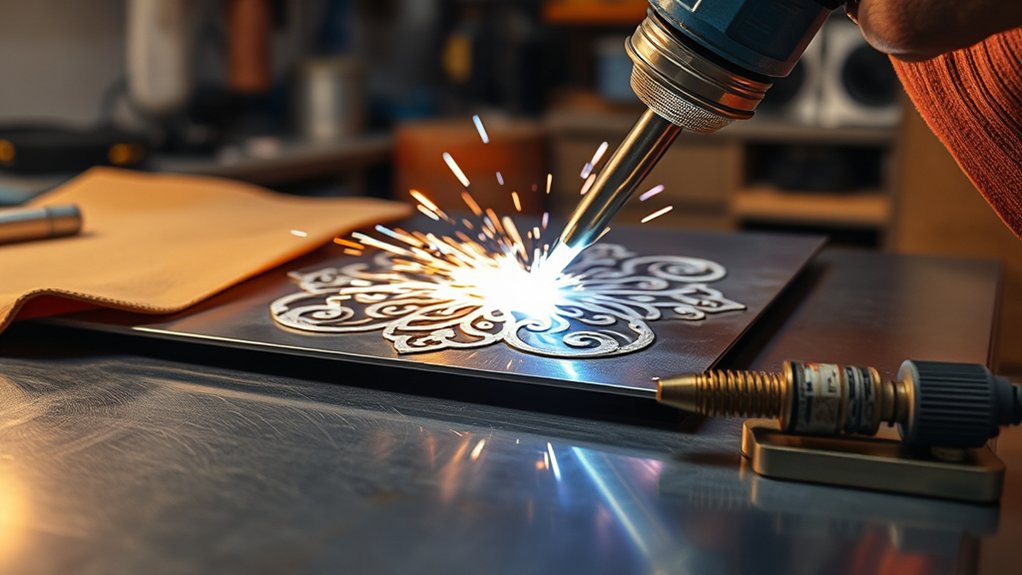
Consumables are wear parts, but you do not need to replace them before every session. Inspect them before use and replace them when wear affects starting, arc shape, cut quality, or safety. Common warning signs include an enlarged or oval nozzle opening, deep electrode wear, heavy spatter, cracks, damaged threads, blocked gas holes, or repeated arc instability.
Use the exact consumable set specified for the torch, amperage, and process. Fine-feature consumables can narrow the kerf on thin material, but their allowed thickness and amperage range is machine-specific. Do not apply a universal 40-amp or thickness rule.
- Disconnect input power and follow the manual before opening or servicing the torch.
- Keep parts clean and dry. Do not scrape precision openings with wire or a drill bit.
- Replace the nozzle and electrode together when the manufacturer instructs you to do so.
- Lubricate O-rings only with the approved lubricant and only in the amount specified.
- Tighten the retaining cap by hand as directed. Do not force or cross-thread it.
- Store spare parts in a clean sealed container away from grinding dust and moisture.
Clean, dry, oil-free air supports stable cutting and longer consumable life. Moisture, oil, and particles can interfere with the arc and damage the torch. Drain the compressor, service filters, repair leaks, and verify that the compressor can maintain the required flow while the torch is operating.
Products Worth Considering

Package Include: 10 Shield Cups, 50 Nozzles, 20 Swirl Baffle, and 30 Electrodes.

[Achieve Precise Cuts] PT31 Plasma Cutting Consumables – Your Essential Tool for Efficient Cutting! Whether you're working with sheet metal, steel, or any other material, superior cutting performance ensure clean, accurate, and smooth cuts.

High-Quality Material:Made of high quality material to ensure a longer lifespan and superior performance.
Step-by-Step Plasma-Cut Metal Art Process
1. Transfer and Mark the Design
Secure the pattern or draw directly on the cleaned metal. Mark interior cutouts, exterior profiles, bridge locations, mounting holes, and the waste side of each line. Add a start point in scrap where possible.
2. Set Up the Cutter
Install the correct consumables, connect the torch and work lead, attach the work clamp, connect the approved gas supply, and turn on the machine in the sequence listed in the manual. Set the process and amperage from the cut chart. Use the specified pressure or automatic gas setting.
3. Make a Test Cut
Use a coupon of the same metal, alloy, thickness, and surface condition. Test a straight line and a curve. Check whether the cut fully separates, how much dross forms, the kerf width, edge taper, and how the sheet reacts to heat. Adjust one variable at a time.
4. Cut Interior Details First
Start with holes, slots, letters, and small negative spaces. Edge-start whenever the design allows because it is easier on consumables than piercing. When you must pierce, use the method and pierce height specified for your torch. A rolling pierce directs molten spray away from the nozzle on thicker material, but the torch should return to square after the arc passes through.
5. Cut the Outer Profile
Keep both hands stable, pull the torch along the line, and avoid stopping in corners. Slow slightly before a tight turn rather than pausing. Leave a small tab if the part might drop, tip, or strike the torch, then cut the tab after the main profile is complete.
6. Cool and Inspect the Piece
Let hot metal cool in a safe area. Quenching can change appearance, increase distortion, or affect some metals and finishes, so use it only when the project and material allow it. Check every cut for sharp edges, incomplete separation, cracks in thin bridges, and distortion before grinding.
Cutting Techniques, Speeds, and Safety Best Practices
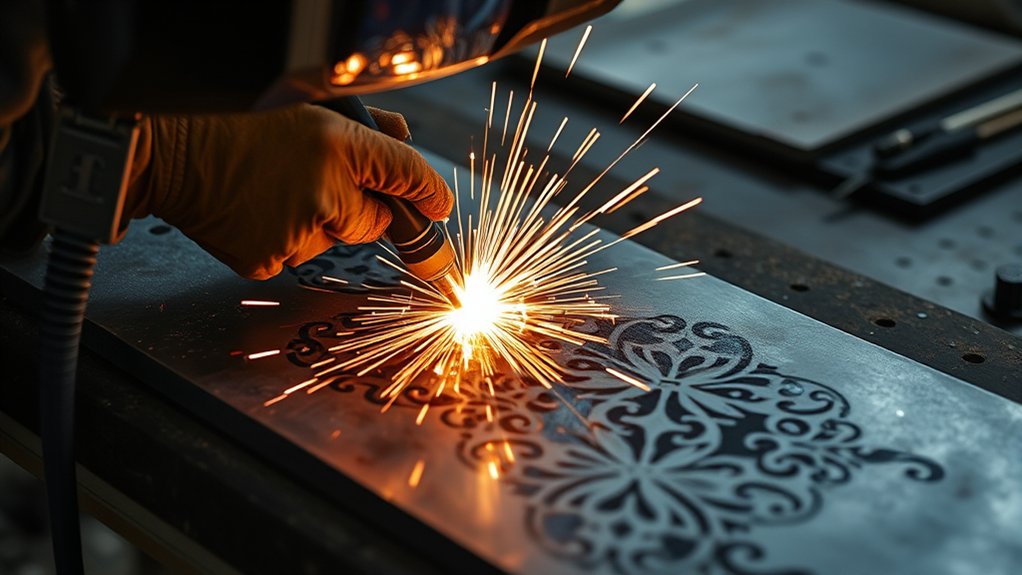
Torch Angle and Standoff
For a normal straight or curved cut, hold the torch perpendicular to the workpiece. A constant 30- to 40-degree angle will create an intentional bevel and more spray. Use an angled torch only when the operation calls for it, such as a rolling pierce, bevel, flush cut, or gouge.
Standoff is not one fixed number for every torch. Some shielded consumables are designed for drag cutting directly on the plate. Other parts need a small gap, and mechanized systems use cut and pierce heights from a cut chart. Follow the consumable and torch instructions instead of assuming 1/16 to 1/8 inch applies to every setup.
Edge Starts and Piercing
For an edge start, center the nozzle opening over the edge, establish the arc, wait for sparks to exit below the plate, and then begin moving. For a pierce, keep molten spray away from the nozzle. On thicker material, the manufacturer may direct you to start at an angle and roll the torch upright after breakthrough.
Note: Never pierce material thicker than the machine’s rated pierce capacity. Starting too close to the plate can throw molten metal into the shield and nozzle, shortening consumable life.
Optimal Travel Speed
Travel speed depends on the cutter, amperage, consumables, metal, thickness, and gas. A single speed such as 40 to 60 inches per minute for 1/8-inch steel is not a safe universal starting point. Begin with the cut chart, then fine-tune on scrap.
For many handheld air-plasma cuts, the sparks should exit below the plate and trail slightly behind the torch. On Hypertherm’s handheld SYNC guidance, a 15- to 20-degree trailing spray is the target. Sparks spraying upward usually mean the torch is moving too fast or lacks enough cutting power. Sparks dropping straight down can mean the torch is moving too slowly and creating low-speed dross.
- Too fast: The arc lags far behind, sparks may spray upward, the cut may not separate, and a narrow hard dross bead can form.
- Too slow: The kerf widens, the sheet receives more heat, and thick bubbly dross can form.
- Close to correct: The cut separates cleanly, the arc stays stable, edge taper is controlled, and dross is light.
Use the manufacturer’s cut charts when available. Change only one setting at a time so you know what improved or harmed the cut.
Cut Direction and the Good Side
The plasma swirl creates one squarer side and one more beveled side. With standard clockwise-swirl consumables, the better edge is usually on the right side of the torch’s forward travel. That generally means cutting an outside contour clockwise and an inside hole counterclockwise. Confirm this with your own torch manual because consumable design can vary.
Safe Torch Handling
Stand with balanced footing, brace your arms, keep the lead free, and keep your body out of the spark path. Hold the torch away from yourself and others because many hand torches are instant-on. Do not wrap the torch lead around your body or reach under a hot workpiece.
Wear impact-rated safety glasses with side protection under a suitable cutting shield or helmet, using at least the filter shade required for the operation and current. OSHA’s general-industry table lists a minimum shade 8 for light plasma arc cutting below 300 amps when the arc is clearly visible. Your equipment maker may recommend a different shade for a specific system, and you can use a darker shade for comfort as long as you can see the cut safely.
Use dry flame-resistant clothing that covers your skin, plasma-cutting gloves, hearing protection, and sturdy closed footwear. Respirator selection should be based on the metal, coating, ventilation, exposure level, and applicable safety program. A disposable dust mask is not automatic protection from metal fumes and gases.
| Action | Target |
|---|---|
| Normal torch angle | Square to the workpiece |
| Standoff | Use the torch manual or drag-cut design |
| Travel speed | Cut-chart setting, refined on matching scrap |
| Grip and stance | Neutral, braced, and clear of sparks |
Troubleshooting Plasma-Cut Metal Art
| Problem | Likely Causes | What to Check |
|---|---|---|
| Cut does not go through | Speed too high, amperage too low, poor work connection, worn parts, or material beyond capacity | Slow to the chart value, verify output and clamp contact, inspect consumables, and confirm thickness rating |
| Heavy bubbly dross | Travel too slow, amperage too high, or torch too low | Increase speed slightly, verify amperage, and use the correct standoff |
| Hard narrow dross bead | Travel too fast, amperage too low, or torch too high | Reduce speed, verify output, inspect the nozzle, and correct height |
| Excessive bevel | Torch not square, wrong cut direction, worn nozzle, wrong height, or excessive speed | Square the torch, reverse path if needed, replace worn parts, and retest height and speed |
| Arc sputters or stops | Wet or dirty air, low flow, loose cap, damaged consumables, or poor electrical connection | Drain and filter the air system, check pressure under flow, reseat parts, and clean the clamp point |
| Thin sheet warps | Too much heat, slow travel, long continuous cuts, or poor support | Use lower approved amperage, move faster, alternate cut areas, add support, and allow cooling breaks |
Finishing Touches: Grinding, Patinas, and Sealing
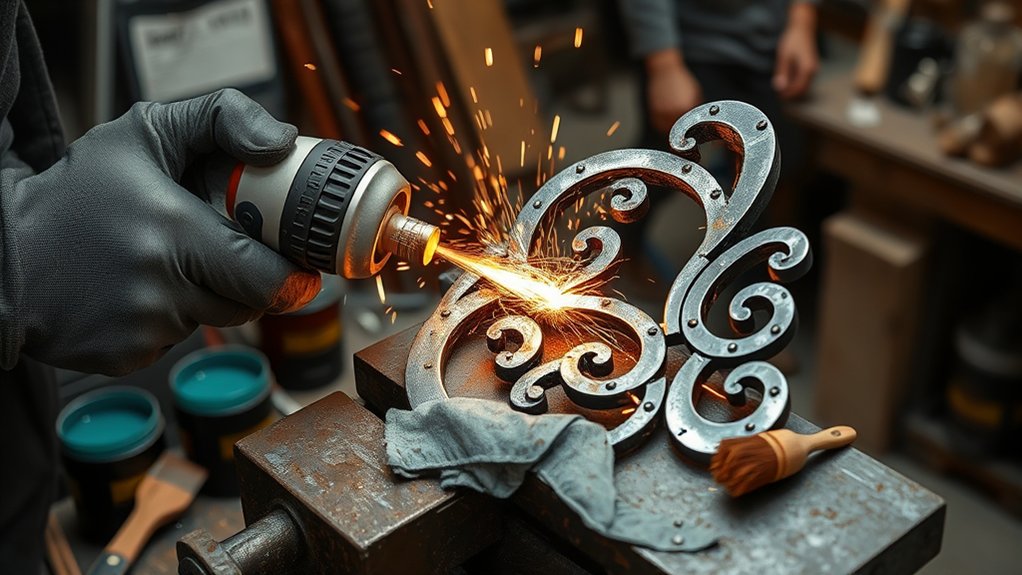
Deburr and Smooth the Edges
Remove loose dross with pliers, a chipping tool, or a scraper before grinding. Use a 60- to 80-grit flap disc for heavy edge cleanup, then move to 120 grit or finer when the design needs a smoother finish. Use cartridge rolls, files, or small abrasive wheels for inside curves and slots.
Keep the grinder moving and avoid thinning narrow bridges. Round any edge that people can touch. Wear eye, hearing, hand, and respiratory protection suitable for the grinding dust, and clamp small pieces instead of holding them in your hand.
Clean and Apply Patina
Remove grinding dust, scale, oil, and fingerprints before applying a finish. Mechanical texture from a wire brush, nonwoven abrasive, or sanding pattern can become part of the design. Use stainless-only brushes and abrasives on stainless steel to avoid embedding free iron.
Patina chemistry varies by metal and product. Follow the patina maker’s surface preparation, PPE, ventilation, application, neutralization, rinsing, and drying instructions. Do not heat unknown chemicals or use an open flame near flammable products. Heat coloring can change quickly and may reduce corrosion resistance on some stainless surfaces, so test the process on scrap first.
Seal and Mount the Art
After the surface is fully neutralized, rinsed, and dry, apply a clear coating that is compatible with the metal and patina. Water-based and solvent-based metal clear coats are available. Apply thin coats within the product’s temperature and recoat limits. Use strong ventilation and remove ignition sources when spraying a flammable solvent-based coating.
For wall art, design the mounting points before finishing. Keyhole plates, welded tabs, stand-offs, French cleats, or hidden brackets can work. Do not assume every wall has studs at the same spacing. Match anchors and fasteners to the wall type and the finished weight, and keep sharp metal edges away from wiring and plumbing.
Frequently Asked Questions
How Do I Price and Sell Plasma-Cut Metal Art Pieces?
Add the cost of metal, consumables, abrasives, finish, packaging, machine time, design time, labor, overhead, selling fees, and your target profit. Photograph the front, back, edge quality, mounting system, and scale. State the dimensions, weight, material, finish care, lead time, and whether outdoor exposure will change the surface.
What Software Helps Design Patterns for CNC Plasma Tables?
Use vector or CAD software that can export the file type accepted by your CAM program, often DXF or SVG. Fusion 360, Inkscape, Affinity Designer, CorelDRAW, and DraftSight can create paths, while SheetCam is commonly used to prepare toolpaths for compatible controllers. Confirm current file support with your table and CAM documentation before designing a large project.
How Can I Reduce Noise and Fumes in a Small Studio?
Capture fumes at the cut with suitable local exhaust, a downdraft table, or an approved water-table system, and provide clean replacement air. Discharge contaminated air safely and follow local rules. Use hearing protection and isolate compressor vibration where practical. Do not seal yourself inside a booth without engineered ventilation, and do not rely on a portable room purifier as the main fume control.
Are There Community Workshops or Maker Spaces Offering Plasma Access?
Many maker spaces, Fab Labs, trade schools, and community colleges offer supervised plasma cutting or CNC plasma access. Ask about required orientation, accepted file formats, material restrictions, consumable fees, ventilation, maximum sheet size, and whether you must supply your own metal.
How Do I Photograph Metal Art for Portfolios and Online Listings?
Use a clean neutral background and large diffused side light to reveal texture without harsh glare. Keep the camera square to flat artwork, lock the white balance, use a tripod, and include one full view, edge details, the mounting hardware, and an in-room scale photo. A polarizing filter can reduce reflections on some finishes.
What Metal Thickness Is Best for Beginner Plasma Art?
Choose a thickness your cutter handles comfortably and that is stiff enough for the design. Thin sheet cuts quickly but warps easily and can lose small bridges. Slightly thicker sheet is more stable but needs more power and creates more heat. Test your exact material before committing to detailed work.
Can I Plasma Cut Painted or Galvanized Metal?
The arc may cut it, but the coating can create hazardous fumes and contaminate the cut. Identify the coating first. Use appropriate coating-removal, ventilation, and respiratory controls based on the hazard, or choose clean uncoated metal. Never cut unknown coated scrap indoors as a casual test.
Why Are My Small Holes and Corners Misshapen?
The torch may be moving too fast for the tight path, the kerf may be too wide for the feature, or the consumables may be worn. Enlarge tiny details, add corner radii, use fine-feature consumables within their approved range, slow only enough to maintain the arc, and practice the path on scrap.
Conclusion
Good plasma-cut metal art comes from planning before you pull the trigger. Build the design around kerf and bridge strength, use the cut chart for your exact machine, test on matching scrap, and keep the torch square during ordinary cuts. Cut interior details first, control heat, and stop to correct worn consumables or dirty air before they ruin the piece.
Finish the work as carefully as you cut it. Remove dross, smooth every touchable edge, clean the surface, apply patina or coating according to the product instructions, and use a mounting system that supports the final weight. Those steps turn a rough plasma-cut shape into safe, durable metal art.
Sources
- Hypertherm: How to Plasma Cut – setup, edge starts, piercing, torch position, and basic cutting technique
- Hypertherm: Basic Tips to Improve Plasma Cut Quality – consumables, cut direction, torch squareness, height, speed, and gas checks
- Hypertherm: Powermax30 XP Specifications – input power, capacity, air supply, and consumable applications
- Hypertherm: Powermax45 SYNC Specifications – current model capacity, duty cycle, applications, and gas requirements
- OSHA 29 CFR 1910.133 – eye and face protection and minimum filter-shade guidance
- OSHA 29 CFR 1926.353 – ventilation and protection during welding, cutting, and heating