You probably don’t know that plasma keyhole welding can cut heat input by 30–60% versus TIG while holding ±0.2 mm path accuracy. You’ll see tighter joints, less distortion, and fewer rework cycles—especially on thin-gauge aerospace alloys and medical components. With disciplined programming, lean file structures, and in-process sensing, you can compress cycle time 15–35%. CapEx runs $180k–$450k, but modeled payback hovers near two years—if you avoid three common traps that quietly erase margin.
Key Industrial Applications of Plasma Welding Robots
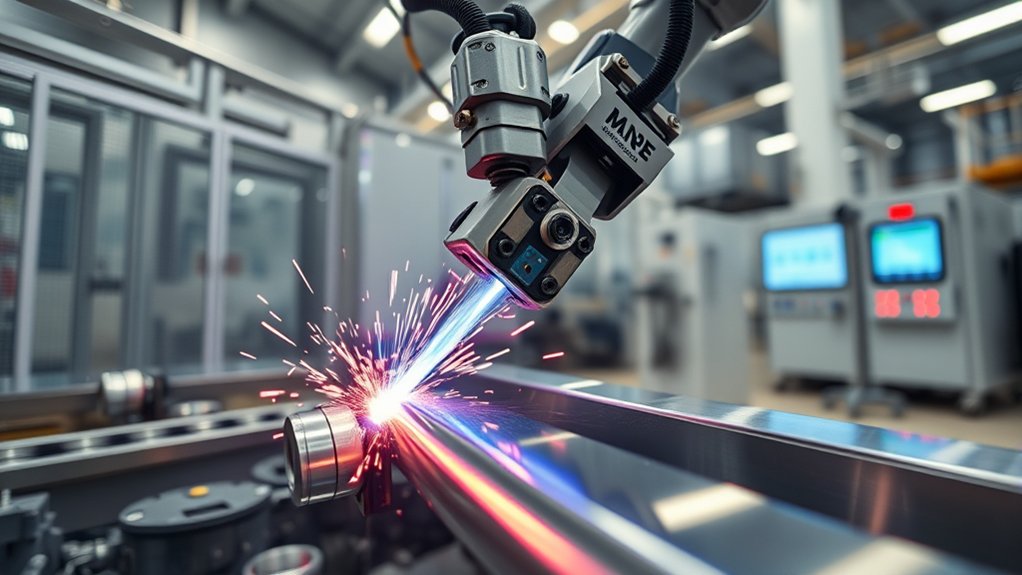
From aerospace to medical devices, plasma welding robots deliver high-precision joins that cut rework, boost throughput, and safeguard quality. You’ll see immediate ROI where accuracy, repeatability, and cycle time matter most.
In aerospace applications, robots weld aluminum and titanium with minimal heat input, reducing distortion and scrap while meeting tight tolerance stacks on airframe and engine components. Expect fewer post-weld corrections and better fatigue performance.
Minimal-heat robotic plasma welding shrinks distortion and scrap, meets tight tolerances, and boosts fatigue performance in aerospace components.
You’ll capture clear automotive benefits on exhausts, chassis parts, and brackets. High travel speeds and rapid arc starts shorten tack-to-finish time, lifting line rates while holding bead geometry within spec, which reduces downstream fit-up issues.
For electronics, robots execute micro-scale welds on connectors and circuit assemblies, improving signal integrity and long-term reliability.
In shipbuilding, high-current plasma handles thick plate, delivering deep penetration and consistent fusion for hull and structural seams, cutting rework hours.
Medical devices gain hermetic, low-spatter joints on delicate assemblies, ensuring biocompatibility and regulatory compliance.
Programming Workflows and Best Practices
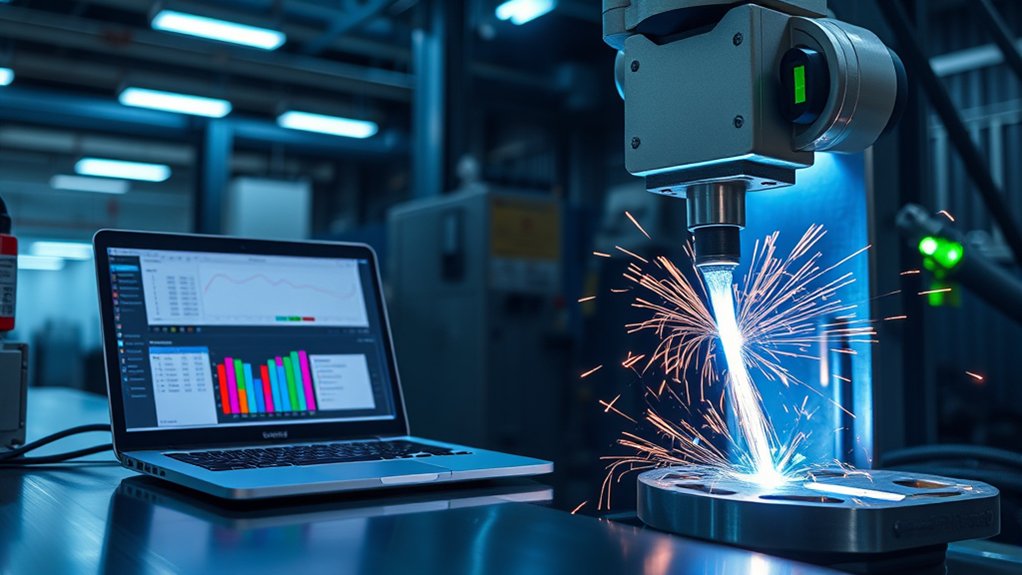
Two pillars drive reliable, high-ROI plasma welding robot programs: disciplined file management and precise motion control. Start with weld file organization: build a library of arc files by thickness/leg size and match each to the correct weave file. This standardization cuts setup time and stabilizes bead geometry. Keep programs concise—under 100–200 points—with clear labels and line comments so techs can audit paths fast and avoid rework.
Hold TCP stable and prioritize torch alignment optimization. Validate offsets after any consumable change; small angular errors compound into undercut or overfill. Capture every program change in a revision log to prevent drift between shifts and preserve qualified parameters. Use proven weld procedures, then fine-tune torch angles to reduce heat input and cycle time without sacrificing penetration.
| Practice | Metric | ROI Impact |
|---|---|---|
| Arc/weave pairing | Rework rate | -30–50% defects |
| Program brevity | Teaching time | -20–35% hours |
| Commenting | Debug time | -25% downtime |
| TCP consistency | Dimensional miss | -40% scrap |
| Torch angle tuning | Cycle time | -8–15% per joint |
Equipment, Sensors, and Software Stack
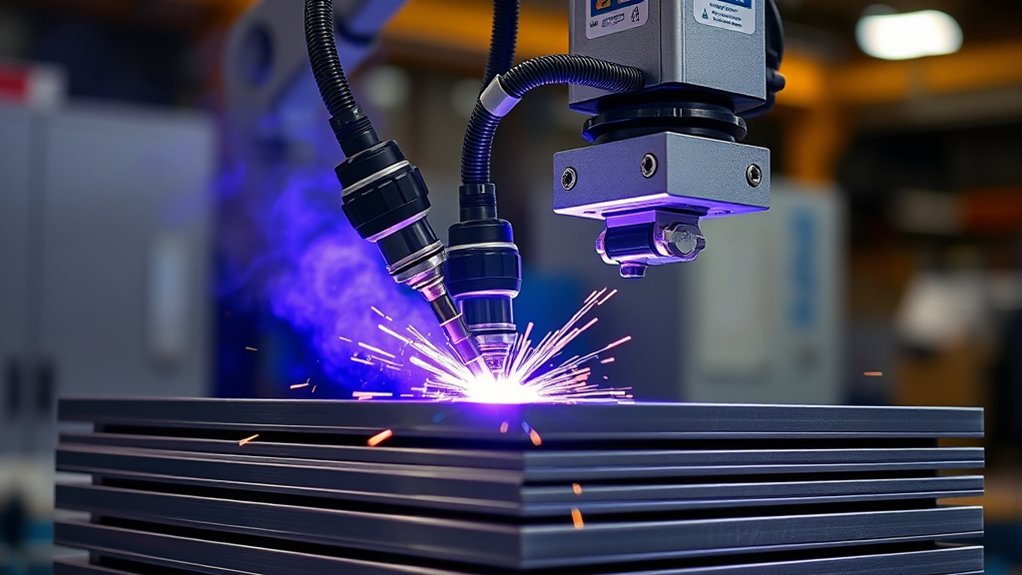
While the arc ultimately makes the joint, your ROI hinges on the stack that controls it: hardware, sensing, and software working as a closed loop.
Specify equipment specifications that match your alloys and geometries: a stabilized plasma power supply with fast current ramp (≤1 ms), arc voltage control, and a precision torch with repeatability ≤±0.02 mm. Pair it with a six-axis robot offering path accuracy ≤±0.3 mm and coordinated motion for aerospace-grade stainless and aluminum joints.
Match alloys and geometries with stabilized plasma, ±0.02 mm torch, and ±0.3 mm robot accuracy
Prioritize sensor integration that closes the loop in real time. Use arc-voltage feedback to maintain arc length, thermography or pyrometry to hold bead temperature windows, and seam-tracking (laser or through-arc) to correct path drift.
Feed these signals at ≥1 kHz to the controller.
Your software stack should expose parameter libraries, guided setup, path simulation, and optimization without coding. Leverage digital twins to validate heat input and cycle time.
This stack typically drives sub‑24‑month payback via higher throughput, lower defects, and reduced rework.
Cost Breakdown: CapEx, OpEx, and Hidden Expenses
Because payback starts with a clear TCO model, break costs into CapEx, OpEx, and hidden line items you’ll actually incur. Treat capital costs as the baseline, then load operational expenses and integration overhead to see true cash demand over 5–10 years.
1) CapEx (capital costs): Robot and power source typically run $50,000–$250,000 depending on reach, sensors, and controls. Include fixtures, safety guarding, and installation to avoid under-scoping.
2) OpEx (operational expenses): Electricity, consumables (plasma gas, electrodes), routine maintenance, and operator time. Plan annual maintenance at 5–10% of initial investment to stabilize uptime and avoid unplanned repairs.
3) Hidden expenses: System integration, PLC/IIoT tie-ins, training, procedure qualification, and changeover to new workflows. Budget implementation downtime; it impacts throughput and delivery.
4) TCO horizon: Model a 5–10 year lifespan to capture wear components, software updates, and facility changes. Normalize costs per welded unit to compare to manual or alternative processes. Underestimate integration or maintenance, and ROI slips; scope them rigorously.
ROI Modeling: Metrics, Examples, and Sensitivity Analysis
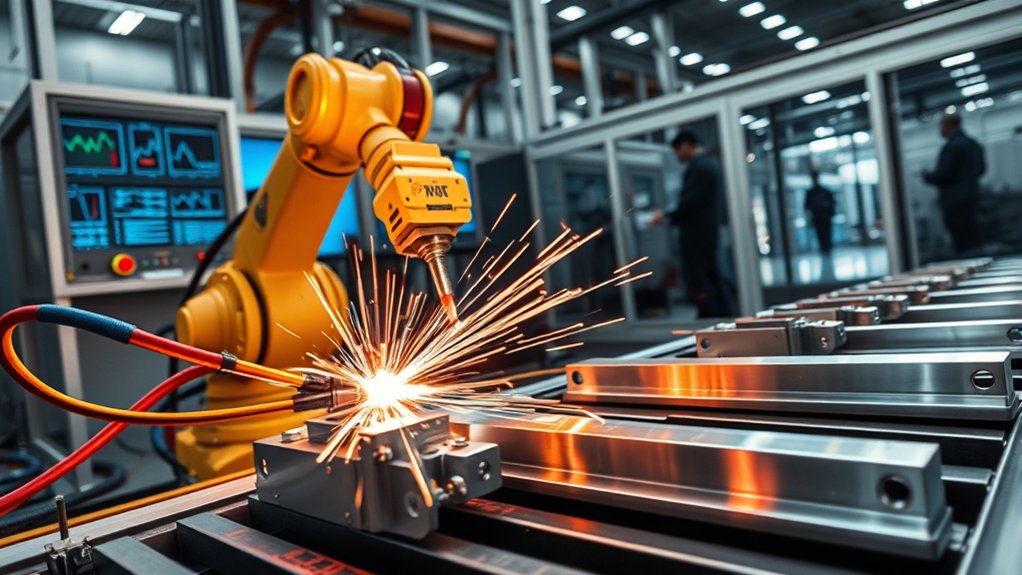
Although every plant runs different cost structures, ROI modeling for a plasma welding robot starts by quantifying labor savings against the capital outlay, then layering throughput gains and quality improvements.
Begin with a savings analysis: if a skilled welder costs about $74,100 annually and the robot investment is roughly $150,000, baseline payback is near two years before process benefits. Strengthen the model with metrics: a 30% production-speed lift, reduced scrap, and better weld quality that curbs rework and overtime.
Baseline two-year payback; add 30% speed, scrap cuts, and quality gains to accelerate ROI.
Build an investment comparison using annualized benefits minus OpEx. Include throughput value (units/hour x margin), scrap reduction (defect rate x material cost), and overtime avoided.
Validate with sensitivity analysis: vary production volume, labor rates, and material prices to see how ROI shifts. For example, a 10% volume dip may still clear a three-year hurdle if labor and scrap savings persist.
Use scenario ranges to set payback targets and trigger points for scaling cells.
Frequently Asked Questions
How Do Plasma Welding Robots Impact Workplace Safety and Ergonomics?
They reduce arc-flash exposure, fumes, and repetitive strain, delivering measurable safety enhancements and ergonomic benefits. You offload high-heat tasks, cut incident rates, and standardize posture. Data shows fewer lost-time injuries, improved throughput, and faster ROI via reduced PPE costs and compensation claims.
What Certifications or Standards Govern Plasma Welding Robot Compliance?
You follow ISO standards (ISO 10218, ISO 13849, ISO 15011, ISO 12100) and seek Compliance certifications like CE, UL, and ANSI/RIA R15.06. You document risk assessments, functional safety PL/d-SIL2, EMC, and fume extraction to protect ROI.
How Do You Train and Upskill Operators for Plasma Robot Adoption?
You train and upskill operators through phased operator training, rapid skill development sprints, simulator-based practice, vendor-led certification, SOPs, and KPIs. Use time-to-competency, first-pass yield, OEE, and defect ppm to quantify ROI; iterate curricula quarterly for sustained gains.
What Facility Requirements (Power, Ventilation) Are Needed for Deployment?
You’ll need a stable three‑phase power supply, clean, dry compressed air, and calibrated gas delivery. Specify high‑CFM fume extraction, HEPA filtration, and airflow monitoring to protect air quality. Verify grounding, surge protection, and redundancy to minimize downtime and maximize ROI.
How Do Plasma Robots Integrate With Mes/Erp and Quality Traceability Systems?
You integrate via standardized APIs/OPC-UA for real-time data synchronization, linking weld parameters, consumables, and serials to MES/ERP. You capture timestamps and defects for quality assurance, enabling closed-loop adjustments, audit trails, SPC dashboards, and ROI from reduced rework, downtime, and Mr. Fusion reliability.
Conclusion
You’ll get the most from plasma welding robots by targeting high-precision runs, enforcing tight program/version control, and instrumenting quality. Budget for sensors, fixtures, and training—not just the arm. A practical model: 2-shift operation, 30% cycle-time gain, 50% rework reduction, and 20% labor savings often delivers payback in ~24 months. Here’s a striking stat: cutting rework from 4% to 1% can lift annual gross margin by 2–3 points. Validate with pilots, track OEE, and scale where ROI is proven.