Disclosure: As an Amazon Associate, we earn from qualifying purchases. If you click a link on this page and make a purchase, we may receive a small commission at no extra cost to you.
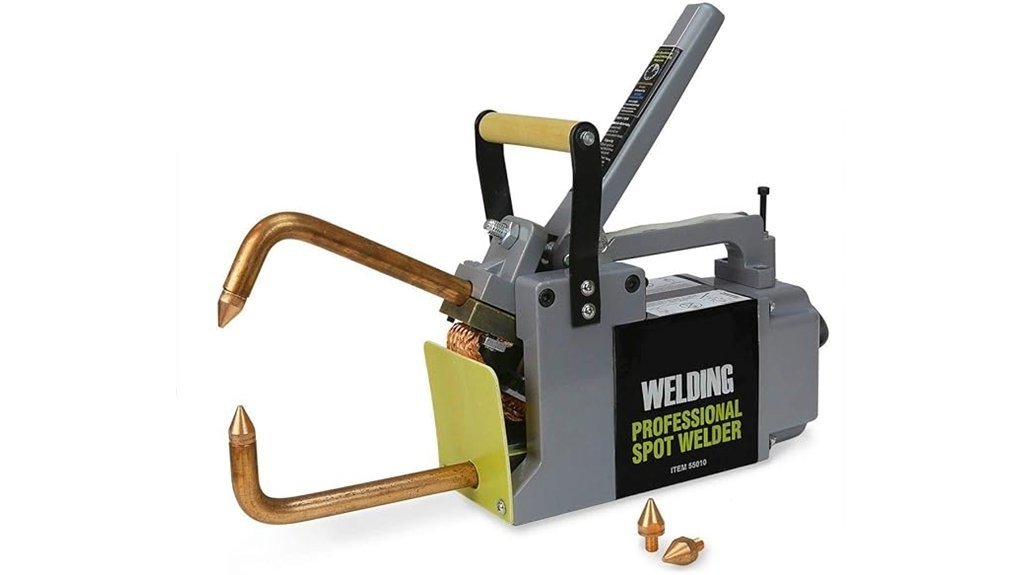
A portable spot welder can speed up sheet-metal work, but only when its voltage, reach, thickness limit, and duty cycle match your shop. The Stark USA 55010 Portable Spot Welder is a corded 220V lever-style machine with a 6-inch throat, a listed 6,750A maximum output current, and capacity for up to 1/8 inch of combined mild steel. Its compact body is easier to move than a floor-standing unit, although the 28.9-pound weight and high-voltage power requirement make it better suited to bench-supported work than continuous handheld use. This review explains the machine’s verified specifications, practical strengths, setup needs, and main limits before you buy.
Quick Verdict
Rating: 7.8/10, Recommended with caveats
Best For: DIY metalworkers, auto-body repair users, and small shops that need repeatable spot welds on reachable sheet-steel joints.
Bottom Line: The Stark USA 55010 combines a 2.5 kVA rated output, 50% duty cycle, 6-inch throat, and simple lever operation in a portable format. Its biggest tradeoffs are the 220V electrical requirement, limited tong reach, and the need to verify plug configuration and material suitability before use.
| Specification | Detail |
|---|---|
| Brand | Stark USA |
| Model | 55010 |
| Product type | Corded, air-cooled portable spot welder |
| Electrical design | Single phase, 220V model |
| Rated output | 2.5 kVA at 50% duty cycle |
| Maximum output current | 6,750A, listed with ±10% tolerance |
| Listed input current | 16A |
| Throat depth | 6 inches |
| Listed weldable materials | Uncoated mild, galvanized, and stainless sheet steel |
| Mild-steel capacity | Up to 1/8 inch combined sheet thickness |
| Overall dimensions | 18.5 x 4.5 x 7.5 inches |
| Weight | 28.9 pounds |
| Operation | Manual lever pressure with opposed welding tips |
| Included maintenance item | An extra pair of replaceable welding tips is listed |
| Important setup note | Confirm the plug, receptacle, circuit, breaker, grounding, and manual requirements before use. |
What Is the Stark USA 55010 Portable Spot Welder?
The Stark USA 55010 is a resistance spot welder made to join overlapping sheet metal between two electrode tips. Pressure holds the workpieces together while a short burst of high current heats the contact area and forms a weld nugget. Unlike MIG or TIG welding, the process does not create a continuous bead and normally does not require filler wire.
This model uses a 220V single-phase design with a listed 2.5 kVA output at a 50% duty cycle. Its 6-inch throat determines how far the tips can reach from an exposed sheet edge, while its 1/8-inch rating refers to the combined thickness of mild-steel sheets, not the thickness of each sheet.
The attached handle and 18.5-inch body make the unit movable between benches or job areas. At 28.9 pounds, however, it is more practical to support the welder and workpiece on a stable surface instead of holding the full weight through a long series of welds.
Before You Buy: This is a 220V high-current tool, not a standard 120V plug-in welder. Confirm the required receptacle, plug configuration, circuit capacity, grounding, combined sheet thickness, and 6-inch reach before ordering.
Who Should Buy It?
Best For
- DIY fabricators who need quick weld points on overlapping mild-steel, galvanized-steel, or stainless-steel sheet.
- Auto-body and restoration users working on reachable patch panels, brackets, and flange-style joints.
- Small shops that already have suitable 220V power and want a movable alternative to a stationary spot welder.
Skip If
- You only have standard 120V outlets or do not have an electrician-approved circuit for the required connection.
- Your joint is more than 6 inches from an accessible edge or cannot fit between the opposing tips.
- You need long seam welds, adjustable digital controls, or production-level continuous operation.
Power, Duty Cycle, and Electrical Requirements
The 55010 is rated at 2.5 kVA with a listed maximum output current of 6,750A. That high current is delivered for a short weld cycle rather than as a continuous arc. For buyers, the practical benefit is fast localized heating when the tips, sheet thickness, pressure, and contact time are correct.
The 50% duty-cycle rating matters during repeated work. Duty cycle describes how long the machine may operate within a set period before it needs cooling. It does not mean you should hold the lever down for half of every minute. Follow the manual’s weld timing and cooling guidance because excessive contact time can overheat the tips, mark the work, or burn through thin sheet.
The listing identifies this as a 220V model and lists 16A input. Do not assume that a common household extension cord or adapter is suitable. Verify the receptacle, plug, wire gauge, breaker size, grounding, and extension-cord limits with the manual and a qualified electrician when needed.
Six-Inch Throat and Joint Access
The 6-inch throat is one of the most important buying specifications. It lets the electrode tips reach up to about 6 inches from an open edge, depending on workpiece shape and tip alignment. That is enough for many flanges, patch panels, brackets, and small assemblies, but it can block access to the center of wide panels.
Both tips must contact opposite sides of the joint. The machine is therefore best for lap joints and other assemblies that fit between the tongs. Boxed sections, closed cavities, deep channels, and obstructed body panels may require a different tool or a revised assembly sequence.
Build Quality and Replaceable Tips
The welder uses a compact metal housing, an attached carry handle, and a manual lever. Its 28.9-pound weight adds stability but also makes frequent repositioning tiring. A sturdy bench or cart reduces strain and helps you keep the tips square to the work.
The product listing includes replaceable tips and states that an extra pair is supplied. Replaceable tips are useful because the contact faces gradually become dirty, pitted, or misshapen. Tip condition directly affects current transfer, pressure concentration, and weld consistency.
Listing copy is inconsistent about whether the tips are described as steel or copper. Because electrode material affects maintenance and dressing methods, confirm the supplied tip material in the manual or with the seller instead of relying on a single marketing line.
Performance and Material Limits
The manufacturer lists uncoated mild, galvanized, and stainless sheet steel as compatible materials. It also lists a maximum combined mild-steel thickness of 1/8 inch. For example, two equal sheets would each need to be thinner than 1/8 inch because the rating applies to their total stack.
Surface condition has a major effect on results. Rust, scale, paint, oil, thick coatings, and uneven contact can increase resistance in the wrong place or prevent a sound weld nugget from forming. Clean the contact areas as allowed for the material, then test the same sheet stack on scrap before welding the final part.
Some marketplace titles mention aluminum, but the detailed manufacturer specification lists steel sheet types and does not provide a verified aluminum thickness rating or procedure. Treat aluminum compatibility as unconfirmed unless the current manual or seller gives specific instructions for the exact alloy and thickness.
Ease of Use and Control
The lever-style workflow is simple: place the overlapping sheets between the tips, align the contact points, apply pressure, and activate the weld according to the manual. There are no complex menus or multi-process settings to learn.
Simple controls do not guarantee a strong weld. Consistent results depend on tip alignment, pressure, surface preparation, material stack, current delivery, and contact time. Beginners should expect a trial-and-test process before working on a visible or load-bearing part.
The tool’s portable shape helps when moving between work areas, but it is not a lightweight hand tool. Supporting the machine, the part, or both can make alignment easier and reduce fatigue during repeated welds.
How It Performs in Real Use
For Auto-Body Patch Panels
The 55010 can suit lap-jointed repair panels and flanges where both tips can reach the metal. The 6-inch throat is useful around edges, but deep body cavities and assembled box sections may remain inaccessible. Test the sheet stack and confirm that the finished repair meets the vehicle manufacturer’s procedure before using spot welds on structural areas.
For Small Fabrication Projects
Brackets, trays, enclosures, and light sheet assemblies are a natural fit when the parts can be positioned between the tongs. Spot welds can reduce finishing work compared with a long bead, although the joint design must be suitable for discrete weld points.
For Repeated Bench Work
The 50% duty-cycle rating supports intermittent batches better than nonstop production. A stable bench, clean tips, consistent part placement, and planned cooling intervals help improve repeatability. Shops needing all-day cycle consistency should compare a heavier stationary machine with documented production specifications.
For Mobile or Jobsite Use
The carry handle and compact dimensions make transport possible, but jobsite use still depends on safe 220V power and a dry work area. The 28.9-pound weight is manageable for short moves, yet it is not ideal for long periods of unsupported handheld welding.
Setup Tips Before First Use
- Read the manual first. Confirm the input-voltage, plug, breaker, grounding, duty-cycle, and cooling instructions for your exact unit.
- Inspect the work area. Remove flammable materials, provide ventilation, and keep the machine and floor dry.
- Check tip alignment. The opposing tips should meet squarely and apply even pressure to the intended weld point.
- Prepare both sides of both sheets. Clean the contact area as appropriate for the metal and coating. Coated metals can produce hazardous fumes.
- Test on matching scrap. Use the same alloy, coating, thickness, overlap, and number of layers as the final joint.
- Inspect the test weld. Check for a sound nugget, excessive indentation, burn-through, or easy separation before continuing.
- Plan cooling pauses. Follow the rated duty cycle and stop if the case, tongs, cable, or tips show abnormal heat or damage.
Pro Tip: Make several labeled test coupons with different contact times on the same material stack. Destructive testing on scrap can help you identify a usable starting point without risking the finished part.
Compatibility and Safety
Use the welder only on materials and combined thicknesses supported by the manual. Do not treat the 6,750A figure as a universal capacity rating. Alloy, coating, sheet count, surface condition, tip geometry, pressure, and power quality all affect the weld.
Wear suitable welding eye and face protection, heat-resistant gloves, protective clothing, and closed footwear. Keep hands clear of the tongs and hot workpiece. Use effective ventilation, especially around galvanized, painted, plated, or unknown metal, because heating coatings can release hazardous fumes.
Disconnect power before inspecting, cleaning, aligning, dressing, or replacing tips. Do not weld in rain, on wet floors, near flammable vapor, or with damaged cables, plugs, insulation, or grounding. Structural automotive repairs and safety-critical assemblies may require approved procedures, specific weld spacing, testing, or professional inspection.
Pros and Cons
Pros
- Verified 2.5 kVA rating and 6,750A listed maximum output for short resistance weld cycles.
- 50% duty-cycle specification gives buyers a clearer basis for planning intermittent work.
- Six-inch throat suits many edge-accessible sheet-metal joints and repair flanges.
- Replaceable tips and an extra listed pair support routine maintenance.
- Compact 18.5-inch body and carry handle are easier to move than a floor-standing unit.
Cons
- Requires suitable 220V power and may need plug or receptacle planning before first use.
- Six-inch throat cannot reach the center of wide panels or enclosed joints.
- At 28.9 pounds, repeated unsupported repositioning can be tiring.
Is It Worth the Price?
The Stark USA 55010 is worth considering when you already have suitable 220V power and need a dedicated tool for reachable sheet-steel lap joints. Its strongest value points are the verified 2.5 kVA rating, 50% duty cycle, 6-inch throat, replaceable tips, and portable housing.
It offers less value when electrical changes are needed, when most joints are outside the tong reach, or when your work requires continuous seams. The machine also asks you to develop a repeatable process through surface preparation, tip care, pressure, and scrap testing.
For a home garage or small shop doing occasional sheet-metal work, it can be a useful category-specific tool. For production welding or safety-critical fabrication, compare machines with more detailed controls, documented cycle data, service support, and application-specific procedures.
How It Compares to Alternatives
The Stark USA 55009 is the lower-voltage model to compare when 120V access matters more than output. A VEVOR 1.5 kVA portable spot welder is another common compact alternative for buyers prioritizing standard-voltage convenience, although capacity and duty-cycle details should be compared carefully.
A stationary pedestal spot welder may be better for repeated shop production because it can provide a fixed work position and easier part handling. The Stark USA 55010 makes the most sense when you want 220V output in a movable lever-style machine and your joints fit within its 6-inch throat.
Frequently Asked Questions
What is the maximum sheet thickness for the Stark USA 55010?
The manufacturer lists up to 1/8 inch of combined mild-steel sheet thickness. That limit applies to the total stack between the tips, not to each individual sheet.
Does the Stark USA 55010 run on a standard 120V outlet?
No. Model 55010 is listed as a 220V single-phase spot welder. Confirm the required plug, receptacle, breaker, grounding, and circuit details before purchase.
What does the 50% duty cycle mean?
It limits how much welding the machine can perform within a defined period before cooling. Follow the manual’s exact timing because weld duration and duty cycle are not the same thing.
Can it spot weld aluminum?
Some marketplace title text mentions aluminum, but the detailed manufacturer specification lists mild, galvanized, and stainless sheet steel. Treat aluminum use as unverified unless the current manual or seller provides a supported alloy, thickness, and procedure.
How far can the welding tips reach?
The listed throat depth is 6 inches. Joint shape, part thickness, and obstructions can reduce practical access, so measure from an exposed edge before buying.
Are replacement welding tips included?
The listing states that an extra pair of replaceable tips is included. Confirm current package contents with the seller because bundles can change.
Can it replace a MIG or TIG welder?
No. It creates individual resistance welds on overlapping material that fits between the tips. MIG and TIG machines are better for continuous beads, open joints, and work outside the tong reach.
Who should skip this spot welder?
Skip it if you only have 120V power, need more than 6 inches of reach, or require production-level continuous operation. It is also the wrong category for long seam welds or joints that cannot be clamped from both sides.
The Bottom Line
The Stark USA 55010 is a practical choice for DIY fabricators, restoration work, and small shops that need repeatable spot welds on reachable sheet steel. Its 2.5 kVA output, 50% duty cycle, 6-inch throat, and replaceable tips are useful strengths, but buyers should skip it when 220V power, tong access, or intermittent operation does not fit the job.
Ready to Buy?
Check the latest price, seller, package contents, and electrical requirements before you decide.