Disclosure: As an Amazon Associate, we earn from qualifying purchases. If you click a link on this page and make a purchase, we may receive a small commission at no extra cost to you.
Brazing HVAC copper lines calls for a filler metal that flows at the right temperature and matches the metals you are joining. The Cloud Fire 25 Sticks 5% Silver BCuP-3 Brazing Rod set is a compact option built around 10-inch, 1/25-inch rods for air-conditioning and refrigeration work. Its biggest strengths are the BCuP-3 composition, convenient 25-stick package, and protective tube, while its thin rod diameter and material-compatibility limits deserve attention before you order. This review explains where the rods make sense, where they do not, and how to avoid common buying and brazing mistakes.
Quick Verdict
Rating: Recommended with caveats
Best For: HVAC and refrigeration work involving compatible copper tubing and copper-alloy joints.
Bottom Line: You get 25 thin BCuP-3 rods with 5% silver and a broad published melting range, which makes the set practical for small service jobs and repairs. The main tradeoff is compatibility: phosphorus-bearing BCuP alloys are well suited to copper-to-copper brazing but are not the right filler for every metal combination.
| Specification | Detail |
|---|---|
| Brand | Cloud Fire |
| Model | YHT |
| Product type | Silver-copper-phosphorus brazing filler rods |
| AWS classification | BCuP-3 |
| Silver content | 5% |
| Nominal alloy family | Silver, copper, and phosphorus |
| Rod size | 1/25 in. diameter × 10 in. long |
| Package quantity | 25 rods |
| Published melting range | 643-812°C (1190-1495°F) |
| Product dimensions | 10 × 0.04 × 0.04 in. |
| Item weight | 1.44 oz |
| Packaging | Transparent acrylic tube with two red rubber stoppers |
| Best use | Copper tubing work in HVAC, refrigeration, and cold-storage systems |
| Warranty | 2 years, as stated in the product listing |
What Is the Cloud Fire BCuP-3 Brazing Rod Set?
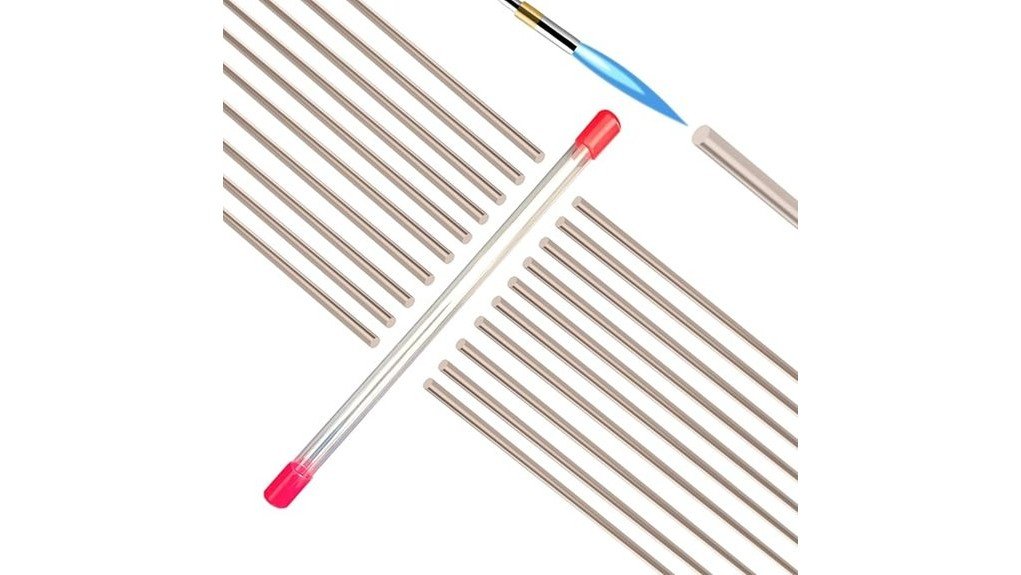
This is a 25-stick pack of BCuP-3 brazing filler metal sold for air-conditioning, refrigeration, cold-storage, and related copper-pipe work. Each rod is about 0.04 inch in diameter and 10 inches long, so you are working with a thinner rod than many larger shop-size brazing sticks.
BCuP-3 is a silver-copper-phosphorus alloy classification. The product is listed as 5% silver, with the balance based on copper and phosphorus. For copper-to-copper work, phosphorus in this alloy family provides self-fluxing behavior, but that does not mean you can use the rods on every metal without flux or without checking compatibility.
Key Takeaways
- The linked product is a 25-stick Cloud Fire set, not a 15-stick pack.
- Each rod is listed as 1/25 inch × 10 inches, with 5% silver and a BCuP-3 classification.
- The published melting range is 643-812°C (1190-1495°F).
- The set is most relevant to copper tubing work in HVAC and refrigeration.
- The thin diameter is easy to meter into smaller joints, but it may feel undersized if you normally use thicker commercial rods.
- Material compatibility matters. Do not assume a phosphorus-bearing BCuP filler is suitable for steel, nickel-rich alloys, or every mixed-metal joint.
Who Should Buy It?
Best For
- HVAC technicians or experienced DIY users brazing compatible copper tubing.
- Refrigeration repair work where a small 25-stick supply is more practical than a bulk package.
- Buyers who want a thin 10-inch BCuP-3 rod that is easy to feed in controlled amounts.
Skip If
- You need a filler specifically approved for steel, ferrous metals, or nickel-rich alloys.
- You prefer thick rods for high-volume shop work or large joints.
- You are new to torch brazing and do not have the equipment, ventilation, and safety knowledge required for high-temperature work.
Before You Buy: Confirm the exact metals in your joint. BCuP-3 is a natural fit for copper-to-copper brazing, but phosphorus-bearing brazing alloys have important limits with ferrous and some nickel-containing materials. Also confirm the current Amazon variant and pack count because marketplace variant labels can change.
Composition and Build Quality
The defining feature is the 5% silver BCuP-3 composition. In this alloy family, silver modifies flow and melting behavior compared with plain copper-phosphorus filler, while phosphorus helps the alloy work effectively on clean copper-to-copper joints.
The rods are narrow, at about 1/25 inch in diameter. That can help you feed small amounts of filler into a joint instead of adding too much at once. The tradeoff is simple: if you are accustomed to thicker 1/16-inch or 1/8-inch rods, these can feel delicate and may be consumed faster on larger joints.
Melting Point Range and Heat Control
The product listing gives a melting range of 643-812°C (1190-1495°F). That is a wide interval between the point where the alloy begins to melt and where it becomes fully liquid. For you, this means heat control matters. You need to bring the joint to brazing temperature evenly rather than trying to melt the rod directly with the flame.
BCuP-3 is not soft solder. A household soldering iron is not appropriate for this temperature range. Use brazing equipment that can heat the joint correctly, and follow the torch, filler-metal, and equipment instructions for your setup.
Suitable Applications and Compatibility
The seller positions these rods for air-conditioning units, household refrigerators, commercial refrigeration equipment, cold-storage systems, and related copper piping. Those are logical uses when the joint materials are compatible with BCuP-3.
For clean copper-to-copper joints, copper-phosphorus brazing alloys are commonly used without a separate flux because phosphorus performs that function on copper. For brass or bronze, a suitable brazing flux is typically required. Do not extend that rule to steel or every dissimilar-metal joint.
Packaging and Storage
The 25 rods come in a transparent acrylic tube with two red rubber stoppers. The tube keeps the thin rods together and makes it easier to see how much material you have left. The stoppers are described as helping reduce oxidation and exposure during storage.
Keep the rods clean and dry. Contaminated filler and dirty base metal can make wetting and joint quality less predictable, so avoid tossing loose rods into a toolbox where they can collect oil, dust, or moisture.
How It Performs in Real Use
For Air-Conditioning Copper Lines
The small-diameter rods suit service work where you want controlled filler addition around a copper joint. Because the rods are only 10 inches long and quite thin, the package is easy to keep with a service kit, though a busy technician may prefer larger or bulk filler for repeated daily jobs.
For Refrigeration Repairs
The same BCuP-3 characteristics apply to compatible refrigeration tubing. The important point is to identify the joint materials first. Copper-to-copper is straightforward for this alloy family, while mixed-metal connections can require flux or a different filler metal entirely.
For Small Repair Jobs
The thin 1/25-inch rod can be useful when you do not want to dump excess filler into a small joint. It gives you fine feed control, but it is not automatically better for wide gaps. Joint fit, cleanliness, heat distribution, and filler selection still determine the quality of the finished braze.
For Storage and Field Use
The tube is one of the more practical parts of the package. It protects the rods better than loose storage and makes the set easy to carry. For occasional HVAC or refrigeration work, that packaging is more useful than decorative extras.
How to Use It Correctly
- Confirm the base metals. Make sure BCuP-3 is appropriate for the metals you are joining.
- Prepare the joint. Clean the tubing and fitting so oil, oxides, and debris do not interfere with filler flow.
- Use flux when the joint requires it. Copper-to-copper work can be self-fluxing with this alloy family, but brass, bronze, and other combinations can need the correct flux or a different filler.
- Heat the joint, not just the rod. Bring the assembly to brazing temperature evenly, then let the hot joint melt and draw the filler.
- Do not overfill. Feed only enough filler to form the joint. The thin rod makes controlled feeding easier.
- Inspect the finished joint. Let it cool safely, clean residues when applicable, and check the completed connection according to the service procedure for the system.
Pro Tip: Keep the flame moving around the fitting so the joint heats evenly. When the base metal is at the correct brazing temperature, touch the filler to the joint and let the joint heat draw it in instead of melting the rod in the flame.
Compatibility and Safety
Brazing takes place at temperatures high enough to cause serious burns, ignite nearby materials, and produce fumes. Use appropriate eye protection, gloves, ventilation, fire-safe work practices, and the safety guidance supplied with your torch, gases, filler metal, and any flux.
BCuP-3 also has metallurgical limits. Phosphorus-bearing copper alloys should not be treated as universal filler metals for ferrous or nickel-rich materials. If you are joining an unfamiliar material, working on a sealed refrigeration circuit, or repairing pressure-containing equipment, use the filler and procedure specified by the equipment manufacturer or a qualified HVAC/refrigeration professional.
Ease of Use
The physical format is simple: a thin 10-inch rod in a tube. That makes the filler easy to organize and meter into smaller joints. The material itself still requires proper brazing technique, so “easy to use” should not be confused with beginner-proof.
The clearest usability advantage is the rod diameter. You can feed the filler gradually and stop when the joint has enough material. The disadvantage is that a very thin rod can bend more easily and may require more frequent repositioning on larger work.
Durability of Connections
A durable brazed joint depends on more than silver percentage. Correct joint clearance, clean base metal, compatible filler, proper heat, and complete filler flow all matter. The 5% silver BCuP-3 alloy is a proven classification for copper brazing applications, but the finished connection is only as reliable as the procedure used to make it.
That makes this set a reasonable choice for compatible HVAC/R work, not a shortcut around joint preparation. If a connection will face vibration, pressure, or repeated thermal cycling, follow the system manufacturer’s service procedure and test the repair as required.
Customer Support and Warranty
The product listing states a two-year warranty. That is useful reassurance for a low-cost consumable-style purchase, but warranty terms can depend on the seller, order date, and marketplace policy. Keep your order information and check the current listing terms if warranty coverage matters to your decision.
Pros and Cons
Pros
- Verified 5% silver BCuP-3 product type for compatible copper brazing work.
- Thin 1/25-inch diameter gives you controlled filler feeding on smaller joints.
- 25-stick package is practical for occasional service work and repairs.
- Transparent tube and rubber stoppers keep the rods organized during storage.
- Published 643-812°C melting range matches the expected high-temperature brazing use case.
Cons
- The 1/25-inch rods are thinner than many shop rods and may feel too small for large joints.
- BCuP-3 is not suitable for every metal combination, so you must confirm compatibility before use.
- The marketplace listing can show different variants or pack descriptions, so verify the selected option before checkout.
Is It Worth the Price?
This set makes the most sense as a small-quantity, task-focused brazing supply. You are paying for 25 pre-cut rods, a defined 5% silver BCuP-3 composition, and a storage tube rather than a bulk spool or large shop package.
It offers strong value if you need a modest amount of thin filler for compatible copper HVAC/R work. It is less attractive if you braze every day, want thicker rods, or need a filler that covers a wider range of dissimilar metals.
How It Compares to Alternatives
Compared with other 5% silver BCuP-3 choices, such as Lucas-Milhaupt Sil-Fos 5 or Washington Alloy SUPERFLOW 5, the Cloud Fire set is positioned more as a compact marketplace package. Those established brazing brands publish detailed technical data, which can be useful when procedure control and documentation matter.
You can also compare BCuP-3 with other filler classifications rather than treating all “silver brazing rods” as interchangeable. Higher-silver or different phosphorus-copper alloys have different flow behavior and liquidus temperatures. Choose by base-metal compatibility and joint requirements first, then by price and package size.
Frequently Asked Questions
How many brazing rods are in this set?
The linked product is listed as a 25-stick set. The original article called it a 15-stick set in a few places, but the product data for this ASIN identifies 25 rods, so check the selected Amazon variant before ordering.
What size are the Cloud Fire BCuP-3 rods?
Each rod is listed as 1/25 inch in diameter and 10 inches long. That thin diameter is useful for controlled feeding, but it can feel smaller than common commercial brazing rods.
Do BCuP-3 rods need flux on copper?
For clean copper-to-copper joints, phosphorus-bearing BCuP alloys are commonly self-fluxing. For brass, bronze, or other materials, you may need a compatible brazing flux or a different filler metal.
Can you use these rods on steel?
You should not treat BCuP-3 as a general-purpose steel filler. Phosphorus-bearing brazing alloys have compatibility limits with ferrous and some nickel-containing materials, so use a filler specified for the metals in your joint.
What temperature range do these rods use?
The product listing states a melting range of 643-812°C (1190-1495°F). That is brazing territory, so the joint must be heated with suitable brazing equipment rather than a low-temperature soldering iron.
Are these rods suitable for outdoor HVAC units?
They can be appropriate for compatible copper joints in outdoor HVAC equipment, but the location alone does not determine suitability. Check the base metals, service procedure, system pressure requirements, and the equipment manufacturer’s repair guidance.
Who should skip this brazing rod set?
Skip it if your job involves incompatible ferrous or nickel-rich materials, if you need thick rods for large-volume work, or if you do not have the equipment and experience to braze safely. In those cases, choose a filler and procedure matched to the actual joint.
The Bottom Line
The Cloud Fire 25 Sticks 5% Silver BCuP-3 Brazing Rod set is a sensible buy for small HVAC and refrigeration jobs involving compatible copper tubing, especially if you value a thin rod and compact storage tube. Skip it when your work involves incompatible metals or when you want thicker, bulk filler for frequent shop use. Its main strength is a practical BCuP-3 format; its main limitation is that proper material selection and brazing technique still matter.
Ready to Buy?
Check the latest price, selected variant, and product details before you decide.