Disclosure: As an Amazon Associate, we earn from qualifying purchases. If you click a link on this page and make a purchase, we may receive a small commission at no extra cost to you.
Repairing a dent with a stud welder takes more than raw power. You need enough control to attach pulling tabs or washers without adding unnecessary heat to thin body panels. The GRAUTOSPOT F98ES Spot Welder Dent Puller combines a 110V, 3KW design with multiple welding modes and fine time and power adjustment for steel body repair. This review explains where that control helps, where the machine demands skill, and why its roughly 49 lb weight makes it portable in a workshop sense rather than truly lightweight.
Quick Verdict
Rating: 8.4/10
Best For: Auto-body technicians and experienced DIY users repairing steel panels
Bottom Line: The F98ES gives you useful control through 9 welding functions, adjustable welding time, and 20% to 99% power control. Its main tradeoffs are the learning curve, substantial weight, and lack of verified aluminum-panel compatibility.
| Specification | Detail |
|---|---|
| Brand | GRAUTOSPOT |
| Model | F98ES |
| Product type | Spot welder dent puller / stud welder for auto-body repair |
| Input voltage | 110V |
| Rated power | 3KW |
| Welding modes | 9 functions, including triangular, round, and OT meson pulling |
| Welding time | 0.01 to 9.99 seconds |
| Power adjustment | 20% to 99%, 79 adjustment levels |
| Weight | About 49 lb, depending on listing/package reference |
| Primary use | Steel/iron automotive body dent and sheet-metal repair |
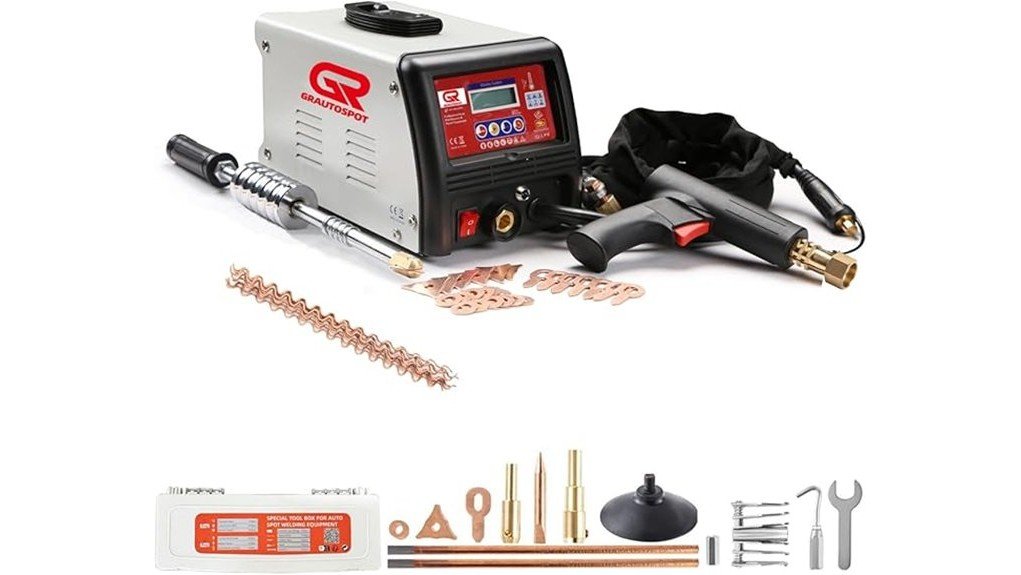
| Accessories | Toolbox with dent-repair accessories; F98ES manufacturer materials list items such as a hook hammer, carbon-rod connector, triangle chuck, manual suction cup, carbon rods, and manual |
| Warranty | Seller-dependent; confirm the current listing before purchase |
Key Takeaways
- The GRAUTOSPOT F98ES is a 110V, 3KW dent-puller spot welder intended for automotive steel bodywork.
- Its 9 welding functions include triangular meson pull, round meson pull, and OT meson pull for different repair shapes and attachment methods.
- Welding time adjusts from 0.01 to 9.99 seconds, while power adjusts from 20% to 99% across 79 levels.
- The machine is movable thanks to its compact body and handle, but at roughly 49 lb it should not be described as a lightweight hand-carried tool.
- The small-spot design is intended to limit unnecessary heat and help protect the anti-rust coating on the reverse side of the panel.
- Verified sources place this model in steel/iron body repair, so you should not assume it is suitable for aluminum panels.
What Is the GRAUTOSPOT F98ES?
The F98ES is a powered dent-repair machine that welds pulling points, washers, studs, or related accessories to damaged automotive sheet metal. Once the attachment is secured, you can apply controlled pulling force to bring a low spot or dent back toward its original shape.
Its main selling point is adjustment. Instead of giving you only a few fixed output choices, the F98ES provides a wide power range and adjustable welding time. That matters when you are moving between small attachment points, different dent shapes, and body panels that can react differently to heat.
This is not a paintless dent repair tool. The listing’s paint-protection claim refers to limiting damage to the anti-rust coating on the opposite side of the panel. You should still expect normal body-repair preparation and refinishing at the weld area.
Who Should Buy It?
Best For
- Auto-body shops that regularly repair dents in steel panels
- Experienced technicians who want fine control over weld time and power
- Skilled DIY users who already understand stud-welder setup, grounding, and panel preparation
Skip If
- You mainly repair aluminum panels and need verified aluminum compatibility
- You want a true paintless dent repair solution
- You need an ultra-light tool for frequent one-handed transport
Before You Buy: Confirm that your work is on compatible steel or iron body panels and that your electrical setup meets the machine’s requirements. Do not assume this F98ES configuration is suitable for aluminum simply because some dent-repair machines are.
Key Features of the F98ES Spot Welder Dent Puller
9 Welding Functions
The F98ES supports multiple dent-repair modes rather than a single stud-welding function. Verified listings specifically mention triangular meson pull, round meson pull, and OT meson pull, along with a total of 9 welding functions. That variety lets you match the attachment style to the dent instead of forcing one method to handle every panel shape.
Fine Time and Power Adjustment
Welding time can be set from 0.01 to 9.99 seconds, and power can be adjusted from 20% to 99% across 79 levels. This is the feature that makes the F98ES more appealing to experienced users. You can reduce output for a smaller attachment point or increase it when a repair needs a firmer weld, while still working within the machine’s supported range.
The benefit is control, not automatic perfection. Thin automotive sheet metal can distort when too much heat is applied, so you still need to choose settings carefully and follow the manual for the accessory and panel you are working on.
Small-Spot Welding Design
The product listing emphasizes small welding spots and states that the design helps protect the anti-rust coating on the back side of a panel. For body repair, that is useful because you want a secure attachment without heating a larger area than necessary.
That does not mean the visible paint at the weld point stays untouched. Stud-welder dent repair normally involves working at the repair surface, so plan for proper bodywork and refinishing after the pulling process.
Accessory Toolbox
The F98ES is sold with a set of dent-repair accessories stored in a toolbox. Manufacturer materials for the F98ES family list a hook hammer, carbon-rod connector, triangle chuck, manual suction cup, carbon rods, and a user manual among the supplied tools. A bundled kit is valuable because it gives you several ways to attack different dent shapes without immediately sourcing every attachment separately.
Performance and Versatility
On paper, the F98ES is built for more than one simple dent-pulling task. Its 3KW rating, adjustable output, and multiple welding modes support common auto-body work such as dent forming, sheet-metal repair, pulling low areas, and other steel-panel correction jobs.
The broad adjustment range is especially useful when the repair changes from a concentrated low spot to a wider damaged area. A fixed-output machine can force you to compromise between weak attachment and excessive heat. The F98ES gives you more room to tune the weld, although that also means the operator has more decisions to make.
Pro Tip: Start with the machine manual and the lowest practical setting for the attachment and panel you are repairing, then increase only as needed for a secure weld. More output is not automatically better on thin body sheet metal.
User Experience and Portability
The compact body and top handle make the F98ES easier to reposition around a shop than a large stationary body-repair system. That is useful when you move between doors, quarter panels, hoods, and different work bays.
However, the original description’s claim that it weighs only a few pounds is not accurate. Current F98ES listings put the unit around 49 lb. You can move it, load it into a service vehicle, or place it on a cart, but you should treat it as a substantial workshop machine rather than a light handheld tool.
The controls also favor users who understand what welding time and power changes do. Beginners may prefer a simpler preset system, while experienced technicians are more likely to appreciate the extra adjustment.
Compatibility and Safety
The verified F98ES sources place this machine in steel or iron automotive body repair. They do not establish that this exact 110V Amazon configuration is an aluminum dent-repair welder. If your vehicle uses aluminum panels, use equipment that is specifically designed and documented for aluminum repair.
Welding and body repair involve high current, heat, sparks, sharp metal, and potential damage to vehicle electronics if procedures are not followed correctly. Use suitable personal protective equipment, follow the F98ES manual, prepare a safe work area, and follow the vehicle manufacturer’s repair procedures. If you are not trained in automotive welding and panel repair, professional instruction is a better starting point than learning on a finished vehicle.
How It Performs in Real Use
For Small Steel-Panel Dents
The small-spot design and adjustable output are well matched to localized dents where you want a controlled attachment point. The key advantage is being able to tune time and power instead of relying on one aggressive setting for every repair.
For Larger or Irregular Dent Shapes
Triangular, round, and OT pulling modes give you more choices when the dent shape changes across the panel. You can select an attachment style that matches the area you need to pull rather than repeatedly using the same stud position.
For Repeated Shop Work
A bundled toolbox and multiple modes reduce the need to stop and source basic accessories between jobs. The machine’s handle helps with repositioning, although its roughly 49 lb weight means a cart is sensible if you move it often through a busy shop.
For Occasional DIY Repair
The F98ES can make sense for an experienced home user who already understands metal finishing and welding safety. For a first-time dent repair, the number of settings can add complexity, and an incorrect weld or pull can create more panel work instead of less.
Setup Tips Before First Use
- Confirm the panel material before welding. Treat this F98ES as a steel/iron body-repair machine unless your exact manual states otherwise.
- Check the 110V electrical requirements and use a properly rated circuit, plug, and extension setup if an extension is permitted by the manual.
- Choose the accessory and welding mode for the dent shape before setting power.
- Keep the work surface, ground connection, and attachment area prepared according to the manual and accepted body-repair practice.
- Use short, controlled pulls. Over-pulling can create a high spot that requires extra metal finishing.
- Allow the machine to cool as directed if you are doing repeated welds over a larger repair area.
Pros and Cons
Pros
- 3KW, 110V configuration suits many North American workshop setups
- 9 welding functions cover several dent-pulling methods
- 0.01 to 9.99-second time adjustment provides fine control
- 20% to 99% power range with 79 levels supports different repair needs
- Accessory toolbox adds practical value for common dent-repair tasks
Cons
- Roughly 49 lb, so portability is limited compared with truly lightweight tools
- No verified aluminum-panel compatibility for this exact configuration
- Fine adjustment is useful but creates a learning curve for new users
Is It Worth the Price?
The F98ES sits in the specialized mid-range of powered auto-body dent-repair equipment rather than the entry-level hand-tool category. Its value comes from combining a 3KW output, 9 functions, fine timing control, adjustable power, and a bundled accessory set in one machine.
It makes the most sense when you will use those controls often. A working body shop or experienced enthusiast can benefit from the flexibility. If you only need to pull one small dent or you prefer a simple preset machine, the extra settings and weight may not justify the purchase.
How It Compares to Alternatives
A VEVOR 90E 110V 3KW dent puller is a direct alternative that offers 7 modes, auto/manual contact welding, and a two-gun configuration, so it may appeal to buyers who value faster switching between attachments. VEVOR also sells a lighter-duty 1.8KW 110V model with 7 preset modes for users who want simpler operation.
For a more shop-focused professional option, the Dent Fix HammerHead DF-595II is a 110V steel dent-puller system with its own pulling accessories and a very different price tier. The F98ES makes the most sense if your priority is a broad adjustment range and 9 functions without moving into that higher-priced professional equipment category.
Frequently Asked Questions
Is the GRAUTOSPOT F98ES a 110V machine?
Yes. The Amazon-linked F98ES configuration is listed as a 110V, 3KW spot-welder dent puller. Confirm the voltage shown on the exact listing and machine label before connecting it to power.
Can the F98ES be used on aluminum panels?
Do not assume it can. Verified sources for this F98ES place it in steel or iron body repair, and they do not establish aluminum compatibility for the exact 110V model reviewed here. Use an aluminum-specific system when the vehicle repair procedure calls for one.
How much does the F98ES weigh?
Current listings put the machine or listed item weight at roughly 49 lb. The handle helps you reposition it, but it is not a tool that weighs only a few pounds.
What welding modes does the F98ES include?
The product is advertised with 9 welding functions. Verified descriptions specifically name triangular meson pull, round meson pull, and OT meson pull among the available repair modes.
Does the F98ES keep the original paint intact?
No paintless result should be assumed. The listing says the small welding spots help protect the anti-rust coating on the reverse side of the panel. The visible repair area can still require surface preparation, welding cleanup, body finishing, and repainting.
Is the F98ES suitable for beginners?
It is easier to recommend to users who already understand auto-body repair and welding safety. The wide time and power adjustment range is useful, but it also gives a beginner more ways to choose an unsuitable setting for a thin panel.
What warranty comes with the F98ES?
Warranty coverage is not consistent across sellers. Some F98ES listings advertise longer coverage than others, so check the warranty shown on the exact Amazon offer and keep the seller’s terms with your purchase records.
What is the biggest mistake to avoid with a dent-puller spot welder?
Avoid treating maximum power as the default. Use the correct attachment, follow the manual, and apply only enough weld energy and pulling force to secure the attachment and move the panel. Too much heat or force can create extra distortion.
The Bottom Line
The GRAUTOSPOT F98ES is a strong fit for auto-body technicians and experienced DIY users who want a 110V, 3KW steel dent-puller with 9 functions and unusually fine time and power adjustment. Skip it if you need verified aluminum compatibility, paintless repair, or a very lightweight machine. Its best feature is control, while its main limitation is that getting good results still depends heavily on operator skill and correct panel setup.
Ready to Buy?
Check the latest price, voltage, included accessories, and seller warranty before you decide.