Disclosure: As an Amazon Associate, we earn from qualifying purchases. If you click a link on this page and make a purchase, we may receive a small commission at no extra cost to you.
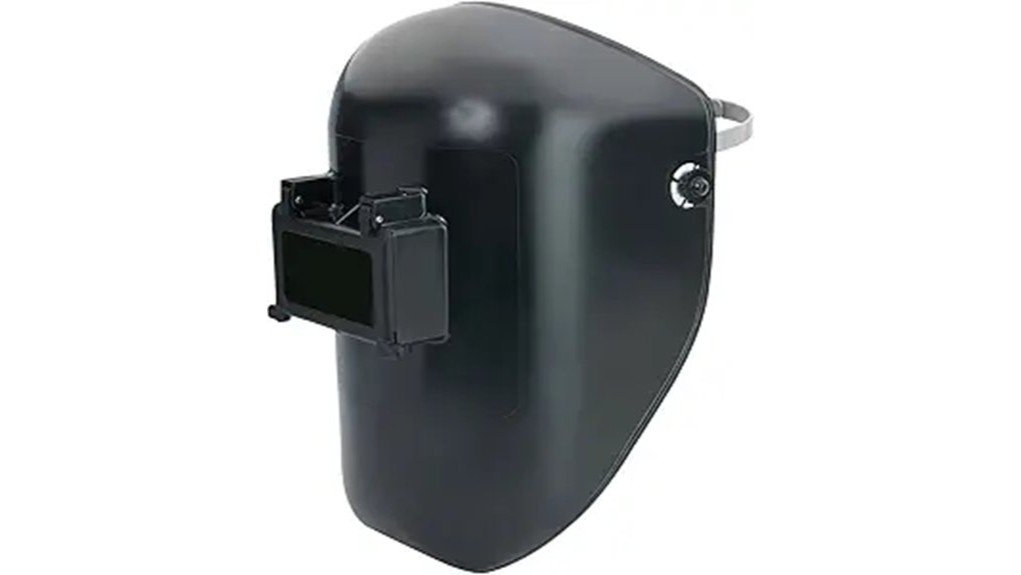
A passive welding helmet still makes sense when you want simple, dependable protection without batteries, sensors, or electronic controls. The Fibre-Metal Tigerhood Classic 5906BK, often sold under Fibre-Metal by Honeywell branding, combines a fixed Shade 10 lens with a heat-resistant thermoplastic shell and lift-front design. Its compact 2 × 4-1/4-inch viewing area suits welders who prefer a traditional hood, especially when working around confined areas or using compatible protective caps. The main tradeoff is important: Shade 10 is fixed, so this helmet is less flexible than a variable-shade auto-darkening model.
Quick Verdict
Rating: 8.5/10, Recommended with caveats
Best For: Welders who want a traditional passive Shade 10 hood, lift-front access, and compatibility with a protective-cap mounting setup.
Bottom Line: The 5906BK offers a durable thermoplastic shell, compact passive lens, and practical lift-front design without batteries or sensors. Its fixed Shade 10 filter is simple and reliable, but it cannot automatically adapt to different welding processes or amperage ranges.
Key Takeaways
- The Fibre-Metal 5906BK is a traditional passive welding helmet with a fixed Shade 10 filter.
- Its viewing area measures 2 × 4-1/4 inches, giving you a compact field of view rather than the wide window found on many modern auto-darkening helmets.
- The lift-front design lets you expose the clear viewing area for inspection and related work without removing the complete helmet.
- The thermoplastic shell is designed for heat resistance and has a smooth surface that helps deflect sparks and spatter.
- The shell design provides extended coverage around the throat area and is made to accommodate protective spectacles and respirators when properly fitted.
- The model is listed as meeting ANSI Z87.1 and CSA Z94.3 requirements.
- Because Shade 10 is fixed, you must confirm that it is appropriate for your welding process, current, electrode size, and workplace requirements.
Key Specifications
| Specification | Detail |
|---|---|
| Brand | Fibre-Metal |
| Product Line | Tigerhood Classic |
| Model | 5906BK |
| Product Type | Passive welding helmet |
| Front Design | Lift front |
| Lens Size | 2 × 4-1/4 inches |
| Lens Shade | Fixed Shade 10 |
| Lens Type | Passive |
| Shell Material | Heat-resistant thermoplastic |
| Color | Black |
| Size | One size |
| Mounting | Speedy Loop protective-cap mounting configuration |
| Standards | ANSI Z87.1 and CSA Z94.3 |
| Power Required | None |
| Best Use | Traditional fixed-shade welding where Shade 10 is appropriate for the task |
What Is the Fibre-Metal 5906BK?
The Fibre-Metal Tigerhood Classic 5906BK is a passive welding helmet built around a traditional 2 × 4-1/4-inch fixed Shade 10 viewing lens. Unlike an auto-darkening helmet, it has no arc sensors, electronic shade controls, or batteries. You get a consistently dark welding filter rather than a lens that switches when an arc starts.
The black thermoplastic shell uses a lift-front configuration. This lets you raise the shaded front section when you need a clearer view for inspection or related non-welding work, while keeping the helmet in position. Its shape also extends lower around the front of your neck and throat compared with a short, open shell.
You may see older retail listings use Fibre-Metal by Honeywell branding, while current Fibre-Metal product information is presented through PIP. The important identifier is model 5906BK, which remains the black Tigerhood Classic version.
Who Should Buy It?
Best For
- Welders who prefer a simple passive Shade 10 lens with no electronics to manage.
- Jobs where a compact 2 × 4-1/4-inch lens and extended shell coverage are useful.
- Users who need a Tigerhood-style helmet compatible with an appropriate protective-cap mounting setup.
Skip If
- You frequently switch between welding processes or amperage ranges that call for different filter shades.
- You want a large panoramic viewing area or automatic darkening.
- You specifically want an electronic grind mode instead of a traditional lift-front arrangement.
Before You Buy: Shade 10 is not automatically correct for every welding task. The proper filter shade depends on the welding process, amperage, electrode size, and applicable workplace requirements. Confirm the required protection for your actual work before relying on any fixed-shade helmet.
Design and Build Quality
The 5906BK uses a heat-resistant thermoplastic shell with a smooth, seamless exterior. That surface is designed to deflect sparks and spatter rather than provide unnecessary edges where hot material can collect. The black color is molded into the shell, which also reduces the chance of visible peeling or chipping from a separate surface paint layer.
The front combines straight and curved sections to extend coverage toward the throat. This shape can be useful when your head position brings the lower edge of a conventional short helmet close to the work area.
The shell is also designed with airflow in mind. That does not turn the helmet into respiratory protection, but the shape can help keep some smoke and welding fumes from moving directly toward your face. You should still use appropriate ventilation and respiratory PPE whenever your work requires it.
Passive Shade 10 Lens and Viewing Area
The defining feature is its fixed Shade 10 passive filter. You do not need batteries, solar cells, sensitivity controls, delay settings, or arc sensors. When the shaded lens is down, it stays at Shade 10.
The viewing area measures 2 × 4-1/4 inches. This is much smaller than the window on many modern auto-darkening helmets, but a compact opening can be useful where you want a narrow helmet profile or work in restricted spaces.
The tradeoff is visibility before and between welds. Because the lens does not electronically lighten, you use the lift-front mechanism or move the hood as appropriate when you need a clear view. If you spend the day making frequent tacks and constantly repositioning, an auto-darkening model may be more convenient.
Hard-Hat Compatibility and Usability
The 5906BK is commonly supplied in a Speedy Loop protective-cap mounting configuration. That makes it particularly relevant for industrial users who need their welding hood integrated with compatible head protection instead of using a standard standalone welding headgear system.
The shell design can also accommodate protective spectacles and respirators, but PPE combinations should never be assumed to fit correctly. Check that your glasses, respirator, protective cap, and helmet can be worn together without breaking seals, blocking vision, or pushing the helmet out of position.
Because this is a passive helmet, operation is mechanically simple. There are no menus to configure and no battery state to check before you start. The main setup tasks are making sure the helmet and mounting system fit correctly, the lens and cover plates are undamaged, and the selected shade is appropriate for the job.
Pro Tip: Before starting work, put on every piece of PPE you plan to use together, including safety glasses, respirator, and protective cap. Check the complete setup for interference instead of testing each item separately.
How It Performs in Real Use
For Repetitive Fixed-Shade Welding
If most of your work is performed with settings where Shade 10 is appropriate, the passive design keeps operation straightforward. There are no sensors to position and no electronic controls to adjust between welds. That simplicity is one of the strongest reasons to choose this style of hood.
For Tight Work Areas
The compact 2 × 4-1/4-inch viewing window keeps the front profile relatively traditional. That can suit fabrication and industrial work where a large, bulky viewing assembly is more difficult to position. You give up some peripheral visibility in exchange for the smaller window.
For Inspection Between Welds
The lift-front design is useful when you need to inspect your work without completely removing the helmet. Raise the shaded front only when it is safe to do so and never expose your eyes to an active welding arc without the correct filter protection.
For Long-Term Ownership
A passive helmet avoids several electronic components found in auto-darkening models. You do not have batteries, sensors, or an electronic shade cartridge to maintain. You still need to inspect the shell, mounting hardware, shaded filter, and clear protective plates and replace damaged components when necessary.
Setup and Usage Tips
- Confirm the required shade first: Do not choose Shade 10 simply because it comes installed. Match your protection to the actual welding process and operating conditions.
- Inspect the viewing system: Replace cracked, deeply scratched, damaged, or contaminated lenses and cover plates before welding.
- Check mounting stability: Make sure the helmet stays in the intended position and does not drop unexpectedly while you work.
- Test all PPE together: Confirm that glasses or a respirator do not interfere with the helmet or protective cap.
- Keep the lift front closed during welding: The clear viewing position is for appropriate non-arc tasks, not for watching an active welding arc.
- Follow workplace PPE rules: Your employer, welding procedure, helmet instructions, and applicable safety standards should guide final setup.
Safety Standards and Certifications
The Fibre-Metal 5906BK is listed as meeting ANSI Z87.1 and CSA Z94.3 requirements. Those standards are an important part of selecting welding eye and face protection, but certification alone does not mean one filter shade works for every welding operation.
A fixed Shade 10 lens can be appropriate for some welding conditions, while other processes and amperage levels require lighter or darker protection. That is the key limitation of a fixed-shade helmet compared with a variable-shade model.
You should also remember that a welding helmet is part of a larger PPE system. Appropriate protective spectacles or goggles may still be required for impact hazards, and welding fumes may require ventilation or respiratory protection. The helmet shell does not replace those controls.
Pros and Cons
Pros
- Fixed Shade 10 passive lens requires no batteries or arc sensors.
- Lift-front design makes between-weld inspection more convenient.
- Heat-resistant thermoplastic shell is designed to deflect sparks and spatter.
- Extended front provides additional throat-area coverage.
- 2 × 4-1/4-inch lens format suits buyers who prefer a compact traditional viewing window.
Cons
- Shade 10 cannot automatically adapt when your required shade changes.
- The 2 × 4-1/4-inch viewing area is small compared with large-window auto-darkening helmets.
- The protective-cap mounting configuration may not suit buyers who want conventional standalone ratcheting headgear.
Is It Worth the Price?
The 5906BK fits the professional passive-helmet category rather than the feature-heavy premium auto-darkening category. Its value comes from its simple fixed-shade design, compact lens, lift front, durable thermoplastic construction, and protective-cap mounting capability rather than electronic features.
It makes the most sense when those traditional features match the way you already work. You are paying for a purpose-built industrial welding hood rather than sensitivity controls, variable shade settings, digital displays, or a large auto-darkening cartridge.
It is less compelling if you regularly change welding processes or want maximum visibility between tacks. In that situation, spending more on a quality variable-shade auto-darkening helmet may provide better day-to-day convenience.
How It Compares to Alternatives
The Jackson Safety HSL-1 is another passive Shade 10 option with a 2 × 4-1/4-inch filter and a narrow thermoplastic shell, but it uses a fixed front and ratcheting headgear. It can make more sense if you want conventional standalone headgear instead of the Tigerhood’s protective-cap-focused setup.
The Jackson Safety Huntsman 430P is a closer comparison if a lift front matters to you. It also uses a 2 × 4-1/4-inch Shade 10 passive filter, but its shell is made from vulcanized fiber and it uses ratcheting suspension. The 5906BK makes more sense when you specifically want the Fibre-Metal Tigerhood shell design and its protective-cap mounting arrangement.
Frequently Asked Questions
Is the Fibre-Metal 5906BK an auto-darkening helmet?
No. The 5906BK uses a passive fixed Shade 10 filter. It has no arc sensors, automatic switching system, or batteries.
What size lens does the 5906BK use?
The helmet uses a 2 × 4-1/4-inch passive viewing lens. This is a compact traditional lens size rather than a large panoramic viewing window.
Is Shade 10 suitable for every type of welding?
No. Required filter shade depends on the welding process, arc current, electrode size, and other working conditions. Confirm the correct shade for your task instead of assuming the installed Shade 10 lens is appropriate for every job.
Can you wear safety glasses or a respirator under it?
The design is intended to accommodate protective spectacles and respirators. You still need to test your exact PPE combination because frame shape, respirator size, protective-cap fit, and adjustment can affect clearance.
Does the lift front give the helmet a grind mode?
It has a mechanical lift-front arrangement, not an electronic grind mode. Raising the shaded front can provide a clearer view for appropriate inspection or related tasks, but you must still use the eye and face protection required for grinding hazards.
What is the warranty on the Fibre-Metal 5906BK?
A specific warranty period for the 5906BK was not confirmed in the current product information reviewed for this article. Check the current seller or manufacturer warranty terms before buying rather than relying on older third-party claims.
Who should skip the 5906BK?
Skip it if you want variable shade control, automatic darkening, a large viewing window, or standard standalone ratcheting headgear. It is designed around a simpler traditional passive-helmet workflow.
The Bottom Line
The Fibre-Metal Tigerhood Classic 5906BK is a strong choice when you want a traditional passive Shade 10 welding helmet with a compact lens, lift-front design, heat-resistant thermoplastic shell, and protective-cap mounting capability. Its biggest limitation is also easy to understand: the fixed Shade 10 lens cannot adapt when your welding conditions call for a different shade, so buyers who frequently change processes may be better served by a quality variable-shade helmet.