Disclosure: As an Amazon Associate, we earn from qualifying purchases. If you click a link on this page and make a purchase, we may receive a small commission at no extra cost to you.
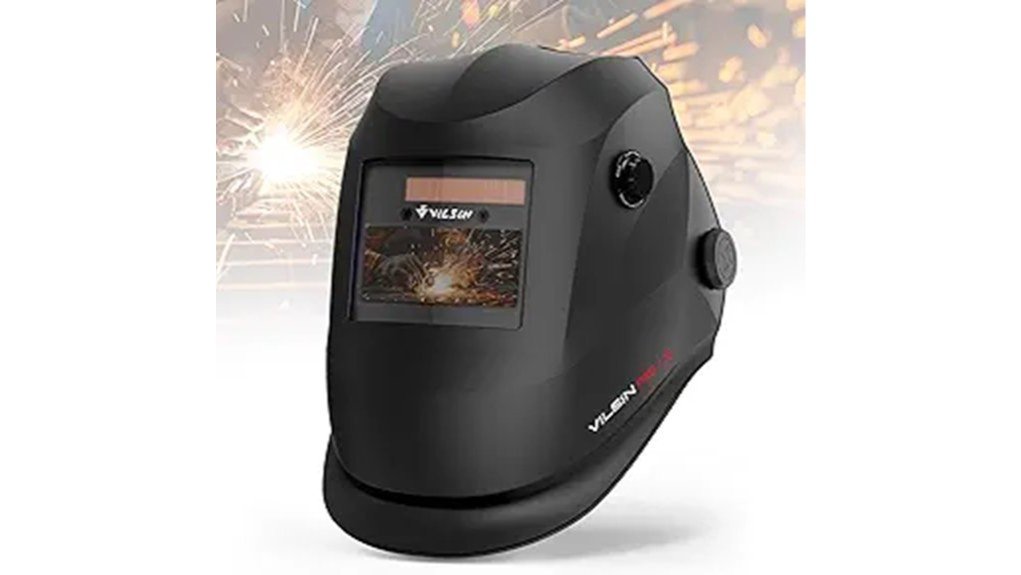
Choosing a welding helmet is not only about finding an inexpensive shell. You also need a lens that reacts reliably, a shade range suited to your work, and headgear that stays comfortable while you position the torch or electrode. The VILSIN Welding Helmet combines a two-sensor auto-darkening filter, a 3.78 x 1.58-inch viewing area, solar-assisted power, and an included replaceable battery. Its practical feature set suits home and hobby welding, but the compact window and limited certification information make it less convincing for demanding professional use.
Quick Verdict
Rating: 7.5/10, recommended with caveats
Best For: Beginners, DIY welders, and light-shop users who want an affordable auto-darkening helmet with replaceable cover lenses.
Bottom Line: The VILSIN helmet provides useful shade adjustment, true-color viewing, a replaceable CR2032 battery, and support for common welding processes. Its smaller viewing window, two-sensor design, and unclear certification details keep it below a professional-grade recommendation.
Key Specifications
| Specification | Detail |
|---|---|
| Brand | VILSIN |
| Amazon identifier | ASIN B0DJGFZ28T |
| Product type | True-color auto-darkening welding helmet |
| Reviewed color | Black |
| Viewing area | 3.78 x 1.58 inches |
| Filter cartridge size | 4.33 x 3.54 inches |
| Optical class | 1/1/1/2, according to the current product listing |
| Arc sensors | Two |
| Claimed switching time | 0.06 milliseconds from light to dark |
| Shade information | The listing title states 3/4-8/9-13. The feature details state DIN 4 light state and DIN 5-9/9-13 dark ranges. Confirm the control markings and manual before use. |
| Power | Solar-assisted operation with one replaceable CR2032 coin-cell battery included |
| Headgear | Padded front band, two top straps, side angle controls, and rear tightness adjustment |
| Included accessories | One helmet, three replacement outside cover lenses, and two replacement inside clear lenses |
| Listed applications | AC and DC TIG, MIG/MAG, MMA/stick welding, plasma cutting, abrasive cutting, and grinding |
| Important limitation | Workplace certification and manufacturer warranty details should be confirmed before purchase. |
What Is the VILSIN Welding Helmet?
The VILSIN Welding Helmet is a solar-assisted auto-darkening hood tied to Amazon ASIN B0DJGFZ28T. It is designed to let you position your torch, wire, or electrode while the filter remains in its lighter state. When the two sensors detect the welding arc, the filter is designed to switch to the selected dark shade.
The helmet is aimed mainly at home garages, welding students, maintenance work, and occasional fabrication. Its main selling points are the adjustable shade controls, true-color filter, included CR2032 battery, replaceable cover lenses, and headgear with several fit adjustments.
This is not a panoramic or four-sensor premium helmet. The 3.78 x 1.58-inch window gives you a focused view of the joint, but you will see less of the surrounding work area than you would through a large-screen professional hood.
Who Should Buy It?
Best For
- Beginners replacing a fixed-shade helmet with basic auto-darkening controls
- DIY welders using MIG, TIG, or stick equipment for repair and fabrication projects
- Light-shop users who value an included battery and several replacement cover lenses
Skip If
- You need a panoramic viewing area or four-sensor detection for difficult welding positions
- Your employer requires documented compliance with a named safety standard
- You prefer an established professional brand with clearly published warranty support
Before You Buy: The Amazon title and feature bullets do not present the shade ranges in exactly the same way. Confirm the markings on the filter and read the supplied manual before choosing a shade or using the helmet for cutting and grinding.
Feature-by-Feature Review
Auto-Darkening Lens and Dual Sensors
The filter uses two arc sensors and carries a claimed 0.06-millisecond light-to-dark switching time. The practical benefit is that you can keep the hood lowered while lining up the weld instead of repeatedly flipping it up and down.
Two sensors are enough for straightforward bench and garage work, but sensor position matters. A pipe, fixture, workpiece edge, or your arm can block the arc from one or both sensors. Keep the sensor windows clean and avoid assuming the filter will react correctly in every unusual position without testing it first.
If the lens becomes slow, inconsistent, or fails to darken, stop welding. Check the battery installation, sensitivity setting, sensor area, and condition of the outer cover lens before using the helmet again.
Viewing Area and Optical Class
The 3.78 x 1.58-inch viewing area gives you a compact horizontal view of the joint. It is wide enough for common garage tasks such as MIG bead placement, stick-welding starts, and TIG torch positioning. The smaller opening can also help keep the helmet compact.
The tradeoff is reduced peripheral awareness. Large-view and panoramic helmets make it easier to see clamps, table edges, nearby tools, and more of a long joint without moving your head. That difference matters more during fabrication, out-of-position work, and long welding sessions.
The listing identifies the filter as optical class 1/1/1/2. The four figures describe optical quality, light diffusion, shade consistency, and angle dependence. Class 1 is the strongest grade in each category, so the final class 2 rating indicates that viewing-angle performance is the weaker part of this filter compared with a 1/1/1/1 lens.
Shade Range and Controls
The product title advertises a broad 3/4-8/9-13 range, while the detailed feature text lists a DIN 4 light state and DIN 5-9 plus DIN 9-13 dark ranges. That inconsistency does not automatically make the helmet unusable, but it means you should rely on the markings on the delivered filter and the user manual rather than a shortened marketplace title.
Choose the shade that matches your welding process, amperage, electrode size, and working conditions. Do not select a lighter shade simply because it makes the puddle easier to see. When you are uncertain, follow the equipment instructions and the shade guidance required by your workplace.
CR2032 Battery and Solar Assistance
The helmet uses one replaceable CR2032 coin-cell battery, and the listing states that the battery is included. Solar cells use light from the welding environment to support operation and extend battery service, but they do not remove the need to monitor the replaceable battery.
A replaceable battery is useful for long-term ownership because you are not dependent on a permanently sealed power source. Keep a fresh CR2032 available, especially when the helmet has been stored for a long period or the filter begins reacting inconsistently.
Headgear Comfort and Fit
The headgear includes a padded front band and two upper straps that spread the helmet’s weight across your head. Side knobs control the helmet angle, while the rear adjustment changes the band tightness.
Set the top straps first so the viewing window sits naturally in front of your eyes. Then adjust the rear band until the helmet feels secure without creating pressure on your forehead. Finally, set the side pivots so the shell stays raised when needed and drops into position without excessive force.
Comfort is personal, and basic headgear may not feel as stable as a professional ratcheting suspension during all-day use. For occasional welding, however, the multiple adjustment points are more useful than a single basic strap.
Included Cover Lenses
The package is listed with three replacement outside cover lenses and two replacement inside clear lenses. These parts protect the auto-darkening filter from sparks, spatter, dust, and handling damage.
The extra lenses reduce the need for an immediate accessory purchase. They are especially useful for stick and flux-core work, where spatter can pit or cloud the outside protector more quickly. Replace a cover lens when scratches, heat damage, or spatter begin to interfere with your view.
Welding, Cutting, and Grinding Support
The current listing names AC TIG, DC TIG, MIG/MAG, MMA or stick welding, plasma cutting, abrasive cutting, and grinding. That broad process list makes the helmet more versatile than a basic fixed-shade hood.
Process compatibility still depends on choosing the correct mode and shade. Do not assume the welding setting is suitable for grinding, and do not use a grinding mode while striking an arc. Confirm how the filter changes between welding, cutting, and grinding before beginning work.
How It Performs in Real Use
For MIG and Flux-Core Welding
The auto-darkening filter lets you keep both hands near the gun and workpiece while positioning the wire. The compact horizontal window should provide a clear view of a short joint, tack location, and travel direction. Included outside cover lenses are helpful because flux-core welding can produce more smoke and spatter than gas-shielded MIG.
For TIG Welding
True-color viewing can make the joint, tungsten position, and surrounding metal easier to distinguish before the arc starts. Low-amperage TIG can be more demanding for any sensor-based helmet, so set the sensitivity correctly and confirm that the filter reacts reliably before continuing.
For Stick Welding
The helmet’s adjustable dark range and quick automatic switching are useful when restarting electrodes or making short repair welds. Keep the two sensor windows clear, because your electrode hand or a workpiece corner can reduce the sensors’ direct view of the arc.
For Cutting and Grinding
The listing supports plasma cutting and abrasive cutting or grinding, but you should confirm the correct mode before use. Grinding normally requires a clear view, while welding requires automatic darkening. A wrong mode selection can leave the lens too dark for grinding or prevent it from darkening when an arc starts.
Setup Tips Before First Use
- Inspect the filter and cover lenses. Do not use the helmet if the shell, filter, sensor windows, or clear protectors are cracked or badly damaged.
- Check the CR2032 battery. Confirm that it is installed in the correct direction and seated firmly in its compartment.
- Adjust the headgear. Set the top straps, rear tightness, and side pivots before putting on welding gloves.
- Select the correct mode and shade. Match the controls to the process and follow the supplied instructions.
- Use the manufacturer’s test procedure. Confirm that the lens switches properly before striking a welding arc.
- Keep both sensors exposed. Reposition yourself if the workpiece, fixture, or your hands block the sensor windows.
- Replace damaged protectors promptly. A cloudy or pitted cover lens can make it harder to see the joint and may expose the filter to spatter.
Pro Tip: Store one of the included outer lenses and a fresh CR2032 battery with your welding supplies. You can restore a clear view and reliable power without stopping a project to find replacement parts.
Safety, Cleaning, and Maintenance
A welding helmet is one part of your protective setup. It does not replace safety glasses, gloves, protective clothing, suitable footwear, hearing protection, or the ventilation controls required for your process and material.
Do not continue welding when the auto-darkening filter fails to switch, flickers, or darkens unpredictably. Check the battery, sensitivity control, sensor windows, cover lenses, and manual. Replace or service the helmet if those steps do not correct the problem.
Clean the shell with a soft cloth and mild soap when needed. Wipe the clear cover lenses carefully to avoid scratches, and do not apply harsh solvents to the auto-darkening filter. Store the helmet where the lens will not be crushed, exposed to heavy moisture, or covered with grinding dust.
The inspected product details did not clearly display a named safety certification or manufacturer warranty. Verify those points before using the helmet in a commercial shop, training program, or job site with formal protective-equipment requirements.
Pros and Cons
Pros
- Two-sensor auto-darkening filter with a claimed 0.06-millisecond switching time
- Replaceable CR2032 battery with solar-assisted operation
- Padded headband, dual top straps, and several fit adjustments
- Three outside and two inside replacement cover lenses included
- Listed for TIG, MIG/MAG, stick welding, plasma cutting, and grinding
Cons
- The 3.78 x 1.58-inch viewing area is smaller than large-view and panoramic alternatives
- The 1/1/1/2 optical class and two-sensor layout trail some 1/1/1/1 four-sensor helmets
- Shade descriptions conflict, and certification and warranty details are not clearly stated
Is It Worth the Price?
The VILSIN Welding Helmet is best treated as a budget-oriented option for occasional welding rather than an all-day production helmet. Its value comes from the auto-darkening filter, replaceable battery, adjustable headgear, and useful set of spare cover lenses.
It makes the most sense when you are moving up from a fixed-shade hood or assembling a home welding setup without paying for a panoramic lens, digital controls, or premium suspension. The included replacement lenses also add practical value because those parts wear out during normal use.
It is not the best fit when a large viewing area, four arc sensors, top-tier optical classification, documented workplace certification, or established warranty support matters more than initial affordability.
How It Compares to Alternatives
YESWELDER and DEKOPRO sell several budget auto-darkening helmets that are worth comparing for lens size, sensor count, and optical class. Some YESWELDER models offer a 1/1/1/1 filter or a larger viewing area, while basic DEKOPRO models often compete with simple controls and entry-level pricing.
Lincoln Electric is the stronger comparison when brand history, replacement-part availability, and clearly documented professional specifications are priorities. The VILSIN helmet makes more sense when you want a straightforward garage helmet with a replaceable battery and several cover lenses included, and you do not need a premium viewing system.
Frequently Asked Questions
Is the VILSIN Welding Helmet suitable for beginners?
Yes. Its auto-darkening operation, adjustable headgear, replaceable battery, and support for common welding processes make it easier to use than a basic fixed-shade hood. Beginners should still read the manual and learn how to select the correct mode, sensitivity, delay, and shade.
What is the viewing area?
The current listing specifies a 3.78 x 1.58-inch viewing area and a 4.33 x 3.54-inch filter cartridge. The window is practical for ordinary garage work but is smaller than the viewing areas on panoramic and large-screen helmets.
What shade range does the helmet use?
The Amazon title states 3/4-8/9-13, while the detailed bullets list a DIN 4 light state and DIN 5-9 plus DIN 9-13 dark settings. Check the markings on the delivered filter and follow the manual because the marketplace descriptions are not fully consistent.
What battery does the VILSIN helmet require?
It uses one replaceable CR2032 coin-cell battery, and the listing states that one is included. Solar cells assist operation and may extend battery service, but you should still keep a replacement battery available.
What accessories come with the helmet?
The package is listed with one welding helmet, three replacement outside cover lenses, and two replacement inside clear lenses. Confirm the package contents when it arrives because seller packaging can change.
Can it be used for TIG, MIG, stick welding, and grinding?
The listing names AC and DC TIG, MIG/MAG, MMA or stick welding, plasma cutting, abrasive cutting, and grinding. Select the correct operating mode and shade before each task, and never strike an arc while the helmet is locked in a clear grinding mode.
What should I do if the filter does not darken?
Stop welding and inspect the helmet. Check the CR2032 battery, sensitivity setting, sensor windows, battery orientation, and outer cover lens. Do not continue using the helmet if the filter remains unstable or fails the test procedure in the manual.
Does the helmet have a warranty or named safety certification?
The inspected product details did not clearly state a manufacturer warranty or a named third-party safety certification. Ask the seller for documentation or inspect the manual before using the helmet where formal workplace compliance is required.
The Bottom Line
The VILSIN Welding Helmet is a reasonable budget choice for beginners, DIY repair work, and occasional MIG, TIG, or stick welding. Its strongest features are the replaceable CR2032 battery, adjustable headgear, quick-switching two-sensor filter, and included cover lenses.
Skip it when you need a panoramic view, four arc sensors, a 1/1/1/1 optical class, or clearly documented professional certification and warranty support. For home-shop use, it is recommended with caveats, provided you verify the delivered shade controls and test the filter before welding.
Ready to Buy?
Check the latest price, seller details, and current product documentation before you decide.