Plasma Arc Welding (PAW) is usually credited to Robert M. Gage, whose work at Union Carbide led to a patented arc torch and process published in 1957. The big change was not simply a hotter arc. Gage’s design used a cooled nozzle to constrict and direct the arc, giving welders and manufacturers a more focused heat source for precise welding, cutting, and surfacing work.
Quick Answer
Robert M. Gage is widely credited with inventing plasma arc welding in the early 1950s. His U.S. patent, US2806124A, “Arc torch and process”, was published and granted on September 10, 1957, with Union Carbide listed as the assignee.
Key Takeaways
- Robert M. Gage is the key inventor associated with plasma arc welding and the 1957 U.S. patent.
- PAW grew from TIG welding, but it uses a nozzle to constrict the arc into a tighter, more focused plasma jet.
- The process became valuable where accuracy, deep penetration, stable arcs, and low distortion mattered.
- PAW is related to plasma cutting and plasma spraying, but those are separate process variants with different goals.
- Modern PAW is strongest in controlled, mechanized, and high-quality production work, not casual repair welding.
The Birth of Plasma Arc Welding
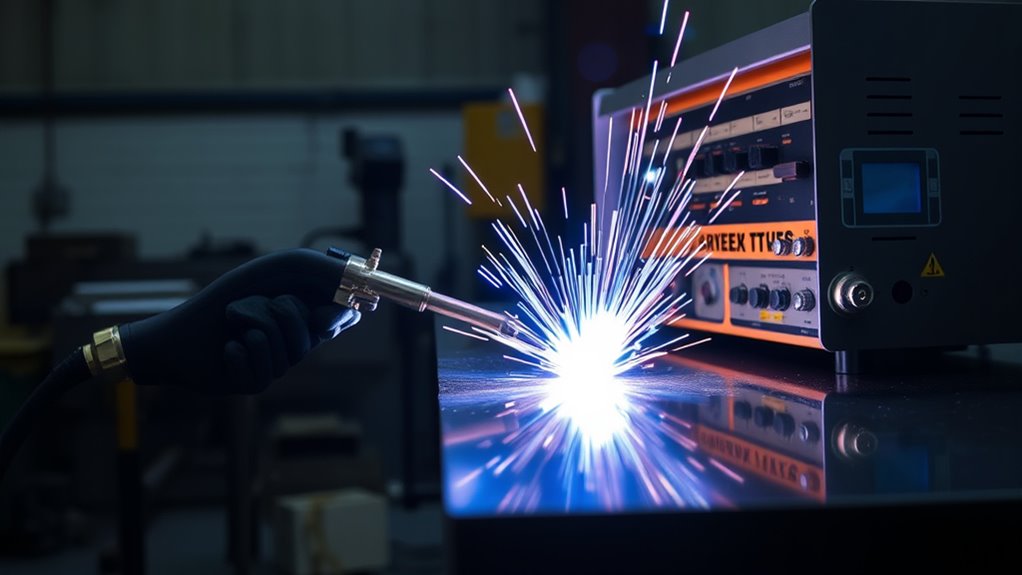
Plasma arc welding developed from the same family of non-consumable tungsten-electrode arc processes as TIG welding. The breakthrough was the way the arc was shaped. In a standard TIG setup, the arc spreads from the tungsten electrode toward the workpiece. In PAW, the electrode sits inside the torch body, and the arc passes through a small, cooled nozzle that narrows and directs the plasma stream.
That constricted arc gives PAW a high energy density. In practical terms, you can focus heat into a smaller area, hold a steadier arc, and control penetration more precisely than with a broad open arc. This made the process useful for thin sheet work, precision seams, keyhole welding, cutting, and surface-treatment processes.
The real invention was controlled arc concentration: a stable, directed plasma stream shaped by a cooled nozzle.
The original patent describes a torch that uses a non-consumable nozzle to stabilize and constrict the arc. It also notes that the gas passing through the nozzle becomes part of the current-carrying arc stream, which helps concentrate and direct heat toward the work.
Key Inventor: Robert M. Gage
Robert M. Gage is the name most closely tied to the invention of plasma arc welding. His patent record lists him as the inventor of US2806124A, with Union Carbide Corporation as the original assignee. The patent was filed in 1955 and published in 1957, which is why the 1957 date appears so often in PAW history.
Many welding histories also connect Gage’s PAW work to the early 1950s. To keep the timeline accurate, it is best to say that Gage is widely credited with developing plasma arc welding in the early 1950s, and that the key U.S. patent was granted in 1957.
What Gage Actually Changed
Gage’s design changed how the arc behaved. The cooled nozzle helped wall-stabilize and constrict the arc, which made the plasma stream more directional. That mattered because a wandering or spreading arc can make penetration, bead width, and edge quality harder to control.
- More focused heat: The nozzle narrowed the arc and concentrated energy into a smaller area.
- Better arc direction: The torch helped the plasma stream follow a controlled path.
- Useful gas control: Gas flow through the nozzle helped shape the arc and move heat toward the workpiece.
- More process options: The same basic idea supported welding, cutting, heating, and surfacing work.
What the 1957 Patent Protected
The 1957 patent did not protect the broad idea of “hot welding.” It focused on an arc torch and process that used a cooled, non-consumable nozzle to stabilize, shape, and constrict the arc and its gas stream. That design helped create a high-energy, current-carrying effluent that could be applied to metalworking tasks.
Note: The patent is now expired, but it remains important because it documents the design idea that separated PAW from ordinary open-arc tungsten welding.
Early Developments in the 1950s
The 1950s were a major period for arc welding development. TIG welding had already proved the value of a non-consumable tungsten electrode and shielding gas. PAW took that idea further by forcing the arc through an orifice and separating the plasma-forming gas from the outer shielding gas.
This gave manufacturers a way to produce narrow, controlled welds with less unwanted heat spread. That was especially helpful for precision metal fabrication, thin parts, and high-value components where rework was expensive.
From TIG to a Constricted Plasma Arc
TIG and PAW look related because both use a tungsten electrode and shielding gas. The difference is the arc shape. TIG uses an open arc. PAW uses a constricted arc. The nozzle acts like a focusing device, tightening the heat source and increasing arc stiffness.
That tighter arc can improve bead control, penetration, and repeatability. It also makes PAW better suited to mechanized welding, where the torch position, current, travel speed, gas flow, and nozzle condition can be controlled closely.
Early Applications and Impact
Early PAW work showed that a constricted plasma arc could do more than join metal. The same design principles supported precision cutting, thermal spraying, surfacing, and coating work. Historical summaries often cite aerospace parts, including turbine-related applications, as early examples of why a focused plasma process mattered.
The larger point is clear: PAW gave industry a heat source that was more concentrated and controllable than many older arc processes. That opened doors in aerospace, instrument work, chemical equipment, and other applications where weld quality and dimensional control mattered.
Patent Milestone in 1957
The major documented milestone was the publication and grant of Gage’s U.S. patent on September 10, 1957. The patent title, “Arc torch and process,” reflects the heart of the invention: a torch design that controlled the arc by using a nozzle and gas stream.
That patent milestone helped define PAW as a separate process family. It also gave manufacturers a clearer technical path for equipment development. Instead of relying only on an open arc, they could build torches that controlled arc shape, direction, gas flow, and heat concentration.
- The patent tied PAW to Robert M. Gage and Union Carbide.
- It documented the cooled nozzle and wall-stabilized arc concept.
- It supported welding, cutting, and other metalworking uses.
- It helped separate PAW from conventional TIG welding.
- It gave later equipment makers a foundation for more refined plasma torches.
Advancements in Aerospace Applications
Aerospace manufacturing values repeatability, clean welds, controlled heat input, and strong joints. Those needs match PAW’s strengths. The process can be used where a narrow heat-affected zone and accurate penetration help protect part geometry.
PAW also fits work where the part material is costly or difficult to repair. A stable, concentrated arc can reduce distortion and improve consistency, especially when the setup is mechanized and controlled by a qualified procedure.
In aerospace and other high-spec fields, PAW is not chosen because it is the easiest process. It is chosen when the weld requirement justifies the extra setup, equipment cost, and process control.
Pro Tip: When comparing PAW to TIG for precision work, look at the full job: joint fit-up, thickness, heat tolerance, distortion limits, production volume, and inspection requirements.
Evolution in Manufacturing Techniques
PAW influenced manufacturing by giving shops another option between conventional TIG and higher-production processes. It is often considered when a part needs cleaner control than many broad-arc methods can offer, but the job still benefits from automation and repeatability.
The process can be run in different modes, depending on current, gas flow, orifice size, travel speed, and material thickness:
- Microplasma: used for very thin materials and delicate parts.
- Melt-in mode: used for controlled fusion without forming a full keyhole.
- Keyhole mode: used for deeper penetration when the plasma jet forms a hole through the joint and the molten metal closes behind it.
These modes helped manufacturers match PAW to different jobs instead of treating it as one fixed process. That flexibility is one reason PAW stayed relevant in precision production.
Plasma Arc Welding in the Modern Era
Modern PAW is most useful when it is part of a controlled production system. That can include mechanized torch travel, fixture control, qualified procedures, gas monitoring, and inspection. The process still depends on the same basic idea Gage documented: constrict the arc, control the gas flow, and apply a focused plasma stream to the work.
| Modern Feature | What It Does | Why It Matters |
| Constricted arc | Focuses heat through a nozzle | Improves penetration control and bead consistency |
| Separate gas flows | Uses plasma gas and shielding gas | Helps protect the weld pool and shape the arc |
| Mechanized setup | Controls travel speed, arc length, and torch angle | Supports repeatable production welds |
| Sensor-assisted welding | Uses cameras or sensors for seam and weld monitoring | Improves quality control in advanced welding cells |
| Arc-based additive research | Builds metal parts layer by layer with arc heat | Shows where controlled arc processes are heading |
PAW is not the most common welding process in small shops because it requires careful setup and more specialized equipment. Still, it remains valuable where weld quality, repeatability, and heat control are more important than the lowest equipment cost.
Products Worth Considering

9-IN-1 WELDER:ARCCAPTAIN MIG205MP MIG welder has 9 welding modes: Gas MIG/Gasless MIG/Cut/DC HF TIG/DC Lift TIG/MMA Stick/Clean/Spot Welding/Spool Gun Aluminum Welding (Need to buy extra spool gun). This multiprocess welder perfectly handles all your needs—from home DIY and garage projects to outdoor repairs, farm equipment, and road maintenance and repairs.

2 IN 1 Multi-functional Design:FEMEROL integrates 60A plasma cutter and 200A MMA stick welder in one unit, supporting plasma cutting and MMA welding dual modes to meet various working needs. It works perfectly for stainless steel, alloy steel, mild steel, copper, aluminum and most common metal materials.

Used Book in Good Condition
Comparisons With Other Welding Technologies
PAW is often compared with TIG because both use a tungsten electrode and shielding gas. The main difference is arc control. TIG gives the welder a broad, flexible arc. PAW gives the process a more focused, nozzle-constricted arc.
- PAW vs TIG: PAW can offer deeper, narrower penetration and better repeatability, but TIG is simpler, cheaper, and more common for manual work.
- PAW vs MIG: MIG is usually faster and easier to automate for general production, while PAW is chosen for tighter control and cleaner precision welds.
- PAW vs stick welding: Stick welding is portable and rugged, but PAW is cleaner and more controlled in a proper shop setup.
- PAW vs plasma cutting: Plasma cutting uses a higher gas flow to sever metal. PAW focuses on joining metal, though both come from related plasma arc technology.
- PAW vs plasma spraying: Plasma spraying deposits coating material onto a surface. PAW joins or melts the base material in a weld joint.
Note: “Plasma” is a broad word. Plasma arc welding, plasma cutting, plasma spraying, and plasma transferred arc surfacing are related, but they are not the same process.
Products Worth Considering

APPLICATION: Apply to YESWELDER CUT-65DS/CUT-55DS PRO/CUT-55NHF/CUT-55NHF PLUS plasma cutters. Replacement for the S45 Plasma Cutting Torch.

AG60 Plasma Cutter Torch Body / Head compatible with standard of AG60 torch for 60A Plasma Cutting Machine. (i.e. CUT50, CUT60, CUT70.)

[Achieve Precise Cuts] PT31 Plasma Cutting Consumables – Your Essential Tool for Efficient Cutting! Whether you're working with sheet metal, steel, or any other material, superior cutting performance ensure clean, accurate, and smooth cuts.
Future Prospects and Innovations
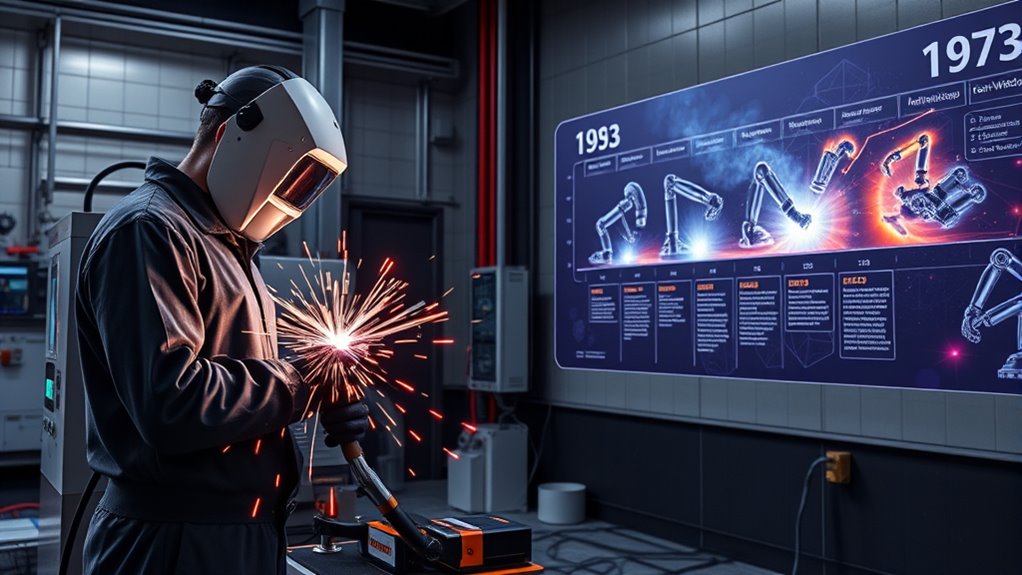
The future of PAW is tied to control. As welding cells become more automated, the value of a stable, focused arc increases. Better sensors, torch controls, gas monitoring, and closed-loop systems can help keep the weld within a narrow quality window.
Research in robotic welding now focuses on visual sensing, seam tracking, weld pool observation, bead geometry, and path planning. These tools can support PAW and other arc processes by helping the system adjust before a small defect becomes a rejected part.
Arc-based additive manufacturing is another area to watch. Not every wire-arc additive process is PAW, but the trend shows why controlled heat sources, repeatable arc behavior, and precise motion control matter in the future of metal fabrication.
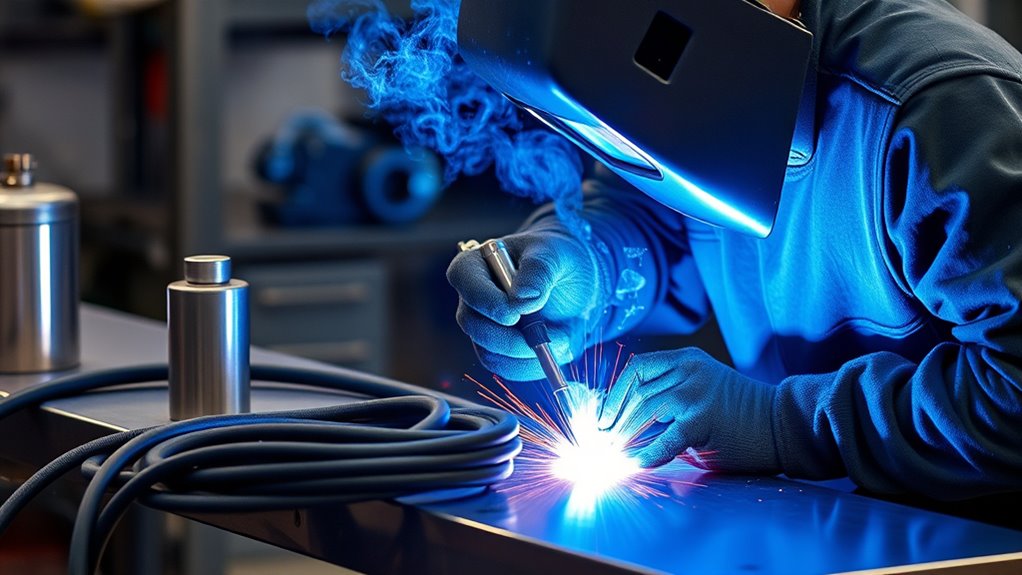
Warning: Plasma arc welding is a high-energy arc process. Use proper eye and face protection, flame-resistant clothing, gloves, ventilation, fume controls, fire prevention, and material hazard review. Do not weld in confined spaces without the required ventilation, permits, and trained supervision.
Frequently Asked Questions
What materials are suitable for plasma arc welding?
PAW can be used on many metals that are also weldable with TIG, including stainless steel, nickel alloys, titanium, copper alloys, and some aluminum applications when the equipment, polarity, gas, and cleaning procedure are correct. The exact procedure depends on thickness, joint design, alloy, and inspection requirements.
How does plasma arc welding differ from TIG welding?
TIG uses an open arc between a tungsten electrode and the workpiece. Plasma arc welding uses a tungsten electrode inside the torch and forces the arc through a small nozzle. That constricted arc is more focused, which can improve penetration control, arc stability, and repeatability.
What safety precautions are needed for plasma arc welding?
Use a welding helmet with the correct shade, safety glasses, gloves, flame-resistant clothing, hearing protection when needed, and proper ventilation or local exhaust. Review the base metal, filler, coatings, and shielding gases before welding. Follow OSHA hot-work, fume-control, and confined-space rules when they apply.
What is the cost comparison with other welding methods?
PAW equipment is usually more expensive and more complex than basic TIG, MIG, or stick welding equipment. It can still save money in production when the job demands fewer defects, less distortion, deeper controlled penetration, or repeatable automated welding.
How does plasma arc welding impact welding speed?
PAW can improve speed on suitable joints because its focused arc can create deeper, narrower penetration with less heat spread. Speed gains depend on material, thickness, mode, fit-up, gas settings, current, and whether the process is manual, mechanized, or automated.
Is plasma arc welding the same as plasma cutting?
No. Plasma arc welding is mainly used to join metal. Plasma cutting uses a high-velocity plasma jet to melt and remove metal so the part is severed. They share plasma arc principles, but the torch setup, gas flow, and goal are different.
Why is Robert M. Gage important in welding history?
Gage is important because his patented torch design helped turn the plasma arc into a controlled metalworking tool. By constricting and stabilizing the arc through a nozzle, his process gave manufacturers a more precise heat source for demanding welding, cutting, and surfacing applications.
Conclusion
Robert M. Gage’s contribution to welding history was the controlled plasma arc. His 1957 patent documented a torch and process that used a cooled nozzle to stabilize and constrict the arc, creating a more focused heat source than ordinary open-arc welding. That idea helped PAW become useful in precision welding, cutting, surfacing, aerospace work, and advanced manufacturing.
PAW is not the simplest or cheapest welding method, but it remains important where control matters. If you understand the inventor, the patent, and the nozzle-constricted arc, you understand why plasma arc welding earned its place among the major welding process developments of the 20th century.
Sources
- Google Patents: US2806124A, “Arc torch and process” — backs Robert M. Gage, Union Carbide, the 1957 patent date, and the cooled nozzle / wall-stabilized arc concept.
- OSHA: Welding, Cutting, and Brazing — backs welding safety standards and hot-work safety context.
- OSHA Fact Sheet: Controlling Hazardous Fume and Gases during Welding — backs welding fume, gas, ventilation, and exposure-control guidance.
- CDC/NIOSH: Welding Fumes and Manganese — backs welding fume health effects and manganese exposure concerns.
- The Active Visual Sensing Methods for Robotic Welding: Review, Tutorial and Prospect — backs modern robotic welding sensing and monitoring trends.
- Robotic Wire Arc Additive Manufacturing with Variable Height Layers — backs current closed-loop robotic arc-based additive manufacturing research.