Potassium chloride, usually written as KCl, is commonly used on the reference side of a pH electrode. It does not sense pH itself. Instead, it helps the reference system maintain a steady electrical potential so the meter can accurately interpret the signal produced by the pH-sensitive membrane.
Quick Answer
KCl is used in many pH electrodes because it works well with silver/silver-chloride reference elements, conducts current efficiently, and helps keep voltage errors at the liquid junction small. Three-molar KCl is common, but the correct filling and storage solutions depend on the electrode model and sample.
Key Takeaways
- The glass or sensing membrane responds to the sample, while the KCl-based reference system provides a stable comparison voltage.
- Approximately 3 M KCl is common, but storage solution, refill solution, and double-junction bridge solution are not always interchangeable.
- Rinse an electrode with distilled or deionized water, but never store it long-term in pure water.
- In a welding shop, pH testing is useful only when an aqueous cleaner, treatment bath, rinse, or coolant specification requires it.
- A pH result does not by itself verify cleaner concentration, passivation quality, coolant condition, or weld quality.

Image by YSI
How a pH Electrode Produces a Reading
A typical combination pH electrode contains two measurement systems in one body:
- A pH-sensitive membrane: Usually a thin glass membrane that develops a voltage related to hydrogen-ion activity in the sample.
- A reference system: A reference element, electrolyte, and porous junction that provide a stable comparison potential.
The meter measures the voltage difference between these systems and converts it into a pH value. For ordinary aqueous work, readers usually see the familiar scale from 0 to 14, with 7 near neutral, lower values acidic, and higher values alkaline.
Many laboratory and portable probes use a silver/silver-chloride, or Ag/AgCl, reference element surrounded by a chloride-containing electrolyte. KCl is a common choice because it supports that reference chemistry and creates reliable electrical contact with the sample.
KCl does not measure the sample’s pH. It helps the electrode create the stable reference voltage needed to measure pH accurately.
Why KCl Is Commonly Used in pH Electrodes
It Supports the Ag/AgCl Reference Element
The potential of an Ag/AgCl reference depends partly on chloride activity around the reference element. A concentrated KCl electrolyte supplies a consistent chloride environment, helping the reference remain stable during measurement.
It Helps Limit Liquid-Junction Error
The reference electrolyte contacts the sample through a porous junction. Whenever two solutions with different ion concentrations meet, unequal ion movement can create an unwanted voltage called a liquid-junction potential.
Potassium and chloride ions move through water at similar rates. Because neither ion gets far ahead of the other, KCl generally produces a smaller and more predictable junction potential than many alternative salts. This is one of the main reasons it is widely used in reference electrodes.
It Provides Good Electrical Conductivity
The reference electrolyte must carry electrical charge between the internal reference element and the sample. Concentrated KCl provides strong ionic conductivity without introducing a complicated mixture of ions.
It Is Widely Supported
Electrode manufacturers commonly design Ag/AgCl probes around KCl-based electrolytes. Replacement filling solutions, storage solutions, cleaning procedures, and compatible junction designs are therefore widely available.
Note: “KCl solution” can mean a reference filling solution, a storage solution, or a bridge electrolyte. These products may have different concentrations or additives. Use the exact solution specified in the electrode manual.
Reference Fill Solution vs. Storage Solution
Reference fill solution and electrode storage solution serve related but different purposes.
| Solution | Purpose | Important rule |
|---|---|---|
| Reference filling solution | Surrounds the internal reference element and flows slowly through the junction in a refillable electrode | Use only the concentration and composition listed for that electrode |
| Electrode storage solution | Keeps the sensing membrane hydrated and the reference junction conditioned while the probe is not in use | Use the manufacturer-specified storage solution; approximately 3 M KCl is common but not universal |
| Outer bridge electrolyte | Fills the outer chamber of a double-junction electrode | Select it for compatibility with the sample and analytical method |
| Calibration buffer | Provides a known pH value for calibration | Do not use calibration buffer as a routine substitute unless the electrode manual allows temporary storage in it |
Sealed and Refillable Electrodes
A sealed or gel-filled electrode contains an internal electrolyte that the user cannot replace. Do not drill, open, or attempt to refill it. When its reference system is exhausted or the probe can no longer pass calibration after proper cleaning and conditioning, replace the electrode.
A refillable electrode has a fill port. Before measurement, the fill port may need to be opened so electrolyte can flow correctly through the junction. Keep the internal liquid above the sample level and top it up only with the specified filling solution. Close the fill port for storage if the manual directs you to do so.
When a Different Reference Electrolyte May Be Better
KCl is the practical default for many measurements, but it is not suitable for every sample.
- Chloride-sensitive samples: KCl slowly leaks through the junction. Even a small chloride addition may interfere with some analyses.
- Samples containing silver-reactive ions: Certain sample components can form precipitates with silver or chloride and clog a conventional junction.
- Special nonaqueous samples: Aqueous KCl may be chemically incompatible with the solvent or measurement method.
- Very dirty or viscous samples: A standard ceramic junction may clog. An open, sleeve, ground-joint, or other easy-clean junction may work better.
- Low-conductivity water: A probe designed for low-ionic-strength samples may stabilize faster and produce less drift.
A double-junction electrode places an extra electrolyte chamber between the Ag/AgCl reference and the sample. One common option is a chloride-free potassium nitrate bridge solution, but KNO3 is not a universal substitute. Confirm the outer electrolyte and junction material with the probe manufacturer and the analytical method.
How pH Testing Applies to Welding Work
A pH electrode is not used to set amperage, voltage, wire speed, travel speed, gas flow, or electrode size. It also cannot directly predict penetration, fusion, tensile strength, porosity, or slag removal.
Its useful role is narrower: measuring specified aqueous process solutions that may affect surface preparation, corrosion control, rinsing, or equipment maintenance.
Aqueous Cleaners and Degreasers
Some water-based cleaners have a specified working pH. Measuring pH can help identify a major chemistry change, accidental contamination, incorrect dilution, or bath exhaustion. Follow the cleaner manufacturer’s limits rather than assuming that neutral pH is always best.
Remember that pH does not directly equal cleaner concentration. Buffered formulations can retain a similar pH even after their cleaning ability has changed. Conductivity, titration, refractometry, contamination testing, or solution replacement may also be required.
Stainless-Steel Cleaning, Pickling, and Passivation
For stainless steel, the applicable drawing, customer requirement, written procedure, and current standard should control the treatment. ASTM A380/A380M-25 addresses cleaning, descaling, pickling, and passivation practices. ASTM A967/A967M-25 covers chemical passivation treatments and verification tests.
A pH measurement can support bath or rinse-water monitoring when the written procedure calls for it. It does not replace required treatment concentrations, exposure times, temperatures, rinsing instructions, visual inspections, free-iron tests, or other acceptance criteria.
Water-Cooled Welding Equipment
Use only coolant approved by the cooler or torch manufacturer. Some maintenance programs monitor pH, conductivity, freeze protection, contamination, or inhibitor condition, while others call for scheduled replacement of a premixed coolant.
Do not create a universal coolant pH target. Different coolants use different inhibitor packages, and adding tap water, automotive antifreeze, salt, or an unapproved chemical can damage the pump, hoses, torch, or electrical insulation.
Flux and Consumables
There is no universal pH target for welding fluxes or consumables. Many fluxes are dry materials for which direct pH measurement is not a routine shop control. Storage temperature, moisture exposure, rebaking rules, classification, lot control, and the consumable manufacturer’s datasheet are usually more relevant.
If a manufacturer specifies a water-based flux slurry or related process solution, use its stated sampling and test method. Do not invent a pH range or adjust the product without written authorization.
Warning: Some stainless-steel pickling products contain hydrofluoric acid, nitric acid, or other highly corrosive chemicals. HF can cause deep burns and life-threatening systemic effects, sometimes before severe pain appears. Do not handle these products as ordinary shop cleaners. Follow the SDS, use trained procedures and specified chemical PPE, provide suitable ventilation and emergency supplies, and obtain immediate medical help after any suspected exposure.
How to Calibrate and Use a pH Electrode
At a Glance
| Time Required | About 10–20 minutes for preparation, calibration, measurement, rinsing, and storage |
| Difficulty | Easy, provided the electrode and buffers match the sample range |
| Tools Needed | pH meter, compatible electrode, fresh calibration buffers, clean beakers, DI or distilled rinse water, storage solution, and an optional temperature probe |
| Cost | Low for buffers and care solutions if a suitable meter is already available; equipment cost varies by accuracy, durability, and probe design |
1. Check the Electrode and Meter
Inspect the glass bulb or sensing surface for cracks, scratches, dried deposits, or trapped air. Confirm that the connector is clean and dry. For a refillable electrode, verify that the fill level and fill solution meet the manual’s requirements.
Do not use a cracked glass electrode. A damaged probe can give false readings and expose the sample or user to internal electrolyte and broken glass.
2. Choose the Correct Buffers
Use fresh, traceable buffers that bracket the expected sample pH. A two-point calibration using pH 7 and either pH 4 or pH 10 is suitable for many jobs. Use three points when the measurement range is broad or the procedure requires greater confidence.
- Pour small amounts into clean calibration beakers.
- Never return used buffer to the original bottle.
- Keep buffer bottles closed when not in use.
- Replace contaminated, expired, or visibly changed buffer.
- Use the buffer value specified for its actual temperature.
3. Rinse and Blot
Rinse the electrode with distilled or deionized water over a waste container. Gently blot excess droplets with a lint-free tissue. Do not rub the glass bulb, because rubbing can create static charge and damage the hydrated surface.
4. Calibrate the Meter
Start with the neutral or near-neutral buffer, usually pH 7, unless the meter manual specifies another order. Immerse the sensing membrane and junction, stir gently or use the recommended stir rate, and wait for a stable result.
Accept the calibration point, rinse and blot the probe, and repeat with the second or third buffer. Reject the calibration if the meter reports an unacceptable slope, offset, or stability error. Troubleshoot instead of forcing the meter to accept a bad calibration.
5. Prepare and Measure the Sample
Mix the sample as required by its written procedure and place enough in a clean container to cover both the sensing area and reference junction. Avoid measuring directly in the main chemical container unless the procedure specifically allows it.
Immerse the electrode, stir gently, and keep the tip away from the bottom and sides. Wait for the reading to stabilize, then record:
- The pH result
- The sample temperature
- The solution or bath identification
- The date and time
- The meter or probe identification when traceability matters
- Any unusual appearance, contamination, or slow response
Note: Automatic temperature compensation adjusts the electrode’s temperature-dependent response and helps the meter use the correct buffer value. It does not normally convert the sample to the pH it would have at 25°C. Record the actual measurement temperature.
6. Rinse Between Samples
Rinse with distilled or DI water between samples to reduce carryover. For sticky, oily, protein-containing, or heavily contaminated samples, use a cleaning solution approved for that electrode before moving to another sample.
7. Store the Electrode Correctly
After the final rinse, place the sensing membrane and junction in the manufacturer-specified storage solution. Approximately 3 M KCl is common, but some electrodes require another formulation.
Do not store the probe dry or long-term in distilled, deionized, reverse-osmosis, or tap water. Pure water can leach ions from the reference system and shorten electrode life.
Pro Tip: Keep calibration buffer, rinse water, cleaning solution, filling solution, and storage solution in clearly labeled bottles. Similar-looking liquids are not interchangeable.
Troubleshooting Unstable or Incorrect Readings
| Symptom | Likely causes | What to do |
|---|---|---|
| Slow response | Dry glass membrane, coated sensing surface, clogged junction, cold sample, or unsuitable probe design | Clean as directed, soak in specified storage solution, allow temperatures to stabilize, and use a probe suited to the sample |
| Reading drifts continuously | Clogged junction, low fill level, contaminated sample, electrical noise, air bubble, or low-conductivity solution | Inspect the junction and electrolyte, remove bubbles according to the manual, isolate the meter from welding equipment, and verify with fresh buffer |
| Calibration fails | Old or contaminated buffer, incorrect buffer setting, dirty electrode, wrong temperature value, exhausted reference, or damaged glass | Use fresh buffers, clean and recondition the probe, verify meter settings, and replace the probe if it still fails |
| Results differ between samples and buffers | Carryover, inadequate rinsing, temperature difference, insufficient mixing, or sample changing while exposed to air | Use separate clean beakers, rinse carefully, measure promptly, and follow a consistent sampling procedure |
| White crystals around the cap | KCl from storage or filling solution has dried on the outside | Rinse the deposits away with water; external salt crystals are usually normal |
| Probe works briefly after soaking, then fails again | Severely aged glass, depleted gel electrolyte, damaged junction, or internal reference failure | Stop repeated temporary fixes and replace the electrode |
Products Worth Considering

For conditioning and extending the life of your probes

1 M KCl solution with preservative ingredients

Country Of Origin: Korea, Republic Of (South)
Cleaning and Reconditioning a pH Electrode
Use a cleaning method matched to the contamination. A general-purpose electrode cleaner may remove ordinary residue, while oils, proteins, mineral scale, or metal deposits can require a different manufacturer-approved solution.
- Rinse loose contamination from the sensing area.
- Soak the sensing membrane and junction in the recommended cleaning solution for the stated time.
- Rinse thoroughly with distilled or DI water.
- Soak the membrane and junction in the specified storage solution for at least the time stated in the manual.
- Calibrate with fresh buffers.
- Replace the electrode if it cannot meet the meter’s calibration checks.
Never scrape the glass bulb or force a wire, drill bit, or sharp tool into the junction. Do not use strong solvents, abrasive pads, or acids unless the electrode manufacturer specifically approves them.
Products Worth Considering

【Small package, easy to store】 YINMIK electrode cleaning solution, each bottle is 50ml, no need to worry about the remaining contamination after opening. Open one of the bottles, the rest are all brand new.

Factory blended to precise standards in a dedicated, temperature controlled environment
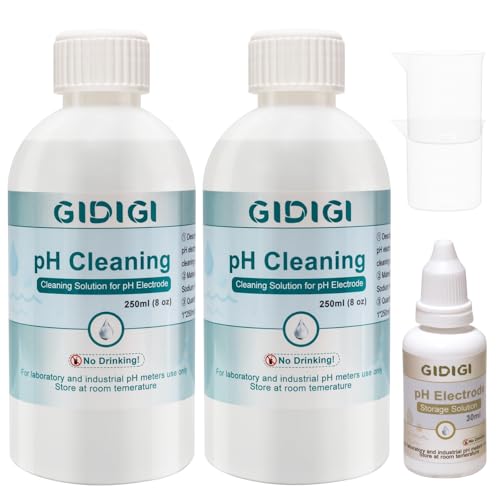
pH Cleaning Solution: Clean the liquid connector of the electrode once after each use to prevent blockage and maintain your pH meter accuracy.Suitable for GIDIGI pH meter and other any pH meter.
Are KCl Crystals a Problem?
Salt deposits around a storage cap or on the outside of a probe are common when a small amount of KCl solution evaporates. Rinse the deposits away before use.
Crystals visible inside some saturated or gel-filled electrodes can be intentional and may help maintain electrolyte concentration. Do not assume that internal crystals mean the probe is defective. Consult the model’s manual before heating, opening, or attempting to dissolve anything inside it.
Safety Considerations
- Wear eye protection when handling glass electrodes and chemical solutions.
- Select gloves and protective clothing from the chemical’s SDS, not from pH alone.
- Keep meters, cables, and sample containers away from active arcs, hot metal, sparks, and spatter.
- Perform chemical sampling in the designated area rather than beside an operating welding station.
- Never mix cleaners, neutralizers, pickling products, or coolants unless an approved procedure requires it.
- Label all solutions and keep them out of food or drink containers.
- Dispose of used buffers, cleaners, and treatment solutions according to the SDS and local requirements.
- Treat a broken electrode as both a glass hazard and a chemical spill.
A pH reading is not a safety clearance. A solution near pH 7 may still contain toxic metals, solvents, fluorides, or other hazardous substances. Continue to follow the SDS and written process controls even after neutralization or rinsing.
Conclusion
KCl is widely used in pH electrodes because it supports stable Ag/AgCl reference chemistry, provides good conductivity, and helps keep liquid-junction errors small. That stable reference allows the meter to interpret the sensing membrane’s voltage more reliably.
For dependable results, use the exact filling and storage solutions specified for your probe, calibrate with fresh buffers, record temperature, rinse between samples, and replace an electrode that cannot pass calibration after proper cleaning and conditioning.
In welding work, use pH measurement only where the cleaner, chemical-treatment procedure, rinse specification, or equipment manufacturer calls for it. It is a useful process-control tool, but it is not a substitute for correct welding parameters, consumable control, chemical concentration testing, or required passivation verification.
Frequently Asked Questions
Why does my pH electrode give inconsistent readings?
Common causes include a dry or dirty sensing membrane, a clogged junction, contaminated buffers, inadequate rinsing, temperature differences, low reference fill level, trapped air, or an electrode that is unsuitable for the sample. Clean and condition the probe, calibrate with fresh buffers, and replace it if it still cannot pass calibration.
Can I use something other than KCl in my pH electrode?
Only use a different electrolyte when the electrode manufacturer and measurement method allow it. A double-junction probe may use KNO₃ or another compatible outer bridge solution for chloride-sensitive samples, while the inner Ag/AgCl reference may still use KCl. Never improvise a fill solution.
How often should I calibrate my pH electrode?
Follow the meter manual and your written procedure. Calibrate before critical measurements, after cleaning or reconditioning, when temperature or sample conditions change significantly, and whenever verification with a known buffer fails. Daily calibration or verification is common in controlled work.
What pH should my welding flux solution be?
There is no universal pH range for welding flux. Many welding fluxes are dry and are not controlled by direct pH measurement. For a manufacturer-specified water-based slurry or process solution, use the product datasheet and its stated sampling method, limits, and adjustment procedure.
How do I store my pH electrode safely?
Rinse the electrode, then immerse the sensing membrane and junction in the manufacturer-specified storage solution. Approximately 3 M KCl is common. Do not store the probe dry or long-term in distilled, deionized, reverse-osmosis, or tap water. Protect the glass from impact and heat.
Are white KCl crystals around the electrode cap normal?
Yes. External crystals often form when a small amount of KCl solution evaporates. Rinse them away with water before using the probe. Do not scrape the glass membrane or insert a sharp object into the junction.
Sources
- Mettler Toledo pH Theory Guide — pH-electrode construction, reference systems, electrolytes, junctions, and measurement theory
- Hanna Instruments electrode-storage guidance — why pH electrodes should not be stored in distilled or deionized water
- Metrohm pH glass and gel electrode fact sheet — KCl references, double-junction construction, and bridge-electrolyte selection
- Thermo Fisher Scientific pH Measurement Handbook — calibration, electrode selection, storage, and temperature compensation
- ASTM A380/A380M-25 and ASTM A967/A967M-25 — current stainless-steel cleaning, pickling, passivation, and verification standards
- CDC hydrogen fluoride safety guidance — health hazards and emergency actions following HF exposure