As an Amazon Associate I earn from qualifying purchases. Buying through these links costs you nothing extra.
You need welding rods for farm repairs that match the metal, thickness, machine, and risk level of the repair. For most farm shops using a stick welder, the most useful core choices are E7018 for properly prepared carbon-steel work, E6013 for clean light-duty repairs, and a compatible stainless stick electrode for occasional stainless jobs.
This guide covers stick-welding electrodes that fit common farm maintenance. TIG filler rods and aluminum brazing products are left out because they use a different process than a standard stick welder.
Quick Verdict
Choose the YESWELDER E7018 3/32-inch for the best balance of control and low-hydrogen performance on clean carbon steel. Pick the YESWELDER E6013 3/32-inch for easier light-duty repairs. Move to the YESWELDER E7018 1/8-inch only when the steel and your welder can support the larger electrode. Use the YESWELDER E308L-16 only after confirming the stainless grade.
Safety note for farm equipment
Do not treat a rod recommendation as a repair procedure. Hitches, loader arms, rollover-protection structures, lifting points, pressure vessels, hydraulic parts, axles, and other load-bearing components can fail dangerously. Follow the equipment manufacturer’s repair instructions and use a qualified welder where failure could injure someone or damage equipment.
Top Picks
|
Category |
Product |
Best For |
Amazon |
|---|---|---|---|
|
Best Overall for Carbon Steel |
Controlled carbon-steel repairs and medium-thickness work |
||
|
Best for Light General Repairs |
Clean, light-gauge mild steel, brackets, fence parts, and noncritical repairs |
||
|
Best for Thicker Carbon Steel |
Thicker clean carbon steel when the welder has enough output |
||
|
Best Beginner-Friendly Alternative |
Routine, noncritical mild-steel repairs and practice |
||
|
Best Stainless Stick Electrode |
Compatible 304/304L-type stainless repairs with a stick welder |
||
|
Best Two-Size Pack |
Shops that want two E7018 diameters in one purchase |
How These Welding Rods Were Picked
This is an editorial comparison based on listing details, not hands-on testing. The rods are compared on electrode classification, process, diameter, package size, intended base metal, equipment requirements, storage demands and usefulness for routine farm maintenance. Products that need TIG equipment, or that are aluminum brazing consumables, are left out so the list matches stick-welder buyers.
Each rod is listed with its limitations, and no single electrode is presented as suitable for a safety-critical repair.
Before You Buy
- Identify the base metal: mild or carbon steel, stainless steel, cast iron, and aluminum need different consumables and procedures.
- Check your welder: confirm AC or DC capability, polarity, open-circuit voltage, and enough amperage for the rod diameter.
- Match diameter to thickness: a larger rod usually needs more current and deposits more metal, but it is not automatically stronger or deeper penetrating.
- Clean the joint: remove paint, oil, rust, scale, and contamination unless the approved procedure says otherwise.
- Control moisture: low-hydrogen electrodes need stricter storage than general-purpose rods. Follow the manufacturer’s printed storage and reconditioning instructions.
- Know the consequence of failure: use a qualified repair procedure for towing, lifting, pressure, rollover protection, and other safety-critical parts.

Best Overall for Carbon Steel
YESWELDER E7018 3/32″
Low-hydrogen E7018 carbon steel stick electrodes, 3/32-inch diameter, 5-pound pack.
The 3/32-inch YESWELDER E7018 is the most balanced choice here when you need a low-hydrogen electrode for clean carbon steel and your machine can run the recommended current and polarity. Its smaller diameter is easier to control than a 1/8-inch rod on moderate-thickness repairs, while the E7018 classification makes it a better fit than E6013 for welds where toughness and crack control matter.
It is not a universal field rod. E7018 performs best on properly prepared steel, and low-hydrogen performance depends on keeping the electrodes dry after opening. For load-bearing tractor, trailer, loader, hitch, rollover-protection, or lifting-component repairs, use the equipment maker’s repair procedure and a qualified welder rather than relying on electrode choice alone.
Who should buy this
Controlled carbon-steel repairs and medium-thickness work.
Who should avoid this
Thin sheet, dirty steel, or jobs without proper low-hydrogen storage.
Ease of Use
|
Feature |
Ease Level |
|---|---|
|
Arc starting |
Moderate |
|
Puddle control |
Moderate |
|
Slag removal |
Usually straightforward |
|
Storage demands |
High |
Key Benefits
- Low-hydrogen E7018 classification for clean carbon steel
- 3/32-inch diameter offers better control than a larger rod on moderate sections
- Works with compatible AC or DCEP equipment as directed by the listing and package
- Good choice when proper joint preparation and dry storage are available

Best for Light General Repairs
YESWELDER E6013 3/32″
E6013 carbon steel stick electrodes, 3/32-inch diameter, 5-pound pack.
Choose the YESWELDER E6013 when ease of use and a smooth, manageable arc matter more than deep fusion. E6013 is a general-purpose mild-steel electrode that can run on compatible AC or DC machines, and its shallow-to-moderate penetration makes it useful for clean light-gauge steel, small brackets, fence components, and practice work.
The tradeoff is important: E6013 is not the first choice for critical structural joints, thick sections, or steel covered with rust, paint, oil, or mill scale. Clean the joint to bright metal, verify fit-up, and follow the package amperage range. For repairs that carry people, loads, or towing forces, use an approved repair method instead of treating this as an all-purpose farm rod.
Who should buy this
Clean, light-gauge mild steel, brackets, fence parts, and noncritical repairs.
Who should avoid this
Critical structural repairs or heavily rusted, painted, or contaminated steel.
Ease of Use
|
Feature |
Ease Level |
|---|---|
|
Arc starting |
Easy |
|
Puddle control |
Easy |
|
Slag removal |
Easy |
|
Tolerance of dirty steel |
Low |
Key Benefits
- Forgiving general-purpose arc for clean mild steel
- Useful on light-gauge material and short repair welds
- Compatible with many AC and DC stick welders
- Good learning option when the joint is noncritical and well prepared

Best for Thicker Carbon Steel
YESWELDER E7018 1/8″
Low-hydrogen E7018 carbon steel stick electrodes, 1/8-inch diameter, 5-pound pack.
The 1/8-inch YESWELDER E7018 is the better size when you are working on thicker clean carbon steel and need a higher deposition rate than a 3/32-inch rod can provide. It is a practical shop choice for prepared plate, brackets, frames, and fabricated parts when the joint design, machine output, and procedure support this electrode size.
Do not describe the larger diameter as automatically creating a deeper or stronger weld. Joint design, amperage, travel speed, technique, base-metal condition, and procedure control the result. The 1/8-inch size also demands more current and is easier to overheat on thin material. Keep it for appropriate sections and store it as a low-hydrogen electrode.
Who should buy this
Thicker clean carbon steel when the welder has enough output.
Who should avoid this
Thin sheet, low-output machines, or casual storage after opening.
Ease of Use
|
Feature |
Ease Level |
|---|---|
|
Arc starting |
Moderate |
|
Heat control |
Moderate |
|
Slag removal |
Usually straightforward |
|
Machine-output demand |
Higher |
Key Benefits
- 1/8-inch size supports higher deposition on thicker steel
- Low-hydrogen E7018 classification
- Useful for prepared shop repairs and fabrication
- Available for compatible AC or DCEP operation as directed by the product instructions

Best Beginner-Friendly Alternative
YesRight J422 3/32″
J422 carbon steel stick electrodes, 3/32-inch diameter, 4.5-pound pack.
The YesRight J422 is a workable beginner-friendly option for noncritical mild-steel repairs when you want a 3/32-inch electrode with a manageable arc. J422 is a classification commonly seen in Chinese-market electrodes, so buyers should not assume an exact AWS classification or procedure qualification unless the package and manufacturer documentation state it.
Use it for practice, small brackets, fence hardware, and routine clean-steel maintenance. Pressure piping, tanks, hydraulic parts, and other code-controlled components require the correct approved consumable, procedure, inspection, and welder qualification.
Who should buy this
Routine, noncritical mild-steel repairs and practice.
Who should avoid this
Code work, pressure piping, or jobs that require a confirmed AWS classification.
Ease of Use
|
Feature |
Ease Level |
|---|---|
|
Arc starting |
Easy |
|
Handling |
Easy |
|
Slag removal |
Easy |
|
Classification certainty |
Check package |
Key Benefits
- 3/32-inch size is manageable for practice and small repairs
- Suitable for routine noncritical mild-steel work when package directions are followed
- Useful alternative for compact stick welders
- Clear limitation: not presented as a code or pressure-service electrode
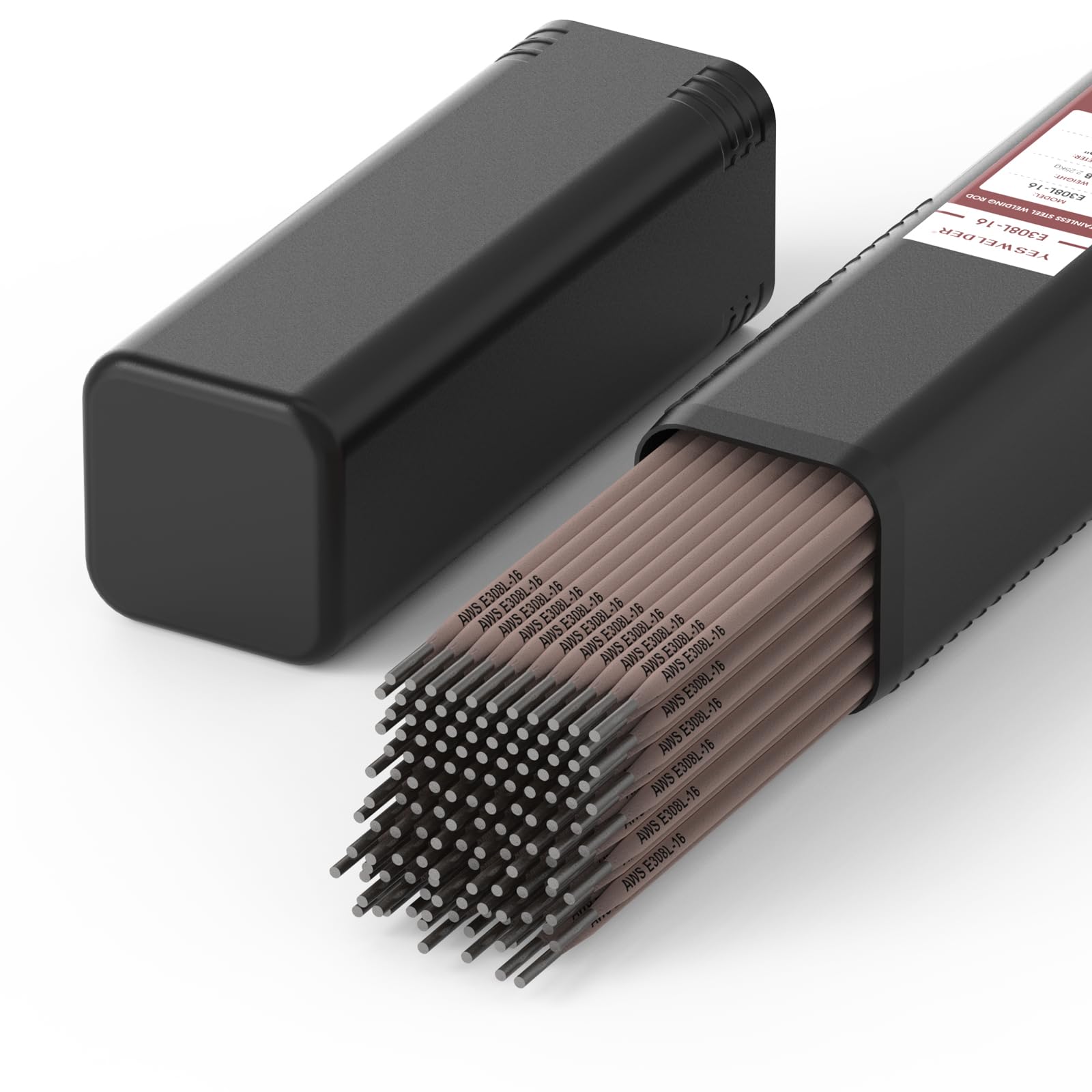
Best Stainless Stick Electrode
YESWELDER E308L-16 Stick
E308L-16 stainless steel stick electrodes, 14 inches long, 3/32-inch diameter, 5-pound pack.
Keep the YESWELDER E308L-16 only as a specialty pick for compatible stainless steel. It gives stick-welder owners an option for 304, 304L, and related stainless grades when the base metal and procedure call for an E308L-type electrode. That can be useful for stainless brackets, guards, food-equipment parts, and shop hardware.
Do not assume every stainless exhaust, appliance, or farm component needs 308L. Exhaust systems may use other stainless grades, and dissimilar-metal repairs can call for a different filler. Identify the base metal first, confirm the product’s current polarity and amperage instructions, and use TIG or MIG when the repair needs finer heat control or a cleaner precision finish.
Who should buy this
Compatible 304/304L-type stainless repairs with a stick welder.
Who should avoid this
Unknown stainless grades, dissimilar-metal jobs, or precision TIG work.
Ease of Use
|
Feature |
Ease Level |
|---|---|
|
Arc starting |
Moderate |
|
Slag removal |
Moderate |
|
Heat control on thin stainless |
Challenging |
|
Material matching |
Essential |
Key Benefits
- Stick-electrode option for compatible 304/304L-family stainless
- 3/32-inch diameter for smaller stainless repairs
- Useful when TIG or MIG equipment is not available
- Honest compatibility warning reduces the risk of using the wrong stainless filler

Best Two-Size Pack
YESWELDER Dual E7018
Low-hydrogen E7018 carbon steel stick electrodes in 3/32-inch and 1/8-inch sizes, 5 pounds total.
The YESWELDER Dual E7018 pack combines 3/32-inch and 1/8-inch electrodes, with about half of the 5-pound pack in each size. That makes it the most flexible package for a small farm shop that moves between moderate and thicker clean carbon-steel work and does not want to buy two full-size containers.
The convenience comes with two limits. First, both sizes are still E7018, so this pack does not replace a more forgiving E6013 for light clean sheet. Second, opening the container begins the moisture-control problem for every rod inside. Keep the pack dry and follow the manufacturer’s storage or reconditioning instructions, especially before critical work.
Who should buy this
Shops that want two E7018 diameters in one purchase.
Who should avoid this
Buyers who only use one diameter or cannot store low-hydrogen rods correctly.
Ease of Use
|
Feature |
Ease Level |
|---|---|
|
Size selection |
Easy |
|
Arc starting |
Moderate |
|
Slag removal |
Usually straightforward |
|
Storage demands |
High |
Key Benefits
- Two E7018 diameters in one 5-pound package
- 3/32-inch option for more control and 1/8-inch option for higher deposition
- Useful for varied clean carbon-steel work
- Avoids buying two separate full-size packs
How to Choose Welding Rods for Farm Repairs
Choose by Welding Process First
A stick electrode must match a stick welder. TIG filler rods need a TIG torch and shielding gas, while low-temperature aluminum brazing rods need a suitable torch and brazing technique. Those products may be useful in another guide, but they are not direct substitutes for the electrodes reviewed here.
Choose E7018 for Controlled Carbon-Steel Work
E7018 is a low-hydrogen electrode used when weld quality, toughness, and hydrogen control matter. It needs clean steel, appropriate machine output, correct polarity, and dry storage. The 3/32-inch size is easier to manage on moderate sections; the 1/8-inch size supports higher deposition on thicker work.
Choose E6013 for Clean Light-Duty Repairs
E6013 is easier to run on many small machines and works well for clean light-gauge mild steel, short welds, and noncritical maintenance. Its relatively shallow penetration and easy slag removal can help beginners, but it is not the right answer for every thick, dirty, or structural repair.
Confirm Stainless Grade Before Using E308L-16
E308L-type electrodes are commonly selected for compatible 304 and 304L-family stainless steels. They are not universal stainless rods. Identify the base metal and service conditions before welding, especially on exhaust, food, chemical, heat-resistant, or dissimilar-metal parts.
Welding Rod Storage and Setup Tips
- Keep unopened packages dry and undamaged.
- After opening low-hydrogen electrodes, follow the manufacturer’s exposure-time, holding-temperature, and reconditioning guidance.
- Do not assume a plastic tube alone restores low-hydrogen condition after long humid exposure.
- Use the amperage and polarity printed on the current package because recommendations can vary by diameter and manufacturer.
- Test settings on scrap of the same material and thickness before welding the actual part.
- Stop if the coating is cracked, flaking, wet, or visibly damaged.
More rod guides: stick welding rods for repairs and welding rods for outdoor projects.
FAQ
What Is the Best All-Around Welding Rod for Farm Repairs?
There is no single rod for every repair. A 3/32-inch E7018 is a strong all-around shop choice for clean carbon steel when you can keep it dry and run it correctly. A 3/32-inch E6013 is easier for clean light-duty work. Keep both only when your repair mix justifies them.
Is E7018 a Deep-Penetration Rod?
No. E7018 is generally chosen for its low-hydrogen properties, smooth arc, deposition, and mechanical performance, not because it is a classic deep-penetration digging rod. Penetration still depends on joint design, current, arc length, travel speed, position, and technique.
Can I Weld Rusty Farm Steel With E6013?
Do not rely on E6013 to burn through heavy rust, paint, oil, or scale. Clean the joint to sound metal. When field conditions or approved procedures call for another electrode, use the correct consumable rather than forcing E6013 into the job.
Do E7018 Rods Need a Rod Oven?
Low-hydrogen electrodes need controlled dry storage after opening when their low-hydrogen condition matters. The exact holding and reconditioning requirements depend on the manufacturer and applicable code. Follow the package data rather than using a household oven or a guessed temperature.
Can E308L-16 Weld Any Stainless Steel?
No. It is intended for specific stainless grades and applications. Confirm the base-metal grade, service temperature, corrosion exposure, and whether the joint is stainless-to-stainless or dissimilar metal before choosing filler.
Can I Repair a Tractor Loader Arm or Trailer Hitch Myself?
Those parts can be safety-critical. Electrode selection alone cannot establish a safe repair. Use the manufacturer’s repair guidance, inspect for hidden cracking or distortion, and use a qualified welder and approved procedure when failure could cause injury, loss of control, or dropped loads.
Final Recommendation
Best starting combination
Keep a 3/32-inch E7018 for controlled carbon-steel repairs and a 3/32-inch E6013 for clean light-duty work. Add the 1/8-inch E7018 only when you regularly weld thicker steel and your machine has enough output. Buy the stainless E308L-16 only for confirmed compatible stainless grades.
Full Comparison
| Product Name | Image | Electrode Type | Size | Best For | Amazon |
|---|---|---|---|---|---|
| YESWELDER E7018 3/32″ |
|
E7018 low-hydrogen stick | 3/32 inch, 5 lb | Controlled carbon-steel repairs and medium-thickness work | Check price on Amazon |
| YESWELDER E6013 3/32″ |
|
E6013 general-purpose stick | 3/32 inch, 5 lb | Clean, light-gauge mild steel, brackets, fence parts, and noncritical repairs | Check price on Amazon |
| YESWELDER E7018 1/8″ |
|
E7018 low-hydrogen stick | 1/8 inch, 5 lb | Thicker clean carbon steel when the welder has enough output | Check price on Amazon |
| YesRight J422 3/32″ |
|
J422 carbon-steel stick | 3/32 inch, 4.5 lb | Routine, noncritical mild-steel repairs and practice | Check price on Amazon |
| YESWELDER E308L-16 Stick |
|
E308L-16 stainless stick | 3/32 x 14 inch, 5 lb | Compatible 304/304L-type stainless repairs with a stick welder | Check price on Amazon |
| YESWELDER Dual E7018 |
|
E7018 low-hydrogen stick | 3/32 + 1/8 inch, 5 lb total | Shops that want two E7018 diameters in one purchase | Check price on Amazon |
Product specifications and Amazon listing details can change. Confirm the current package size, diameter, polarity, amperage guidance, and included quantity before ordering.