A plasma cutter can cut stainless steel faster than an angle grinder and usually leaves less heat distortion and cleanup. The right model depends on your normal material thickness, available 220V power, compressor capacity, start type, and whether you cut clean sheet or rusty and perforated stock. This guide compares eight identifiable models and explains the trade-offs so you can choose without relying on inflated maximum-cut claims.
Last updated: July 20, 2026
Affiliate disclosure: This article contains Amazon affiliate links. If you buy through a qualifying link, the site may earn a commission at no extra cost to you.
Quick Verdict
The bestarc BTC500DP is the most balanced dedicated pick for typical stainless work because it combines a pilot arc, pressure monitoring, and a 50A-class clean-cut claim. Choose the ARCCAPTAIN Cut60 or YESWELDER CUT-65DS PLUS when you need more output or extra modes. Pick the ARCCAPTAIN Cut50 or Reboot RBC6000D when low weight matters more than non-touch starting.
Top Picks
|
Category |
Product |
Why It Stands Out |
|---|---|---|
|
🏆 Best Overall for Stainless |
Pilot arc, air-pressure display, built-in filter, and a seller-stated 1/2-inch clean cut on 220V. |
|
|
💰 Best Lightweight Value |
About 13 lb with simple controls and dual voltage, but no non-touch pilot arc. |
|
|
📱 Best App-Controlled |
55A output, non-touch pilot arc, app control, and separate quality-cut and maximum-cut claims. |
|
|
🧱 Best for Expanded or Rusty Metal |
Mesh, rust-removal, pressure-monitoring, pilot-arc, and app functions in one 55A machine. |
|
|
🛠️ Best 65A Multi-Mode Cutter |
Non-HF pilot arc with plate, grid, gouging, and marking modes. |
|
|
⚡ Best Non-HF 60A Pick |
Blowback pilot arc, pressure detection, and higher-output cutting without an HF start. |
|
|
💼 Best Ultralight Mobile Pick |
Very light 8.69 lb body and simple touch-arc setup for clean, continuous metal. |
|
|
🧰 Best All-in-One |
Combines a 50A plasma cutter with gas MIG, flux-core MIG, HF TIG, stick, and spool-gun compatibility. |
How We Picked These Plasma Cutters
We prioritized identifiable models with dedicated product pages, useful 220V performance, clear start-type information, and features that matter when cutting stainless. The main comparison points were clean-cut capacity rather than severance claims, pilot-arc type, air-pressure controls, compressor demands, portability, consumable availability, and whether extra modes solve a real workshop problem. We removed generic search-only products because their exact model, specifications, and current listing could not be confirmed.
Stainless Steel Safety Note
Plasma cutting stainless is hot work. Use effective local exhaust or ventilation, suitable eye and face protection, hearing protection, gloves, and fire-safe clothing. OSHA notes that hot work on stainless can expose workers to hazardous hexavalent chromium. Follow your local workplace rules and the cutter manufacturer’s safety manual.
References: OSHA Hexavalent Chromium Overview and Hypertherm Plasma Gas Selection Guide.
Before You Buy
- Size for your normal thickness: Choose a machine that can cleanly cut the stainless thickness you use most often. Do not shop by maximum severance alone.
- Plan for 220V: Most dual-voltage cutters deliver noticeably lower current on 110V. A dedicated, correctly protected circuit gives more stable results.
- Check compressor flow: Pressure without enough airflow will fall during a cut. Match both PSI and CFM or L/min to the manual.
- Use dry, oil-free air: Moisture and oil can reduce cut quality, lower thickness capacity, and shorten consumable life.
- Choose the right start type: Non-touch pilot arc is better for expanded, painted, or rusty stock. Touch-arc models are simpler but prefer clean, continuous metal.
- Confirm consumables: Check torch model, local availability, and cost before choosing a machine.
The ARCCAPTAIN Cut50 is the easiest option here to carry, store, and set up for routine stainless sheet, brackets, and repair work. It runs on 110V or 220V, but you should treat 110V as the light-duty setting because the available cutting current is lower.
Its biggest limitation is the lack of a non-touch pilot arc. It works best on clean, continuous metal where the torch can start reliably. Choose it for portability and simple controls, not for frequent expanded-metal, painted, or heavily rusted work.
Best for: DIY users who mainly cut clean stainless sheet and want a light, simple machine.
Skip it if: you regularly cut expanded metal, rusty stock, or need a non-touch pilot arc.
Buyer Considerations
This is the value-focused pick, but its lower 110V output and contact-style starting matter more than the headline 50A rating. Plan on 220V for the cleanest practical results and verify that your compressor can maintain the pressure and flow listed in the manual.
Review snapshot note: The chart below is retained from the original article. Ratings, review totals, and buyer feedback change over time, so check the current Amazon listing before deciding.

Situational Benefits
|
Situation |
How It Helps |
|---|---|
|
Clean Stainless Sheet |
The light body and simple controls suit trim work, brackets, and common sheet-metal projects. |
|
Garage Repairs |
Dual voltage lets you use 110V for lighter work and 220V when you need more stable cutting power. |
|
Portable Use |
At about 13 lb, it is easier to carry and store than the larger machines in this guide. |
|
Continuous Flat Stock |
Contact-style starting is most practical on clean, uncoated, non-perforated metal. |
Ownership and Maintenance
Keep the incoming air clean, dry, and oil-free. Drain the compressor, use a moisture separator, and replace worn PT31-style consumables before cut quality drops. The simpler torch setup can keep consumable costs manageable, but starting on dirty material may shorten tip life.
Key Features and Trade-Offs
- Dual-voltage 110V/220V input
- Up to 50A output on 220V
- Large LED display with 2T/4T and post-flow controls
- Built-in air filter and quick-connect fitting
- About 13 lb for easy transport
- No non-touch pilot arc, so clean metal gives the best starts
The Cut55 Pro adds a non-touch pilot arc, which makes it easier to start on painted, rusty, or perforated metal. That is a meaningful upgrade if your stainless projects include expanded sheet, old brackets, or parts that are not perfectly clean.
App control and the large display make setup convenient, but this model uses a high-frequency start. Keep that in mind around sensitive electronics, CNC controls, or other equipment that can be affected by electrical interference.
Best for: hobby fabricators who want pilot-arc starting, app control, and stronger 240V performance.
Skip it if: you need a non-HF cutter for use close to sensitive electronic controls.
Buyer Considerations
The 3/4-inch figure is a maximum-cut claim, not the thickness you should expect to cut quickly with a clean edge. Size the machine around the stainless thickness you cut most often, and use the 1/2-inch quality-cut claim as the more useful planning number.
Review snapshot note: The chart below is retained from the original article. Ratings, review totals, and buyer feedback change over time, so check the current Amazon listing before deciding.

Situational Benefits
|
Situation |
How It Helps |
|---|---|
|
Rusty or Painted Parts |
Non-touch pilot arc can start without dragging the tip directly on the work surface. |
|
Expanded Metal |
Pilot-arc starting helps the torch re-establish the cut across gaps. |
|
Home Shop |
120V covers lighter work, while 240V gives the machine its stronger practical output. |
|
Longer Cuts |
The 4T mode can reduce trigger fatigue during steady manual cutting. |
Ownership and Maintenance
Pilot-arc operation helps on imperfect surfaces, but extended pilot time can consume electrodes and nozzles faster. Use the shortest pilot setting that starts the cut reliably, keep the air dry, and inspect the torch parts before long sessions.
Key Features and Trade-Offs
- 55A output with 120V/240V input
- High-frequency non-touch pilot arc
- App control and a large LED display
- 2T/4T operating modes
- Seller-stated 1/2-inch quality cut and 3/4-inch maximum cut
- HF start may not suit every CNC or electronics-heavy workspace
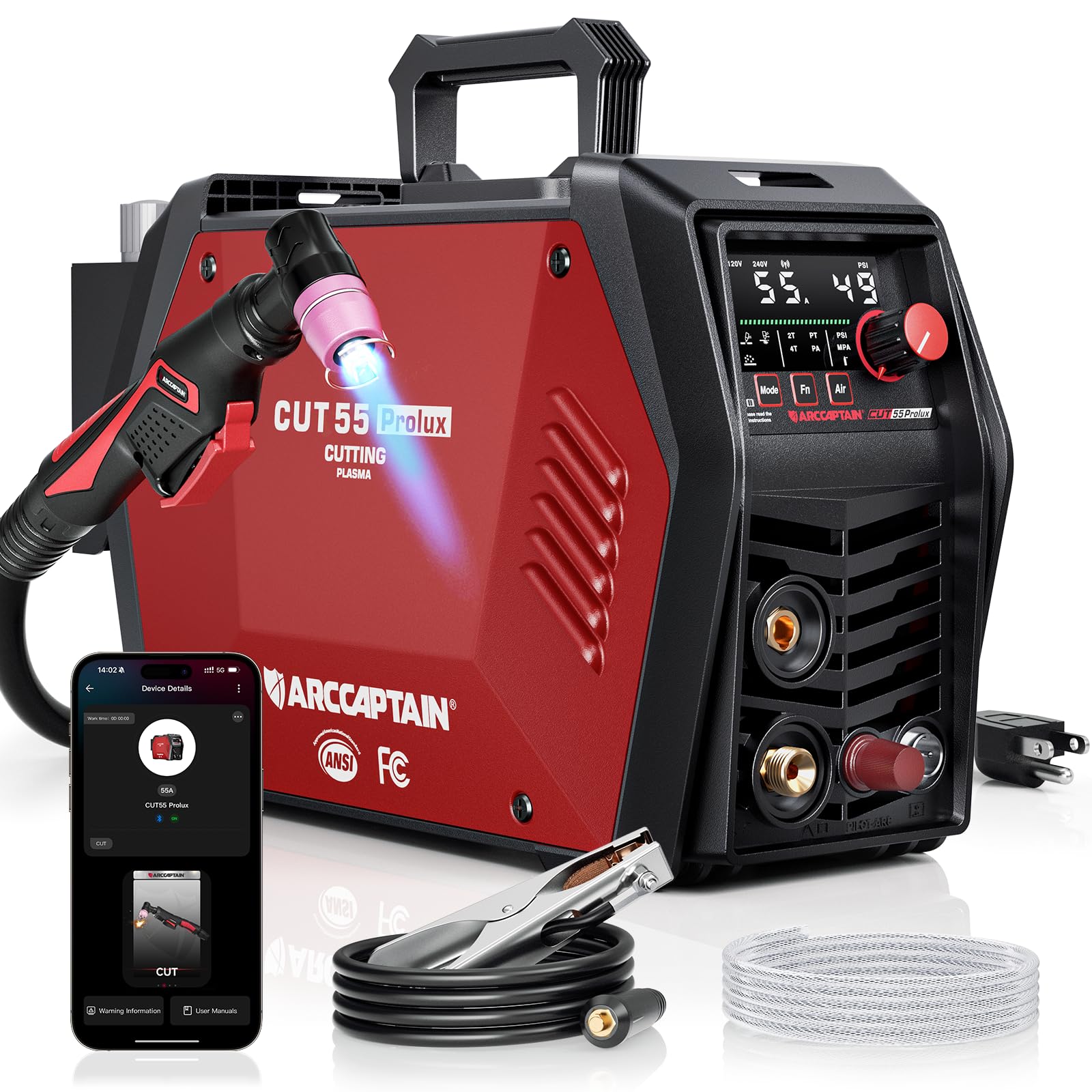
The Cut55 Prolux is the most feature-heavy 55A ARCCAPTAIN option in this roundup. Its pilot-arc, mesh, rust-removal, app, and air-pressure functions are useful when you switch between clean sheet, perforated material, and repair work.
The seller lists a wide maximum cutting range on 240V, but maximum severance is not the same as a fast, square, low-dross cut. Choose this model for control features and difficult surfaces rather than for the largest advertised number alone.
Best for: users who frequently cut expanded metal, rusty parts, or want pressure monitoring and remote adjustments.
Skip it if: you only cut clean sheet and do not need app or specialty modes.
Buyer Considerations
Its added modes can make setup easier, but they also add complexity. Use the correct mode, confirm the pressure on the front display, and follow the manual’s clean-cut chart instead of assuming every listed maximum thickness will produce a finish-ready edge.
Review snapshot note: The chart below is retained from the original article. Ratings, review totals, and buyer feedback change over time, so check the current Amazon listing before deciding.

Situational Benefits
|
Situation |
How It Helps |
|---|---|
|
Expanded Metal |
Mesh mode and pilot arc help the torch cross open gaps without repeated contact starts. |
|
Rusty Repair Work |
The dedicated modes help you work on imperfect surfaces with less manual restarting. |
|
Pressure Troubleshooting |
The display makes it easier to see unstable or incorrect air pressure before cutting. |
|
Mixed Workshop Tasks |
App control and multiple modes suit users who move between thin sheet and repair stock. |
Ownership and Maintenance
Pressure monitoring can help you spot an undersized compressor, a restricted hose, or a regulator problem before it ruins a cut. Keep the filter dry and use pilot-arc and rust-removal modes only when needed to reduce unnecessary consumable wear.
Key Features and Trade-Offs
- 55A dual-voltage 120V/240V operation
- High-frequency non-touch pilot arc
- Expanded-metal and rust-removal modes
- App control and real-time air-pressure display
- Adjustable pilot and post-flow timing
- Maximum-thickness claims should not be treated as clean-cut capacity
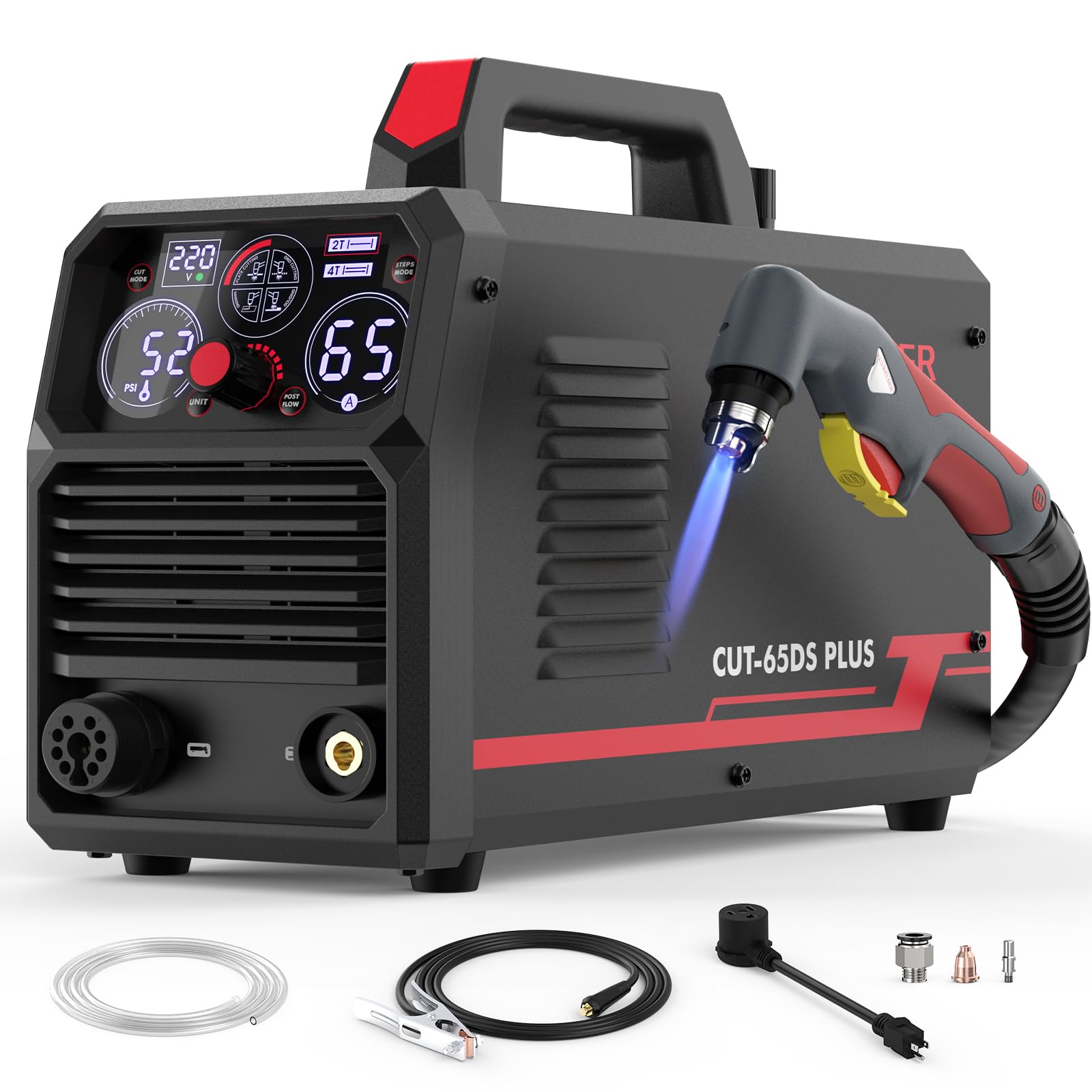
The YESWELDER CUT-65DS PLUS is the higher-current option for users who want more than straight plate cutting. Its four modes cover normal cuts, grid or expanded metal, gouging, and marking, which can reduce tool changes in a busy home or farm shop.
Use the correct torch parts for each mode. The listing warns that mixing the accessories can accelerate wear, so this model rewards users who are willing to read the setup chart and organize consumables.
Best for: heavier hobby work, grid cutting, gouging, and marking with a non-HF pilot arc.
Skip it if: you want the lightest, simplest cutter for occasional thin-sheet work.
Buyer Considerations
The 65A rating gives you more headroom on 220V, but cut quality still depends on the correct air supply, torch parts, travel speed, and the manufacturer’s thickness chart. Do not size it by amperage alone.
Review snapshot note: The chart below is retained from the original article. Ratings, review totals, and buyer feedback change over time, so check the current Amazon listing before deciding.

Situational Benefits
|
Situation |
How It Helps |
|---|---|
|
Heavier Plate Work |
The higher 220V output gives more cutting headroom than the 50A models. |
|
Expanded or Grid Metal |
A dedicated grid mode helps maintain the arc across gaps. |
|
Gouging |
The gouging function can remove weld metal or prepare repair areas without a separate machine. |
|
Marking and Layout |
Marking mode can trace lines or identifiers without fully cutting through the workpiece. |
Ownership and Maintenance
Keep separate, labeled consumables for the different modes and inspect the torch before switching functions. Dry air and a secure work clamp are especially important during gouging and higher-output work because poor setup increases heat and consumable wear.
Key Features and Trade-Offs
- Up to 65A output with 110V/220V input
- Non-HF non-touch pilot arc
- Plate, grid, gouging, and marking modes
- Digital monitoring and error information
- Portable design at roughly 22 lb
- Different functions may require different torch accessories
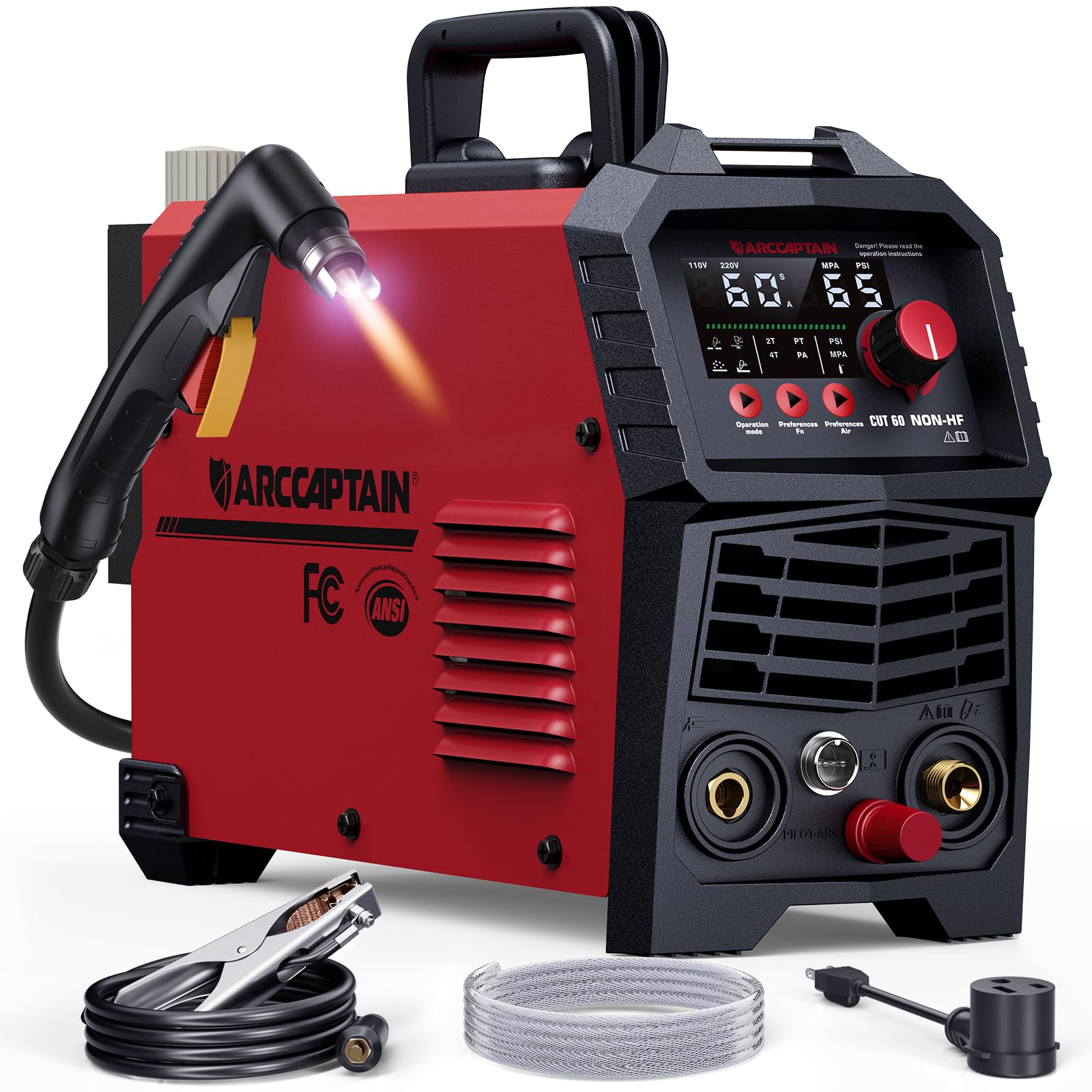
The Cut60 combines higher output with a non-HF blowback pilot arc. That makes it a stronger fit for shops that cut thicker stainless but also want to reduce high-frequency interference around nearby electronics.
The seller publishes large maximum-thickness ranges, but those figures describe the upper cutting range, not guaranteed finish-quality cuts. Base your purchase on the clean-cut chart, your normal plate thickness, and the power available on your 220V circuit.
Best for: users who want 60A output, non-HF pilot starting, and several repair-oriented modes.
Skip it if: your work is mostly thin stainless and portability matters more than extra output.
Buyer Considerations
This is a better choice than an HF-start model near electronics, but no compact cutter is immune to poor grounding, wet air, undersized wiring, or incorrect consumables. Treat the advertised maximum as occasional capacity, not the everyday target.
Review snapshot note: The chart below is retained from the original article. Ratings, review totals, and buyer feedback change over time, so check the current Amazon listing before deciding.

Situational Benefits
|
Situation |
How It Helps |
|---|---|
|
Thicker Stainless |
The 60A output offers more headroom for plate work when powered from 220V. |
|
Electronics-Heavy Shop |
Non-HF blowback starting can reduce interference compared with high-frequency pilot systems. |
|
Repair and Fabrication |
Rust-removal, gouging, and marking modes cover more than straight cuts. |
|
Expanded Metal |
Pilot-arc operation helps maintain cutting across perforations and gaps. |
Ownership and Maintenance
Use clean air, keep the pressure within the manual’s range, and let post-flow cool the torch after demanding cuts. Blowback torches use different consumables from PT31-style contact torches, so confirm local replacement availability before buying.
Key Features and Trade-Offs
- Up to 60A output on 220V
- Non-HF blowback pilot arc
- 110V/220V dual-voltage input
- Air-pressure detection and large LED display
- Expanded-metal, rust-removal, gouging, and marking functions
- Requires the correct blowback-torch consumables
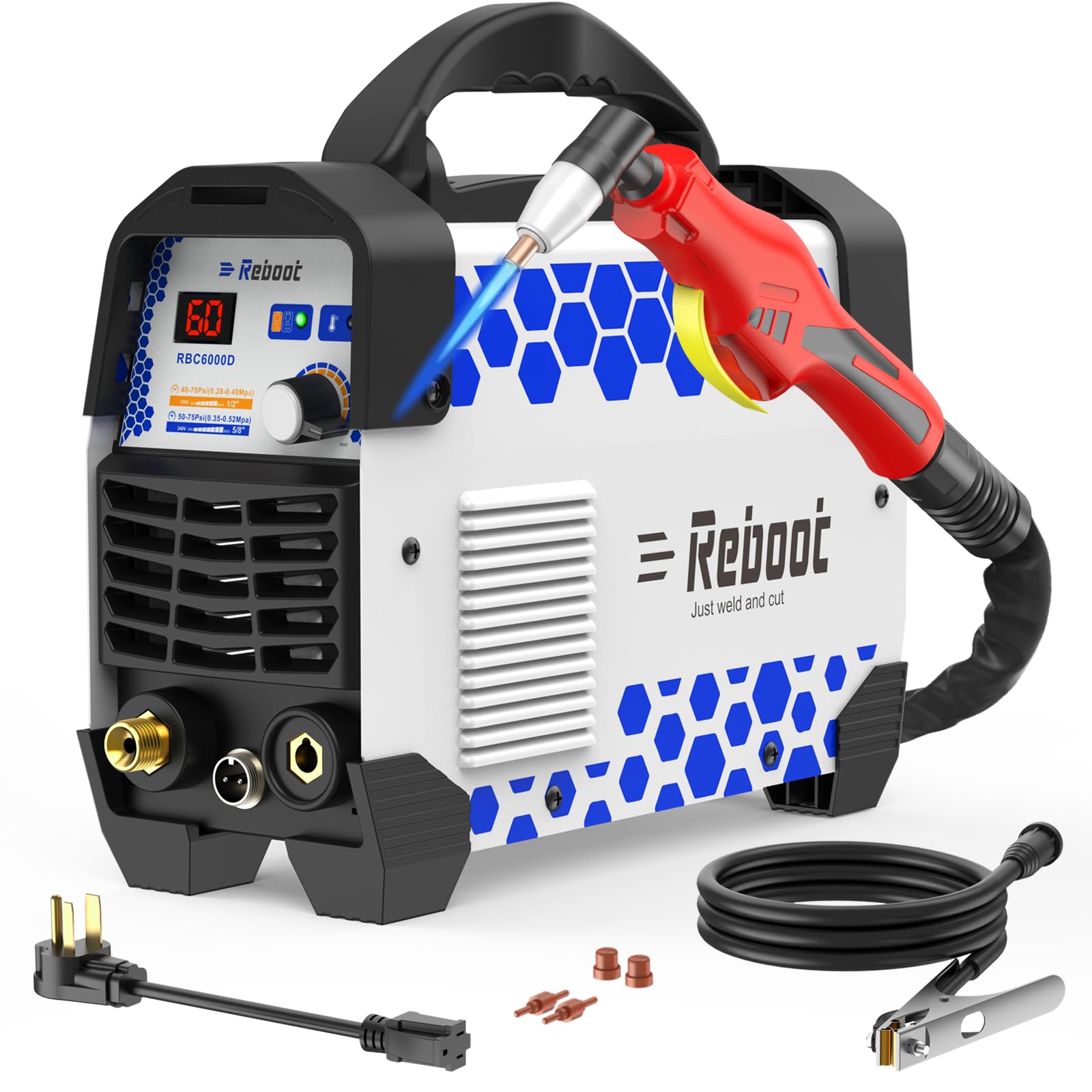
The Reboot RBC6000D stands out for low weight and straightforward controls. It is easy to carry between a garage, garden, or repair site, and the pre-installed regulator reduces setup steps.
Best for: mobile repairs and users who want the lightest 60A-labeled cutter in this roundup.
Skip it if: non-touch starting on expanded, painted, or rusty metal is a priority.
Buyer Considerations
Its low weight is the main buying advantage. The trade-off is the simpler touch-arc torch. Confirm the required breaker, plug, and compressor before relying on it for field work because a portable cutter still needs a substantial air and power supply.
Review snapshot note: The chart below is retained from the original article. Ratings, review totals, and buyer feedback change over time, so check the current Amazon listing before deciding.

Situational Benefits
|
Situation |
How It Helps |
|---|---|
|
Mobile Repairs |
The low machine weight makes transport easier when power and compressed air are available. |
|
Clean Flat Stock |
Touch-arc starting works best when the torch can make reliable contact with bare metal. |
|
Garage Storage |
The compact body takes up less bench and shelf space than larger multiprocess machines. |
|
Occasional DIY Work |
Simple controls suit users who do not need app control or specialty cutting modes. |
Ownership and Maintenance
PT31 consumables are common, but contact starting can wear the tip faster if you drag it across dirty surfaces. Clean the work area, secure the ground clamp to bright metal, and replace the nozzle when the orifice becomes enlarged or irregular.
Key Features and Trade-Offs
- 60A-labeled dual-voltage 120V/240V design
- Very light 8.69 lb body
- Pre-installed air regulator
- PT31 touch-arc torch
- Seller-stated 1/2-inch capacity at 120V and 5/8-inch at 240V
- No non-touch pilot arc
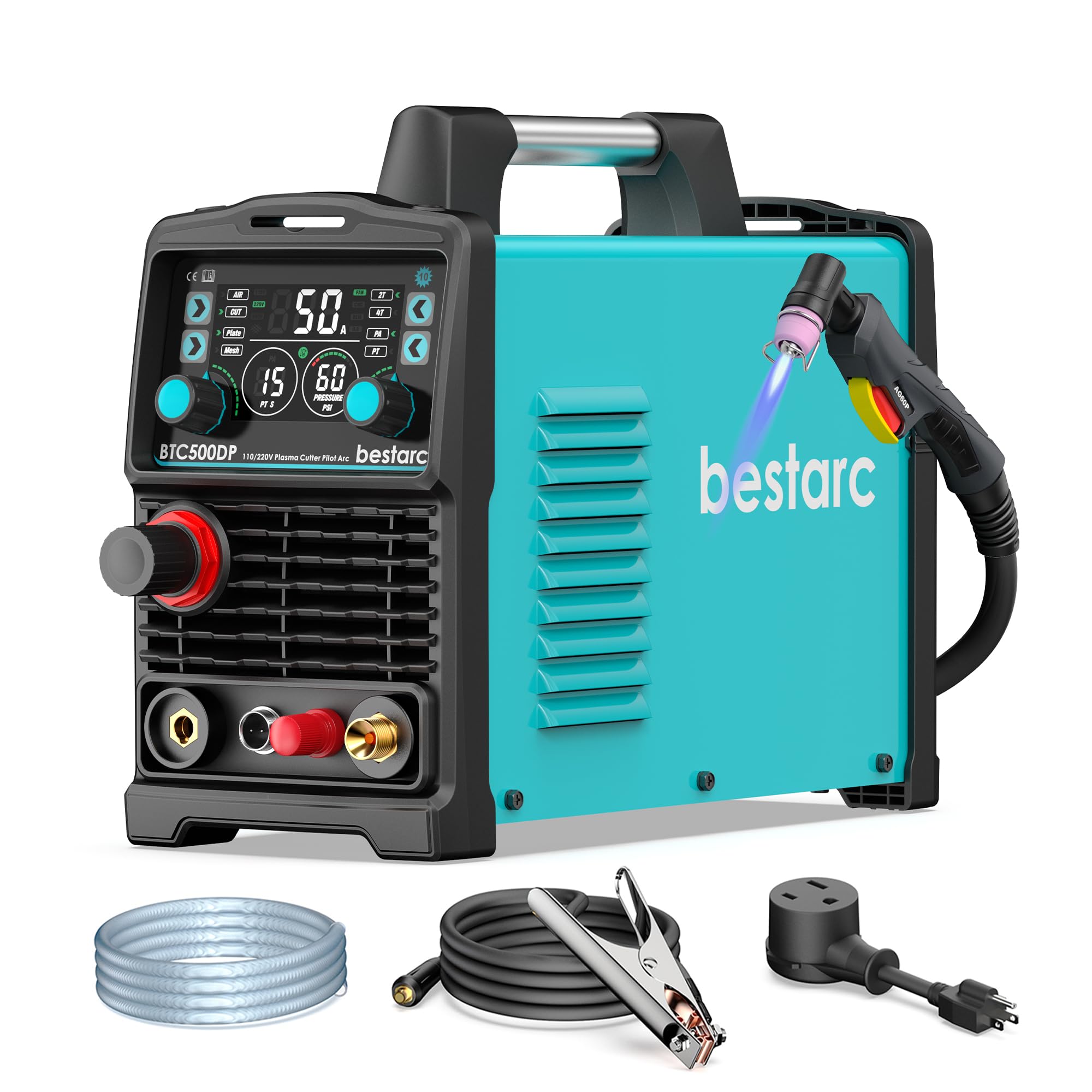
The bestarc BTC500DP is the most balanced dedicated stainless cutter in this list for typical home-shop work. It combines non-touch pilot starting with an air-pressure display, so two common causes of poor cuts, bad starts and incorrect pressure, are easier to manage.
The listing claims a 1/2-inch clean cut on 220V and requires dry compressed air. That makes it a strong match for sheet, brackets, art, and moderate plate, but it is still a compact 50A-class machine rather than an industrial production cutter.
Best for: buyers who want a pilot arc, pressure monitoring, and a clear setup without moving to a heavier 60A or 65A model.
Skip it if: your normal work is above its clean-cut range or you need non-HF starting near sensitive controls.
Buyer Considerations
This model uses a high-frequency pilot arc. It is convenient for manual cutting, but check compatibility before using it near CNC electronics. Also note that the air sensor displays pressure; it does not automatically correct an undersized compressor or restricted hose.
Review snapshot note: The chart below is retained from the original article. Ratings, review totals, and buyer feedback change over time, so check the current Amazon listing before deciding.

Situational Benefits
|
Situation |
How It Helps |
|---|---|
|
Stainless Sheet and Brackets |
The pilot arc and pressure display make routine manual setup more forgiving. |
|
Expanded Metal |
Mesh mode helps the arc restart across perforated material. |
|
Beginner Setup |
The display shows current, voltage, pressure, and error information in one place. |
|
Moderate Plate |
The 50A output is suited to common shop thicknesses when you use 220V and dry air. |
Ownership and Maintenance
Use the built-in pressure display as a diagnostic tool and keep the filter element dry. Set post-flow long enough to cool the torch, avoid excessive pilot time, and replace the electrode and nozzle as a set when cut quality becomes inconsistent.
Key Features and Trade-Offs
- 50A output with 110V/220V input
- High-frequency non-touch pilot arc
- Large LED display with air-pressure monitoring
- Built-in filter/regulator and quick connector
- Seller-stated 1/2-inch clean cut on 220V
- Mesh, post-flow, and 2T/4T functions
The PUWU CT-418PRO is the space-saving choice when you need to cut and weld with one machine. Its current listing describes six functions, not five, and the plasma side provides 20A to 50A output alongside MIG, TIG, and stick processes.
It is less portable and more complex than a dedicated cutter. Buy it because you need the welding functions too. If stainless cutting is your only goal, a dedicated pilot-arc cutter will usually be lighter, simpler, and easier to troubleshoot.
Best for: a small workshop that needs MIG, TIG, stick, and plasma cutting in one cabinet.
Skip it if: you only need a plasma cutter or want the easiest machine to carry to a jobsite.
Buyer Considerations
The current listing states clean-cut claims of 5/16 inch on 110V and 1/2 inch on 220V, with a 5/8-inch maximum on 220V. It uses a high-frequency touch-arc plasma process, so do not confuse the HF TIG non-touch start with a non-touch plasma pilot arc.
Review snapshot note: The chart below is retained from the original article. Ratings, review totals, and buyer feedback change over time, so check the current Amazon listing before deciding.

Situational Benefits
|
Situation |
How It Helps |
|---|---|
|
Small Workshop |
One cabinet can replace separate basic welding and cutting machines when space is limited. |
|
Automotive Repair |
You can cut a patch or bracket, then switch to MIG or TIG for installation. |
|
Mixed Fabrication |
Multiple processes cover mild steel, stainless, and some aluminum workflows with the correct setup. |
|
Occasional Plasma Cutting |
The 50A cutting function adds convenience when welding is the machine’s main job. |
Ownership and Maintenance
Multiprocess machines have more cables, torches, gas connections, and settings to manage. Label the leads, keep the air and shielding-gas systems separate, store unused torches carefully, and confirm which accessories are included before ordering.
Key Features and Trade-Offs
- Gas MIG, flux-core MIG, HF TIG, stick, and 50A plasma cutting
- Spool-gun compatible, but the spool gun is not included
- 110V/220V dual-voltage input
- Seller-stated 1/2-inch clean cut and 5/8-inch maximum cut on 220V
- About 25.5 lb, heavier than the dedicated cutters
- Touch-arc plasma process with more setup complexity
Frequently Asked Questions
What Power and Air Supply Do I Need?
Use the voltage, breaker, plug, wire size, PSI, and airflow listed in the model’s manual. Dual-voltage machines usually produce less current on 110V, so 220V is the better choice for thicker stainless and longer cuts. Your compressor must maintain both the required pressure and airflow while the torch is running. Add a moisture separator and drain the tank regularly.
Can an Air Plasma Cutter Cut Stainless Steel?
Yes. Clean, dry compressed air is an economical plasma gas for stainless steel and can produce useful shop-quality cuts. The cut edge may show oxidation or nitriding, so clean the edge before critical welding, coating, or corrosion-sensitive service.
What Is the Difference Between a Clean Cut and a Maximum Cut?
A clean-cut rating describes the thickness the machine can cut at a practical speed with a more usable edge. A maximum or severance rating is the thickest material it may separate slowly, often with more bevel and dross. Buy around the clean-cut capacity you need most often.
Do I Need a Pilot Arc?
A non-touch pilot arc is worth paying for when you cut expanded metal, painted parts, rust, or uneven surfaces. It lets the torch start without direct tip contact. A touch-arc machine can still work well on clean, continuous sheet and is often lighter and less expensive.
How Do I Reduce Dross on Stainless Steel?
Use fresh consumables, correct air pressure, a steady travel speed, the right torch height, and the amperage recommended for the nozzle. Slow travel often leaves heavy low-speed dross, while moving too fast can leave an incomplete cut or trailing slag.
How Do I Maintain Reliability and Fix Common Starting Problems?
Start with the basics: connect the work clamp to bright metal, verify live air pressure, drain moisture, inspect the electrode and nozzle, tighten fittings, and confirm the torch parts are installed in the correct order. If the fault remains, record the error code and contact the seller or manufacturer with photos or a short video.
ARCCAPTAIN Model Preference Snapshot
Among the three ARCCAPTAIN options, choose the Cut50 for the lightest and simplest setup, the Cut55 Pro for pilot-arc starting plus app control, and the Cut55 Prolux when expanded-metal, rust-removal, and pressure-monitoring features matter most.
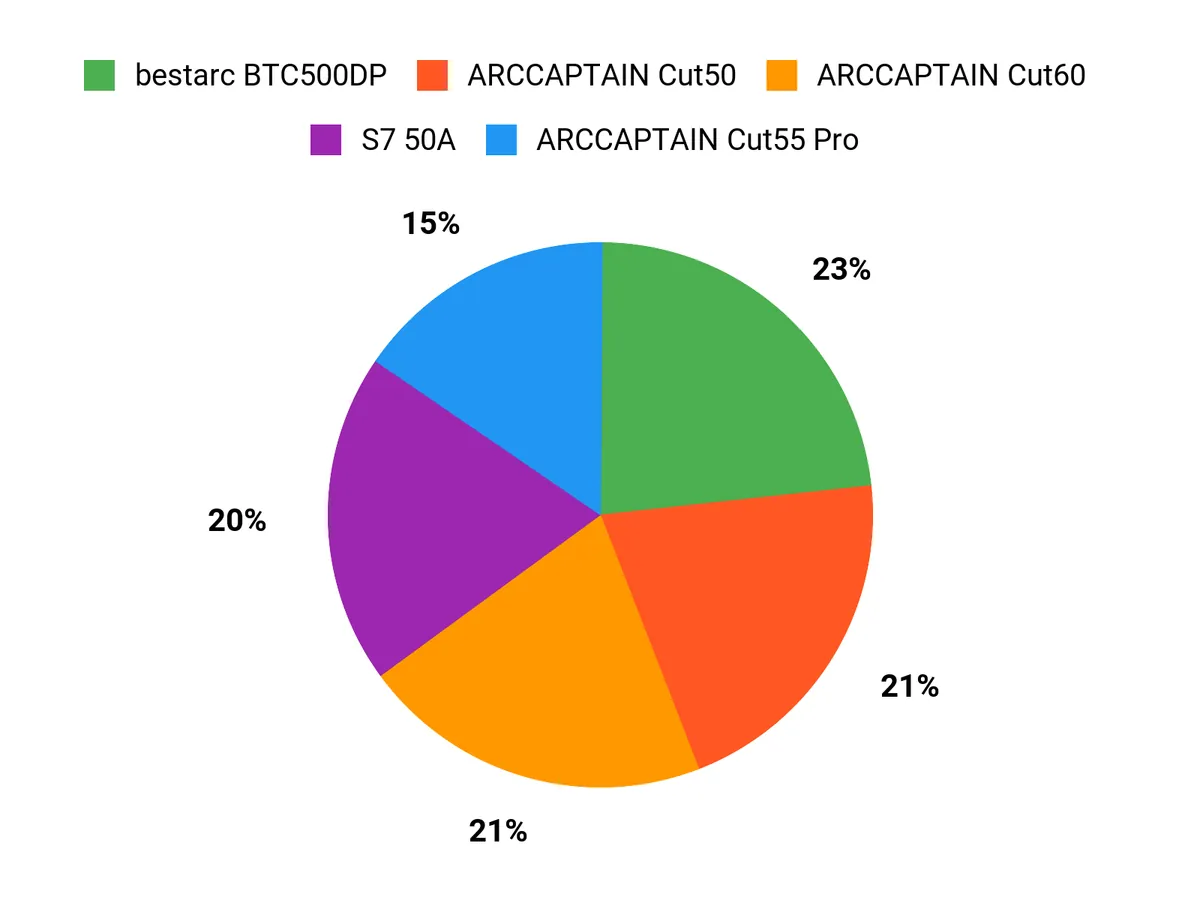
This retained chart is a historical visual snapshot from the original article. Check current product details and feedback before buying.
Final Recommendations
For most home shops cutting stainless sheet, brackets, and moderate plate, the bestarc BTC500DP offers the most useful mix of pilot-arc starting, pressure visibility, and simple controls. The ARCCAPTAIN Cut50 is the better value when you only need clean-stock cutting and easy portability.
For thicker work or more specialized tasks, choose the ARCCAPTAIN Cut60 for non-HF blowback starting or the YESWELDER CUT-65DS PLUS for cutting, grid, gouging, and marking modes. The PUWU CT-418PRO is a workshop-space solution, not the best dedicated cutter, because its main advantage is combining welding and cutting in one cabinet.
Best Buying Rule
Choose the smallest machine that comfortably covers your normal clean-cut thickness on the power you actually have. Then confirm compressor flow, torch type, and local consumable availability before clicking through to Amazon.
| Product | Image | Start Type | Input | Output | Seller-Stated Capacity | Best For | Amazon |
|---|---|---|---|---|---|---|---|
| ARCCAPTAIN Cut50 |
 |
Contact-style start | 110V/220V | Up to 50A on 220V | Listing markets a 1/2-inch clean cut | Lightweight value and clean flat stock | Check Price |
| ARCCAPTAIN Cut55 Pro |
 |
HF non-touch pilot arc | 120V/240V | 55A | 1/2-inch quality cut; 3/4-inch maximum | App control and imperfect surfaces | Check Price |
| ARCCAPTAIN Cut55 Prolux |
 |
HF non-touch pilot arc | 120V/240V | 55A | Seller lists up to 22 mm maximum on 240V | Expanded metal, rust, and pressure monitoring | Check Price |
| YESWELDER CUT-65DS PLUS |
 |
Non-HF non-touch pilot arc | 110V/220V | 65A | Check current clean-cut chart in the listing or manual | Plate, grid, gouging, and marking | Check Price |
| ARCCAPTAIN Cut60 |
 |
Non-HF blowback pilot arc | 110V/220V | Up to 60A on 220V | Use the manual’s clean-cut chart; seller maximums are higher | Higher output near sensitive electronics | Check Price |
| Reboot RBC6000D |
 |
Touch arc | 120V/240V | 10-35A at 120V; 30-60A at 240V | 1/2 inch at 120V; 5/8 inch at 240V | Ultralight transport and clean stock | Check Price |
| bestarc BTC500DP |
 |
HF non-touch pilot arc | 110V/220V | 50A | 1/2-inch clean cut; listing also gives a higher maximum | Balanced stainless setup and pressure visibility | Check Price |
| PUWU CT-418PRO |
 |
HF touch-arc plasma | 110V/220V | 20-50A cutting output | 5/16-inch clean at 110V; 1/2-inch clean at 220V | One-box welding and cutting | Check Price |
This roundup is reader-supported. When you click an Amazon link, the site may earn a commission on qualifying purchases.