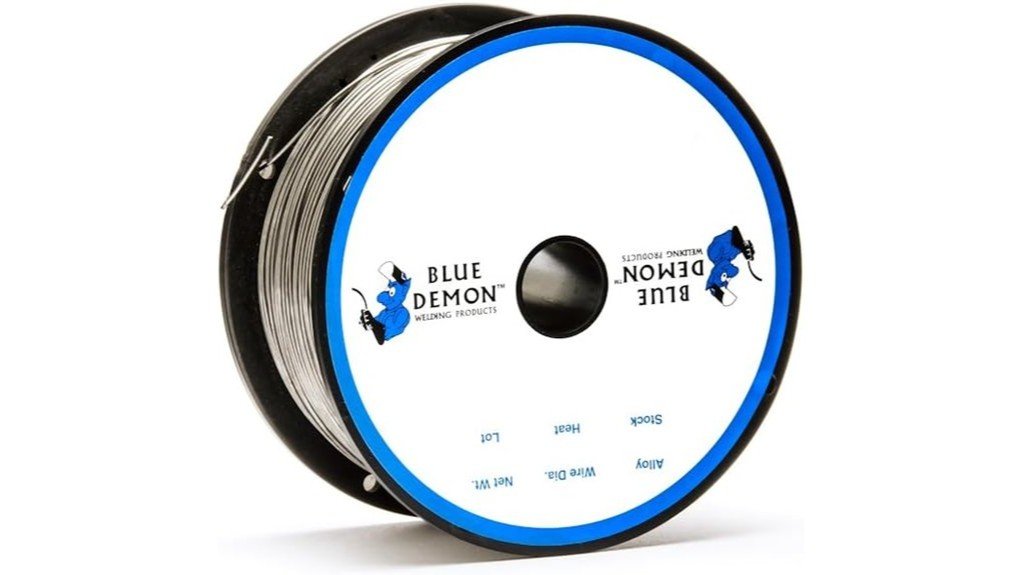
The Blue Demon 55FC-O is a self-shielded, gasless flux-cored wire for hardfacing: you weld it over worn or wear-prone steel parts to build a hard, tough surface. It is not a general-purpose joining wire, so buy it only if you want to rebuild or protect parts such as bucket edges, shovel tips and farm tooling. This Blue Demon 55FC-O review covers what it is, who it suits, how to run it and what to check on the listing first.
Blue Demon 55FC-O at a glance
| Item | Detail (per retailer and listing data) |
|---|---|
| Type | Self-shielded hardfacing flux-cored wire, no shielding gas |
| Deposit | Martensitic alloy steel, H-12 tool steel type |
| Wire sizes | 0.035 in and 0.045 in, in 1 lb and 10 lb spools; confirm which one the listing sells |
| Hardness as welded on 1020 steel | About Rc 47 (one layer), Rc 49 (two layers), Rc 53 (three layers) |
| Heat resistance | Keeps its hardness up to about 1000 F |
| Strengths | Resistance to metal-to-metal wear, with good resistance to abrasion and impact |
| Positions | Listed for flat, horizontal, vertical and overhead |
| Polarity | Listed as DCEN or DCEP; follow the label on your spool |
Figures come from retailer product data for the 55FC-O line. Check the label and the Amazon listing for the exact size and settings of the spool you buy.
What hardfacing wire is for
Hardfacing lays a wear-resistant layer on a part that grinds against soil, rock or other metal. Earth-moving buckets, farm implements, dredge parts and similar tooling are typical examples. The 55FC-O deposit is aimed at metal-to-metal wear with some abrasion and impact resistance, which makes it a middle-of-the-road choice rather than a specialist for extreme abrasion.
It is applied as an overlay on carbon and low-alloy steel. It is not meant for joining parts, for stainless steel, or for cast iron work that needs a nickel filler.
How to check the listing and your machine
- Wire diameter: match 0.035 in or 0.045 in to your gun, liner and drive rolls.
- Spool size: a 1 lb spool fits small machines and spot repairs; a 10 lb spool suits larger jobs and needs a spool hub that holds it.
- Power: retailer data gives 80 to 120 A for 0.035 in and 120 to 150 A for 0.045 in. A small 110 V machine may not reach the upper end.
- Polarity: a flux-cored wire needs the right polarity. Check the spool label and your machine manual before you strike an arc.
- Base metal: confirm the part is carbon or low-alloy steel and find out whether it needs preheat.
How to hardface with it
- Grind off paint, rust, oil and loose scale, and remove cracked or badly worn metal first.
- Preheat if the part is thick or low alloy. High hardenability can crack a cold deposit, so check the maker data for guidance.
- Run stringer or lightly weaved beads and keep a steady travel speed. Overlap each bead into the last one.
- Limit the layers. The deposit gets harder with each layer but also more prone to cracking, so do not stack more than the job needs.
- Let the part cool slowly and chip off slag with a hammer and wire brush.
Wear a proper welding helmet, gloves and a long-sleeve jacket, and keep fumes out of your face with local exhaust or good ventilation. Self-shielded wires create a lot of smoke.
Pros and limitations
Pros
- No gas cylinder needed, so it is easy to use in the field or on a farm.
- Aimed at metal-to-metal wear with some abrasion and impact resistance.
- Holds its hardness at high working temperature, per retailer data.
- Offered in small spools for repair jobs.
Limitations
- It is a hardfacing wire, not a wire for joining or general repairs.
- Can crack on thick or low-alloy parts without preheat and slow cooling.
- Not the best pick for severe abrasion, where a chromium-carbide overlay is usually chosen.
- Needs slag removal between layers, and the deposit is hard to machine.
Alternatives and related guides
If you are new to gasless wire, read the guide to self-shielded versus gas-shielded flux-core and the flux-core welding tips for beginners. For cleaning up afterward, see how to use a chipping hammer and wire brush after flux-core. For general joining with a gasless wire, compare the Blue Demon E71T-11 gasless wire.
Frequently Asked Questions
What is Blue Demon 55FC-O used for?
It is a hardfacing wire used to build a wear-resistant layer on carbon and low-alloy steel parts such as buckets, farm tools and dredge parts. It is not intended for joining metal.
Does Blue Demon 55FC-O need shielding gas?
No. It is a self-shielded flux-cored wire, so the flux in the core provides the shielding. Ventilation and fume control are still needed.
How hard is the weld deposit?
Retailer data lists about Rc 47 for one layer on 1020 steel, rising to about Rc 53 at three layers. Actual hardness depends on base metal, dilution, heat input and cooling.
Can beginners use this wire?
Beginners can run it if they already handle flux-core wire, but the main risk is cracking. Practice on scrap, follow preheat guidance and avoid stacking too many layers.
Is it suitable for welding two parts together?
No. Use a general-purpose joining wire or rod for that. The 55FC-O deposit is hard and can crack under the stress of a joint.
Verdict
The Blue Demon 55FC-O is a sensible gasless hardfacing wire for rebuilding and protecting steel parts that wear against other metal. Buy it for wear surfaces, not for joining, confirm the wire diameter and spool size on the listing, and plan for preheat and slow cooling.