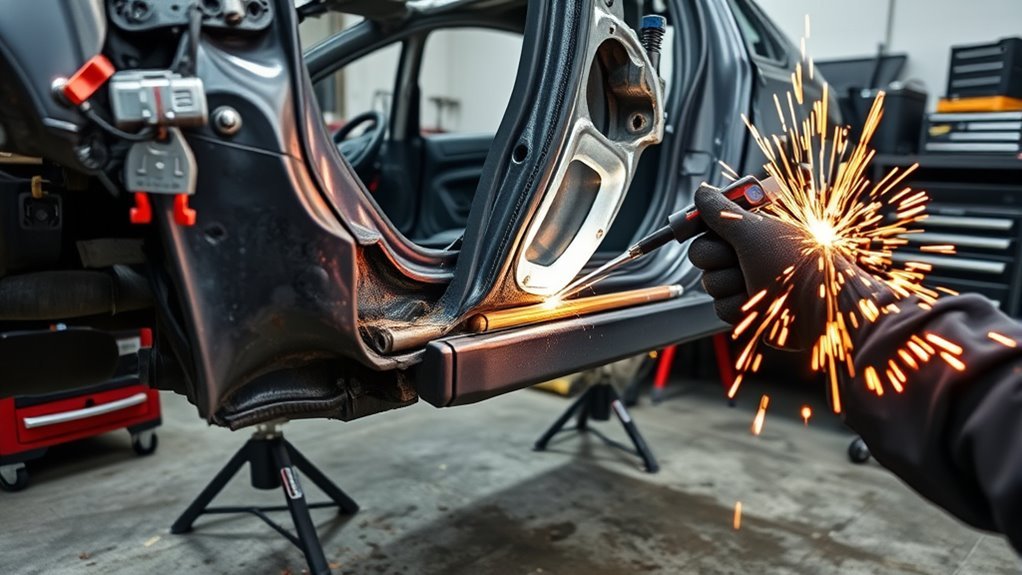
Repairing a unibody car at home is only reasonable when the corrosion is localized, the exact panel and steel grade are known, and the vehicle maker provides a repair procedure you can follow with the equipment you have. Treat every rocker, floor, pillar, rail, and suspension-area repair as a structural decision until the OEM information proves otherwise.
Quick Answer
You may be able to repair localized rust in an OEM-approved, sectionable steel panel at home. Do not DIY a unibody repair involving a rail, pillar, rocker reinforcement, suspension mount, restraint-system mount, battery enclosure, unknown steel, or distorted body measurements. Verify the VIN-specific procedure before cutting.
Key Takeaways
- Use the VIN, model year, body style, and exact panel location to find the correct OEM collision-repair procedure.
- Do not assume an outer rocker skin, floor panel, pillar, or rail is mild steel or safe to section.
- Brace and measure the shell before removing any metal that helps hold a door opening or body aperture in shape.
- Prove the welder setup on matching test coupons before welding the vehicle.
- Use only the joint, wire, shielding gas, adhesive, fasteners, coating preparation, and weld locations the OEM permits.
- Restore primer, seam sealer, chip protection, undercoating, and cavity wax without blocking factory drains.
Warning: Stop and use a qualified collision or frame shop if damage reaches a frame rail, inner rocker or rocker reinforcement, A-pillar, B-pillar, roof rail, door-ring reinforcement, strut tower, suspension pickup point, seat or seat-belt mount, airbag sensor area, hybrid/EV battery enclosure, or any unknown high-strength steel. Also stop if the shell is kinked, twisted, or outside the OEM body dimensions.
At a Glance
| Time Required | Varies by teardown, hidden corrosion, coating cure time, and the OEM procedure. Even a localized approved repair can occupy several work sessions. Structural repairs are not suitable for a home timeline estimate. |
| Difficulty | Advanced metalwork and automotive repair. Not a beginner welding project. |
| Tools Needed | VIN-specific OEM repair information, measuring tools, bracing material, approved vehicle supports, gas-shielded welder or other specified joining equipment, matching test coupons, clamps, drill and spot-weld cutter, cutting and grinding tools, ventilation, welding PPE, suitable fire extinguisher, fire-resistant blankets, approved primer and seam-sealing system, underbody coating, and cavity wax |
| Cost | Highly variable. Replacement panels, OEM information access, coatings, ventilation, measuring equipment, and correct welding equipment can cost more than expected. Structural repair should be quoted after teardown and measurement. |
How to Repair a Unibody Car at Home?
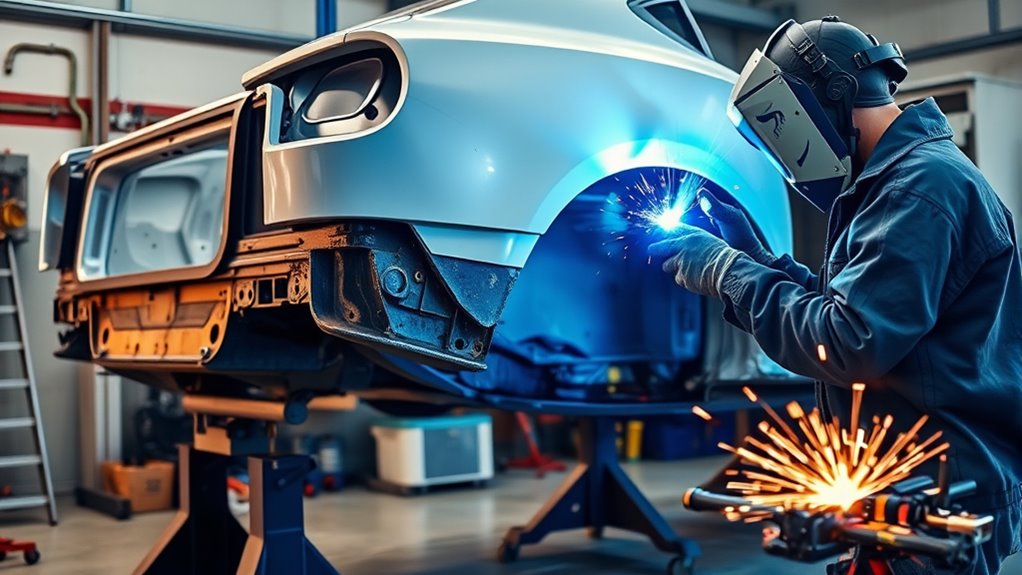
Begin by deciding whether the damaged area belongs in a home garage at all. A unibody carries loads through joined sheet-metal panels, reinforcements, flanges, and closed sections. A panel that looks like a simple rocker or floor patch from the outside may contain several steel layers with different strengths.
Do not identify repairability by panel name alone. Confirm the exact vehicle, steel map, panel construction, allowed sectioning point, joining method, corrosion-protection steps, and measuring requirements before removing paint or drilling a spot weld.
Confirm the VIN-Specific Repair Is Allowed
Use the vehicle identification number, model year, body style, drivetrain, and exact repair location to find the correct factory information. Manufacturer portals such as the Toyota Technical Information System provide access to model-specific service and repair information.
Check the OEM procedure for all of the following:
- The tensile strength and construction of every layer in the repair area.
- Whether repair, partial replacement, or complete panel replacement is required.
- Approved sectioning locations and joint geometry.
- Required spot welds, plug welds, butt welds, brazed joints, adhesives, rivets, or other fasteners.
- Welding wire strength, shielding gas, welder capability, and test requirements.
- Whether factory e-coat must be removed and whether weld-through primer is allowed.
- Seam sealer, adhesive, foam, underbody coating, and cavity-protection locations.
- Body dimensions and datum points to measure before and after repair.
- Electrical, airbag, hybrid/EV, scanning, calibration, and roadworthiness procedures.
Current Honda/Acura welding and sectioning guidance shows why this step matters. Approved welding methods change with steel strength, and some ultra-high-strength assemblies must be replaced as complete units rather than partially installed.
Decide Whether the Damage Is a DIY Repair
| Condition | Home Repair Decision | Reason |
|---|---|---|
| Localized corrosion in a single-layer outer panel that the OEM permits you to section | Potentially suitable for an experienced DIY welder | The repair scope, steel, joint, and corrosion protection can be verified before cutting |
| Rust extends into an inner rocker, reinforcement, pillar tie-in, door ring, or floor crossmember | Professional repair | These parts may carry crash, suspension, seat, or body-opening loads |
| Collision kink, torn seam, buckled rail, changed door opening, or unequal body dimensions | Professional measuring and structural repair | The shell may need anchoring, pulling, and three-dimensional measurement |
| Unknown steel, no OEM procedure, or joining equipment cannot reproduce the specified joint | Do not continue | A neat-looking substitute weld does not prove restored strength |
| Damage near an airbag sensor, restraint mount, high-voltage component, or battery enclosure | Qualified collision or EV repair facility | Electrical isolation, structural safety, scanning, and calibration may require specialized training and equipment |
Note: “Rocker panel” is not one universal part. A vehicle may have an outer skin, inner rocker, reinforcement, pillar extensions, and several overlapping flanges. An outer patch does not restore strength when the hidden layers are thin or perforated.
Prepare the Work Area Safely
Welding and cutting are hot work. Remove carpet, trim, insulation, foam, seam sealer, undercoating, adhesive, fuel-vapor sources, and other combustible material far enough from the repair that sparks and conducted heat cannot ignite them. Inspect the opposite side of every panel and any concealed cavity that sparks could enter.
OSHA’s welding, cutting, and brazing standard requires workplace fire precautions when combustible materials are exposed. It also requires a fire watch for at least 30 minutes after completion when fire-watch conditions apply. A home garage is not automatically governed in the same way as a covered workplace, but these precautions are a sensible minimum safety benchmark.
- Keep suitable extinguishing equipment within immediate reach.
- Use fire-resistant welding blankets to protect immovable materials.
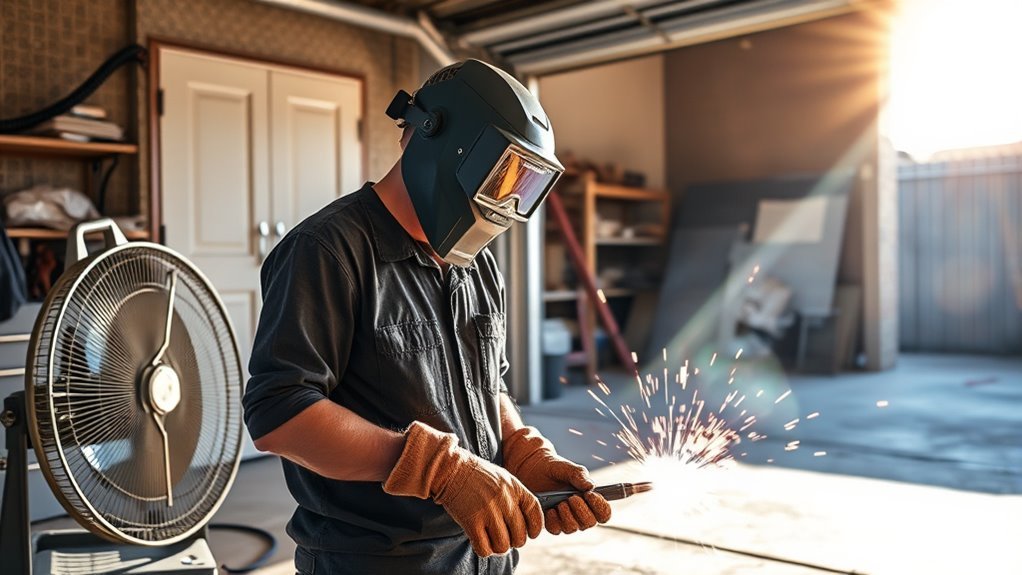
- Provide local exhaust or effective ventilation for welding fumes and coating residue.
- Do not weld near fuel vapor, a leaking fuel system, an open battery, or an explosive atmosphere.
- Have another adult act as a fire watch when sparks can enter concealed areas.
- Inspect both sides of the repair during work and for at least 30 minutes after the last spark.
Disable Electrical, SRS, and High-Voltage Systems
Do not rely on the general instruction to “disconnect the battery.” Follow the exact OEM procedure for the vehicle before welding.
Depending on the model, preparation may include:
- Saving required memory or initialization information.
- Turning the ignition off and keeping keys or transmitters away from the vehicle.
- Disconnecting one or more 12-volt battery cables in the specified order.
- Disabling the supplemental restraint system and waiting the specified discharge time.
- Disconnecting or shielding modules, sensors, wiring, brake lines, fuel lines, and nearby components.
- Using the model-specific high-voltage shutdown procedure on a hybrid, plug-in hybrid, or EV.
- Verifying the absence of high voltage with the specified meter, PPE, and process when the OEM procedure requires it.
GM’s official electrical welding precautions call for protecting wiring and modules, disabling the airbag system, disconnecting battery negative cables, and placing the welder ground close to the repair.
Warning: High-voltage shutdown is not a normal battery-disconnection task. Do not cut, heat, weld, probe, or brace against a traction-battery enclosure or orange high-voltage cable. Use a trained hybrid/EV technician when the repair procedure requires high-voltage isolation or verification.
Brace the Unibody Before You Cut
Before removing metal that borders a door, hatch, windshield, rocker, roof opening, or floor aperture, support and brace the shell so it cannot sag or twist. The brace must hold the existing geometry; it must not pull a distorted body into an assumed position.
Place the vehicle on a level, solid surface. Use approved stands or cribbing under strong support points identified for the vehicle. Do not rely on hydraulic jacks as the only support, and do not place a stand under rusted or weakened sheet metal.
Temporary Bracing and Measurement Setup
Tube, angle iron, or square stock can be used for temporary bracing when it is strong enough and attached to stable locations that will not damage safety-critical steel. Plan how each brace will be removed without cutting into finished structure.
Record the following before locking the braces in place:
- Door gaps at the front, rear, top, and bottom.
- Diagonal measurements across each affected opening.
- Distances between OEM datum or reference points.
- Plumb-bob marks from specified body or suspension reference points.
- Rocker, roof, sill, and floor heights from a level reference surface.
- Latch alignment, hinge condition, and door-closing effort.
- Wheelbase or suspension-reference measurements when the OEM procedure requires them.
Photograph the tape, ruler, tram gauge, or plumb-bob position so each measurement can be repeated. Write the numbers in a repair log rather than relying on photographs alone.
Pro Tip: Test-fit the door, latch, trim, weatherstrip, and nearby bolt-on parts before cutting. A good diagonal measurement does not reveal every hinge, flange, glass, or weatherstrip fit problem.
Cut Without Sagging
Mark each approved cut line with a fine paint marker or scribe. Verify that the line is in a single-layer, sectionable area and does not cross an unseen reinforcement, patch, adhesive joint, wire, tube, or drain.
Remove the smallest approved area first. Watch the braces, door openings, roof line, rocker line, and floor for movement as each weld or flange is released. Stop immediately if a gap changes, a brace loads up, or the shell shifts on its supports.
Before final fitting or welding, reinstall the door or nearby bolt-on part and repeat the recorded measurements. Correct an alignment problem before adding weld heat.
Cut Out Rust and Weak Metal
Visible perforation rarely shows the complete corrosion boundary. Rust can spread between lap joints, behind seam sealer, around spot welds, inside rocker cavities, and under sound-looking paint.
Remove enough trim, coating, and adjacent material to inspect every layer called out in the OEM body-construction diagram. Do not close a repair over a perforated inner panel or reinforcement.
Rust Extent Assessment
Clean small inspection areas to bare steel with a method that does not thin the panel. Look for deep pitting, swelling between layers, cracked sealer, separated spot-weld flanges, pinholes, and rust trails coming from seams.
| Checkpoint | Risk | Action |
|---|---|---|
| Outer rocker or quarter skin | Corrosion hidden behind the visible panel | Inspect the inner structure before defining the patch |
| Inner rocker or reinforcement | Loss of a body or crash load path | Stop and follow the complete OEM replacement procedure or use a professional shop |
| Floor edge or flange | Weak plug-weld base metal or hidden crossmember damage | Expose both layers and confirm the steel map and flange thickness |
| Spot-weld line | Rust between overlapping panels | Separate the approved flange far enough to inspect and clean it |
| Cut edge | Burn-through, porosity, or weak fusion | Continue trimming until the parent metal is full thickness and free of deep pits |
Weak Metal Removal
Brace the shell before releasing any flange that helps support an opening. Then remove every thin, perforated, delaminated, or deeply pitted section within the approved repair boundary.
Do not weld over rust, rust converter, paint, oil, adhesive residue, seam sealer, undercoating, heavy primer, or scale. These contaminants can create gas, porosity, unstable arc behavior, and weak fusion.
Match the replacement panel’s material, thickness, shape, and flange configuration to the OEM service part or repair procedure. Do not assume thicker steel is stronger in a unibody repair. An unapproved thick patch can change stiffness, concentrate stress, interfere with trim, and make a poor transition into the original thin panel.
Fit the Replacement Panel Before Welding
Shape the replacement panel until it follows the factory contour without being forced into place by clamps or weld heat. A panel that springs away from the opening will pull on the surrounding structure as the welds cool.
During fit-up:
- Maintain the OEM joint type, overlap, root gap, flange width, and sectioning angle.
- Keep factory drains, access holes, locating holes, and fastener locations open.
- Confirm that hidden reinforcements and stiffeners remain intact.
- Use screws, panel pins, magnets, or clamps only as temporary alignment aids.
- Refit doors, trim, seals, brackets, and nearby bolt-on parts before final welding.
- Repeat the recorded body and opening measurements.
Do not automatically coat every mating flange with weld-through primer. The approved coating depends on the OEM and joining process. Honda/Acura’s September 2025 guidance, for example, calls for zinc-rich weld-through primer with certain squeeze-type resistance spot welds but says not to use it for MAG plug welding, MAG butt welding, or MIG brazing. In those cases, its process calls for controlled e-coat removal and epoxy primer after the joint is completed.
Products Worth Considering

Non-Scratch Pry Tools: Made from durable nylon, this auto trim removal tool kit protects your car’s surfaces from scratches while offering strong leverage for trims, panels, and dashboards

19 Pcs Trim removal tools - Works great for car audio/radio system installing or removing, door panel, moldings, emblems, window trims or automotive interior repairing and furniture restoration

【Full Toolkit】Not just a basic pry kit—Includes 4 pry tools + 1 clip remover — designed for dashboards, door panels, trims, audio units, and interior clips. Designed to handle delicate trims and tough disassembly jobs. Multiple colors available for easy tool identification.
Verify the Welder Setup on Test Coupons
Before welding the car, reproduce the planned joint on scrap coupons that match the panel thickness, number of layers, coating condition, joint type, wire, and shielding gas. Clean and prepare the coupons exactly as the vehicle joint will be prepared.
Use the OEM procedure and welder instructions to set:
- Wire type, diameter, and tensile strength.
- Shielding-gas type and flow range.
- Voltage, current, wire-feed speed, pulse program, or manual spot-welder setting.
- Plug-weld hole diameter and flange overlap.
- Electrode tip, squeeze force, weld time, and current for resistance spot welding.
- Adhesive, sealer, or primer placement when the procedure includes it.
Do not assume common ER70S-6 wire is suitable for every advanced steel. Honda/Acura’s current general guidance states that welding wire used for high-strength steel repair must meet the required tensile strength for the joint.
Inspect and destructively test the coupons using the method specified by the vehicle maker or welding-equipment procedure. A plug weld should fuse to the lower panel rather than separating cleanly around the hole. A failed peel, chisel, nugget, or bend test means the setup is not ready for the vehicle.
Warning: Stop when your welder, wire, electrodes, access, power supply, or test results cannot reproduce the specified joint. Do not substitute a longer bead, thicker patch, extra plate, or more heat to compensate for inadequate equipment.
Products Worth Considering
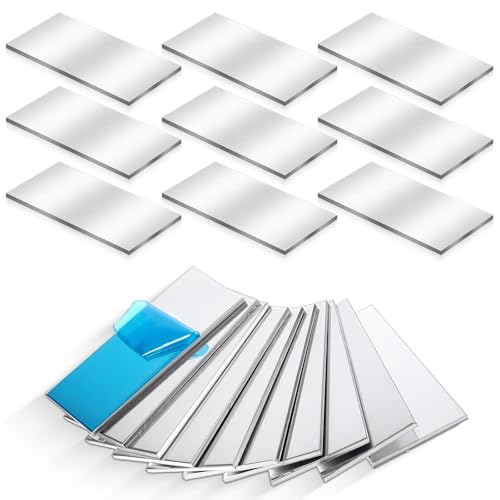
Detailed Dimensions with Ample Quantity: Our package includes 20 pieces of aluminum sheet welding kit, each crafted to precise dimensions of 2 x 4 inches (5 x 10 cm) with a thickness of 1/8 inches (3 mm). These plates are perfect for tasks demanding precision, such as laser cutting and professional welding, delivering consistent results every time.

♛【What You Get】: You will get 5pcs welding coupons, which is 100mm/3.9inch in length, 50mm/1.96inch in width. Sufficient quantities and commonly used size of welding coupons are enough for your daily welding requires.

6061 T6 Aluminum Sheets: The welding plate kit includes 32 welding coupons, each measuring approximately 2” x 4”/5cm x 10cm with a thickness of 1/8”
Join the Panel Using the OEM Method
Once fit-up, measurements, and test coupons pass, tack or fasten the panel in the sequence required by the repair procedure. Recheck alignment before completing the joint.
A vehicle maker may require one or more of the following:
- Squeeze-type resistance spot welding.
- Gas-shielded MAG or GMAW plug welds.
- MAG butt welding in an approved sectioning location.
- MIG brazing.
- Structural adhesive used with welds, rivets, or other mechanical fasteners.
- Complete assembly replacement at factory seams.
Do not replace the specified process merely because another welder is available. Each process creates a different heat-affected zone, joint geometry, stiffness, and corrosion-protection challenge.
Place the welder ground clamp on clean parent metal as close as practical to the weld. Do not allow welding current to travel through a wheel bearing, suspension joint, electronic module, braided ground strap, or other unintended path.
Control heat by following the specified weld sequence and allowing cooling time where required. Do not quench a weld unless the OEM procedure expressly permits it. Rapid cooling can affect metal properties and may hide distortion until the panel is released.
A smooth bead is not proof of a safe unibody repair. The correct steel identification, joint design, wire, settings, measurements, and corrosion protection matter as much as appearance.
Do Not Add Reinforcement Plates Unless Specified
Do not add a backing plate, fish plate, sleeve, doubler, or continuous seam weld to a unibody simply because the repair looks stronger with more metal. Extra reinforcement can bridge a designed crush area, change load transfer, cover a drain, interfere with trim, create a hard stress transition, or trap moisture.
Use a reinforcement only when the VIN-specific procedure shows its shape, material, thickness, location, attachment method, and corrosion protection. A factory-supplied internal reinforcement is not permission to fabricate a different one.
| Question | Required Answer Before Continuing |
|---|---|
| Does the OEM procedure show the reinforcement? | Yes, including its exact part or fabrication specification |
| Is the section a single-layer approved area? | Yes; no hidden stiffener, patch, or multi-layer load path crosses the cut |
| Are drains, foam, adhesive, and coating locations documented? | Yes; the finished repair will reproduce them without trapping water |
| Can the specified joint be tested before installation? | Yes; matching coupons pass the required test |
| Do measurements remain within specification after tacking? | Yes; otherwise remove the temporary joint and correct the fit |
Troubleshoot Weld Defects Before Continuing
Stop when a test coupon or vehicle weld shows a defect. Grinding the surface smooth does not correct poor fusion underneath.
| Problem | Likely Causes | Corrective Action |
|---|---|---|
| Porosity or pinholes | Rust, sealer, oil, coating residue, poor gas coverage, drafts, or a leaking gas system | Remove the defective weld, clean to sound metal, correct shielding-gas delivery, and retest on coupons |
| Burn-through | Thin parent metal, excessive heat, poor fit, oversized gap, or incorrect settings | Cut back to full-thickness steel, correct the joint, lower heat only within the approved setup range, and repeat the coupon test |
| Cold lap or poor fusion | Insufficient heat, incorrect wire speed, coating at the weld, poor gun angle, or failure to fuse the lower layer | Remove the defective joint, restore clean access, correct the setup, and verify fusion destructively on a coupon |
| Panel distortion | Forced fit, poor bracing, excessive weld length, wrong sequence, or inadequate cooling time | Stop welding, remeasure, release stress only as the repair procedure allows, and correct fit before continuing |
| Excessive spatter or unstable arc | Wrong polarity, contaminated wire, poor ground, incorrect settings, coating at the arc, or gas trouble | Check the welder, consumables, polarity, ground, preparation, and gas before making another vehicle weld |
| Crack beside or through the weld | Wrong wire, incompatible steel, excessive restraint, contamination, poor joint design, or too much heat | Stop the repair and verify the steel, wire, joint, and OEM procedure before removing or replacing the affected section |
Protect the Repair From Rust
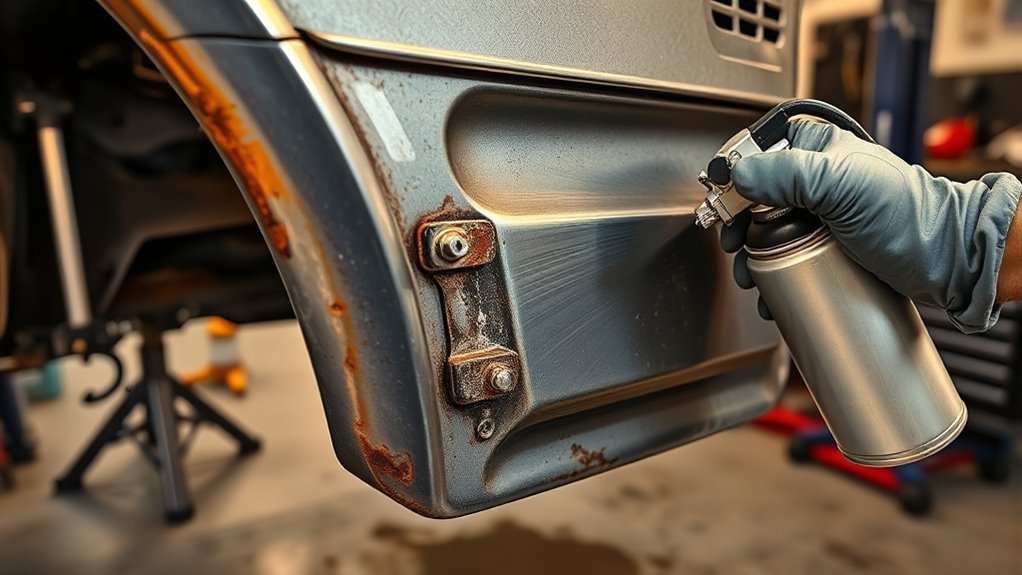
Welding, cutting, grinding, and panel separation remove factory e-coat, galvanizing, seam sealer, and cavity protection. Restore each layer identified in the repair procedure after the joint has cooled and passed inspection.
- Remove weld residue and contamination without thinning the surrounding panel.
- Inspect the uncoated weld before filler, sealer, or paint hides it.
- Apply the specified epoxy, direct-to-metal, or other approved primer to exposed steel.
- Apply seam sealer in the required location, shape, and thickness.
- Restore chip-resistant coating or underbody coating where the factory used it.
- Apply cavity wax to the back of welds and inside closed sections after paint and sealer operations are complete.
- Keep drain holes, vent paths, threaded inserts, and attachment points clear.
3M’s collision-repair corrosion guidance identifies cavity wax as important for restoring protection inside rocker panels, pillars, and other closed cavities. Its guidance also explains that zinc-based coatings provide sacrificial protection to steel, while copper can accelerate steel corrosion.
Do not treat product guidance as a substitute for the vehicle procedure. The OEM controls where primer, adhesive, sealer, foam, undercoating, and cavity material belong.
Inspect the Repair Before Driving
Inspect the bare joint and body alignment before seam sealer, filler, undercoating, or trim hides the work. Compare the final result with the OEM procedure and the measurements recorded before cutting.
- Confirm diagonal, datum, height, and opening measurements.
- Check door, hood, hatch, glass, latch, hinge, and weatherstrip fit.
- Inspect weld spacing, nugget size, fusion, penetration, cracks, porosity, undercut, and burn-through.
- Confirm that required adhesives, rivets, and fasteners are present and cured.
- Inspect brake lines, fuel lines, wiring, modules, trim, insulation, and coatings for heat or spark damage.
- Confirm that drains, vents, access holes, and water paths remain open.
- Verify seam-sealer, primer, underbody, chip-coating, and cavity-wax coverage.
- Reconnect electrical and restraint systems only in the specified sequence.
- Check for warning lights and complete any required diagnostic scan, initialization, calibration, or aiming procedure.
- Have wheel alignment and body dimensions checked when the repair was near a suspension or subframe area.
Do not road-test the car when a door no longer closes normally, a steering or restraint warning remains on, alignment cannot be set, a body measurement differs from specification, or a repair weld has not passed inspection.
When to Use a Professional Frame Shop
A professional collision or frame shop is the correct choice when the repair requires anchoring, pulling, three-dimensional measurement, resistance spot-welding access you do not have, advanced-steel wire or equipment, hybrid/EV isolation, structural adhesive control, scanning, or calibration.
Get professional help for:
- Kinked, crushed, torn, or heat-damaged rails.
- Strut towers, control-arm mounts, subframe mounts, or other suspension pickup points.
- Inner rockers, rocker reinforcements, A-pillars, B-pillars, roof rails, or door-ring assemblies.
- Seat mounts, seat-belt anchors, airbag sensors, or restraint-system structures.
- Hybrid/EV battery enclosures or damage near high-voltage components.
- Unknown high-strength, ultra-high-strength, press-hardened, or boron-alloyed steel.
- Multi-layer corrosion for which the OEM does not publish an approved sectioning procedure.
- Unequal wheelbase or body dimensions, changed glass openings, or suspension that will not align.
- A required weld or joint that your equipment cannot reproduce on a test coupon.
A qualified shop can measure the shell, identify the material and repair procedure, anchor or pull the body when permitted, reproduce specified joints, restore corrosion protection, scan affected systems, and document whether the car is safe to return to service.
Frequently Asked Questions
Can unibody frame damage be repaired?
Some unibody damage can be repaired, but the vehicle maker’s procedure must permit the repair. Local corrosion in a sectionable outer panel is different from a kinked rail, pillar, rocker reinforcement, suspension mount, or crash-energy structure. Structural deformation normally requires professional measuring and repair equipment.
How much does it cost to have a car frame welded?
There is no reliable flat price. Cost depends on teardown, measuring, steel type, replacement-panel availability, welding or bonding equipment, corrosion spread, scanning, calibration, refinishing, and the location of the damage. A useful quote requires inspection and, in many cases, partial teardown.
Can you fix a car frame by welding?
Only when the OEM repair information allows welding at that exact location and identifies the steel, joint, wire, settings, and supporting steps. Do not weld over rust or improvise on rails, pillars, suspension areas, restraint mounts, battery enclosures, or unknown advanced steel.
How much does it cost to get a chassis welded?
The damage must be identified before cost can be estimated. Labor rate, body measurements, panel construction, hidden rust, replacement parts, required joining methods, refinishing, corrosion protection, and safety-system work all affect the total.
Is MIG or TIG better for unibody repair?
Neither process is automatically best. Many steel collision repairs use gas-shielded MAG or GMAW, commonly called MIG, while others require squeeze-type resistance spot welding, MIG brazing, adhesive and rivets, or complete panel replacement. Do not substitute TIG for a process specified by the OEM.
Can I weld a rusty rocker panel without replacing the whole rocker?
Sometimes an OEM-approved outer-rocker section can be replaced, but only after the inner rocker, reinforcement, pinch weld, floor connection, and pillar tie-ins are inspected. A small outer patch does not restore strength when a hidden layer is thin, perforated, or made from steel that cannot be sectioned there.
Should I use weld-through primer before plug welding?
Only when the vehicle maker and joining procedure call for it. Some current OEM procedures limit zinc-rich weld-through primer to resistance spot welding and prohibit it for MAG plug welds, butt welds, or MIG brazing. Follow the coating preparation and post-weld primer steps for the exact vehicle.
How do I know whether my test weld is strong enough?
Make matching coupons and test them using the OEM or welder procedure. The test should confirm the required weld nugget, fusion, penetration, or joint failure pattern. Surface appearance alone is not enough. If the coupon separates at the weld or shows porosity, cracks, or poor fusion, correct the setup before welding the car.
Conclusion
If you repair localized unibody rust at home, start with the VIN-specific factory repair information rather than the grinder. Identify every steel layer, confirm that sectioning is allowed, brace and measure the shell, expose the full corrosion boundary, and prove the welding setup on matching coupons.
Use only the specified joint, wire, settings, adhesive, fasteners, and coating process. Do not add generic reinforcement plates or substitute a familiar welding method for the required one. Restore every corrosion-protection layer and verify body measurements, closures, warning lights, drains, and any affected alignment or safety systems before driving.
When the damage reaches a load path, restraint mount, suspension point, advanced-steel assembly, or hybrid/EV structure, professional measurement and repair are not optional extras. They are part of restoring the vehicle safely.
Sources
- OSHA 29 CFR 1910.252 — Welding, Cutting, and Brazing — hot-work fire prevention, combustible-material control, fire-watch conditions, ventilation, and post-work monitoring.
- American Honda Body Repair Manual Welding & Sectioning Guideline Revisions, September 2025 — steel-strength limits, approved welding methods, wire selection, primer restrictions, and sectioning rules.
- Toyota Technical Information System — manufacturer access point for model-specific repair manuals, wiring diagrams, bulletins, and service information.
- General Motors Electrical Best Practices — welding-ground placement, wiring protection, battery disconnection, airbag disabling, and electrical precautions.
- 3M Collision Repair Corrosion Protection Resources — cavity wax, seam sealing, undercoating, weld-through coating, and closed-cavity corrosion protection.