Underwater welding can pay well, but the biggest figures shared online often leave out the hard parts: years of training, irregular project schedules, unpaid downtime, medical requirements, and the fact that only a small share of commercial divers move into deep offshore or saturation work. The most reliable U.S. benchmark is the broader Commercial Divers occupation, which includes underwater welding along with inspection, cutting, rigging, salvage, construction, and repair.
Quick Answer
The current U.S. median wage for Commercial Divers, the closest national benchmark for underwater welders, is $72,990 per year. The 10th percentile is $43,330, while the 90th percentile is $157,790. Offshore, hyperbaric, and saturation contracts can pay more, but there is no universal day rate or guaranteed six-figure salary.
Key Takeaways
- The best current U.S. benchmark is the 2025 wage data for Commercial Divers: a $72,990 median and $157,790 90th percentile.
- Those figures cover the full commercial-diving occupation, not only workers who weld underwater.
- Actual annual income depends on utilization, overtime, diving mode, location, qualifications, contract terms, and unpaid time between projects.
- Saturation work is a specialist career path, not an entry-level job or an automatic route to $200,000 a year.
- Commercial-diving competency, welding qualifications, medical fitness, dive-team support, and strict operating procedures matter more than recreational scuba experience.
Getting the work right takes far more than laying a clean bead. A commercial underwater welder must combine diving skills, construction awareness, welding knowledge, communications discipline, physical fitness, and the ability to follow a detailed procedure in cold water, current, low visibility, and elevated pressure. This guide explains what the current salary data really shows, why offshore pay varies so much, and what it takes to build a credible career in the field.
Image by waylanderwelding
What Does a Deep-Sea Underwater Welder Actually Do?
An underwater welder is usually a commercial diver first and a welder as part of the job. The worker may inspect a structure, clean marine growth, remove damaged steel, set rigging, position a patch, install bolts, take measurements, perform nondestructive testing, cut metal, or complete a weld during the same project.
The U.S. Department of Labor’s Commercial Divers occupation profile includes work on ships, bridge foundations, pipelines, cables, platforms, water intakes, pilings, and other underwater structures. Welding is one possible duty within that larger occupation, which is why national wage data should be treated as a benchmark rather than an underwater-welder-only salary survey.
Many jobs use surface-supplied breathing gas and a hard helmet connected to the dive station by an umbilical. The umbilical may carry breathing gas, communications, a safety line, power, and hot water. The diver remains in voice contact with the surface team while a designated person in charge coordinates the operation.
A typical repair may include the following work:
- Reviewing the dive plan, hazards, drawings, welding procedure, and emergency plan.
- Inspecting the breathing-gas system, communications, helmet, thermal protection, reserve gas, tools, and electrical equipment.
- Descending to inspect, measure, photograph, clean, or prepare the damaged area.
- Positioning a patch, clamp, support, or habitat with help from riggers and the surface team.
- Cutting or welding only when the supervisor authorizes the operation and the electrical circuit is controlled according to procedure.
- Completing visual inspection, measurements, photography, or nondestructive examination after the repair.
- Recording dive time, depth, decompression information, equipment use, and job results.
Projects occur in inland waterways, ports, shipyards, dams, power facilities, offshore oil and gas fields, offshore wind developments, and salvage operations. Not all commercial divers work in the open ocean, and not every offshore diver performs deep mixed-gas or saturation work.
Note: “Deep-sea underwater welder” is a popular search term, not a separate federal occupation with its own national wage survey. Reliable salary comparisons normally begin with Commercial Divers data and then account for the specific contract.
How Much Does a Deep-Sea Underwater Welder Make in 2026?
The latest national figures available through O*NET use 2025 Bureau of Labor Statistics wage data for Commercial Divers. The national median is $72,990 per year, or $35.09 per hour. These figures cover workers across commercial-diving duties and industries, not only deep-water welders.
The current national wage range runs from $43,330 at the 10th percentile to $157,790 at the 90th percentile for the broader Commercial Divers occupation.
| National Percentile | Annual Wage | Hourly Wage | How to Read It |
|---|---|---|---|
| 10th percentile | $43,330 | $20.83 | A lower-end national benchmark, not a guaranteed starting wage |
| 25th percentile | $54,810 | $26.35 | Below the national median across the occupation |
| Median | $72,990 | $35.09 | Half of reported workers earn less and half earn more |
| 75th percentile | $101,550 | $48.82 | Upper-quarter national benchmark |
| 90th percentile | $157,790 | $75.86 | High-end benchmark across the occupation |
These percentiles are more defensible than a table that assigns a salary to a certain number of years in the trade. A diver with several years of experience can still have a weak annual total during a slow project year. Another diver may earn more during a short period because of overtime, travel, a difficult location, a specialist qualification, or a well-utilized offshore rotation.
Note: Wage percentiles are not promises. They do not tell you how many days a contractor will offer, whether travel is paid, or how much time you may spend waiting between projects.
Why Reported Underwater Welder Salaries Vary So Much
Two job advertisements can show similar headline rates and produce very different annual incomes. Compare the complete compensation package rather than multiplying a day rate by 365.
Base wage or day rate
Inland and coastal employees may receive an hourly wage. Offshore contractors may be paid by the day, shift, trip, or rotation. A quoted day rate may apply only while the worker is offshore, on the vessel, in saturation, or actively assigned to a project.
Overtime and shift length
Twelve-hour shifts, overtime rules, night work, weekends, and holiday provisions can materially change total pay. Ask whether the quoted figure already includes overtime or whether overtime is calculated separately.
Saturation, depth, and specialist allowances
Some agreements add saturation, depth, bell, habitat, hazardous-work, supervisory, or specialist allowances. These are contract terms, not universal entitlements. In the UK North Sea, the Offshore Diving Industry Agreement establishes minimum rates and employment conditions for covered work.
Standby and weather delays
Wind, waves, vessel availability, equipment problems, permits, and client decisions can stop diving. A strong contract explains whether standby, weather days, travel days, mobilization, demobilization, and canceled shifts are paid.
Utilization and downtime
A high rate is less valuable when the worker receives only a few paid rotations. Annual income depends on how consistently the contractor can place the diver and how much unpaid time falls between jobs.
Location and tax treatment
Remote work may include lodging, meals, travel, per diem, or offshore accommodations. Tax treatment can also differ by employment status and jurisdiction. Compare gross compensation, reimbursed expenses, benefits, insurance, retirement contributions, and out-of-pocket costs.
Pro Tip: Ask for a sample pay calculation covering one normal shift, one overtime shift, one weather day, one travel day, and one canceled day. That reveals more than the headline rate alone.
What to Ask Before Accepting an Offshore Diving Rate
Before comparing offers, get the important terms in writing. A practical checklist includes:
- Is the position an employee role or an independent contract?
- Is pay hourly, daily, per shift, per trip, or per rotation?
- When does paid time begin and end?
- How are overtime, nights, weekends, and holidays calculated?
- Are standby, weather, travel, mobilization, and demobilization paid?
- Does the company guarantee a minimum number of days or rotations?
- Which saturation, depth, bell, habitat, supervisory, or specialist allowances apply?
- Who pays for medical examinations, certifications, visas, travel, lodging, meals, and training?
- Which tools and personal protective equipment does the employer supply?
- What insurance, disability coverage, medical evacuation, and death benefits apply?
- What happens if the project is delayed or canceled?
- Which jurisdiction, collective agreement, or company policy controls the contract?
For covered U.S. federal prevailing-rate employees, 5 CFR 532.281 authorizes a special schedule. Employees performing diving duties receive 175% of the locality WG-10 step 2 rate for payable shift hours. That formula is useful as a federal reference, but it does not establish private offshore pay.
How Pay Changes as Your Responsibilities Grow
Commercial-diving careers do not follow one fixed pay ladder. Responsibility, competence, work availability, and the type of operation matter more than a simple year count.
| Career Stage | Typical Responsibilities | Main Pay Drivers | Important Reality |
|---|---|---|---|
| Tender or entry dive-team worker | Equipment handling, umbilical management, setup, maintenance, logs, and supervised tasks | Local wage scale, overtime, travel, union or company agreement | Graduation does not guarantee immediate full-time diving work |
| Qualified commercial diver | Inspection, cleaning, rigging, tools, installation, repair, and approved cutting or welding tasks | Competency, diving mode, project demand, location, hours, and utilization | Many divers perform several construction tasks rather than welding every day |
| Experienced specialist | Nondestructive testing, complex rigging, burning, welding, inspection, habitat work, or specialist equipment | Recognized qualifications, client approval, task complexity, and responsibility | Specialist credentials help only when projects require them |
| Supervisor or person in charge | Planning, briefings, risk control, team assignments, procedures, records, and emergency coordination | Supervisory qualification, jurisdiction, team size, and operation type | Greater responsibility can raise pay but also increases legal and safety duties |
| Saturation diver | Mixed-gas work from a saturation system and diving bell during specialist offshore campaigns | Agreement rates, sat allowance, rotation length, depth, project, and utilization | It is a selective specialist path with demanding medical, training, and experience requirements |
A new worker often starts by tending, maintaining equipment, managing umbilicals, helping with rigging, and proving reliability. Employers assign dive-team tasks according to each worker’s training and experience. The first goal is not a dramatic salary figure; it is becoming a safe, useful member of the crew who can be trusted with progressively harder assignments.
Training and Certifications for Underwater Welding
There is no single U.S. federal “underwater welder license” that replaces all other qualifications. Employers must ensure that dive-team members have the experience or training required for their assigned tasks, equipment, diving mode, emergency procedures, first aid, CPR, and relevant diving physics and physiology. Those requirements appear in 29 CFR Part 1910 Subpart T.
A common career path looks like this:
- Build topside trade skills. Learn fit-up, joint preparation, cutting, grinding, rigging, inspection basics, and welding processes used by target employers.
- Complete recognized commercial-diving education or equivalent training. A program should cover surface-supplied diving, decompression, emergency procedures, equipment, communications, tools, physics, physiology, and practical work.
- Pass required medical evaluations. Hyperbaric exposure and demanding physical work require continuing medical fitness.
- Enter a dive team and build documented experience. Expect tending, equipment work, maintenance, and supervised assignments before complex dives.
- Qualify for the procedure and project. The employer or client may require specific welding, cutting, inspection, NDT, rigging, or offshore credentials.
- Add specialist training only when it fits the career path. Mixed-gas, bell, supervisor, inspection, or saturation qualifications require additional experience and employer acceptance.
Santa Barbara City College’s Marine Diving Technologies program is one current example of formal commercial-diving education. It lists training connected with commercial diving, surface-supplied equipment, underwater work, and industry-recognized organizations. It is an example, not the only acceptable route worldwide.
Warning: Recreational scuba certification alone does not prepare a worker for commercial construction, surface-supplied operations, underwater electrical work, decompression management, or employer-assigned welding tasks.
Wet vs. Dry Underwater Welding
The AWS D3.6M:2017 Underwater Welding Code covers welding performed in both wet and dry underwater environments. The approved welding procedure specification, weld class, inspection plan, client requirements, and site conditions determine what process can be used.
| Technique | Advantages | Limitations | Typical Use | Procedure Notes |
|---|---|---|---|---|
| Wet welding | Faster mobilization and direct access to the structure | Rapid cooling, difficult visibility, hydrogen concerns, porosity risk, and demanding inspection | Approved repairs, temporary work, attachments, or applications where the specified weld class permits it | Use underwater-rated consumables, qualified personnel, an approved WPS, controlled current, and the required inspection method |
| Dry or habitat welding | Better visibility, fit-up, environmental control, and potential for weld quality closer to topside work | Higher cost, more equipment, longer setup, access limits, and pressurized-environment complexity | Critical structures, high-integrity joints, risers, nodes, and repairs requiring stricter quality control | Control atmosphere, shielding, preheat, consumables, pressure effects, and inspection according to the qualified procedure |
Wet welding is not simply ordinary shielded metal arc welding performed in water. Water pressure, cooling rate, gas behavior, visibility, electrode condition, joint access, and electrical control all affect the operation. Amperage must follow the qualified procedure, consumable instructions, and site conditions rather than a general rule to turn the current up or down.
Products Worth Considering

Diameter 5/64-Inch
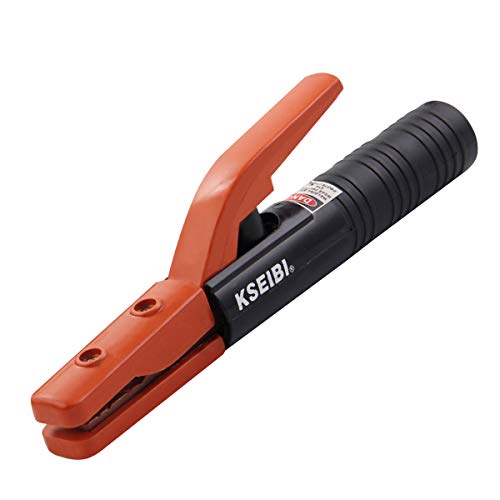
This Electrode holder is Made from high quality materials for high conductivity and improved cable connections. Supplied with an allen wrench and cable connection ferrule, assuring efficient connnection and minimizing cable strand breakage at the connection.
Gear Used in Commercial Underwater Welding
Commercial-diving equipment is part of an integrated life-support and work system. Depending on the diving mode and project, that system can include:
- A commercial diving helmet or mask with two-way voice communications.
- A surface-supplied breathing-gas system with an independent reserve.
- An umbilical carrying gas, communications, strength member, and other services.
- A diver-carried bailout or reserve breathing-gas supply when required.
- A dry suit, hot-water suit, gloves, harness, weights, and other thermal protection.
- Video, lighting, depth monitoring, and recording equipment.
- Hydraulic, pneumatic, mechanical, inspection, rigging, cutting, and welding tools.
- A welding power source with a controlled circuit, suitable leads, return connection, insulated holder, and approved consumables.
An insulated holder such as the Broco BR-21 underwater welding stinger and underwater consumables such as ESAB Arcair SEA-WELD electrodes are examples of purpose-built products. The employer, approved procedure, compatibility requirements, and client specification determine the actual equipment.
Major life-support equipment is normally controlled, inspected, and maintained through the employer’s diving system. Workers may still pay for some personal clothing, hand tools, medical examinations, renewals, travel, or training, depending on the contract. Those costs should be clarified before accepting an offer.
Products Worth Considering

Electrode holder is made of high quality brass material with insulated handle

Durable Material: ARCCAPTAIN electrode holder is made of high quality copper as well as insulating materials to ensure high efficiency and safety while welding.
The Real Risks of Underwater Welding
Commercial diving combines hyperbaric exposure with construction hazards. The risks can include drowning, decompression sickness, gas-supply failure, entanglement, differential pressure, vessel movement, falling or suspended loads, contaminated water, hypothermia, electric shock, burns, poor visibility, tool injuries, and communication failure.
The CDC and NIOSH commercial-diving overview reports 460 nonfatal occupational injuries and illnesses involving days away from work and 39 fatal occupational injuries among commercial divers during 2011–2017. Those figures describe that historical period; they are not a current annual death rate.
Federal commercial-diving rules require qualified team members, a designated person in charge, a safe-practices manual, pre-dive planning, equipment inspection, emergency information, breathing-gas reserves, communications, and procedures suited to the diving mode. Offshore projects may also use the IMCA International Code of Practice for Offshore Diving and additional national, client, flag-state, or contractor rules.
Warning: Underwater welding current must be controlled from the surface under the approved procedure and supervisor’s commands. Grounding, lead placement, insulation, gloves, communications, and equipment condition are parts of the complete system. A diver should never improvise electrical isolation or energize a circuit outside the dive plan.
Nitrogen narcosis and deep exposure
Nitrogen narcosis can impair judgment, coordination, and awareness as depth and nitrogen partial pressure increase. Management involves a controlled move to a shallower depth under the dive plan. Deep operations may use helium-based breathing mixtures to reduce nitrogen exposure. Gas selection, ascent, decompression, and emergency response belong to the diving supervisor and approved procedure; hyperventilation is not a remedy.
Why risk does not guarantee high pay
Hazardous work may attract allowances or stronger contract terms, but danger alone does not create a high annual salary. Contractors also price labor according to qualifications, project need, agreement coverage, competition, vessel cost, region, and available workforce. Safe performance and employability depend on controlling hazards, not accepting them casually.
What Is Saturation Diving?
Saturation diving is a specialist mixed-gas method used when repeated deep excursions would make separate decompression after every dive inefficient. Divers live in a pressurized chamber system at a storage depth and travel to the worksite in a closed diving bell. They remain under pressure during the working phase and complete one controlled decompression at the end of the saturation period.
The work involves a large surface team, chambers, bells, life-support technicians, gas systems, medical planning, backup systems, and detailed procedures. Saturation divers may perform inspection, construction, cutting, welding, connection, maintenance, and repair tasks, but they do not necessarily weld on every dive.
Saturation compensation may include a base rate, saturation allowance, depth-related terms, travel, standby, and other payments. A strong rotation can produce high gross earnings. However, access to saturation work depends on recognized commercial-diving experience, medical fitness, required training, contractor acceptance, project demand, and a limited number of available positions.
Note: A quoted saturation day rate is not the same as annual income. The number of paid days, applicable allowances, taxes, travel terms, and time between campaigns determine the final total.
Can an Underwater Welder Make $200,000 or More?
It is possible for a highly utilized specialist to exceed $200,000 in an unusually strong contract year, but that is not a dependable national salary expectation. The current 90th-percentile wage for the broader Commercial Divers occupation is $157,790.
Claims of routine $200,000–$300,000 starting salaries often assume a premium day rate is paid every day of the year. Real contracts may include unpaid gaps, limited rotations, project cancellations, seasonal work, training time, travel, medical downtime, and expenses. Some workers also quote gross contract revenue rather than employee wages after costs.
A more realistic comparison uses three numbers:
- Guaranteed compensation: Pay the contract promises regardless of optional overtime or future projects.
- Likely compensation: Guaranteed pay plus a reasonable estimate of expected rotations, overtime, and allowances.
- Best-case compensation: The total only if the project runs fully, every offered rotation occurs, and all premium terms apply.
This approach protects readers from treating a possible high-income year as a normal starting salary.
Where Do Underwater Welders Earn the Most?
There is no permanent best-paying location. High earnings usually appear where specialist demand, offshore activity, difficult logistics, collective agreements, and limited qualified labor overlap.
In the United States, compare current state and local figures through the O*NET Commercial Divers wage tool. Some state estimates may be unavailable or volatile because the occupation is small. A state with a high published percentile may still offer limited work or a high cost of living.
In the UK sector of the North Sea, covered contractors and workers operate under ODIA terms that address minimum rates, allowances, insurance, and other conditions. Elsewhere, pay may depend on national diving regulations, union agreements, contractor policies, vessel arrangements, and individual negotiation.
Look beyond geography. Nuclear facilities, inland infrastructure, contaminated-water operations, complex inspection, offshore construction, salvage, and hyperbaric repairs can carry different requirements and compensation even when the work is not technically “deep sea.”
Commercial Diver Job Outlook for 2026 and Beyond
O*NET currently marks Commercial Divers as a Bright Outlook occupation. Its 2026 profile reports approximately 4,200 workers in 2024, projected growth of 7% or higher from 2024 to 2034, and approximately 400 projected openings over the projection period.
The occupation is small, so project awards, offshore investment, infrastructure budgets, energy markets, and regional regulations can produce noticeable swings in hiring. Offshore wind, bridge and port maintenance, water infrastructure, inspection, salvage, and life-extension work can support demand. Remotely operated vehicles and robotic tools may take over some inspection or repetitive tasks, but human divers remain important where projects require judgment, rigging, fit-up, tool handling, repair, or rapid adaptation.
The projection applies to all Commercial Divers. It does not guarantee an equal number of underwater-welding, offshore, or saturation openings.
Wrapping Up: A Realistic Path to Better Underwater Welding Pay
The deep sea underwater welder salary can be attractive, but the most reliable current benchmark is the broader Commercial Divers wage distribution: a $72,990 national median and a $157,790 90th percentile. Premium offshore and saturation contracts may exceed those figures, yet no public national table supports a universal $1,000 day rate or a guaranteed $200,000 salary.
The practical route is to build strong topside trade skills, complete suitable commercial-diving training, maintain medical fitness, become dependable on a dive team, document experience, and add specialist qualifications when real project demand supports them. Compare complete contracts rather than headline rates, and treat safety procedures as part of the profession—not as an obstacle to earning more.
Frequently Asked Questions
How much does an entry-level underwater welder make?
There is no official national wage band based only on entry-level underwater-welding experience. The 10th and 25th percentile benchmarks for all U.S. Commercial Divers are $43,330 and $54,810. A new worker’s actual pay depends on the employer, region, hours, tending duties, overtime, travel, and available projects.
Can underwater welders really make $200,000 a year?
A highly utilized specialist may exceed $200,000 in an exceptional contract year, but it is not a normal starting salary or a guaranteed national benchmark. The current 90th percentile for the broader Commercial Divers occupation is $157,790. Annual totals depend heavily on paid rotations, allowances, overtime, and downtime.
What is the difference between wet and dry underwater welding?
Wet welding places the arc directly in the water. It can be faster to deploy but faces rapid cooling, visibility, hydrogen, porosity, and inspection challenges. Dry welding isolates the joint in a pressurized habitat, improving environmental control and fit-up at the cost of more equipment, planning, and setup. AWS D3.6M:2017 covers both environments.
Do I need a college degree to become an underwater welder?
A four-year degree is not normally required. Workers commonly complete commercial-diving education, employer training, an apprenticeship-style progression, or another recognized pathway. They must also demonstrate competence for assigned diving and welding tasks, maintain medical fitness, and meet employer, client, and jurisdiction requirements.
Is there one required underwater welding license?
No single U.S. federal license replaces commercial-diving training, employer competency checks, medical requirements, and job-specific welding qualifications. Credentials vary by employer, client, diving mode, jurisdiction, weld class, and project specification.
How dangerous is underwater welding?
It is high-hazard work involving hyperbaric exposure, breathing-gas systems, electricity, tools, rigging, currents, limited visibility, decompression, and construction activity. CDC/NIOSH reports 460 nonfatal cases involving days away from work and 39 fatalities among commercial divers during 2011–2017. Qualified teams, maintained equipment, communications, planning, and strict procedures reduce risk.
What does a saturation diver do?
A saturation diver lives in a pressurized chamber system during a deep offshore campaign and travels to the worksite in a closed bell. The diver may inspect, install, connect, cut, weld, or repair subsea equipment. Saturation work requires specialist experience, training, medical fitness, and contractor acceptance.
Where are the best-paying underwater welding jobs?
Pay changes with offshore activity, specialist demand, collective agreements, project risk, logistics, and available labor. The UK North Sea uses ODIA terms for covered work, while U.S. wages vary by state, employer, and industry. Compare total paid days, overtime, allowances, expenses, and downtime rather than location alone.
Sources
- O*NET OnLine — Commercial Divers Wages — 2025 U.S. wage percentiles and hourly benchmarks.
- O*NET OnLine — Commercial Divers Occupation Profile — duties, employment, outlook, and occupation scope.
- 29 CFR Part 1910 Subpart T — U.S. commercial-diving qualifications, planning, equipment, and operating requirements.
- CDC/NIOSH — Commercial Diving — documented hazards and 2011–2017 injury and fatality figures.
- American Welding Society — AWS D3.6M:2017 — requirements for wet and dry underwater welding.
- IMCA — International Code of Practice for Offshore Diving — offshore-diving operational guidance.