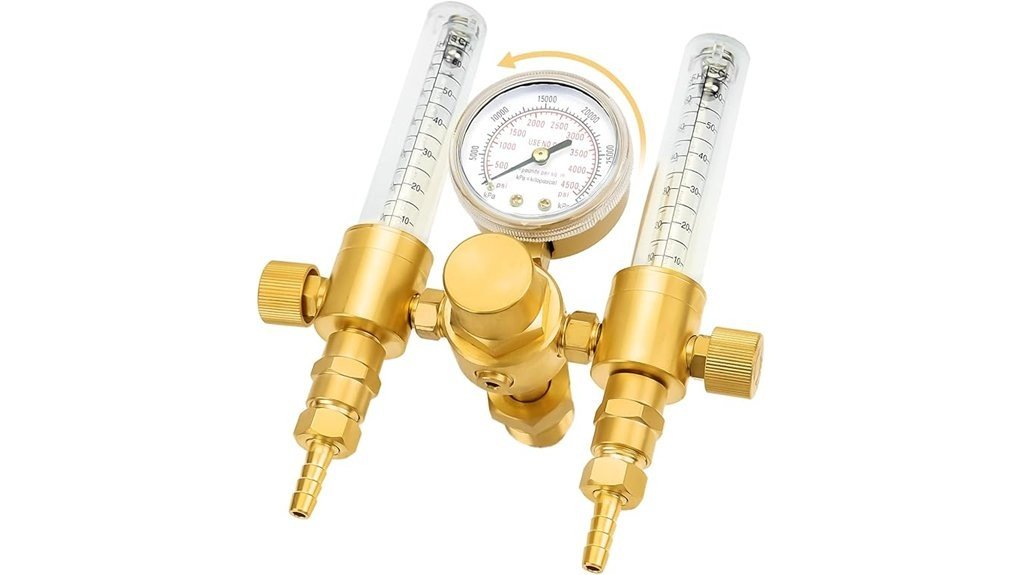
This dual output argon regulator flow meter has two outlets with independent flow control, listed for MIG and TIG gas supply with a gauge up to 4500 PSI and a 0 to 60 CFH flow range. It is worth considering if you run two welders or two stations from one argon cylinder. Skip it if you only have one machine, since a single-outlet regulator is simpler and often cheaper.
Dual Output Argon Regulator at a Glance
| Item | Per the listing |
|---|---|
| Outlets | Two, with independent flow adjustment |
| Flow range | 0 to 60 CFH |
| Cylinder gauge | Up to 4500 PSI |
| Body | Brass |
| Weight and size | About 2.6 lb, 7.6 x 6.3 x 5.0 in |
| Verify | Cylinder inlet, outlet threads and gas rating |
What It Is and Who It Suits
A normal regulator and flow meter sends gas to one torch. This dual-output design splits the supply into two lines, each with its own flow meter, so two welders can share a cylinder. That is handy in small shops, classrooms and garages where TIG and MIG machines sit side by side.
It suits shops that want to save on cylinder rental and regulator costs, and welders who switch between processes without moving gas hoses. If you only run one machine at a time, a single regulator keeps things tidy.
How to Check It Fits Your Setup
- Cylinder connection: Argon and argon/CO2 cylinders typically use CGA 580. Confirm the regulator inlet before ordering.
- Outlet threads: Check the thread on both outlets and whether your hoses use matching nuts or barbed stems.
- Gas type: Argon is the main use. For CO2 or other gases, confirm the rating before buying.
- Flow range: 0 to 60 CFH is useful for MIG. TIG often needs lower flow, so check the scale is readable at the low end.
- Total flow: Both outlets draw from the same cylinder, so the combined use matters.
Pros and Limitations
Pros
- One cylinder can feed two machines, with separate flow settings.
- Brass body and a gauge range suited to full cylinders.
- Compact enough for bench and wall use.
Limitations
- Gas runs out faster when both outputs are used.
- Product listing gives limited detail on the gas rating and warranty.
- More ports mean more connections to leak test.
Setup and Safety Tips
- Chain the cylinder upright and clear the valve of dust before fitting the regulator.
- Tighten the inlet nut with a proper wrench and back the flow adjusters out.
- Open the cylinder valve slowly and stand beside the gauge.
- Leak test the inlet, both outlets and each hose with soapy water.
- Cap or plug any unused outlet so it does not leak.
- Set each flow meter while its machine is purging gas, then re-check after changing cup size or torch.
Alternatives and Related Guides
- For a single-outlet argon unit, see the Meanlin argon regulator review.
- The WeldingStop argon/CO2 regulator review covers a regulator with a hose.
- For a branded argon regulator, read the Miller 30 Series flow gauge regulator review.
- To feed several cylinders into one line, see the Western Enterprises MB-70 manifold block review.
Frequently Asked Questions
What does a dual output argon regulator let me do?
Per the listing it has two outlets with independent flow control, so you can feed two machines, such as a TIG welder and a MIG welder or two stations, from one cylinder. Each outlet has its own flow adjustment, but both draw from the same cylinder supply.
Can I use it with CO2?
The listing is not consistent about this, so do not assume it. Argon and argon/CO2 mixes use a CGA 580 cylinder connection, while pure CO2 normally uses a CGA 320 connection. Confirm the inlet fitting and the gas rating with the seller before use.
How long will a cylinder last with two outputs?
Both outlets draw from the same cylinder, so run time drops when both machines are in use. Add the flow set on each outlet to estimate consumption in cubic feet per hour, then compare with the contents of your cylinder size.
Does it need check valves on each output?
It is wise to add check valves or use hoses with them where your setup allows, so gas from one outlet cannot flow back through a disconnected line. Follow the manufacturer instructions and check that the outlet threads match your hoses.
Verdict
A dual-output regulator makes sense for a shop running two machines from one argon cylinder. Confirm the inlet fitting, outlet threads and gas rating on the current listing before ordering.