Disclosure: As an Amazon Associate, we earn from qualifying purchases. If you click a link on this page and make a purchase, we may receive a small commission at no extra cost to you.
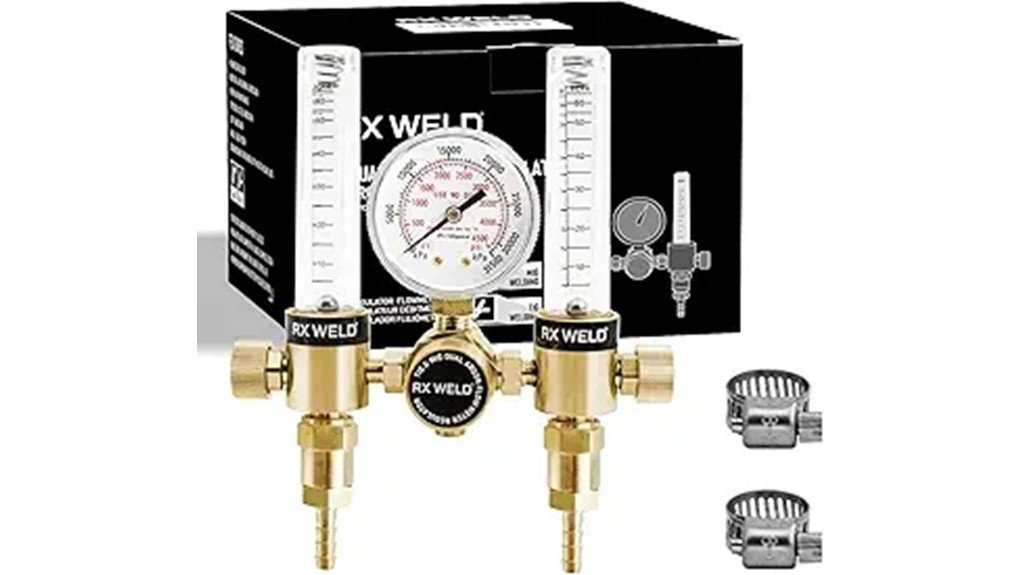
A shielding-gas regulator must match your cylinder, hose, and welding process before its extra features matter. The RX WELD Dual Output Argon Flow Meter, model QYS1, combines a CGA-580 inlet, two 0-60 CFH flow-control outlets, a 0-4500 PSI cylinder-pressure gauge, and a brass body. Its dual-output layout can simplify a two-line bench setup, but the extra fittings also create more points to inspect for leaks. This review explains the verified connection details, included adapters, gas compatibility, setup needs, and limits so you can decide whether it fits your MIG or TIG system.
Quick Verdict
Rating: Recommended with caveats, 8.2/10
Best For: Home and small-shop MIG/TIG welders who use a compatible CGA-580 shielding-gas cylinder and need two independently adjustable gas lines.
Bottom Line: The RX WELD QYS1 offers useful 0-60 CFH dual-flow control, brass construction, and several outlet options at a value-focused level. Its main tradeoffs are limited published warranty documentation and the need to verify every cylinder and hose connection before pressurizing it.
| Specification | Detail |
|---|---|
| Brand | RX WELD |
| Model / part number | QYS1 |
| Product type | Dual-output shielding-gas regulator and flow meter |
| Flow range | 0-60 CFH |
| Cylinder-pressure gauge | 0-4500 PSI |
| Inlet connection | CGA-580 |
| Outlet connections | Female 9/16-18 nut and male 5/8 UNF-18RH fitting |
| Included adapter | 1/4-inch hose-barb adapter |
| Body material | Brass |
| Listed gas compatibility | Argon, helium, nitrogen, and compatible argon/CO2 shielding-gas cylinders using CGA-580 |
| Welding processes | MIG and TIG shielding-gas setups |
| Item weight | 2.44 lb |
| Package dimensions | 7.36 x 6.3 x 5.59 inches |
| Package quantity | One regulator/flowmeter assembly |
| Safety note | Not an oxygen regulator; use only with the correct gas and matching cylinder valve |
| Warranty note | A clear manufacturer warranty term is not published in the listing details reviewed |
Key Takeaways
- The RX WELD QYS1 combines two 0-60 CFH flow controls with a 0-4500 PSI cylinder-pressure gauge.
- The CGA-580 inlet is the first fit check. Your cylinder valve must match before you consider hose adapters or downstream connections.
- The listing includes a male 5/8 UNF-18RH fitting, a female 9/16-18 nut, and a 1/4-inch hose-barb adapter.
- The brass body and dual-output layout suit a fixed garage or small-shop setup better than a welder who needs only one simple gas line.
- Do not use it with oxygen. Also, do not assume it fits a standard pure CO2 cylinder just because the listing mentions CO2-compatible shielding-gas use.
What Is the RX WELD Dual Output Argon Flow Meter?
The RX WELD QYS1 is a shielding-gas regulator with two vertical flow-control tubes. It is designed for MIG and TIG setups that use a compatible CGA-580 cylinder. The 0-4500 PSI gauge shows cylinder-side pressure, while the 0-60 CFH flow scale helps you set gas delivery to the welding process.
The main selling point is the dual-output layout. You can run two compatible gas lines from one cylinder, such as two machines at a shared bench or a welding line plus another approved shielding-gas line. Each added hose and fitting must still be rated for the gas service and checked for leaks.
The listing identifies a brass body, model QYS1, a male 5/8 UNF-18RH outlet, a female 9/16-18 nut, and a 1/4-inch hose-barb adapter. Those details make the regulator more flexible than a basic single-outlet unit, but they do not remove the need to confirm every thread and cylinder connection.
Who Should Buy It?
Best For
- MIG or TIG welders using a CGA-580 argon, helium, nitrogen, or compatible argon/CO2 mixed-gas cylinder.
- Garage and small-shop users who need two separately controlled gas outputs from one cylinder.
- Buyers who want a brass regulator body and several outlet connection options without moving to a premium industrial unit.
Skip If
- You need an oxygen regulator, a standard CGA-320 pure CO2 connection, or any gas service not confirmed for this unit.
- You use only one gas line and prefer the fewer leak points of a single-output flowmeter.
- You require published calibration data, industrial certifications, or a clearly stated manufacturer warranty.
Before You Buy: Confirm the cylinder valve first, then match the outlet fitting and hose. CGA-580 is common for argon and several inert or mixed shielding gases, but standard pure CO2 cylinders often use a different connection. Never force an adapter or use this unit for oxygen.
Flow Range and Dual-Output Control
The RX WELD QYS1 uses a 0-60 CFH flow range, which covers the common adjustment range used for many MIG and TIG shielding-gas jobs. The correct setting still depends on your process, cup or nozzle size, joint position, drafts, and gas type. More flow is not always better because excessive flow can create turbulence and waste gas.
The 0-4500 PSI gauge is a cylinder-pressure reference, not a flow gauge. It helps you monitor cylinder pressure, while the vertical flow tubes show the gas-delivery setting. Read the floating ball at the point specified by the product instructions, and adjust gas while it is flowing through the system.
Two outlets are useful when you truly need two lines. They can reduce cylinder swapping at a shared bench, but both lines draw from the same gas supply. Opening a second line can affect total gas use and makes it more important to recheck both flow settings before welding.
Gas Metering and Everyday Performance
A tube-style flow meter gives you a direct visual reference for gas flow instead of asking you to estimate delivery from sound or torch feel. That can make setup more repeatable, especially when you move between MIG and TIG work or use two machines with different flow needs.
The useful part of the dual design is independent adjustment. You can close one line while using the other or set each line for its own approved application. The limitation is that this is still a value-focused regulator. The listing does not publish calibration tolerance, test certification, or long-term accuracy data.
Use the 0-60 CFH scale as a setup tool, then judge the weld by shielding quality, drafts, nozzle condition, and the procedure recommended for your machine and consumables. If the ball sticks, the tube is damaged, or the reading changes without an adjustment, stop and inspect the system before continuing.
Durability and Build Quality
The regulator body is listed as brass, which is a practical choice for threaded gas equipment that may be installed and removed in a garage or shop. The assembly weighs about 2.44 pounds, so it has more mass than a lightweight gauge-only accessory but is still manageable for bench use.
The vulnerable parts are the gauge lens, flow tubes, adjustment valves, and outlet fittings. Do not lift the cylinder by the regulator, use the flow tubes as handles, or store heavy tools against the assembly. A hard impact can damage a gauge or create a leak even when the brass body still looks intact.
Good threading is part of build quality. Connections should start by hand, align without side load, and seat with the correct tool and sealing method for that fitting. Cross-threading or forcing a mismatched connection can ruin the regulator and create a pressurized-gas hazard.
Setup Tips Before First Use
Secure the cylinder upright before attaching the regulator. Confirm the cylinder valve is CGA-580, inspect the regulator inlet and cylinder seat for damage or contamination, and make sure the adjustment valves are in the position required by the product instructions before pressurizing the system.
Stand to the side of the regulator and open the cylinder valve slowly. Watch the pressure gauge for a stable reading, then check the inlet, outlets, adapters, and hose connections with an approved leak-detection method. Never search for a leak with a flame.
Connect only gas-rated hose and downstream equipment that match the listed outlet fittings. Adjust flow with gas moving through the line, then recheck the setting after the second output is opened or closed. When the job is finished, close the cylinder valve and relieve downstream pressure according to your welder and regulator instructions.
Pro Tip: Label the two hoses at the regulator and the machine ends. Clear labels reduce mix-ups when each line uses a different flow setting or serves a different welder.
Compatibility and Safety
The Amazon listing identifies this regulator for CGA-580 cylinders and names argon, helium, nitrogen, and argon/CO2 shielding-gas use. The cylinder connection controls compatibility. A gas name alone is not enough because suppliers may use different valves for pure gases, mixtures, pressure classes, or regions.
This is not an oxygen regulator. Oxygen systems use gas-specific equipment and strict contamination controls, so do not use an adapter to make this CGA-580 regulator fit an oxygen cylinder. The same rule applies to fuel gases and any cylinder that does not match the regulator’s listed service.
Inspect the regulator, gauge, flow tubes, hoses, and fittings before each use. Close the cylinder and remove the equipment from service if you find a leak, damaged tube, bent fitting, unreadable gauge, or threads that no longer seat cleanly. Repairs to pressure regulators should be handled by a qualified service provider.
Shielding gases can displace oxygen in a closed space. Use the regulator in a properly ventilated work area, secure the cylinder against falling, and close the cylinder valve when the system is not in use.
How It Performs in Real Use
For a Home Garage MIG Setup
For one MIG welder, the QYS1 gives you a readable 0-60 CFH scale and several outlet options. It works best when your cylinder is already CGA-580 and your hose matches one of the listed fittings. A single-output model may be simpler if you never plan to use the second line.
For a Shared MIG and TIG Bench
The dual-output design is most useful when a MIG machine and TIG machine share one compatible shielding-gas cylinder. You can route one line to each machine and close the unused side. Recheck flow whenever you switch machines because hose length, torch setup, and downstream restrictions can change the reading you need.
For Purging or a Second Approved Gas Line
A second outlet can support an approved purge line while the other line feeds the torch, provided both uses are compatible with the same gas and regulator. This can be useful for stainless TIG work, but it increases gas consumption and makes accurate labeling and leak checks more important.
For Repeated Setup and Storage
The included outlet options make frequent setup easier, but repeated handling also increases the chance of cross-threading or impact damage. Start fittings by hand, cap clean connections during storage, and protect the pressure gauge and flow tubes from tools and metal stock.
Pros and Cons
Pros
- Two independently adjustable 0-60 CFH flow tubes support a two-line bench setup.
- CGA-580 inlet fits many common argon, helium, nitrogen, and mixed shielding-gas cylinders.
- Brass body is better suited to regular shop handling than a plastic-heavy assembly.
- Includes male 5/8 UNF-18RH, female 9/16-18, and 1/4-inch hose-barb connection options.
- 0-4500 PSI gauge gives a clear cylinder-pressure reference.
Cons
- Not compatible with oxygen and should not be assumed to fit a standard pure CO2 cylinder.
- Two outlets create more fittings and potential leak points than a single-output regulator.
- The listing does not provide clear calibration tolerance, industrial certification, or manufacturer warranty terms.
Is It Worth the Price?
The RX WELD QYS1 is a value-focused choice for welders who will use both outputs and already own a compatible CGA-580 cylinder. Its 0-60 CFH range, brass body, and included outlet adapters cover the features most home and small-shop buyers need without moving into a premium industrial price tier.
You get less value if the second output will stay capped for the life of the regulator. A simpler single-output flowmeter has fewer fittings to maintain and may be easier to store. Buyers who need traceable calibration, a published warranty, or documented industrial approvals should compare higher-tier regulators before ordering.
How It Compares to Alternatives
Compared with a basic single-output argon flowmeter, the RX WELD QYS1 gives you a second controlled line and more included connection options. The tradeoff is extra bulk, more leak-check points, and features you may not use in a one-machine garage.
Comparable dual-output models from SPARC and YESWELDER are worth checking for current outlet layouts, support, and warranty wording. The RX WELD makes the most sense when its exact CGA-580 inlet, 0-60 CFH range, included adapters, and value-focused positioning match your setup.
Frequently Asked Questions
What is the flow range of the RX WELD QYS1?
The listing gives a 0-60 CFH flow range and a separate 0-4500 PSI cylinder-pressure gauge. Set flow while gas is moving through the line, and use the value recommended for your welding process and torch setup.
Which gases and cylinders are compatible?
The listing names argon, helium, nitrogen, and argon/CO2 shielding-gas service with a CGA-580 inlet. Compatibility depends on the cylinder valve, so confirm the actual connection with your gas supplier before purchase.
Will it fit a standard pure CO2 cylinder?
Do not assume it will. Many standard pure CO2 cylinders use a different valve connection than CGA-580, even though argon/CO2 mixed shielding-gas cylinders commonly use CGA-580. Check the valve number before ordering.
Can I use this regulator with oxygen?
No. This is a CGA-580 shielding-gas regulator, not an oxygen regulator. Use only gas-specific equipment that matches the cylinder and application.
What outlet fittings are included?
The listing identifies a female 9/16-18 nut, a male 5/8 UNF-18RH fitting, and a 1/4-inch hose-barb adapter. Match the hose and downstream equipment to the correct outlet rather than forcing or improvising a connection.
How should I check it before welding?
Inspect the inlet, gauge, flow tubes, adjustment valves, hoses, and fittings. Secure the cylinder, open the valve slowly while standing to the side, and use an approved leak-detection method at every connection before welding.
Who should choose a single-output regulator instead?
A single-output unit is usually the cleaner choice when you run one welder from one cylinder and do not need a purge or second machine line. It has fewer fittings to inspect and may take up less room.
What warranty does RX WELD provide?
A clear manufacturer warranty period was not published in the listing details reviewed. Check the current seller page and included paperwork before relying on warranty coverage or service support.
The Bottom Line
The RX WELD QYS1 is recommended with caveats for garage and small-shop welders who need two 0-60 CFH gas lines from a compatible CGA-580 cylinder. Its main strengths are the brass body, dual flow control, and included outlet options; its main limits are the extra leak-check points and limited published warranty or calibration documentation. Choose a different regulator if you need oxygen service, a standard pure CO2 connection, or verified industrial certification.
Ready to Buy?
Confirm your cylinder valve and hose fittings, then check the latest product details before you decide.