Disclosure: As an Amazon Associate, we earn from qualifying purchases. If you click a link on this page and make a purchase, we may receive a small commission at no extra cost to you.
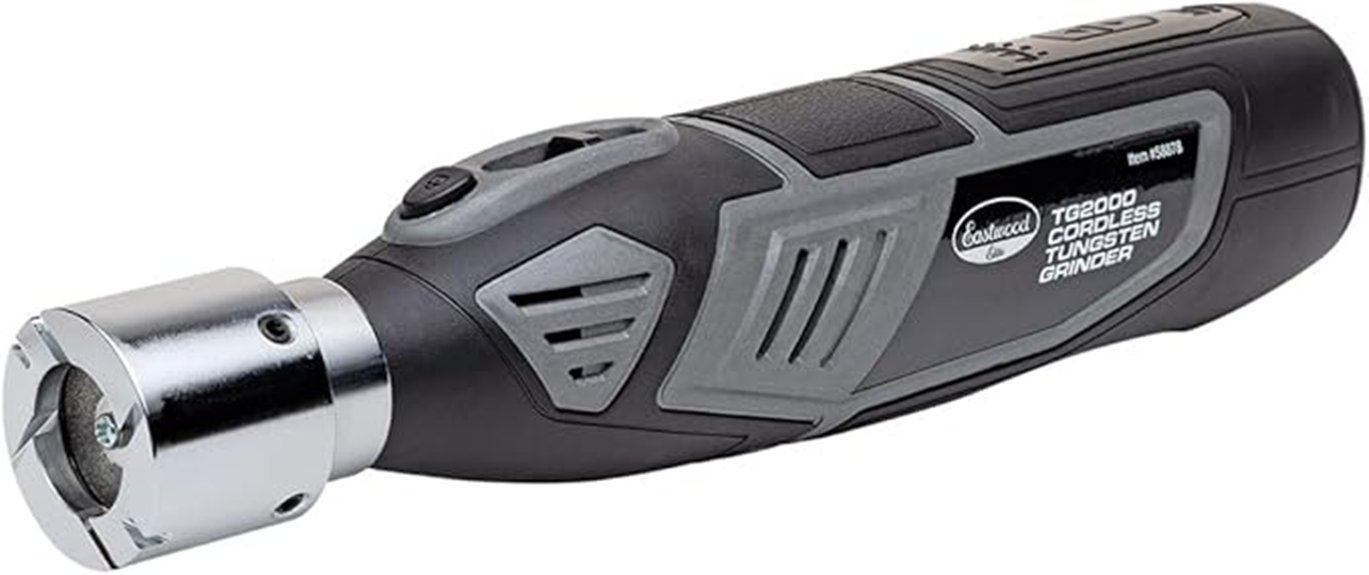
Grinding TIG tungsten by hand on a bench grinder can waste time, create inconsistent points, and make it harder to repeat the same arc behavior from one weld to the next. The Eastwood Elite TG2000 Cordless TIG Welder Tungsten Grinder is built to solve that problem with fixed guide slots, a cordless body, and a double-sided diamond wheel. This review helps you decide if it fits your welding setup, especially if you use 1/16-inch or 3/32-inch tungsten electrodes. Its biggest strength is repeatable sharpening away from the bench, while its main limitation is narrow size and angle compatibility.
Quick Verdict
Rating: 8.4/10
Best For: TIG welders who want portable, repeatable tungsten sharpening for 1/16-inch and 3/32-inch electrodes.
Bottom Line: The Eastwood Elite TG2000 is a practical cordless tungsten grinder for cleaner, more consistent electrode prep. Skip it if you need more tungsten sizes, more grind angles, or a heavy-duty stationary grinder for continuous shop use.
| Specification | Detail |
|---|---|
| Brand | Eastwood |
| Model | Elite TG2000 |
| Product Type | Cordless TIG tungsten electrode grinder |
| Power Source | Rechargeable 12V lithium-ion battery |
| Battery Capacity | 12 VDC, 2000 mAh |
| No-Load Runtime | 20 minutes, listed as no-load runtime |
| No-Load Speed | 8,000 to 35,000 RPM, variable speed |
| Supported Tungsten Sizes | 1/16-inch and 3/32-inch tungsten electrodes |
| Grinding Angles | 10° and 22.5° guide slots |
| Grinding Wheel | 1-inch two-sided diamond and nickel-coated carbon steel wheel |
| Wheel Life Claim | Over 200 tungsten sharpenings per wheel, 100 per side |
| Tool Construction | Steel with silver and chrome-plated finish on listed tool construction |
| Useful Feature | Slots for breaking off burned tungsten tips |
| Certifications Listed | ETL certification listed for charger and tool; UL-listed battery noted in product details |
| Included Items | Grinder, installed diamond grinding wheel, wall charger, collet wrench, and instruction manual |
| Best Use | Portable tungsten prep for TIG welding, field work, tight spaces, roll cages, and jobs away from the welding bench |
What Is the Eastwood Elite TG2000?
The Eastwood Elite TG2000 is a cordless tungsten grinder made for TIG welders who want controlled electrode preparation without walking back to a bench grinder. It uses guide slots that hold 1/16-inch and 3/32-inch tungsten electrodes at fixed 10° or 22.5° angles. That design helps you create a more repeatable point with less guesswork.
The tool uses a 12V rechargeable lithium-ion battery, a variable-speed motor, and a 1-inch double-sided diamond grinding wheel. Eastwood positions it for frequent users who need a portable sharpening tool near the weld area, not just at a workbench.
It also includes a slot for breaking off burned tungsten tips before you reshape the point. That small detail matters when you contaminate an electrode and need to prep it quickly before continuing a bead.
Before You Buy: This grinder is designed for 1/16-inch and 3/32-inch tungsten electrodes only. Choose another option if you regularly use 1/8-inch tungsten or need more angle choices.
Who Should Buy It?
Best For
- TIG welders who use 1/16-inch or 3/32-inch tungsten most of the time.
- Fabricators who want a portable grinder near the workpiece instead of across the shop.
- Hobbyists who want more consistent tungsten points than freehand bench grinding.
Skip If
- You need to sharpen tungsten sizes outside 1/16-inch and 3/32-inch.
- You want several custom grind angles beyond 10° and 22.5°.
- You prefer a corded shop grinder for long, continuous sharpening sessions.
Key Features of the Eastwood Elite TG2000
The TG2000 focuses on repeatability. Instead of holding tungsten by eye against a wheel, you place the electrode into the correct slot for its size and angle. The grinder head includes machined guide slots for 1/16-inch and 3/32-inch tungsten at both 10° and 22.5°.
The double-sided diamond wheel gives you two usable abrasive surfaces. Eastwood lists the wheel for over 200 sharpenings total, split as about 100 sharpenings per side. That makes it more practical for repeated shop use than a light-duty abrasive wheel that wears quickly.
The cordless design also helps when you weld around a vehicle, roll cage, fixture, trailer, or frame section. You can keep the grinder close by, prep a fresh point, and return to the weld without changing your whole setup.
Design and Build Quality
The Eastwood Elite TG2000 uses a handheld body with a metal grinder head, on/off switch, speed adjustment controls, and battery charge indicators. Its listed tool construction includes steel with a silver and chrome-plated finish, while the product body is shown as a compact black cordless tool.
The grinder uses a sealed deep groove ball bearing for shaft support and a spindle lock for wheel work. Those details matter because tungsten grinding needs stable rotation and controlled contact with the wheel. A loose or unstable grinder can make it harder to create a clean, centered point.
The six-slot grinding head is the main design advantage. Four slots guide 1/16-inch and 3/32-inch tungsten at 10° or 22.5°, while two notches help break off damaged tips before grinding.
Compatibility and Tungsten Sizing
This grinder works with 1/16-inch and 3/32-inch tungsten electrodes, including all color-coded tungsten types listed for the product. That covers many common TIG welding jobs, especially light fabrication, automotive work, stainless projects, mild steel repairs, and general hobby welding.
The limitation is just as important. The TG2000 does not give you a universal open guide for every electrode diameter. If your welding work often uses 1/8-inch tungsten or specialty setups, you may need a different sharpener or a bench-mounted tungsten grinding system.
Grinding Angles and Arc Control
The TG2000 gives you two angle choices: 10° and 22.5°. A consistent taper helps the electrode behave more predictably, especially when you want stable arc starts and less wandering from a poorly shaped point.
The fixed guide slots help reduce user error. You still need to roll the tungsten as it contacts the diamond wheel, but the guide keeps the electrode aligned better than freehand grinding. That can make a real difference if you are learning TIG or trying to repeat the same weld settings across multiple joints.
Battery Life and Charging
The grinder uses a rechargeable 12 VDC lithium-ion battery rated at 2000 mAh. Eastwood lists a 20-minute no-load runtime, so real runtime can vary based on speed setting, pressure, wheel condition, and how often you start and stop the tool.
For most tungsten touch-ups, the runtime should be enough because each sharpening pass only takes a short time. It is not the best fit if you expect to sharpen large batches continuously without stopping, but it works well as a nearby prep tool during normal TIG welding.
The listing and manual note a wall charger, battery charge indicators, and charge-while-in-operation support. You should still charge it before a long welding session so you are not depending on a low battery when you contaminate an electrode mid-job.
Performance and Efficiency in Tungsten Grinding
Performance depends on three things: wheel condition, proper slot choice, and light pressure. The TG2000 performs best when you let the diamond wheel do the work instead of forcing the tungsten into the abrasive surface.
The variable no-load speed range of 8,000 to 35,000 RPM gives you control over how aggressively the grinder cuts. Eastwood notes that a middle speed is the default and that one higher setting is generally useful for tungsten grinding, though personal preference may vary.
For repeat work, the biggest benefit is consistency. Once you choose your tungsten size and preferred angle, the guide makes it easier to create the same general shape each time. That helps your workflow because you spend less time correcting uneven points.
Pro Tip: Use the correct slot for both tungsten diameter and angle, then roll the tungsten slowly while applying light pressure. Forcing the electrode into the wheel can shorten wheel life and create a rougher point.
How It Performs in Real Use
For Garage and Hobby TIG Welding
For a home garage or small welding bench, the TG2000 helps you avoid the guesswork of freehand sharpening. You can prep tungsten for thin steel, stainless, and small repair work without setting up a dedicated bench grinder wheel for tungsten only.
For Automotive Fabrication
The cordless design makes sense when you weld around frames, brackets, exhaust parts, or roll cage tubing. You can keep the grinder nearby, fix a contaminated point, and continue without walking across the shop.
For Field or Mobile Work
A battery-powered grinder is useful when your welding cart, work table, or power outlet is not close to the weld. The 20-minute no-load runtime is not meant for endless batch sharpening, but it suits quick tungsten prep between welds.
For Repeatable Shop Workflow
In a small professional shop, the TG2000 can help standardize tungsten prep among different users. The fixed 10° and 22.5° slots reduce variation, which is helpful when several people share a TIG station.
How to Use It Correctly
Start by charging the grinder fully and choosing the slot that matches your tungsten diameter and angle. Turn the tool on, give the motor a few seconds to reach speed, then place the tungsten into the guide slot.
Move the tungsten gently into the diamond wheel and roll it steadily as the point forms. Do not push hard. Heavy pressure can heat the electrode, wear the wheel faster, and make the point less even.
If the tungsten tip is burned or contaminated, use the correct break-off notch before grinding a fresh point. After grinding, turn the tool off before handling the electrode or making adjustments.
Safety Notes Before You Use It
Tungsten grinding creates dust and metal particles, so you should follow the manual and use proper protective equipment. Eye protection matters because abrasive surfaces can eject debris at high speed. Respiratory protection also matters because grinding dust can be hazardous, especially in a small or poorly ventilated workspace.
Keep loose clothing, long hair, jewelry, pets, and bystanders away from the grinder while it runs. The tool can create sparks, so avoid grinding near flammable materials. Wear work gloves when handling sharpened tungsten because the finished point can cut skin.
Turn the tool off before changing or flipping the diamond wheel. The manual describes wheel work using tools such as a 3mm hex key and a #1 Phillips screwdriver, which are not listed as included items.
Pros and Cons
Pros
- Fixed guide slots help you repeat 10° and 22.5° tungsten points.
- Supports common 1/16-inch and 3/32-inch tungsten sizes.
- Cordless body works well near vehicles, frames, fixtures, and tight weld areas.
- Double-sided diamond wheel is rated for over 200 total sharpenings.
- Includes wall charger, installed diamond wheel, collet wrench, and manual.
Cons
- Limited to 1/16-inch and 3/32-inch tungsten electrodes.
- Only two guide angles, so it may not fit every TIG preference.
- Battery runtime is listed as 20 minutes no-load, not continuous heavy-use runtime.
Is It Worth the Price?
The Eastwood Elite TG2000 is worth considering if you want a dedicated tungsten grinder without building a full bench-grinding setup. It gives you a more controlled sharpening process than freehand grinding, and the cordless format adds value if you move around your work area often.
It makes the most sense for welders who care about repeatability, portability, and cleaner tungsten prep. You get less value from it if you rarely TIG weld, only sharpen tungsten occasionally, or need a wider range of electrode sizes and angles.
Think of it as a convenience and consistency tool, not a universal tungsten grinding station. For the right user, that convenience can save time and reduce frustration during real welding work.
How It Compares to Alternatives
Compared with a standard bench grinder, the TG2000 is more portable and easier to use near the weld area. A bench grinder can be better for continuous shop use, but it requires more care to keep tungsten grinding clean, centered, and separate from general metal grinding.
Compared with corded rotary-tool-style tungsten sharpeners from brands such as YESWELDER or compact cordless sharpeners from brands such as DIDUEMEM, the Eastwood makes the most sense if you want Eastwood’s fixed-slot design, 12V cordless format, and included TIG-focused grinding head. Other alternatives may offer more angle choices, different power formats, or lower entry cost, so compare based on the tungsten sizes and angles you actually use.
Frequently Asked Questions
What tungsten sizes does the Eastwood Elite TG2000 sharpen?
It sharpens 1/16-inch and 3/32-inch tungsten electrodes. Those are common sizes for many TIG welding jobs, but this grinder is not listed for 1/8-inch tungsten.
What angles can it grind?
The guide slots support 10° and 22.5° grinding angles. Those fixed angles help you repeat the same general point shape, but they do not replace a fully adjustable tungsten grinder.
Does it work with all tungsten colors?
The product listing states that it works with all color-coded tungsten types in the supported sizes. You still need to choose the correct tungsten type for your TIG process and material.
How long does the battery last?
Eastwood lists a 20-minute no-load runtime. Actual use can vary because grinding pressure, speed setting, and start-stop use affect battery life.
What comes in the box?
The listed contents include the Eastwood Elite cordless tungsten grinder, an installed diamond grinding wheel, a wall charger, a collet wrench, and the instruction manual. Always check the current seller listing before purchase because package details can change.
Can you flip or replace the diamond wheel?
Yes. The manual explains how to remove the grinding head, flip the wheel to the fresh side, or replace it with a new wheel. It also notes tools such as a 3mm hex key and #1 Phillips screwdriver, which are not listed as included.
Is it safer than using a bench grinder?
It gives you a more controlled tungsten guide than freehand bench grinding, but you still need eye, respiratory, hearing, and hand protection. Grinding dust, sparks, sharp points, and moving parts still create hazards.
Who should skip the TG2000?
Skip it if your shop needs 1/8-inch tungsten sharpening, many custom angles, or continuous batch grinding. It is better as a portable TIG prep tool than a large stationary grinding system.
The Bottom Line
The Eastwood Elite TG2000 Cordless TIG Welder Tungsten Grinder is a strong choice if you want portable, repeatable sharpening for 1/16-inch and 3/32-inch tungsten electrodes. Its fixed guide slots, cordless design, and double-sided diamond wheel make tungsten prep easier, but its limited size and angle range will not suit every TIG setup.
Buy it if you want a dedicated tungsten grinder close to your work area. Skip it if you need broader compatibility, long continuous runtime, or full adjustability.