Flame Tech FTFG-25-AR Review: Quick Answer
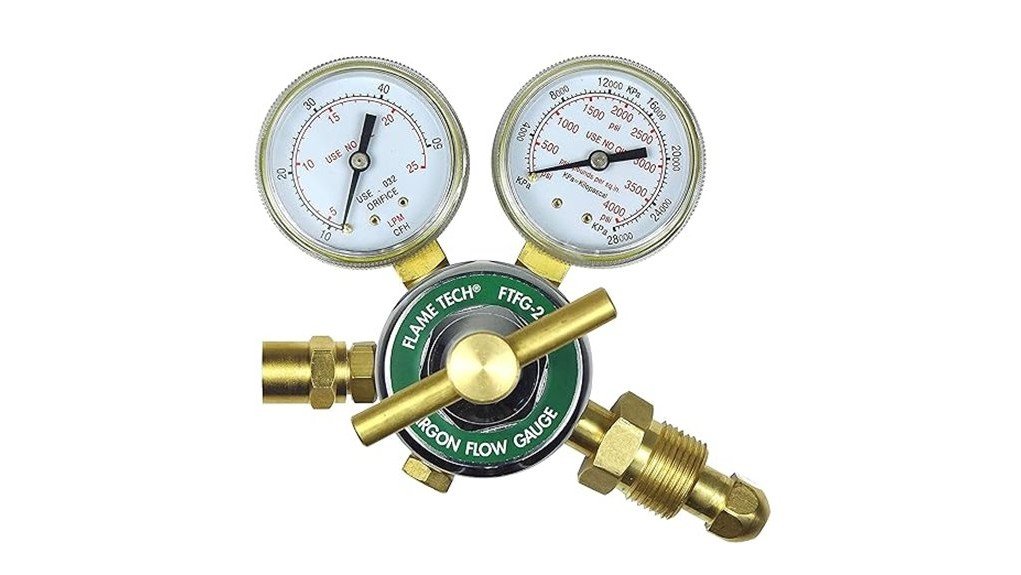
Shielding gas problems can turn a clean weld into a porous, inconsistent mess, so your regulator needs to match the cylinder and give you a clear flow reading. The Flame Tech FTFG-25-AR is a gauge-style argon regulator built for small-to-medium TIG and MIG operations, with an 8-45 SCFH flow range, a CGA 580 cylinder fitting, and two easy-to-read 2-inch gauges. Its forged brass body, plated bonnet, safety relief valve, and sintered inlet filter make it a practical shop tool. The main limitation is compatibility: you should buy it only for an approved argon setup that uses CGA 580.
Quick Verdict
Rating: Recommended with caveats
Best For: Home-shop and professional welders who need a dedicated argon flow gauge regulator for a CGA 580 cylinder.
Bottom Line: The FTFG-25-AR combines a durable brass body with a readable 8-45 SCFH gauge range. It is not a universal gas regulator, so cylinder fitting and gas approval must be confirmed before you connect it.
Before You Buy: Confirm that your cylinder uses a CGA 580 valve and that your shielding gas is approved for this regulator. Never force a regulator onto a different fitting or use an adapter to bypass gas-specific safety requirements.
Key Specifications
| Specification | Detail |
|---|---|
| Brand | Flame Tech |
| Model | FTFG-25-AR |
| Product type | Argon flow gauge regulator |
| Flow range | 8-45 SCFH |
| Gauge design | Two 2-inch, dual-scale gauges |
| Body material | Forged brass |
| Bonnet finish | Nickel-chrome plating |
| Cylinder fitting | CGA 580 for argon cylinders |
| Safety feature | Safety relief valve |
| Inlet protection | Sintered metal inlet filter |
| Intended use | Small-to-medium TIG and MIG operations using an approved argon setup |
| Packaging | Box-packaged FTFG-25-AR model |
| Amazon-listed package size | 8.03 x 7.17 x 4.53 inches |
| Amazon-listed weight | 2.46 pounds |
What Is the Flame Tech FTFG-25-AR?
The Flame Tech FTFG-25-AR is a cylinder-mounted regulator that displays shielding gas flow on a gauge rather than through a vertical ball-style flow tube. Flame Tech lists it for argon and equips it with a CGA 580 inlet, which is the fitting you must match before installation.
The regulator is aimed at small-to-medium TIG and MIG work where you want a compact gauge layout and an adjustable range of 8-45 SCFH. Its two 2-inch gauges let you monitor cylinder pressure and gas flow without relying on a clear flow tube that can be harder to protect in a busy shop.
This model is the box-packaged FTFG-25-AR. Flame Tech also identifies a clamshell-packaged FTFG-25-ARCS, so check the exact model suffix when packaging matters to you.
Who Should Buy It?
Best For
- TIG welders using an approved argon cylinder with a CGA 580 valve.
- MIG welders whose machine, wire, and shielding gas setup call for compatible argon delivery.
- Home shops and fabrication areas that prefer a protected gauge-style regulator over a tube-style flowmeter.
Skip If
- Your cylinder uses a fitting other than CGA 580.
- You need a CO2-specific regulator or another gas model.
- You need confirmed warranty, service, or replacement-part terms before purchase.
Build Quality and Materials
Forged Brass Body
The forged brass body is the main durability feature. It gives the regulator a solid metal housing for repeated cylinder changes and normal shop handling. Brass also suits gas-control equipment because it can be machined precisely, although the regulator still needs protection from drops, impact, moisture, and contamination.
Nickel-Chrome Plated Bonnet
Flame Tech uses nickel-chrome plating on the bonnet. The finish helps protect the outer surface and makes the regulator easier to wipe clean. It does not make the unit weatherproof, so you should store it in a dry area when it is not attached to a cylinder.
Sintered Metal Inlet Filter
The inlet filter is designed to trap particles before they move deeper into the regulator. This is useful when a cylinder is changed often or the shop has grinding dust and metal debris. The filter is a protective part, not a substitute for keeping the cylinder valve, regulator inlet, and hose connections clean.
Flow Control and Gauge Readability
The FTFG-25-AR covers 8-45 SCFH, a range intended for small-to-medium welding operations. That gives you room to adjust shielding gas for different torches, cup sizes, wire processes, and shop conditions, but the correct setting comes from your welder and torch instructions rather than a single universal number.
Two 2-inch, dual-scale gauges give you a larger face than many compact regulators. One gauge helps you monitor cylinder contents, while the flow gauge shows the delivery setting. The gauge-style design also avoids an exposed upright flow tube, which can be useful where equipment is moved or stored often.
Pro Tip: Set and confirm the flow while gas is moving through the torch. A static reading may not reflect the flow you get when the solenoid opens and the hose is supplying gas.
Compatibility and Safety
The model suffix “AR” identifies this as the argon version, and the cylinder fitting is CGA 580. A matching thread does not automatically approve every gas or application. Confirm the gas label, cylinder valve, hose connection, and welder requirements before use.
Secure the cylinder upright before installing the regulator. Inspect the inlet and cylinder valve for damage or contamination, and never apply oil or grease to gas fittings. Open the cylinder valve slowly while standing to the side of the gauges, then check connections with a leak-detection method approved by the regulator or gas supplier.
The built-in safety relief valve adds equipment protection if pressure rises where it should not. It does not replace correct installation, a secure cylinder, sound hoses, ventilation, or personal protective equipment. Stop using the regulator if a gauge is damaged, a connection leaks, or the flow cannot be controlled.
How It Performs in Real Use
TIG Welding in a Home Shop
For routine TIG work, the 8-45 SCFH range gives you enough adjustment for many common torch setups. The larger gauge faces help when the cylinder sits beside or behind the welding cart. You still need to account for cup size, drafts, torch angle, and post-flow settings.
MIG Welding With an Approved Argon Setup
The regulator can serve MIG equipment when the machine and shielding gas setup call for compatible argon delivery. Its gauge-style layout is easy to check before a weld and between jobs. Do not assume it fits a CO2 cylinder, because Flame Tech lists a separate FTFG-25-CD model with a CGA 320 fitting for CO2.
Repeated Fabrication Jobs
During repeated shop work, the forged brass body and plated bonnet are more reassuring than a lightweight plastic housing. The inlet filter also provides a layer of protection against particles during cylinder changes. A damaged gauge or bent inlet can still make the unit unsafe, so durability should not lead to careless handling.
Portable Welding Carts
The compact gauge design can work well on a mobile welding cart because there is no vertical metering tube sticking upward. Keep enough clearance around the gauges and adjustment control, and secure the cylinder so the regulator cannot strike a wall, doorway, or workpiece while the cart moves.
Setup Tips and Common Mistakes
- Match the fitting first: Verify CGA 580 on the cylinder before buying or connecting the regulator.
- Read the gas label: Use only a gas and process approved by the product instructions and your welding equipment.
- Protect the inlet: Keep the regulator capped or stored clean when it is off the cylinder.
- Check flow under use: Trigger the torch or machine gas control, then adjust within the approved range.
- Watch for drafts: More flow is not always better. Excessive flow can waste gas and create turbulence at the weld.
- Close down safely: Follow the manufacturer’s shutdown procedure, including closing the cylinder and relieving line pressure when required.
Maintenance and Storage
Before each use, look for a cracked lens, bent connection, damaged threads, loose fittings, or a gauge that does not return as expected. Keep the gauge faces clean with a dry or lightly damp cloth, and do not spray solvents into the inlet or adjustment mechanism.
When the regulator is removed, store it in a dry place where the inlet cannot collect dust or metal grit. Do not try to repair an internal leak or recalibrate a damaged regulator unless the work is performed by an authorized service provider. Gas regulators are pressure-control devices, so replacement is safer than an improvised repair.
Pros and Cons
Pros
- Forged brass body supports regular shop use.
- Two 2-inch gauges are easier to read than very compact gauge faces.
- 8-45 SCFH range covers small-to-medium welding operations.
- Safety relief valve adds equipment protection.
- Sintered metal inlet filter helps trap particles.
Cons
- CGA 580 and argon-focused design limit compatibility.
- A gauge-style regulator is less direct to read than a ball-style flowmeter for some welders.
- Current warranty and replacement-part terms are not clearly confirmed in the source material.
Is It Worth the Price?
The Flame Tech FTFG-25-AR is worth considering if you want a durable gauge-style regulator for a compatible argon cylinder. Its value comes from the forged brass body, readable gauge faces, safety relief valve, inlet filter, and useful 8-45 SCFH adjustment range.
It offers the most value to welders who will use it regularly and already know that CGA 580 matches their cylinder. It is not the best fit if you want a universal regulator, a tube-style flowmeter, or fully documented warranty and service details before purchase.
How It Compares to Alternatives
A Victor gauge-style argon regulator may appeal to buyers who prioritize a widely established industrial service network. A Hobart or Miller argon flowmeter regulator may be easier to read if you prefer a vertical ball tube and can protect it from impact. YESWELDER offers lower-cost regulator and flowmeter options, but fittings, materials, accuracy claims, and service support vary by model.
The Flame Tech FTFG-25-AR makes the most sense when you specifically want a compact gauge-style unit, an 8-45 SCFH range, and forged brass construction for a CGA 580 argon cylinder.
Frequently Asked Questions
Does the Flame Tech FTFG-25-AR fit every argon cylinder?
No. It is listed with a CGA 580 argon cylinder fitting. Check the valve marking on your cylinder and do not use force or an unapproved adapter when the fitting does not match.
Can this regulator be used for CO2?
The FTFG-25-AR is the argon model with CGA 580. Flame Tech identifies a separate FTFG-25-CD model for CO2 with a CGA 320 fitting, so use the gas-specific version approved for your cylinder.
Is this a flow gauge regulator or a flowmeter?
It is a gauge-style flow regulator. It displays flow on a dial rather than through the floating ball and vertical tube used by many flowmeter regulators.
What flow setting should you use for TIG or MIG welding?
The regulator covers 8-45 SCFH, but the correct setting depends on the process, torch or gun, cup size, joint, gas, and air movement. Start with the range recommended by your welder or torch manufacturer and confirm flow while gas is moving.
How do you check the regulator for leaks?
Secure the cylinder, install the regulator as directed, open the valve slowly, and use a leak-detection method approved by the manufacturer or gas supplier. Stop and correct the problem if you see bubbles, hear gas escaping, or notice pressure dropping unexpectedly.
What is included with the FTFG-25-AR?
The model is identified as a box-packaged argon flow gauge regulator. The reviewed sources do not clearly confirm a hose or extra fittings, so check the current listing contents before ordering.
What warranty does Flame Tech provide?
Current warranty terms were not clearly verified for this exact listing. Review the Amazon seller information, package documents, and Flame Tech support terms before buying if warranty coverage is a deciding factor.
The Bottom Line
The Flame Tech FTFG-25-AR is a sensible choice for welders who need a compact, gauge-style argon regulator with CGA 580 compatibility, an 8-45 SCFH range, and a forged brass body. Skip it if your cylinder or gas requires another fitting, or if you prefer a ball-style flowmeter. Its strongest points are durable construction and readable gauges, while its main limitation is narrow gas and fitting compatibility.
Ready to Buy?
Check the latest price, seller details, and package contents before you decide.