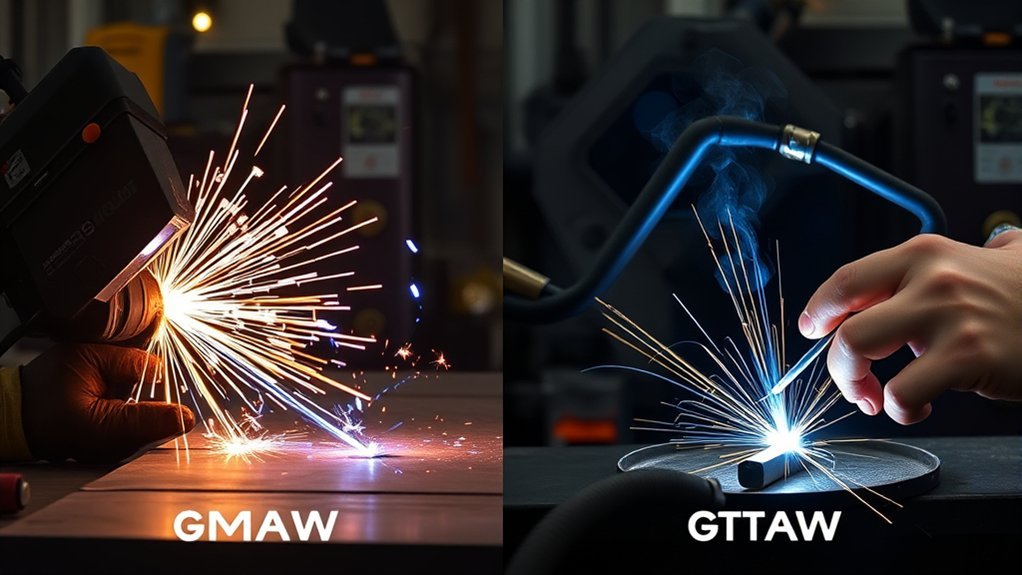
GMAW and GTAW can both make strong, professional welds, but they solve different problems. GMAW, often called MIG welding, uses a continuously fed wire electrode and favors speed, deposition, and easier training. GTAW, often called TIG welding, uses a non-consumable tungsten electrode and gives the welder finer control over heat, filler metal, and bead appearance. The better choice depends on the metal, thickness, joint, production needs, shop conditions, and required finish.
Quick Answer
Choose GMAW when speed, high deposition, easier setup, and repeatable production matter most. Choose GTAW when thin material, precise heat control, clean appearance, or sensitive metals matter more than speed. Neither process is automatically stronger; weld strength depends on joint design, filler, preparation, settings, technique, and the approved procedure.
Key Takeaways
- GMAW is usually faster because the consumable wire feeds continuously and supports higher deposition rates.
- GTAW gives the welder more direct control over arc length, amperage, filler addition, and puddle size.
- GMAW is generally easier to learn, while GTAW has a steeper coordination and setup learning curve.
- Both processes can weld steel, stainless, and aluminum, but equipment, current type, filler, gas, and technique must match the material.
- Both depend on shielding gas, so wind and drafts can cause porosity unless the work is protected.
- Safety and procedure control matter more than appearance, especially on structural, pressurized, vehicle, aerospace, or code-governed work.
GMAW vs. GTAW Comparison at a Glance
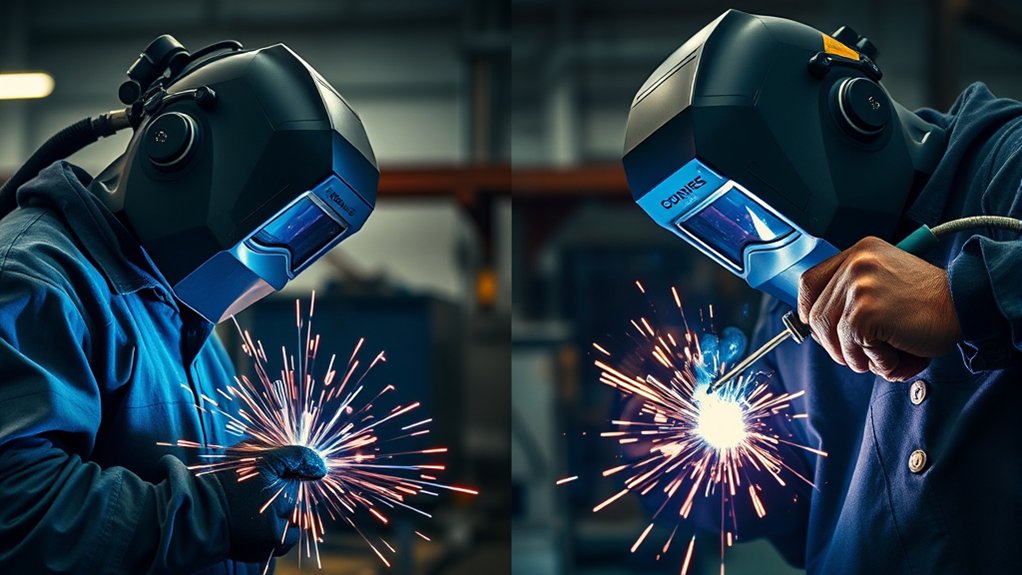
Use GMAW when the job values speed, repeatability, and a shorter learning curve. It is a strong fit for general fabrication, repair work, automotive sheet metal, brackets, frames, production fixtures, and many steel structures when the qualified procedure allows it.
Use GTAW when you need a neat bead, close heat control, or careful work on thin or sensitive material. It is common on stainless steel tubing, aluminum, titanium, chromoly, aerospace parts, sanitary tubing, motorsport parts, custom exhausts, and visible fabrication.
| Factor | GMAW / MIG | GTAW / TIG |
|---|---|---|
| Electrode | Consumable wire electrode that also supplies filler metal | Non-consumable tungsten electrode; filler is separate when needed |
| Speed | Usually faster, especially on repeated joints and production work | Usually slower because the welder controls more variables |
| Learning curve | Generally easier for beginners to start | More difficult to coordinate and master |
| Heat control | Controlled mainly through machine settings, travel speed, stickout, and technique | Fine real-time control with a pedal, fingertip remote, pulse settings, or torch movement |
| Weld appearance | Clean with correct settings, but some transfer modes can create spatter | Normally little to no spatter and strong cosmetic control |
| Outdoor use | Poor in wind unless the weld is screened and gas coverage is protected | Also sensitive to wind and drafts because shielding is critical |
| Best fit | Fabrication, repair, production, automation, and general steel work | Thin metal, tubing, visible welds, root passes, and sensitive alloys |
Quick Selection Checklist
- Choose GMAW for long welds, repeated joints, faster training, robotic work, and higher deposition.
- Choose GTAW for thin edges, small tubing, close puddle control, precise starts and stops, and cosmetic welds.
- Choose by procedure when the part is structural, load-bearing, pressurized, fatigue-sensitive, or inspected to a code.
- Choose another process when wind, dirty material, remote field work, or limited shielding-gas access makes both gas-shielded methods impractical.
What Is GMAW and How Does It Work?
Gas Metal Arc Welding, or GMAW, creates an arc between a continuously fed consumable wire electrode and the workpiece. The wire melts into the joint, so it acts as both the electrode and filler metal. Shielding gas flows through the gun to protect the molten pool and hot weld metal from the surrounding air.
In U.S. shop language, GMAW is often called MIG welding. More precisely, MIG uses an inert shielding gas, while MAG uses an active gas or active-gas blend. GMAW is the broader process name, so it covers the common argon-carbon dioxide blends used on steel as well as inert-gas setups used on aluminum.
GMAW is productive because you do not stop to replace a stick electrode or hand-feed a separate rod. Once voltage, wire-feed speed, gas flow, travel angle, work angle, and contact-tip-to-work distance are set correctly, the process can move quickly. That makes it useful for automotive repair, farm repair, trailers, fixtures, racks, brackets, and production welding.
GMAW is not a point-and-shoot process. You still need clean metal, good fit-up, correct polarity, the right wire and gas, and a steady travel speed. Poor setup can cause lack of fusion, porosity, undercut, burn-through, excessive spatter, or an unstable arc.
GMAW Transfer Modes
GMAW behavior changes with the transfer mode. The main modes are short-circuit, globular, spray, and pulsed spray. Modern waveform-controlled systems also use modified short-circuit and other controlled modes.
- Short-circuit transfer: Useful on thinner material and out-of-position work. It runs at lower heat, but poor settings or technique can increase spatter or lack-of-fusion risk.
- Globular transfer: Moves larger droplets across the arc and can be spattery. It is usually less desirable when a smoother transfer mode is available.
- Spray transfer: Produces a stable stream of small droplets at higher current. It supports high deposition and good fusion but normally needs an argon-rich gas and is usually limited to flat and horizontal positions because the pool is fluid.
- Pulsed spray: Alternates peak and background current to obtain spray-like transfer with lower average heat. It can reduce spatter and expand position and thickness capability when the equipment and procedure are matched correctly.
Transfer mode affects penetration, heat input, spatter, position capability, gas choice, and bead shape. Lincoln Electric’s pulsed MIG overview explains how pulsed transfer differs from short-circuit, globular, and conventional spray behavior.
GMAW Polarity and Power Source
Most solid-wire GMAW uses direct current electrode positive, or DCEP, with a constant-voltage power source. Do not assume every wire uses the same polarity. Follow the machine chart, filler-metal data sheet, and approved welding procedure because specialty wires and processes can differ.
What Is GTAW and How Does It Work?
Gas Tungsten Arc Welding, or GTAW, creates an arc between a non-consumable tungsten electrode and the workpiece. The tungsten carries the arc but is not intended to become filler metal. The welder may add a separate filler rod, use an automatic cold-wire feed, or make an autogenous weld without filler when the joint and procedure allow it.
Most people call GTAW TIG welding. It normally uses argon, helium, or an argon-helium blend. Because the torch, amperage, arc length, travel, and filler addition can be controlled separately, GTAW gives the welder close control over puddle size, bead shape, and heat placement. A current Miller TIG guide describes the non-consumable electrode, separate filler rod, and common argon shielding setup.
The tradeoff is speed and coordination. GTAW asks the welder to control torch angle, arc length, travel speed, amperage, filler timing, shielding, and puddle size at the same time. That makes it slower to learn, but well suited to thin stainless steel, aluminum, titanium, chromoly tubing, edge joints, root passes, and high-appearance work.
Note: TIG does not automatically mean stronger. Weld strength still depends on the base metal, joint design, filler classification, preparation, penetration, heat input, shielding, technique, and the welding procedure.
GTAW Current Type and Polarity
DC electrode negative, or DCEN, is the normal starting point for carbon steel, stainless steel, titanium, and many other alloys. AC is commonly used for aluminum and magnesium because the electrode-positive part of the cycle helps remove the oxide layer while the electrode-negative part provides penetration. Follow the equipment manual and procedure rather than treating AC or DC as a universal rule for every alloy and joint.
Speed and Efficiency: GMAW vs. GTAW
GMAW is usually faster because the filler wire feeds continuously through the gun. It supports higher deposition rates and long, uninterrupted welds when the machine, wire, gas, transfer mode, and joint are matched to the work.
GTAW is usually slower because the welder controls the arc and filler separately. That slower pace can be useful. It gives the welder more time to watch the puddle, manage a thin edge, control distortion, and place only the amount of filler needed.
Process Speed Comparison
Do not choose a process from one inches-per-minute number. Travel speed changes with material thickness, joint type, position, transfer mode, machine output, shielding gas, filler size, fit-up, and operator skill. As a practical rule, GMAW wins on deposition and throughput, while GTAW wins on direct puddle and heat control. A July 2026 Miller comparison makes the same distinction between control, heat management, and pacing.
Productivity in Welding
Productivity includes more than travel speed. It also includes preparation, fixture time, gas changes, cleanup, rework, inspection, consumable changes, and training. GMAW can save labor because it deposits metal quickly and is easier to teach. GTAW can save time when a precise weld reduces grinding, distortion, or rejected parts.
- Choose GMAW for volume: frames, brackets, general steel fabrication, repetitive joints, and automated cells.
- Choose GTAW for precision: thin stainless, aluminum tubing, titanium, root passes, small edge joints, and visible custom work.
- Choose by total job time: a fast pass is not productive if poor fit-up, wrong settings, or missed fusion causes rework.
Weld Quality and Appearance: GMAW vs. GTAW
Both GMAW and GTAW can produce sound, strong welds. The main difference is how the welder controls the pool and how much cleanup the selected mode may require.
GMAW can produce clean welds when the joint is prepared and the settings are correct. Spatter is most common when voltage, wire-feed speed, polarity, stickout, gas coverage, or transfer mode is wrong. Short-circuit and globular transfer are more likely to create spatter than a well-tuned spray or pulsed process.
GTAW normally creates little to no spatter because the tungsten does not feed into the pool and filler is added separately. A stable arc and close filler control help produce smooth beads and controlled edge tie-in. This is why GTAW is common on visible welds, aerospace parts, sanitary stainless tubing, motorsport fabrication, and art metalwork.
A smooth bead is not proof of a sound weld. Appearance cannot confirm root fusion, penetration, internal porosity, filler compatibility, or compliance with a qualified procedure.
GMAW vs. GTAW: Electrode Types and Their Impact
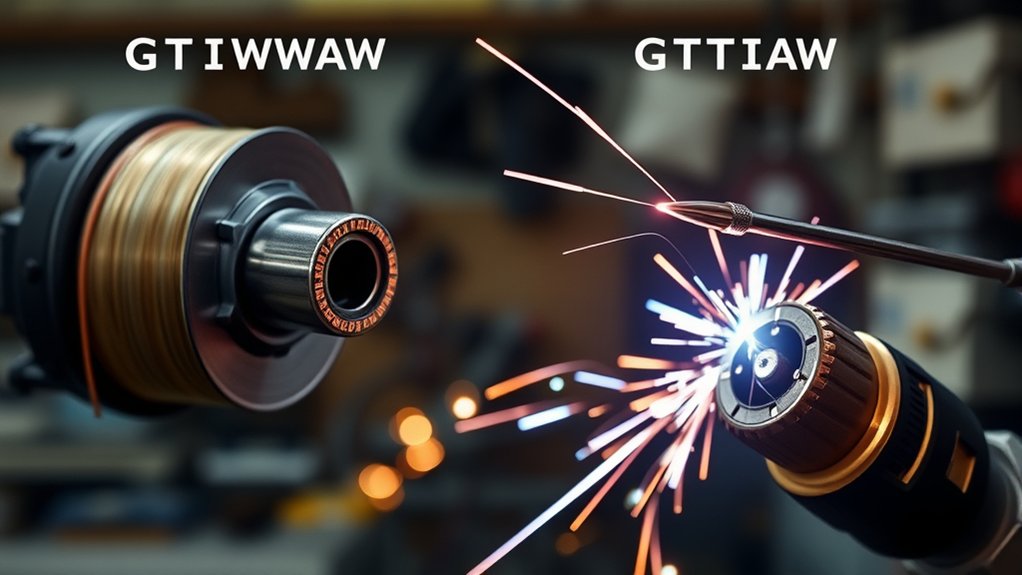
The electrode is one of the biggest differences between GMAW and GTAW.
- GMAW uses a consumable wire electrode. The wire melts into the joint and becomes filler metal. Its classification, diameter, and chemistry must suit the base metal, strength requirement, gas, position, and procedure.
- GTAW uses a non-consumable tungsten electrode. The tungsten carries the arc but should not enter the pool. Contact with the puddle or filler rod can contaminate the electrode and the weld.
- GMAW filler is built into the process. Pulling the trigger starts gas, wire feed, and the arc sequence on most machines.
- GTAW filler is controlled separately. The welder can add rod only where needed or make an autogenous weld when the joint design allows it.
For GMAW, wire diameter, wire type, contact-tip-to-work distance, drive-roll tension, liner condition, and wire-feed speed affect arc stability and bead shape. For GTAW, tungsten type, size, grind, stickout, arc length, amperage, filler size, cup size, and torch angle all influence the result.
Shielding Gas, Metal Cleanliness, and Wind
Both GMAW and GTAW need stable shielding gas coverage. If wind or turbulence pulls air into the arc, the molten and cooling metal can absorb atmospheric contamination. The result may be porosity, oxidation, an unstable arc, or poor mechanical properties.
GMAW gas depends on the metal and transfer mode. Mild steel often uses carbon dioxide or an argon-carbon dioxide blend. Aluminum commonly uses argon, while stainless steel may use an argon-rich blend selected for the wire, transfer mode, and finish. GTAW commonly uses pure argon, helium, or an argon-helium blend. Carbon dioxide and oxygen-bearing MIG blends are not suitable for normal TIG shielding because they can damage the tungsten and contaminate the weld.
Cleanliness matters for both processes. Remove paint, rust, oil, plating, heavy mill scale, moisture, and cleaning residue before welding. GTAW is especially sensitive because contamination quickly shows in the arc, tungsten, puddle, and finished bead.
Pro Tip: When porosity appears suddenly, check drafts, gas flow, cylinder contents, leaks, loose fittings, blocked torch parts, dirty metal, excess stickout, and gas turbulence before changing every machine setting.
Can You Weld Outdoors With GMAW or GTAW?
You can use either process outdoors only when the shielding gas remains stable. Even a light breeze can move gas away from the puddle. Use safe wind screens that do not trap fumes or create a fire hazard, and verify the weld remains properly shielded. For exposed field repairs, self-shielded FCAW or SMAW may be a better process if the approved procedure permits it.
Material and Thickness Guide
The material, joint, and thickness often decide the process before speed or price does. Machine capacity and the approved procedure still control the actual usable range.
| Project Type | Better Fit | Why |
|---|---|---|
| Mild steel brackets and frames | GMAW | Fast, productive, and easy to repeat when the joint and procedure are suitable |
| Thin sheet metal | GTAW or low-heat GMAW | GTAW gives close heat control; short-circuit or pulsed GMAW can be faster with correct setup |
| Stainless steel tubing | GTAW | Precise starts, controlled filler, and good access to small tube joints |
| Aluminum fabrication | Both | GMAW is productive on thicker sections; AC GTAW gives close control on thin or visible joints |
| Titanium or reactive alloys | GTAW | Requires very clean preparation and extended shielding of the hot weld zone |
| Thick groove welds | GMAW for fill; GTAW often for roots or specialty work | GMAW fills faster; GTAW offers careful root control but has a lower deposition rate |
| High-volume production | GMAW | Higher deposition, easier automation, and shorter cycle times |
Aluminum Selection Notes
Aluminum needs oxide removal, correct filler, clean tools, and stable shielding. GMAW often uses a spool gun or push-pull feeder to handle soft aluminum wire. GTAW normally uses AC and may need a water-cooled torch for long, high-amperage work. Neither process will overcome the wrong alloy, filler, joint design, or cleaning method.
Stainless and Titanium Selection Notes
Stainless steel and titanium can lose corrosion resistance or ductility when shielding, purge gas, heat input, or filler selection is wrong. Stainless tubing may need back-purging to protect the root. Titanium often needs trailing shielding or an enclosure so the weld stays protected while hot. Follow the applicable procedure and acceptance criteria rather than judging the weld by color alone.
Real-World Applications of GMAW and GTAW
GMAW is common in automotive repair, trailers, farm equipment, gates, racks, general fabrication, manufacturing, and structural components. Its wire feed supports repeatable production and pairs well with jigs, positioners, cobots, and robotic systems.
GTAW is common in aerospace, motorsport, sanitary stainless tubing, pressure tubing, artistic metalwork, bicycle frames, custom exhausts, tool repair, and precision fabrication. It is slower, but it gives the welder close control on thin parts, roots, corners, and visible joints.
Pipeline and code work can use GMAW, GTAW, SMAW, FCAW, submerged arc, or automated processes. The correct choice depends on the governing code, welding procedure specification, material, position, service, essential variables, and inspection requirements.
Note: “Sanitary,” “aerospace,” or “pressure” quality is not created by choosing TIG alone. Those applications also depend on qualified procedures, material control, purge quality, inspection, documentation, and acceptance criteria.
Skill Requirements: Who Should Use GMAW or GTAW?
If you are new to welding, GMAW is usually the easier starting point. You can focus on travel speed, gun angle, work angle, stickout, and arc sound while the machine feeds the filler wire.
GTAW takes more coordination because you manage more inputs at once. You need a short, steady arc, clean tungsten, controlled filler timing, stable shielding, and careful heat control. A foot pedal or fingertip remote adds another real-time control.
- Beginners: Start with GMAW for general repair and fabrication, but practice on scrap and verify fusion before working on real parts.
- Intermediate welders: Add GTAW when thin material, tubing, aluminum, stainless, or cosmetic work becomes important.
- Production shops: Use GMAW where speed, repeatability, automation, and lower training time support the procedure.
- Precision fabricators: Use GTAW where direct heat and filler control justify the slower pace.
Cost, Equipment, and Shop Setup
A basic GMAW setup includes a suitable power source and wire feeder, gun, work lead, wire, drive rolls, liner, contact tips, nozzle, regulator or flowmeter, shielding gas, and PPE. Aluminum may need a spool gun or push-pull system. Specialty wire may need different drive rolls, liners, tips, and gas.
A GTAW setup may include an AC/DC or DC-only power source, torch, tungsten electrodes, filler rods, collets, cups, gas lenses, regulator or flowmeter, shielding gas, and a foot pedal or fingertip remote. High-amperage or long-duration work may need a water-cooled torch and cooler.
Machine price alone does not show total cost. GMAW can reduce labor time through faster deposition. GTAW can reduce cleanup and give better control on thin or expensive parts. Consumables, gas, power input, accessories, duty cycle, maintenance, training, and rework all affect the real cost.
Products Worth Considering

3 IN 1 MULTI-PROCESS WELDER: The FEMEROL MIG140R mig welder delivers a reliable 140A output, enabling seamless welding of materials up to 1/8 inch in thickness. With its versatile Flux Core MIG, Lift TIG, and Stick welding capabilities, this machine is designed to handle a wide range of tasks, from home repairs to professional projects.
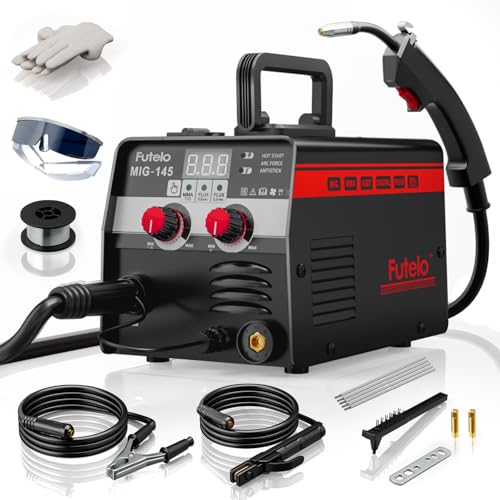
【3-IN-1 WELDER】Compact 3 in 1 welder combines MIG welder, Stick, and Lift TIG welding machine functions to tackle a wide range of welding tasks. With 30–145A output and support for carbon and stainless steel (1–5mm), it’s ideal for home DIY, repairs, and outdoor metal work. (NOTE: TIG torch not included—please purchase separately)

【Flux-Cored MIG with PULSE】 Delivers a smoother, more stable arc for improved weld formation, producing finer, more uniform beads and stronger joints. With excellent portability, it enhances the quality and versatility of gasless welding—ideal for efficient, high-quality field work. It delivers powerful output and easily welds materials up to 5.0 mm (3/16") thick.
Duty Cycle and Input Power
Duty cycle is the percentage of a 10-minute period that a machine can weld at a stated output before it must cool. A small machine may be suitable for short hobby welds but frustrating on long production joints. Check the rated output, duty cycle, input voltage, breaker requirement, and available generator capacity before buying either process.
Safety and Setup Checks Before Welding
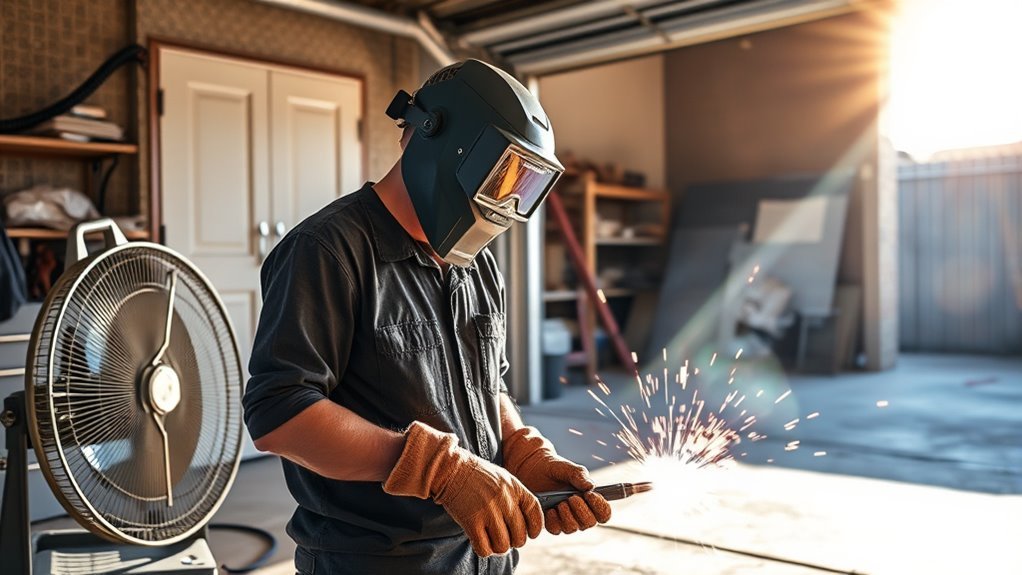
GMAW and GTAW create intense arc light, heat, hot metal, fumes, gases, electrical hazards, and fire risk. Use a welding helmet with the correct filter shade, safety glasses with side protection, gloves, flame-resistant clothing, and suitable footwear. OSHA’s eye and face protection rule lists minimum protective shades by process and current, including GMAW and GTAW.
Control fumes with local exhaust or effective ventilation. Keep your head out of the plume, read the safety data sheets for the base metal, coating, and filler, and use the required respiratory protection when ventilation cannot keep exposure controlled. Stainless steel, plated metal, painted parts, and some specialty alloys can create added hazards.
Move combustibles away or protect them from sparks and hot metal. Keep suitable fire-extinguishing equipment ready. OSHA’s general welding requirements address fire prevention, PPE, ventilation, confined spaces, coatings, and hot work on used containers.
Warning: Do not weld on a closed container, fuel tank, drum, wheel, pressure vessel, or part that may hold flammable or toxic residue unless it has been cleaned, isolated, vented, tested, and approved under a proper hot-work procedure. An “empty” container can still explode.
Pre-Weld Safety Checklist
- Confirm the correct machine settings, polarity, wire or tungsten, filler, and shielding gas.
- Inspect leads, torch parts, hoses, regulator, fittings, cylinder restraint, and work connection.
- Remove coatings and contamination safely; do not use chlorinated cleaners near arc welding.
- Provide ventilation without directing a strong draft across the shielding gas.
- Shield nearby people from arc rays and control sparks, hot metal, and trip hazards.
- Follow lockout, confined-space, fire-watch, and hot-work permit rules when they apply.
Advancements in Welding Technology: The Role of Orbital Welding
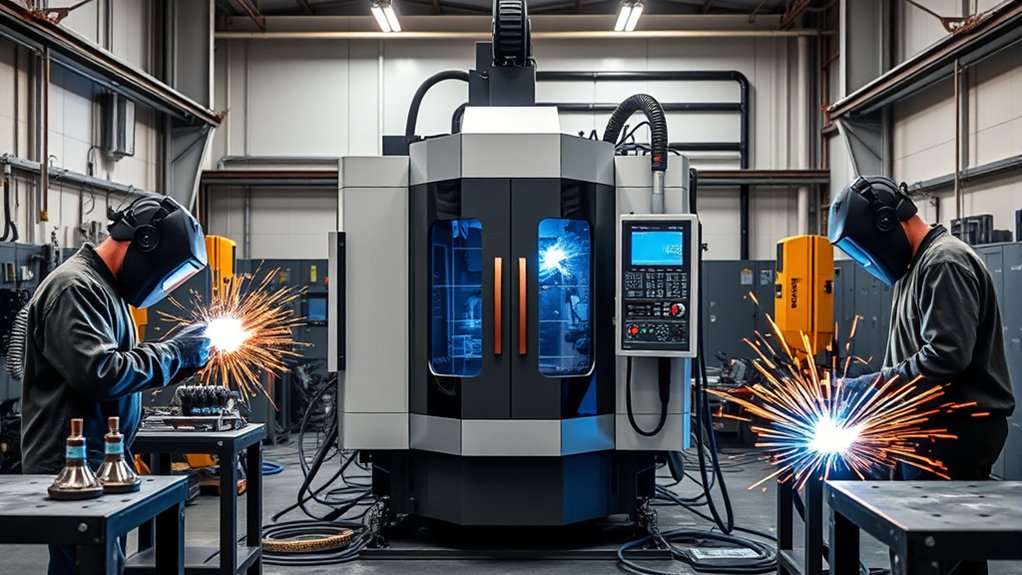
Modern equipment is improving both GMAW and GTAW. Orbital welding is a major GTAW example. A weld head moves the tungsten around tube or pipe while a programmed power source controls current, travel, and gas. This supports repeatable welds, documentation, and access in applications that demand leak integrity or high cleanliness. Swagelok’s orbital welding overview describes automatic GTAW control of current, electrode speed, and shielding or purge gas.
GMAW has also advanced. Pulsed transfer, controlled short-circuit waveforms, robotic torch movement, seam tracking, adaptive control, and process monitoring can reduce spatter, manage heat, and improve repeatability. These tools still require correct joint preparation, consumables, programming, maintenance, and inspection.
Research is also moving toward closed-loop control and data-assisted quality monitoring. A January 2026 GMAW current-control preprint reported experimental testing of a model-based closed-loop strategy. A 2023 weld-quality prediction preprint proposed a multi-sensor deep-learning pipeline for GMAW. These studies are useful research signals, but arXiv papers are preprints and should not be treated as production standards or substitutes for inspection.
Common Weld Problems and Troubleshooting
If a weld is rough, weak, or inconsistent, the problem is usually not the process name alone. Start with preparation, consumables, gas, electrical connections, machine settings, and technique.
| Problem | Common Cause | Fix |
|---|---|---|
| Porosity | Poor gas coverage, wind, leaks, dirty metal, moisture, or excessive gas turbulence | Clean the joint, block safe drafts, inspect gas parts, confirm flow, and check for leaks |
| Excessive GMAW spatter | Wrong voltage, wire-feed speed, polarity, stickout, gas, or transfer mode | Return to the machine chart or procedure, confirm polarity, clean the nozzle, and retune one variable at a time |
| Burn-through | Too much heat, wide gap, slow travel, or poor fit-up on thin metal | Improve fit-up, reduce heat, use shorter welds or pulse, move faster, or select a lower-heat mode |
| Tungsten contamination | Touching the tungsten to the pool or filler, wrong polarity, or excessive current | Stop, remove the contaminated area as required, regrind or replace the tungsten, and correct the setup |
| Lack of fusion | Low heat, long arc, wrong angle, poor prep, fast travel, or bad joint access | Improve preparation and access, shorten the arc, correct the angle, adjust heat, and verify fusion on test coupons |
| Wire feeding problems | Wrong drive rolls, liner damage, excess tension, worn tip, cable bends, or poor spool setup | Match the feed parts to the wire, straighten the gun cable, set tension correctly, and replace worn parts |
| Crater cracks | Stopping suddenly and leaving the end of the weld underfilled | Use crater-fill controls, taper the current, backstep as permitted, or add filler before breaking the arc |
Frequently Asked Questions
How does GMAW differ from GTAW?
GMAW uses a continuously fed consumable wire that becomes filler metal. GTAW uses a non-consumable tungsten electrode and usually a separate filler rod. GMAW is generally faster and easier to learn, while GTAW gives the welder more direct control over heat, filler addition, and bead shape.
Is GMAW or GTAW better for beginners?
GMAW is usually the easier starting process because the machine feeds the filler wire. Beginners can focus on angle, stickout, travel speed, and puddle control. GTAW requires more hand coordination because the torch, filler, arc length, and often amperage are controlled separately.
What is the hardest welding process to learn?
There is no official single “hardest” process because difficulty depends on the joint, position, material, equipment, and learner. GTAW is often considered one of the more demanding common processes because it requires tight arc control, clean preparation, filler timing, shielding, and heat management at the same time.
What is the golden rule in welding?
Welding codes do not define one universal golden rule. A useful shop rule is to keep the puddle visible and controlled while following the approved procedure. Clean metal, correct setup, proper fit-up, stable shielding, and consistent travel are what make puddle control possible.
What is the hardest metal to TIG weld?
There is no universal hardest metal, but titanium and other reactive alloys are demanding because hot metal absorbs oxygen, nitrogen, and hydrogen easily. Successful work needs very clean preparation, correct filler, stable argon shielding, and often back-purging, trailing shielding, or an enclosure.
Can GTAW be used on thick metal?
Yes. GTAW can weld thick metal when the machine and procedure provide enough output, but filling a large groove is slow. GTAW is often used for a precise root pass or specialty alloy, followed by a higher-deposition process for the remaining fill passes.
Does GMAW make weaker welds than GTAW?
No. A properly designed and executed GMAW weld can meet demanding strength and code requirements. GTAW gives the welder more direct control and often a cleaner appearance, but the process name alone does not determine strength.
Can GMAW and GTAW use the same shielding gas?
Sometimes both can use pure argon, especially for aluminum, but many common steel GMAW setups use carbon dioxide or an argon-carbon dioxide blend. Those active-gas blends are not suitable for normal GTAW. Always match the gas to the process, metal, filler, transfer mode, and procedure.
Which process is better for aluminum?
GMAW is usually faster on thicker aluminum and production work, especially with a spool gun or push-pull feeder. AC GTAW is often better for thin, visible, or tightly controlled joints. The right filler alloy, cleaning method, shielding gas, and machine capacity are essential for both.
Conclusion
GMAW and GTAW are both valuable processes, but they favor different priorities. Pick GMAW when you need speed, higher deposition, easier training, repeatable production, or straightforward general fabrication. Pick GTAW when you need close heat control, thin-material accuracy, careful root work, or a clean visible bead.
The smartest choice is not automatically the fastest or the cleanest-looking process. Match the process to the metal, thickness, joint, position, service, inspection needs, shop conditions, power supply, and operator skill. For structural, pressurized, vehicle-safety, aerospace, or code-controlled welds, use the approved procedure and a qualified welder.
Sources
- OSHA Welding, Cutting, and Brazing — welding hazards, standards, and safety resources.
- OSHA 1910.133 Eye and Face Protection — minimum protective shade guidance for GMAW and GTAW.
- OSHA 1910.252 General Welding Requirements — PPE, ventilation, fire prevention, confined spaces, and used-container precautions.
- Improving the GMAW Process Through Current Control — January 2026 preprint on model-based closed-loop GMAW current control.
- Towards a Deep Learning-Based Online Quality Prediction System for Welding Processes — 2023 preprint on multi-sensor GMAW quality prediction.
- Multiphysics Modelling of GTAW on Ultra-Thin-Walled Titanium Tubing — research on GTAW heat and flow behavior in thin titanium tubing.