A grinding wheel hardness grade does not tell you how hard the abrasive grains are. It tells you how firmly the wheel’s bond holds those grains. The basic selection rule surprises many people: a hard or difficult-to-grind workpiece generally needs a softer wheel grade, while an easier-to-grind material can usually use a harder grade. The final choice also depends on pressure, contact area, finish, speed, coolant, and machine power.
Quick Answer
Choose wheel grade by how readily the wheel must release dull grains. Hard or difficult-to-grind workpieces generally need a softer grade; easy-to-grind materials can usually use a harder grade. Then adjust for contact area, pressure, finish, wheel speed, coolant, and machine power. Follow the wheel manufacturer’s application chart for the final specification.
Key Takeaways
- Wheel grade measures grain retention, not abrasive-grain hardness.
- A hard or hard-to-grind workpiece usually calls for a softer grade that releases dull grains and exposes sharp ones.
- An easy-to-grind workpiece, a small contact area, heavy pressure, or strict form holding may push selection toward a harder grade.
- Grade letters are useful within a manufacturer’s product line, but the same letter may not behave identically across brands.
- For aluminum, use a wheel specifically rated for aluminum or nonferrous metal. Grade alone does not prevent loading.
- Never exceed the wheel’s rated speed or use a wheel without the correct guard, mounting hardware, and application approval.
At a Glance
| Time Required | About 5–15 minutes to review the wheel marking, machine requirements, material, and operation |
| Difficulty | Moderate; final selection may require a controlled grinding trial |
| Tools Needed | Wheel label or specification sheet, machine manual, workpiece material and hardness information, and inspection tools required by the manufacturer |
| Cost | No added selection cost; a correct wheel may reduce dressing, rework, heat damage, and premature wheel changes |
Understanding Grinding Wheel Hardness Ratings
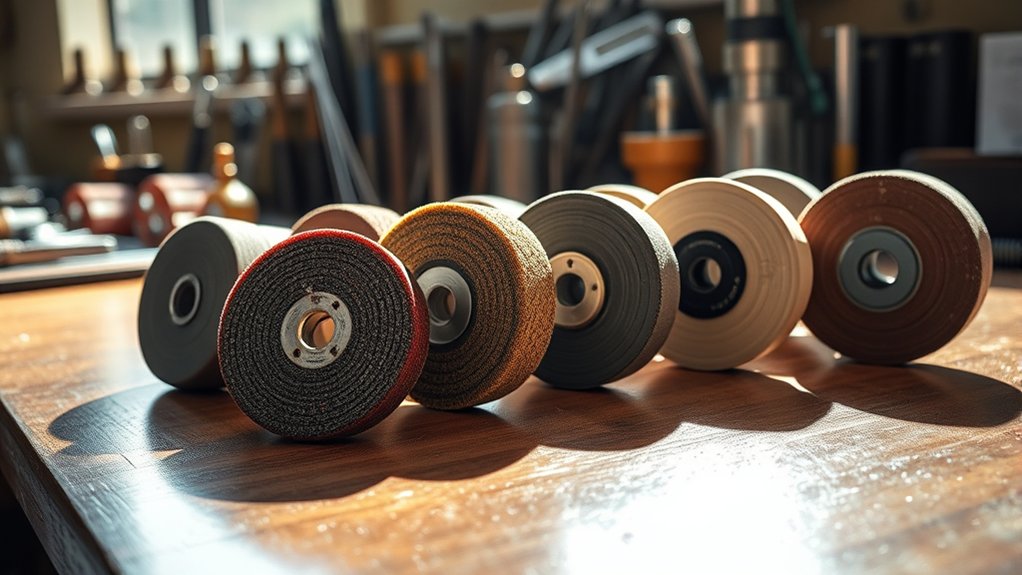
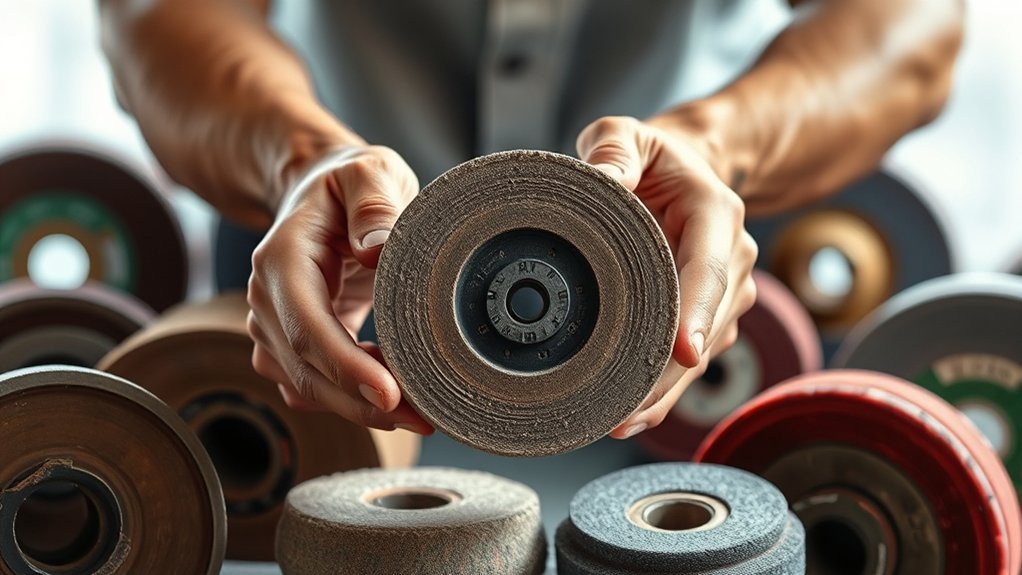
The hardness rating of a conventional grinding wheel is often called its grade. It describes how strongly the bond holds abrasive grains in the wheel. A soft-grade wheel releases grains more readily. A hard-grade wheel holds them longer.
Conventional wheel grades are commonly identified by letters that progress from soft to hard. Norton lists D-H as soft, I-P as medium, and Q-Z as hard reference ranges. However, the grade is relative to the manufacturer’s own system. A J-grade wheel from one company is not guaranteed to act exactly like a J-grade wheel from another. See Norton’s grinding wheel basics guide for an explanation of the marking system.
Note: Wheel grade is not the hardness of aluminum oxide, silicon carbide, ceramic alumina, diamond, or CBN grain. It is the strength with which the bond retains that grain.
How to Read a Grinding Wheel Specification
A conventional grinding-wheel marking may contain the abrasive type, grit size, grade, structure, and bond. Manufacturer-specific prefixes and suffixes may also appear.
| Example Element | What It Describes | Why It Matters |
|---|---|---|
| A | Abrasive type, such as aluminum oxide in a common marking system | Controls material compatibility, grain toughness, and fracture behavior |
| 46 | Grit size | Lower grit numbers are coarser and usually remove stock faster |
| J | Wheel grade | Shows the relative strength with which the bond holds the grains |
| 8 | Wheel structure or grain spacing | More-open structures provide additional space for chips and coolant |
| V | Vitrified bond | Affects wheel rigidity, permissible use, speed, finish, and form holding |
The sequence is a useful decoding aid, but always read the wheel manufacturer’s label and specification sheet. Product-specific codes, modifiers, dimensions, wheel type, expiration information, and maximum operating speed can be just as important as the grade letter.
Choosing the Right Hardness Grade for Your Material
The general rule is opposite the workpiece: a hard or difficult-to-grind material usually needs a softer wheel grade, while an easy-to-grind material can usually use a harder grade.
Hard workpieces tend to dull abrasive cutting points before the grains are fully consumed. A softer grade releases those dull grains and exposes fresh, sharp grains. This self-sharpening action helps the wheel continue cutting instead of rubbing and generating excessive heat.
On an easy-to-grind material, the grains can remain sharp and productive longer. A harder grade can retain them instead of shedding usable abrasive too early. Norton explains this relationship in its seven-factor grinding-wheel selection guide.
Workpiece hardness is not the only issue. Stainless steel, nickel alloys, and other materials can be difficult to grind because of their toughness, heat behavior, or tendency to load a wheel, even when a simple hardness value does not tell the full story.
Products Worth Considering

BUFFING WHEEL PACK of 2 : Stadea 6 Inch polishing and buffing wheel, pack of 2 for bench grinder for polishing metal, wood etc

High performance aluminum oxide grain for long life and high material removal of the grinding wheel

VERSATILE 150 GRIT ALUMINUM OXIDE Wheel – Our 6 inch grinding wheel offers an ideal balance between material removal and surface finish, perfect for sharpening blades, drill bits, chisels and tool grinding
Material-Based Starting Points
| Material or Application | Grade Direction | Other Selection Priorities |
|---|---|---|
| Hardened or difficult-to-grind steel | Generally softer | Friable or self-sharpening grain, adequate chip clearance, correct coolant delivery, and burn control |
| Mild steel and easy-to-grind steel | Often medium to harder than the choice for hardened steel | Stock-removal rate, pressure, wheel type, finish, and machine power |
| Aluminum, copper, and other nonferrous metals | Do not choose by grade alone | Use a wheel specifically rated for the exact nonferrous material and designed to resist loading |
| Carbide, ceramics, glass, and other very hard nonferrous materials | Application-specific, often freer cutting | Correct abrasive chemistry, such as silicon carbide or diamond where approved, plus the manufacturer’s bond recommendation |
| Diamond or CBN superabrasive grinding | Use the manufacturer’s superabrasive system | Bond type, concentration, wheel speed, dressing method, coolant, and workpiece compatibility |
Warning: Do not use a general steel grinding wheel on aluminum unless the wheel manufacturer expressly approves that use. Aluminum can load a steel-oriented wheel and cause rubbing and heat. Keep aluminum dust and chips appropriately separated from iron or steel contamination, control combustible-metal dust, and use only dust-collection equipment approved for the material.
Why Does Hardness Matter in Grinding Wheels?
Wheel grade changes how quickly abrasive grains are released. That affects cutting action, heat, wheel wear, form retention, dressing frequency, and surface quality.
Cutting Action and Self-Sharpening
A grinding wheel cuts best when its active grains remain sharp. As grains dull, one of two things must happen: the grain fractures to expose a fresh edge, or the bond releases it so another grain can take over. A wheel grade that is too hard may retain dull grains and begin rubbing. A grade that is too soft may release effective grains before their cutting life is used.
Signs a Wheel Is Too Hard or Too Soft
| Condition | Common Symptoms | Possible Next Step |
|---|---|---|
| Wheel acts too hard | Glazing, reduced cut rate, rubbing, increased heat, burn, chatter, or greater power draw | Dress the wheel correctly; verify coolant and operating conditions; consider a softer or more-open manufacturer-approved specification |
| Wheel acts too soft | Rapid diameter loss, excessive abrasive dust, poor form retention, frequent dressing, or short wheel life | Check pressure and dressing; consider a harder grade or more durable specification approved for the operation |
| Wheel is loaded | Workpiece material fills pores or coats the cutting surface, causing smearing and poor cutting | Confirm abrasive and material compatibility; use a more-open or application-specific non-loading wheel |
Glazing and loading are different. A glazed wheel has dull, retained grains and a smooth-looking cutting face. A loaded wheel has workpiece material packed around or over the abrasive. Both can reduce cutting, but their causes and corrections are not identical.
Seven Factors That Influence the Correct Grade
Material compatibility is the starting point, not the complete answer. Use these factors together:
| Selection Factor | Typical Direction |
|---|---|
| Workpiece grindability | Hard or difficult to grind → softer grade; easy to grind → harder grade |
| Grinding pressure or operation severity | Heavy pressure may require a tougher grain and harder grade; light pressure may require a more friable grain and softer grade |
| Finish and form accuracy | Strict form holding can favor a harder grade; free cutting and burn control can favor a softer grade |
| Area of contact | Small contact area often permits a harder grade; large contact area usually needs a softer, more-open wheel |
| Wheel speed | Higher surface speed can make a wheel act harder; lower surface speed can make it act softer, within the approved speed range |
| Coolant and bond type | Coolant can affect vitrified and organic bonds differently, so follow the wheel maker’s wet- or dry-grinding recommendation |
| Machine power and stiffness | Higher available power may support a harder grade; a low-powered or flexible setup may need a freer-cutting wheel |
Bond Types and Their Impact on Hardness
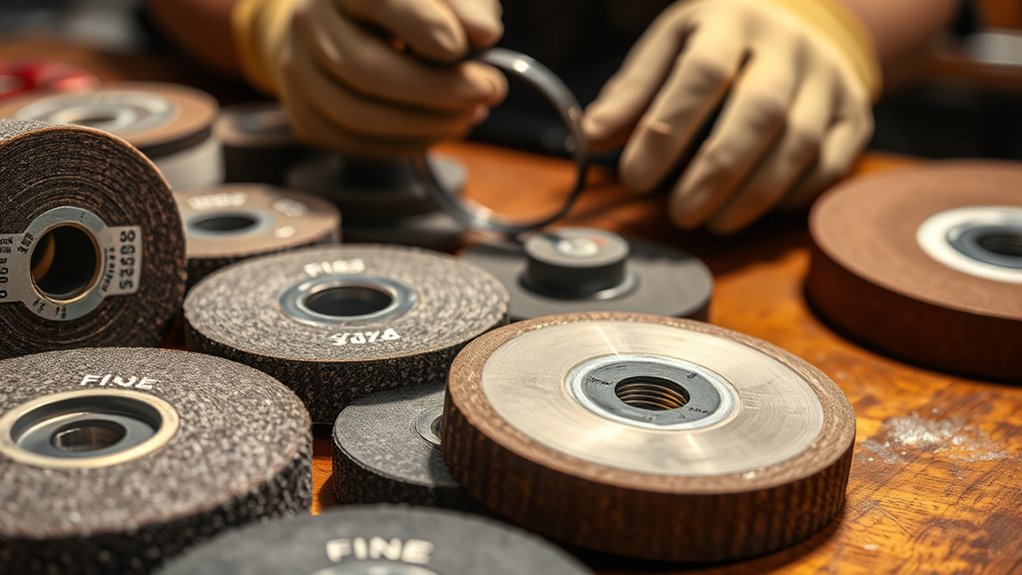
The bond type and wheel grade are related but separate parts of the specification. Grade describes grain-holding strength within a wheel system. Bond type describes the material that holds the wheel together and strongly affects rigidity, heat response, speed capability, finish, and application.
Vitrified Bond Characteristics
Vitrified bonds use ceramic materials and are common in precision grinding. They are rigid, porous, stable with common grinding fluids, and capable of holding accurate forms when properly dressed.
- Common in surface, cylindrical, toolroom, honing, and other precision operations
- Good form holding and predictable dressing behavior
- Available in a wide range of grades and structures
- More brittle and less shock-tolerant than many resin-bonded wheels
A vitrified wheel still needs the correct grade. A rigid bond does not automatically mean the finished wheel should have a hard grade.
Resinoid Bond Advantages
Resinoid bonds use thermosetting resin. They have more elasticity and shock resistance than vitrified bonds and are widely used in high-speed, high-pressure, offhand, cutoff, roll-grinding, and specialty applications.
- Suitable for many rough-grinding and portable-wheel applications
- Can support high operating speeds when the specific wheel is rated for them
- Provides resilience under shock and heavy grinding forces
- May change behavior as grinding heat and coolant conditions change
Do not assume a universal conversion such as “a resin wheel acts one or two grades harder.” Use the manufacturer’s wet or dry application recommendation for the exact wheel.
Rubber Bond Applications
Rubber-bonded wheels are elastic and are used in specialized applications such as centerless regulating wheels and certain wet cutoff operations. Their flexibility can support controlled action and smooth results, but grinding heat can soften the bond.
- Elastic behavior: Useful where controlled contact or regulating action is needed
- Specialized applications: Common examples include centerless control wheels and approved wet cutting
- Heat sensitivity: Use only at the speed and under the cooling conditions specified by the manufacturer
Noritake’s grinding-wheel bond guide provides examples of vitrified, resinoid, rubber, metal, and electroplated bond applications.
Grit Size and Its Relationship With Wheel Hardness
Grit size and wheel grade influence different parts of grinding performance:
- Grit size mainly affects chip size, stock-removal rate, scratch depth, and potential finish.
- Wheel grade controls how firmly the bond retains abrasive grains.
- Structure controls the relative spacing among grains and the amount of room available for chips and coolant.
- Abrasive type controls material compatibility, toughness, friability, and cutting behavior.
- Bond type affects rigidity, resilience, speed capability, heat response, and form holding.
Coarse grits such as 12-24 are commonly associated with heavy stock removal. Medium grits such as 30-60 cover many general grinding operations. Fine grits are used for finer finishes and small features. These are broad categories, not universal prescriptions.
A finer grit does not automatically require a harder grade. A demanding finish or complex form may favor fine grit and a harder grade for form retention, while a heat-sensitive or high-removal operation may still need a softer grade to keep sharp grains exposed. Use the coarsest grit that can meet the required finish, then tune grade and structure for cutting behavior.
Avoid These Mistakes When Choosing Your Grinding Wheel Hardness
- Using the workpiece name as the only selection factor: Alloy, hardness, heat treatment, contact area, and operation can all change the correct specification.
- Assuming a hard workpiece needs a hard wheel: The general relationship is usually the opposite.
- Assuming a higher letter is automatically better: An excessively hard wheel can glaze, rub, and generate heat.
- Comparing grade letters directly across brands: Grade scales are relative to each manufacturer’s wheel system.
- Selecting an aluminum wheel by grade alone: Use a product expressly designed and rated for aluminum or the exact nonferrous alloy.
- Ignoring contact area: A wide or long contact zone often needs a softer and more-open wheel than a small contact zone.
- Ignoring the bond: Vitrified, resinoid, and rubber bonds do not respond identically to heat, coolant, speed, or shock.
- Changing several variables at once: You will not know whether grade, grit, dressing, speed, feed, coolant, or pressure caused the result.
- Using an unapproved wheel type or speed: Fit alone does not make a wheel safe for a machine or application.
Tips for Testing and Adjusting Grinding Wheel Hardness

Sandblast indentation, Rockwell-style measurements, bond-dosage changes, and similar methods belong to wheel manufacturing or quality control. They are not normal operator adjustments. Never drill, reshape, rebond, chemically treat, or otherwise alter a grinding wheel.
Use this controlled procedure instead:
- Confirm the complete specification. Check the wheel type, dimensions, arbor, abrasive, grit, grade, structure, bond, application approval, and maximum operating speed.
- Confirm machine compatibility. Verify the machine, flanges, guard, speed, power, and mounting method against the wheel and machine instructions.
- Inspect before mounting. Look for cracks, chips, water damage, distortion, contamination, and other defects. Perform a ring test only when it is applicable to that wheel type and required by the manufacturer.
- Mount, true, and dress correctly. Use approved flanges and blotters where required. Never force the wheel onto the spindle or overtighten the mounting nut.
- Set a baseline. Record speed, feed, depth of cut, pressure, dressing method, coolant condition, workpiece material, contact area, and observed finish.
- Watch the wheel and workpiece. Look for glazing, loading, burn, chatter, rapid wear, loss of form, high power draw, and finish changes.
- Change one factor at a time. When changing grade, move in a small step within the manufacturer’s product system and repeat the same controlled trial.
- Record the result. Compare cut rate, finish, wheel wear, dressing interval, temperature, and dimensional accuracy.
Pro Tip: Before replacing a wheel because it seems too hard, confirm that it is properly dressed. A loaded or glazed cutting face can make an otherwise suitable wheel perform poorly.
Grinding Wheel Troubleshooting Chart
| Observed Problem | Possible Grade-Related Cause | Checks and Corrections |
|---|---|---|
| Wheel stops cutting and surface looks shiny | Wheel may be acting too hard or may be glazed | Dress correctly, confirm pressure and speed, improve coolant delivery, or test a softer approved grade |
| Workpiece burns or discolors | Dull grains may be retained too long | Check dressing, wheel sharpness, grade, coolant, feed, contact area, and wheel structure |
| Wheel wears away unusually fast | Wheel may be too soft for the pressure or operation | Check excessive pressure, incorrect dressing, vibration, machine condition, and whether a harder approved grade is needed |
| Wheel loses its profile | Grade may be too soft for form holding | Review grade, bond, dressing method, contact pressure, and machine rigidity |
| Metal packs into the wheel face | Loading rather than grade alone | Verify material compatibility and use a more-open or dedicated non-loading wheel |
| Chatter or repeating marks | Wheel may be acting too hard, but balance or machine problems are also possible | Check wheel balance, truing, mounting, spindle condition, workholding, dress, grade, and speed |
Weiler’s grinding troubleshooting guidance also stresses that wheel behavior must be matched to both the material and the operation.
Grinding Wheel Safety Checklist
Warning: A bonded abrasive wheel can break violently if it is damaged, mounted incorrectly, used without the proper guard, side-loaded when not designed for side grinding, or operated above its rated speed. Follow the wheel label, machine manual, manufacturer instructions, applicable standards, and workplace safety requirements.
- Use only a wheel approved for the machine, material, operation, wheel type, and direction of force.
- Make sure the machine’s maximum spindle speed does not exceed the wheel’s marked maximum operating speed.
- Use the correct guard and keep it properly positioned.
- Inspect the wheel before mounting and after any event that could have damaged it.
- Ring-test applicable vitrified wheels before mounting. A ring test checks for cracks; it does not measure grade.
- Use clean, undamaged, correctly sized flanges, blotters, adapters, and mounting hardware where required.
- Never force a wheel onto the spindle or overtighten the nut.
- On covered bench and pedestal grinders, maintain required work-rest and tongue-guard clearances. OSHA’s checklist identifies maximum gaps of 1/8 inch for the work rest and 1/4 inch for the adjustable tongue guard.
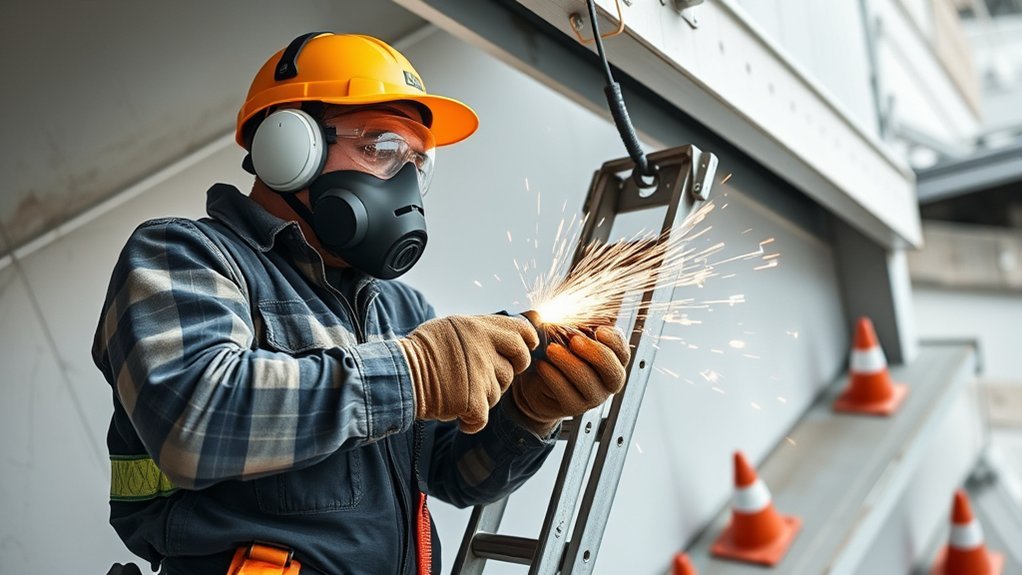
- Wear appropriate safety glasses and face protection, plus hearing, respiratory, hand, body, and foot protection selected for the hazard.
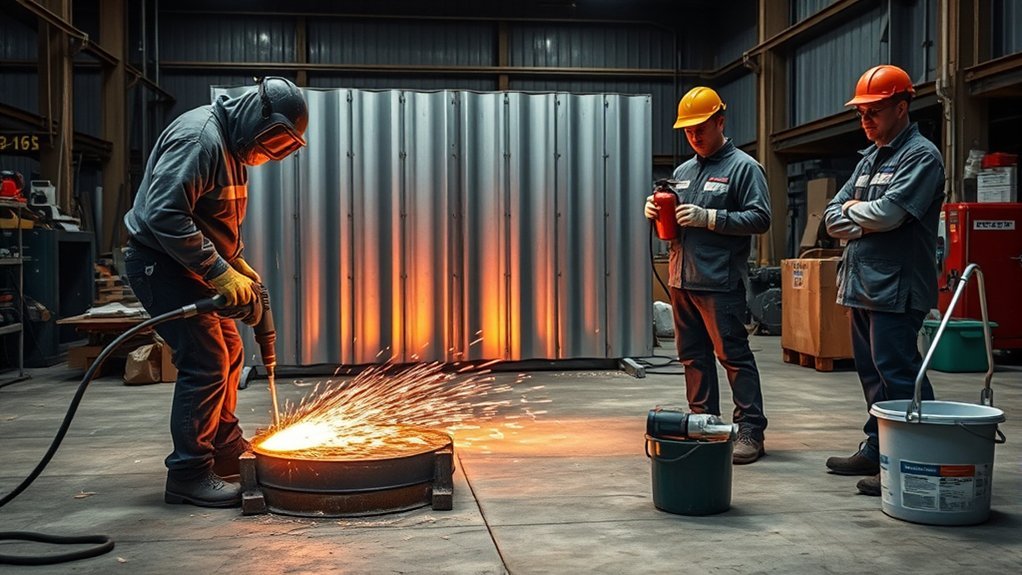
- Provide suitable ventilation or dust extraction. Use equipment approved for combustible metal dust where applicable.
- Keep bystanders away from the wheel’s operating plane during startup and stand out of that plane yourself when practical.
- Allow the wheel to reach operating speed before applying it to the workpiece, following the manufacturer’s startup procedure.
Review the OSHA abrasive-wheel grinder checklist and Norton’s ring-test instructions before installing applicable wheels.
Practical Applications of Grinding Wheel Hardness
The following examples show how grade direction changes with the complete grinding system. They are starting principles, not substitutes for the wheel manufacturer’s recommendation.
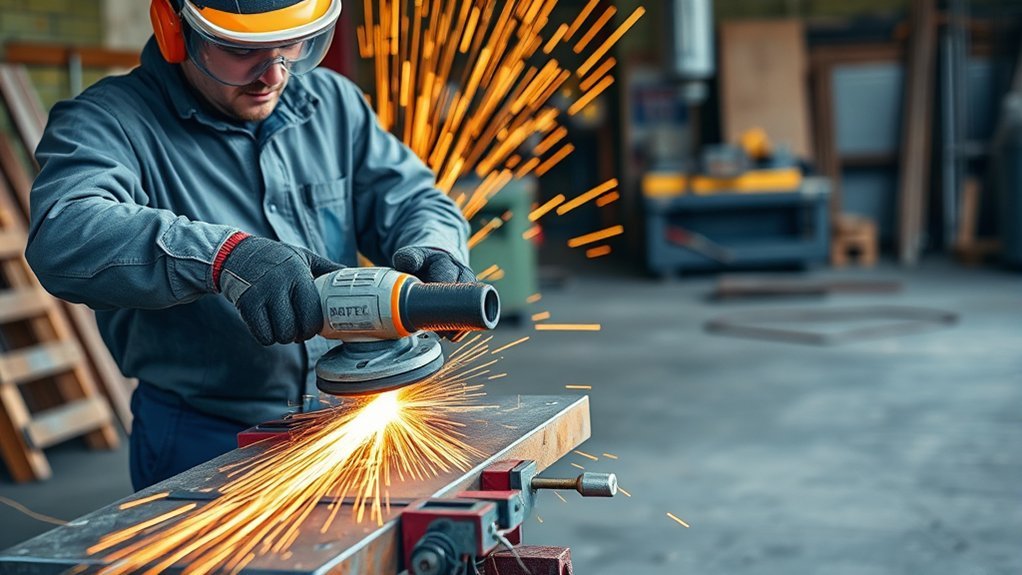
- Surface grinding hardened tool steel: The hard workpiece and broad contact area often push the choice toward a softer, freer-cutting, open-structure wheel to control heat.
- Grinding mild steel with a small contact area: An easy-to-grind material and concentrated contact may permit a harder grade that holds grains and form longer.
- Heavy-pressure snagging or offhand grinding: High force can require a durable grain and stronger grade, but the wheel must still be compatible with the workpiece and portable grinder.
- Precision form grinding: Close form tolerances may require a harder grade and rigid vitrified bond, balanced against the need to prevent glazing or burn.
- Large-contact creep-feed or wide surface grinding: The large grinding zone commonly calls for a softer grade, open structure, strong coolant delivery, and application-specific grain.
- Aluminum weld grinding: Use a grinding wheel expressly designed for aluminum or the exact nonferrous alloy. Do not rely on an A-H grade assumption.
- Carbide or technical ceramics: Choose the correct silicon carbide, diamond, or other manufacturer-approved abrasive system before selecting bond behavior or grade.
The right grade is the one that keeps the wheel cutting freely while providing acceptable wheel life, finish, form, temperature, and productivity. A grade that works well on one machine may behave differently when wheel speed, horsepower, coolant, contact area, or dressing changes.
Products Worth Considering


High Grinding Ratio - High hardness, sharp edges and corners, good cutting performance and low grinding heat.
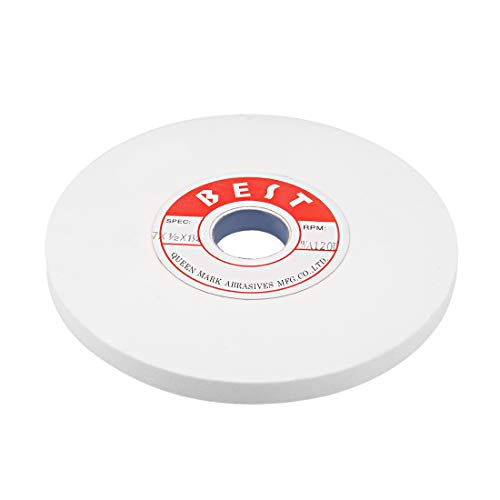
Size: 7-Inch diameter 120# White Aluminum Oxide(WA) grinding wheel.
Frequently Asked Questions
What determines a grinding wheel’s hardness?
A grinding wheel’s grade is determined by how firmly its bond holds the abrasive grains. Bond formulation, bond quantity, structure, porosity, abrasive system, and manufacturing process all influence the finished grade. During use, speed, pressure, coolant, contact area, and machine power affect how hard or soft the wheel appears to act.
Does a hard workpiece need a hard grinding wheel?
Usually not. A hard or difficult-to-grind workpiece generally needs a softer wheel grade so dulled grains are released and replaced by sharp grains. Easy-to-grind materials can usually use a harder grade that retains useful grains longer. Other operating factors can modify this starting rule.
What grinding wheel grit should I use?
Use a coarse grit for faster stock removal and a finer grit for a finer scratch pattern, small features, or close finish requirements. Use the coarsest grit that can still meet the required finish, then choose the grade, structure, abrasive, and bond for the material and operation.
How do you select the correct grinding wheel for a specific material?
Identify the workpiece material, hardness, heat treatment, and grindability. Then consider stock removal, finish, form, contact area, pressure, machine power, wheel speed, coolant, and grinding method. Select a compatible abrasive, grit, grade, structure, bond, wheel shape, and speed rating from the manufacturer’s application chart.
Which grinding wheel grit is coarser, 46 or 60?
A 46-grit wheel is coarser than a 60-grit wheel. It generally removes stock faster and leaves a deeper scratch pattern. A 60-grit wheel is finer and is commonly selected when a smoother finish or more cutting points are needed.
How can I tell whether a grinding wheel is too hard?
A wheel may be acting too hard if it glazes, stops cutting, rubs, generates excess heat, burns the workpiece, or requires unusual force. First check dressing, loading, coolant, speed, and operating technique. If those are correct, test a softer manufacturer-approved grade under controlled conditions.
Can I use the same grinding wheel on aluminum and steel?
Only when the manufacturer expressly rates that exact wheel for both materials. Standard wheels designed for steel can load rapidly on aluminum. Separate wheels and suitable housekeeping also help prevent cross-contamination between aluminum and iron or steel dust.
Conclusion
Selecting a grinding wheel hardness grade starts with understanding what grade actually measures: the bond’s ability to retain abrasive grains. For conventional wheels, hard or difficult-to-grind workpieces generally need softer grades, while easier-to-grind materials can usually use harder grades.
That rule is only a starting point. Pressure, contact area, grit, required finish, form holding, wheel speed, coolant, machine power, abrasive type, structure, and bond can all change the correct choice. Use the wheel manufacturer’s application chart, verify every safety marking, and make controlled one-step adjustments based on actual cutting behavior.
Sources
- Norton Abrasives — Grinding Wheel Basics — wheel components, grade ranges, structure, bonds, and manufacturer variation
- Norton Abrasives — Seven Factors Used to Determine a Grinding Wheel Specification — material, pressure, finish, contact area, speed, coolant, and horsepower selection factors
- Weiler Abrasives — Troubleshooting Tips for Grinding Metal — grade selection and grinding-performance troubleshooting
- Norton Abrasives — Aluminum Metal Fabrication Drives Abrasive Developments — aluminum loading, dedicated wheels, and cross-contamination concerns
- Noritake — Grinding Wheel Bond Guide — vitrified, resinoid, rubber, metal, and electroplated bond characteristics
- OSHA — Abrasive Wheel Equipment Grinder Checklist — guarding, speed compatibility, inspection, clearances, and protective equipment