A welded joint can pass a visual check and still contain high residual stress, hard heat-affected zones, or a microstructure that is unsuitable for service. Post-weld heat treatment (PWHT) uses a qualified heating, holding, and cooling cycle to manage those risks. The correct cycle depends on the exact alloy, thickness, joint, service, and governing code.
Quick Answer
Post-weld heat treatment is a controlled thermal cycle applied after welding. Depending on the material and procedure, it can reduce residual stress, temper hard zones, improve dimensional stability, and support resistance to brittle or service-assisted cracking. PWHT is not one universal temperature; it must follow the approved code, material specification, and heat-treatment procedure.
Key Takeaways
- PWHT mainly controls residual stress and microstructure; it does not automatically improve every weld.
- Postweld hydrogen bakeout is an immediate, lower-temperature treatment and is not the same as a full stress-relief PWHT cycle.
- Temperature, hold time, heating rate, cooling rate, and heated width must come from the applicable code and qualified procedure.
- Austenitic stainless steels generally do not receive routine PWHT; an incorrect intermediate-temperature cycle can damage corrosion resistance.
- Thermocouple placement, calibrated recording, inspection, and traceable records are as important as reaching the target temperature.
What’s in This Article
- What Is Post-Weld Heat Treatment?
- Why PWHT Matters After Welding
- What PWHT Can and Cannot Do
- How PWHT Relieves Residual Stress
- How PWHT Relates to Hydrogen Cracking
- How PWHT Can Change Weld Toughness
- When Is Post-Weld Heat Treatment Used?
- How Codes Determine Whether PWHT Is Required
- PWHT Temperature Guidance by Metal
- PWHT Equipment and Heating Methods
- How PWHT Heating and Soaking Work
- How PWHT Cooling and Monitoring Work
- Inspection and Acceptance After PWHT
- PWHT Risks and Safety Requirements
- What Records Should You Keep for PWHT?
- Frequently Asked Questions
- Conclusion
- Sources
What Is Post-Weld Heat Treatment?
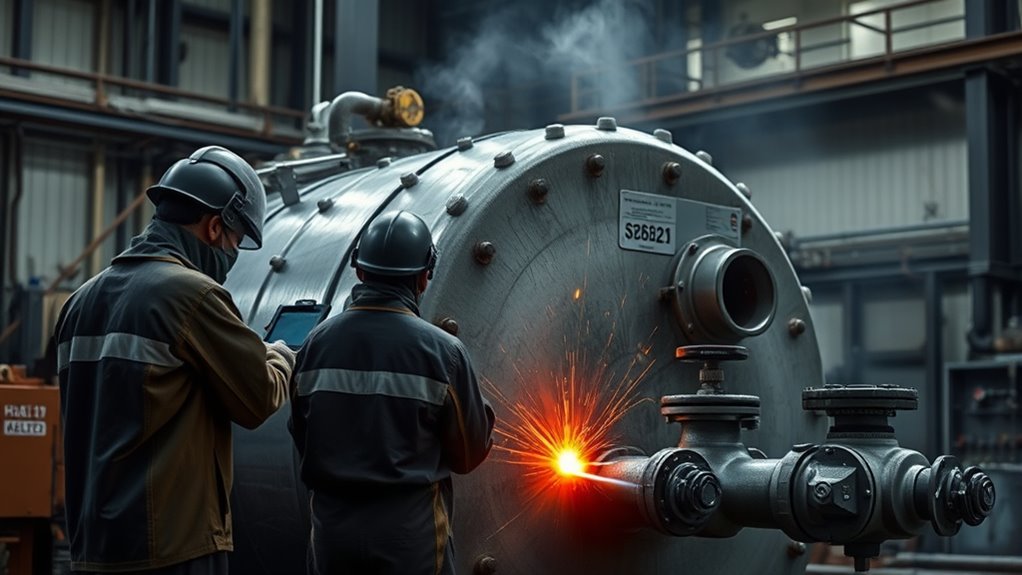
Post-weld heat treatment, or PWHT, is a planned thermal process applied after welding. In pressure equipment and piping work, the term often means subcritical stress relief or tempering: the weldment is heated below the material’s transformation range, held within a specified band, and cooled at a controlled rate.
PWHT is also used more broadly for other alloy-specific treatments, including tempering, solution annealing, aging, or hydrogen-release treatments. Those processes have different goals and must not be treated as interchangeable.
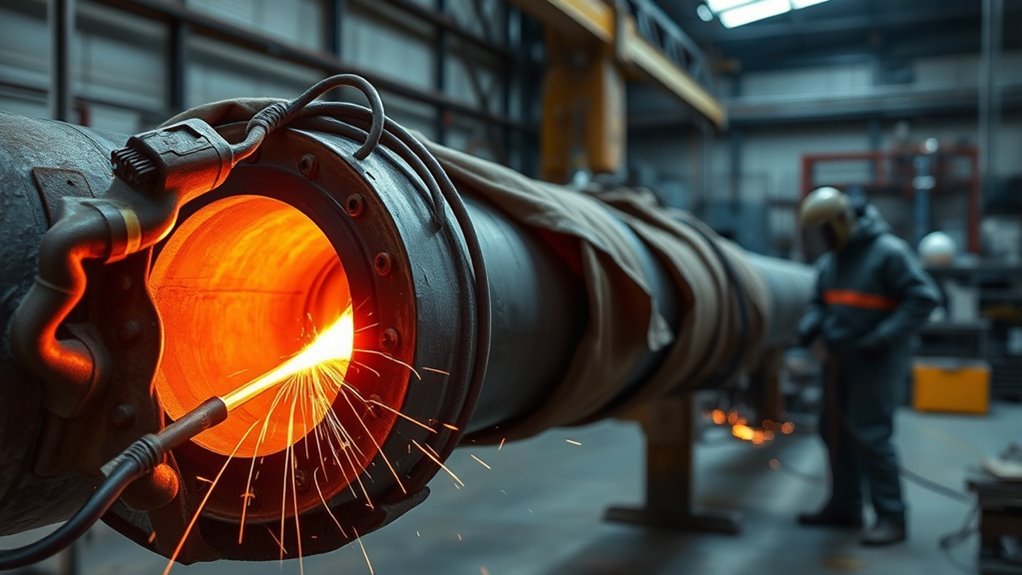
The cycle may be performed in a furnace or by local heating. Local work can use electric-resistance heaters, induction coils, or another approved system. The AWS D10.10/D10.10M:2021 recommended practice covers equipment, temperature control, insulation, and other considerations for local heating of pipe and tube welds.
There is no safe universal PWHT temperature. The required cycle comes from the governing construction or repair code, the material specification, the qualified welding procedure, and the approved heat-treatment procedure.
Why PWHT Matters After Welding
Welding creates steep temperature differences. The hot weld metal expands, then contracts as it cools while the surrounding material restrains it. This can leave tensile residual stress near the weld and heat-affected zone.
In suitable ferritic steels, a qualified PWHT cycle can reduce those stresses, temper hard microstructures, improve dimensional stability, and lower susceptibility to some brittle-fracture or service-assisted cracking mechanisms. It may also be required to satisfy a construction code, repair code, owner specification, or service requirement.
PWHT is not automatically beneficial. The wrong cycle can overtemper the weld, reduce strength, lower notch toughness, cause reheat cracking, sensitise some stainless steels, or create harmful thermal gradients. The decision must therefore be based on the exact material and service—not on a generic temperature chart.
PWHT is a qualified metallurgical process, not simply a matter of making the weld hot for a set number of hours.
What PWHT Can and Cannot Do
| PWHT can | PWHT cannot |
|---|---|
| Reduce and redistribute residual stress when the cycle is suitable. | Repair lack of fusion, incomplete penetration, porosity, cracks, or poor joint geometry. |
| Temper hard weld or heat-affected-zone microstructures in some steels. | Replace correct preheat, interpass control, low-hydrogen practice, or qualified welding parameters. |
| Improve dimensional stability and support code compliance. | Guarantee better fatigue life; weld shape, defects, and service loading may remain the controlling factors. |
| Support hydrogen diffusion when the correct postweld treatment is applied promptly. | Reverse cracking that has already formed. |
PWHT vs. Postheat, Annealing, and Stress Relief
- Postweld hydrogen bakeout or postheat: An immediate, lower-temperature hold used mainly on crack-sensitive ferritic steels to help hydrogen leave the joint.
- Subcritical stress relief: A controlled cycle below the lower critical transformation temperature, used to redistribute residual stress and often temper hard regions.
- Annealing or solution annealing: A higher-temperature treatment intended to change or restore a broader microstructure; it may require rapid cooling.
- Tempering or aging: Alloy-specific treatments used to develop required strength, hardness, or toughness after welding.
Note: Job documents may use “PWHT” as an umbrella term, but the procedure must identify the exact treatment, target range, hold time, ramp limits, cooling limits, and acceptance criteria.
How PWHT Relieves Residual Stress
Welding produces uneven expansion and contraction. The weld metal and nearby base metal do not cool at the same rate, so part of the strain remains locked into the component after it reaches room temperature.
Residual Stress Formation
Residual stress is usually highest where shrinkage is strongly restrained. Thick joints, rigid assemblies, repairs in existing equipment, complex attachments, and local heating can all increase restraint or thermal gradients.
Good joint design, fit-up, welding sequence, heat input, and restraint control can reduce distortion and stress, but they do not always remove the need for PWHT when a code or service condition requires it.
Stress Relief Mechanism
As temperature rises, the metal’s yield strength falls. Under a controlled soak, local plastic flow and time-dependent deformation allow peak welding stresses to redistribute. Controlled cooling then limits the formation of new thermal stresses.
| Mechanism | Likely effect |
|---|---|
| Reduced yield strength at temperature | Allows peak residual stresses to relax and redistribute. |
| Tempering in suitable ferritic steels | Can lower excessive hardness and improve the hardness profile. |
| Time at temperature | Allows the effect to penetrate through the required section. |
| Controlled thermal gradients | Reduces distortion and new stress caused by uneven heating or cooling. |
Controlled Heating and Cooling
The cycle is more than a soak temperature. A complete procedure controls the heating rate, temperature difference across the heated area, minimum and maximum soak temperature, hold time, cooling rate, heater arrangement, insulation, thermocouple locations, and recording method.
- Heat gradually enough to limit damaging gradients.
- Keep every required monitoring point inside the approved soak band.
- Hold for the time required by the applicable code or engineering procedure.
- Cool at the specified rate until the procedure allows uncontrolled cooling.
Warning: Overheating, excessive holding time, or large temperature differences can reduce strength or toughness, cause distortion, damage nearby components, or create harmful phases in some alloys.
How PWHT Relates to Hydrogen Cracking
Hydrogen cracking—also called cold or delayed cracking—is mainly a concern in susceptible ferritic steels. It requires a combination of diffusible hydrogen, a crack-sensitive microstructure, and sufficient tensile stress. Cracking can begin shortly after welding, so prevention must start before and during the weld.
The main controls are clean and dry materials, low-hydrogen consumables, correct storage and baking of electrodes or flux, suitable preheat and interpass temperature, controlled heat input, and an approved welding procedure.
An immediate postweld hydrogen bakeout can help hydrogen diffuse from a crack-sensitive joint. The Welding Institute’s heat-treatment guidance distinguishes this lower-temperature postheat from stress-relief PWHT. A later full PWHT may also reduce hydrogen and residual stress, but it is not a substitute for proper hydrogen control during welding.
Note: Do not wait for a routine PWHT cycle to address a joint that requires immediate postheat. Delayed cracking may develop before the full treatment begins.
How PWHT Can Change Weld Hardness and Toughness
PWHT can improve the balance of hardness, strength, and toughness in some ferritic steels, especially when welding creates hard martensitic or bainitic regions. A suitable tempering cycle can soften those areas and reduce residual stress.
The result is not always an improvement. Excessive temperature or time can overtemper the weld, lower tensile or creep strength, reduce notch toughness, or promote temper embrittlement. Dissimilar-metal welds may also experience carbon migration or property gradients across the fusion boundary.
Stress Relief Benefits
- Lower peak residual stress can reduce the driving force for brittle fracture or stress-corrosion cracking in applicable services.
- Improved dimensional stability can help large fabrications retain alignment.
- Reduced hardness can help a weld meet material or sour-service limits when the qualified procedure produces the required result.
- Code compliance can be demonstrated when the complete recorded cycle meets the governing requirements.
PWHT should not be presented as a guaranteed fatigue-life upgrade. The Welding Institute notes that stress relief may have little beneficial effect on fatigue performance when weld geometry and cyclic stress remain controlling factors.
Microstructure Reconditioning
Subcritical PWHT usually promotes recovery and tempering rather than “grain refinement.” The exact response depends on alloy chemistry, prior heat treatment, weld metal, peak welding temperature, and time at temperature.
Creep-strength-enhanced ferritic steels, such as Grade 91, require especially strict control. Generic carbon-steel settings can leave the weld too hard, too soft, or otherwise unsuitable for high-temperature service.
Toughness Recovery Process
When toughness recovery is an objective, the procedure should define the material condition and required test results. Verification may include hardness surveys, tensile testing, impact testing, metallography, or other examinations required by the code or engineering specification.
Use measured acceptance criteria rather than assuming that a completed heating cycle automatically restored the weld.
When Is Post-Weld Heat Treatment Used?
You use PWHT when the governing code, material specification, engineering design, owner requirement, or repair plan calls for it. Common applications include pressure vessels, boilers, power piping, process piping, thick restrained weldments, certain high-strength or chromium-molybdenum steels, and repairs to equipment already in service.
| Application | Why PWHT may be specified |
|---|---|
| Pressure vessels and boilers | Code compliance, stress relief, hardness control, or resistance to service damage. |
| Power and process piping | Material- and thickness-based code rules, high-temperature service, or repair requirements. |
| Cr-Mo and creep-strength-enhanced steels | Tempering, hardness control, toughness, and long-term creep performance. |
| Heavy machinery and restrained structures | Dimensional stability or an engineering stress-relief requirement. |
| Aerospace or automotive parts | Only when the drawing, alloy heat-treatment specification, or qualified manufacturing process requires it. |
Thin low-carbon-steel welds and many noncritical fabrications may be exempt, but exemption cannot be assumed from thickness alone. Joint type, material group, service, preheat, toughness requirements, and code-specific conditions can change the answer.
How Codes Determine Whether PWHT Is Required
PWHT rules are code-specific. The decision may depend on the material group or P-Number, governing thickness, weld type, nominal composition, service temperature, fluid service, required impact testing, preheat, and permitted exemptions.
For pressure vessels, verify the contract-specified edition of ASME BPVC Section VIII, Division 1. Power piping and process piping commonly use ASME B31.1 or ASME B31.3. ASME also publishes B31P, Standard Heat Treatments for Piping.
In-service repairs may also fall under an inspection or repair code, such as API 570, plus the original construction code and owner requirements.
- Use the edition named by the contract, jurisdiction, or repair plan.
- Check current addenda, errata, code cases, and owner supplements.
- Do not copy a temperature or hold time from a different material group.
- Resolve conflicts through the responsible engineer, inspector, or authorized code professional before heating begins.
PWHT Temperature Guidance by Metal
Temperature must be selected by exact grade and objective. The ranges below are broad orientation only and must never replace a qualified procedure.
| Material family | General guidance |
|---|---|
| Carbon and carbon-manganese steels | Many subcritical stress-relief procedures are roughly in the 1,100–1,250°F (595–675°C) region, but the governing code sets the actual minimum, maximum, hold time, and exemptions. |
| Chromium-molybdenum and other low-alloy steels | Grade-specific tempering ranges are often higher or narrower than those for plain carbon steel. Creep-strength-enhanced grades require dedicated procedures and tighter control. |
| Austenitic stainless steels | Routine PWHT is generally not required. If a full solution anneal is specified, a manufacturer may call for about 1,830–2,010°F (1,000–1,100°C) followed by rapid cooling; intermediate-temperature stress relief can threaten corrosion resistance in some grades. |
| Ferritic and martensitic stainless steels | Tempering or annealing is highly grade-specific. Use the material producer’s data and the qualified welding and heat-treatment procedures. |
| Duplex stainless, nickel alloys, aluminum, and precipitation-hardening alloys | Do not apply a generic steel stress-relief cycle. Phase balance, precipitation, aging response, corrosion resistance, and cooling rate can control the treatment. |
Products Worth Considering
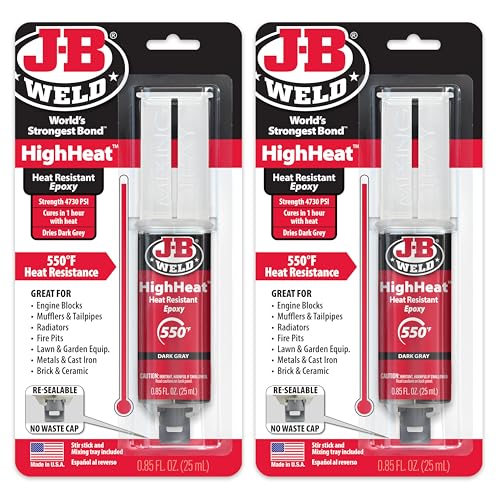
J-B Weld HighHeat Syringe is a two-part epoxy system that provides strong, lasting, heat-resistant repairs up to 550°F


Multi-Purpose Heating Oil Treatment – Formulated to support heating oil system maintenance.
Carbon Steel Ranges
Carbon-steel stress relief is commonly subcritical, but a broad “1,100°F to 1,400°F” rule is not safe. The upper limit may approach transformation or produce unwanted property changes in some materials. Use the code table and qualified procedure for the exact grade and thickness.
Low-Alloy Heat Windows
Low-alloy steel is not one heat-treatment group. A 1.25Cr-0.5Mo steel, a 2.25Cr-1Mo steel, and Grade 91 can require different minimums, maximums, holds, and cooling controls. Dissimilar joints can add further limits because each side and the filler metal respond differently.
Stainless Steel Limits
The original idea that austenitic stainless steel commonly receives PWHT between 900°F and 1,500°F is misleading. Outokumpu’s austenitic stainless-steel guidance states that PWHT is generally not required and describes solution annealing at much higher temperatures when it is necessary.
For stainless steels, corrosion performance can be as important as stress relief. Verify grade, carbon level, stabilization, service environment, oxide removal, and cooling method before approving any treatment.
PWHT Equipment and Heating Methods
Products Worth Considering

Furnace PWHT
A furnace can heat the entire component more uniformly and is often preferred when the weldment fits and transport is practical. The setup still needs calibrated sensors, load arrangement, circulation control, and a recorded cycle.
Local Resistance Heating
Flexible ceramic resistance heaters are placed around the weld and covered with insulation. Controllers divide the work into zones, while thermocouples measure control and monitoring temperatures. Local heating must include enough width to control both the soak area and the temperature gradient into colder material.
Induction Heating
Induction coils heat the component through an electromagnetic field. The method can provide fast, controllable heating, but coil design, coupling, geometry, material response, and thermocouple strategy must be qualified for the job.
Supporting Equipment
- Calibrated temperature controllers and data recorders
- Suitable thermocouples, attachment equipment, and extension wire
- Insulation rated for the treatment temperature
- Independent power distribution, grounding, and overcurrent protection
- Barriers, hot-surface signs, fire protection, and communication equipment
- Backup sensors or power arrangements when the procedure requires them
How PWHT Heating and Soaking Work
Before heating, verify the material identification, weld number, approved procedure, equipment calibration, thermocouple map, insulation layout, support condition, and required inspection sequence. Remove or protect coatings, seals, instruments, lubricants, and nearby components that cannot tolerate the cycle.
- Install heaters and insulation: Cover the required heated and gradient-control areas, not only the weld bead.
- Attach thermocouples: Put control and monitoring sensors where they can prove that the required weld and adjacent base metal reached the specified range.
- Begin the controlled ramp: Increase temperature within the permitted rate and temperature-difference limits.
- Enter the soak: Start hold time only after all required monitoring points are inside the approved band, unless the procedure states otherwise.
- Maintain the soak: Keep temperatures within limits for the full specified duration and document any power loss or excursion.
Do not assume a universal “one hour per inch” rule. Hold-time formulas, minimum times, thickness definitions, and permitted reductions differ among codes and material groups.
Pro Tip: Review the live temperature chart during the ramp instead of waiting until the cycle is over. A drifting sensor, failed heater zone, or large circumferential difference is easier to correct before the soak clock starts.
How PWHT Cooling and Monitoring Work
After the soak, cool the weldment at the controlled rate required by the procedure. Keep heaters, insulation, and monitoring in place until the temperature falls below the specified control point. Removing insulation too early or exposing one side to wind or rain can create fresh gradients and distortion.
- Track every control zone and required monitoring point.
- Keep the maximum temperature difference within the approved limit.
- Record the complete ramp, soak, and controlled-cooling period.
- Protect the recorder and thermocouple connections from damage or electrical interference.
- Document excursions and obtain engineering disposition rather than editing or discarding the chart.
For local pipe heating, the temperature at the inside surface can differ from the outside reading. AWS D10.10 emphasizes that the root or inside diameter must achieve the required minimum PWHT temperature, so heater layout and thermocouple strategy must account for wall thickness and geometry.
Inspection and Acceptance After PWHT
Acceptance is not based only on a smooth chart. The responsible team should confirm that the weld, material, and finished component still meet every applicable requirement.
Checks Before PWHT
- Confirm weld completion, repair status, material traceability, and required pre-PWHT examination.
- Verify whether attachments, temporary welds, and support welds are included in the heat-treatment scope.
- Check that the component is supported so thermal expansion will not overload nozzles, branches, or restraints.
- Confirm the sequence for nondestructive examination because some codes require specific tests before, after, or both before and after PWHT.
Checks After PWHT
- Review the chart for ramp, soak, cooling, temperature spread, and interruptions.
- Perform visual, dimensional, hardness, surface, volumetric, or leak testing when required.
- Inspect thermocouple attachment sites and remove temporary attachments by the approved method.
- Obtain formal disposition for any excursion before releasing the component for service.
PWHT Risks and Safety Requirements
Common technical risks include underheating, overheating, short hold time, excessive gradients, heater failure, thermocouple error, local distortion, reheat cracking, overtempering, stainless-steel sensitization, and damage to nearby components.
PWHT also creates job-site hazards: hot surfaces, high electrical current, temporary power cables, combustible insulation or coatings, confined-space exposure, fumes from heated contamination, falling insulation, and stored energy in restrained components.
Warning: PWHT on pressure equipment or process piping is specialist work. Use trained personnel, an approved procedure, calibrated equipment, lockout/tagout, fire controls, ventilation, PPE, hot-surface barriers, and confined-space controls where applicable. OSHA’s 29 CFR 1910.252 addresses fire prevention, ventilation, PPE, and hot-metal warnings for welding, cutting, and heating work.
The applicable code or standard takes precedence over general guidance. AWS D10.10 also states that additional criteria may be needed for creep-strength-enhanced ferritic steels and that the applicable code governs when requirements conflict.
What Records Should You Keep for PWHT?
Keep a traceable record for each treated weld or component. At a minimum, the file should identify:
- Project, component, line, spool, vessel, and weld numbers
- Material specification, grade, thickness, and heat or traceability numbers
- Applicable code edition, approved procedure, and revision
- Heating method, heater layout, insulation, and control-zone arrangement
- Thermocouple type, identification, exact locations, attachment method, and calibration status
- Heating rate, soak range, hold time, cooling rate, and release temperature
- Original time-temperature chart or secure digital log
- Power interruptions, excursions, repairs, engineering dispositions, and operator notes
- Required pre- and post-PWHT inspection or hardness results
- Operator, heat-treatment technician, inspector, and approval signatures
Retention time depends on the construction code, owner quality system, jurisdiction, and service. Store original data in a way that preserves legibility, timestamps, and revision history.
Frequently Asked Questions
How is PWHT different from annealing or stress relieving?
PWHT is an umbrella term for heat treatment performed after welding. Subcritical stress relief is one common PWHT method. Annealing usually involves a different, often higher-temperature cycle intended to change or restore the broader microstructure. The procedure must identify the exact treatment.
Is postweld hydrogen bakeout the same as PWHT?
No. Hydrogen bakeout is normally an immediate, lower-temperature postheat used to promote hydrogen diffusion in susceptible ferritic steels. Stress-relief PWHT is usually hotter and has additional goals, such as residual-stress redistribution and tempering.
Which welds do not require post-weld heat treatment?
Many thin, low-carbon-steel, noncritical welds may be exempt, but there is no universal exemption. Verify material group, controlling thickness, joint type, service, toughness requirements, and every condition in the applicable code or engineering specification.
What equipment is used to perform PWHT?
Common systems include furnaces, flexible ceramic resistance heaters, induction coils, temperature controllers, thermocouples, data recorders, power distribution equipment, and high-temperature insulation. The approved method depends on component size, geometry, alloy, access, and code requirements.
How long does PWHT usually take?
There is no reliable universal duration. Total time includes setup, heating, soak, and controlled cooling. A large or thick component can take many hours or longer, while the required hold is calculated or selected from the governing code and procedure.
Can PWHT be done on site or only in a shop?
It can be performed in a shop furnace or on site with an approved local-heating method. Field PWHT needs suitable power, weather protection, access control, insulation, thermocouple coverage, fire protection, and secure data recording.
What happens if you skip required PWHT?
The component may fail code acceptance and may retain excessive stress, hardness, or an unsuitable microstructure. That can increase the risk of cracking or premature service damage. Any omission requires formal engineering and code disposition, not an informal waiver.
Does PWHT change the strength of a weld?
Yes. PWHT can change tensile strength, yield strength, hardness, toughness, ductility, and creep properties. A qualified cycle aims to achieve the required balance without overtempering or otherwise degrading the weld or base metal.
Can austenitic stainless steel be post-weld heat treated?
It can, but routine PWHT is generally not required. Some intermediate-temperature cycles can reduce corrosion resistance. When treatment is necessary, the exact grade, service, solution-annealing temperature, and rapid-cooling requirement must come from the material producer and approved procedure.
Conclusion
Post-weld heat treatment can control residual stress, hardness, microstructure, and dimensional stability, but only when the cycle matches the exact material and service. It cannot repair a defective weld or replace correct preheat, low-hydrogen practice, qualified welding parameters, and inspection.
Before starting PWHT, confirm the governing code edition, material grade, controlling thickness, approved procedure, heater and thermocouple layout, safety plan, inspection sequence, and acceptance criteria. A complete, traceable temperature record is part of the treatment—not optional paperwork after the fact.
Sources
- AWS D10.10/D10.10M:2021 — local heating methods, equipment, temperature control, insulation, and code precedence.
- ASME B31P, Standard Heat Treatments for Piping — code-based heat-treatment requirements for piping and pipelines.
- ASME BPVC Section VIII, Division 1 — construction rules for pressure vessels.
- The Welding Institute: Heat Treatment of Welded Joints, Part 1 — stress relief and the distinction between postheat and PWHT.
- Outokumpu Core Range Datasheet — austenitic stainless-steel welding and solution-annealing guidance.
- OSHA 29 CFR 1910.252 — fire prevention, ventilation, PPE, confined-space, and hot-metal requirements for welding, cutting, and heating.